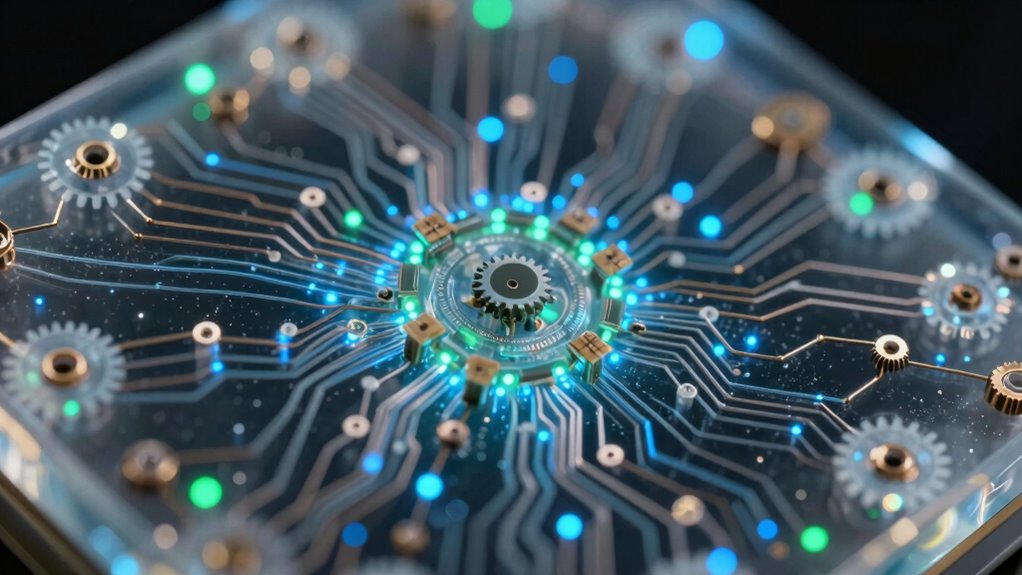

Picomachines are indeed a real possibility as the next frontier beyond nanotech. By manipulating matter at the picometer scale, you’ll be able to control atomic and subatomic structures with unprecedented precision. Advances in quantum control, atomic force microscopy, and ultrafast laser techniques are already making this feasible. If you want to explore how these technologies could revolutionize industries and what challenges lie ahead, there’s more to uncover.
Key Takeaways
- Picomachines are theoretically possible given advancements in atomic manipulation and quantum control at picometer scales.
- Progress in picotechnology relies on precise atomic, electron, and nuclear spin control using advanced microscopy and quantum sensors.
- Environmental stability and quantum decoherence present significant challenges to reliably constructing and operating picomachines.
- Ethical and regulatory frameworks are crucial to prevent misuse and ensure safe development of atomic-scale devices.
- The integration of nanotech, quantum tech, AI, and materials science makes the realization of picomachines increasingly feasible.

Atomic Force Microscopy in Cell Biology (Volume 68) (Methods in Cell Biology, Volume 68)
As an affiliate, we earn on qualifying purchases.
As an affiliate, we earn on qualifying purchases.
Understanding the Foundations of Picotechnology

Understanding the foundations of picotechnology begins with recognizing that it operates at an extremely small scale—one trillionth of a meter, or a picometer. At this level, you’re working with matter on the atomic and subatomic scale, where traditional physics shifts to quantum effects. Unlike nanotechnology, which arranges atoms, picotechnology manipulates internal atomic structures, such as electron clouds and nuclear spins, with extraordinary precision. You’re fundamentally controlling the fundamental building blocks of matter, enabling precise modifications at the quantum level. This requires understanding quantum field effects, electron energy states, and intraatomic forces. By harnessing these principles, you can potentially engineer materials and devices with atomic-level accuracy, opening doors to revolutionary advancements across science and technology. Additionally, understanding the role of contrast ratio in imaging quality is vital for developing more precise control over atomic-level modifications. Moreover, mastering quantum field effects is essential for pushing the boundaries of atomic manipulation techniques. Gaining a comprehensive knowledge of atomic-scale interactions is also critical for advancing picotechnology capabilities. Developing a deep understanding of atomic and subatomic dynamics can further enhance our ability to manipulate matter at these extreme scales.
ultrafast laser systems for atomic manipulation
As an affiliate, we earn on qualifying purchases.
As an affiliate, we earn on qualifying purchases.
The Scale and Precision of Picometer Manipulation

Picometer manipulation operates at an ultra-fine scale, where even tiny positional changes have profound effects on atomic structures. At this level, you’re working within a thousandth of a nanometer, targeting subatomic particles and electron clouds. Small shifts—just 50 to 100 picometers—can alter chemical bonds or electronic states, making precision essential. You’d manipulate atoms with extraordinary accuracy, controlling quantum states and intraatomic forces. This level of control could enable quantum-level engineering, opening new horizons in nanotechnology. Achieving such precision requires the development of quantum sensors and other advanced tools capable of operating at these incredibly small scales. This precision allows you to:
Master atoms at a trillionth of a nanometer, reshaping chemical bonds and quantum states with precision.
- Fine-tune electron orbitals, affecting atomic behavior
- Alter nuclear spin and orientation for new element creation
- Precisely position atoms within molecular structures for custom functions
- Attain unprecedented control over atomic interactions and properties
- Developing reliable measurement techniques is crucial for verifying manipulations at this scale.
- Additionally, advances in nanomechanical systems can facilitate movement and positioning at picometer accuracy.

Load Cell Sensor with Indicator Display,S Type Test Tension and Compression Force Weight Scale Sensor,with 2PCS Hanging Ring,Units: Kilogram, gram, kN, ton Two Sets of Relay Outputs (0-5000KG)
High precision measurement: The use of unique sensing elements and signal processing technology to ensure that the measurement…
As an affiliate, we earn on qualifying purchases.
As an affiliate, we earn on qualifying purchases.
Current Techniques Driving Picotech Development

You can explore how advances in Atomic Force Microscopy enable precise control at the picometer scale by measuring and manipulating matter with exceptional accuracy. Quantum state manipulation techniques, such as controlling electron orbitals and nuclear spins, open new avenues for picotechnology applications. These methods are pushing the boundaries of what’s possible in atomic precision, driving the development of next-generation picomachines. Additionally, affiliated technologies are enhancing our ability to achieve even greater levels of precision and control at the nanoscale. For example, innovations in Youngster Choice contribute to refining measurement techniques and pushing the limits of nanoscale engineering, while quantum control methods further expand the scope of manipulation at the atomic level. Furthermore, advancements in nanoscale instrumentation enable researchers to develop more sophisticated tools for atomic-level manipulation. Emerging techniques are also opening new possibilities for integrating these precise control methods into practical applications.
Atomic Force Microscopy Advances
Recent advances in atomic force microscopy (AFM) are propelling the development of picotechnology by enabling unprecedented control at sub-nanometer scales. You can now measure and manipulate matter at the atomic and sub-atomic levels with remarkable precision. These improvements include enhanced sensitivity to atomic forces, allowing you to detect minute variations in surface properties. Additionally, innovations in AFM tip design and feedback systems let you position probes with picometer accuracy, essential for controlling electron clouds and atomic structures. The ability to perform real-time, high-resolution imaging of individual atoms and molecules opens doors to direct atomic editing. This progress is vital in shaping the future of picomachines and atomically precise manufacturing. Furthermore, developments in nanomechanical sensing are expanding the potential applications of AFM in various scientific fields. Advances in precision control are also crucial for developing reliable atomic-scale devices, making this technology increasingly practical for industrial applications. Moreover, ongoing improvements in instrument stability contribute significantly to achieving consistent results in atomic-scale experiments. An emerging focus on scaling nanotech emphasizes the importance of consistent, repeatable fabrication at atomic dimensions, which is essential for practical industrial use. This progress is vital in shaping the future of picomachines and atomically precise manufacturing.
Quantum State Manipulation Techniques
Building on advances in atomic force microscopy that allow for atomic-scale imaging and manipulation, researchers are now focusing on quantum state manipulation techniques to push the boundaries of picotechnology. These methods target control over electron energy levels, nuclear spins, and atomic resonances with unprecedented precision. Techniques like laser excitation of metastable electron states, quantum field effects on electron orbitals, and attosecond pulse manipulation enable manipulation of matter at the picoscale. By altering nuclear orientations and electron clouds, you can program atoms directly, creating new materials or structures with atomic accuracy. These approaches rely on controlling intraatomic forces and quantum phenomena, opening avenues for real-time, dynamic adjustment of matter beyond the capabilities of conventional nanotech. Quantum control techniques are increasingly being developed to enhance the precision and scope of atomic manipulation. In addition, the integration of quantum computing principles promises to significantly accelerate the development of picomachines by enabling complex quantum simulations and control protocols. Furthermore, advances in quantum sensors are providing new ways to measure and manipulate quantum states with greater accuracy, reinforcing the feasibility of picotechnology. As research progresses, understanding quantum coherence plays a vital role in maintaining stability during atomic-scale manipulations. Recent breakthroughs in quantum error correction are also contributing to achieving the stability required for reliable atomic control. Ultimately, quantum state manipulation makes the dream of picomachines increasingly feasible.
nanoscale atomic manipulation tools
As an affiliate, we earn on qualifying purchases.
As an affiliate, we earn on qualifying purchases.
Comparing Nanotechnology and Picotechnology Capabilities

While nanotechnology has revolutionized our ability to manipulate matter at the atomic scale, picotechnology pushes these boundaries even further by operating at the subatomic and picoscale levels. You’d be working with structures that are a thousand times smaller than nanometers, targeting individual electrons, quarks, and nuclear spins. Unlike nanotech’s atomic arrangements, picotechnology aims to modify internal atomic structures, electron clouds, and quantum states directly. This allows for unprecedented control over matter at the fundamental level.
- Picotechnology manipulates quantum fields and nuclear states, beyond simple atom placement.
- It uses ultrafast pulses and quantum effects to influence subatomic particles.
- The precision extends to altering atomic nuclei rather than just surface structures.
The Scientific Challenges in Realizing Picomachines

You face significant scientific hurdles in making picomachines a reality, especially with quantum control limitations that challenge precise atomic manipulation. Material stability becomes a concern as structures at the picoscale are highly sensitive to environmental disturbances. Additionally, measurement precision barriers make it difficult to accurately observe and verify atomic-level changes necessary for picotechnology. Understanding quantum control limitations and informal language can also influence how future communication about these advancements is understood by a broader audience.
Quantum Control Limitations
Achieving precise quantum control at the picometer scale presents formidable scientific challenges because manipulating atomic and subatomic states requires an unprecedented level of accuracy and stability. Quantum systems are inherently sensitive to environmental disturbances, making consistent control difficult. The unpredictable nature of quantum decoherence and noise limits your ability to maintain desired states over time. Additionally, controlling electron and nuclear spins at such a minuscule scale demands advanced methods beyond current technology. Small fluctuations can cause significant errors, undermining the reliability of picomachines.
- Quantum decoherence occurs rapidly at picoscale, disrupting control.
- Environmental noise, like temperature and electromagnetic interference, hampers stability.
- Precise manipulation of quantum states requires technical breakthroughs in measurement and stabilization.
Material Stability Issues
Material stability poses a fundamental obstacle to developing picomachines because structures at the picoscale are highly sensitive to environmental disturbances. Tiny forces like thermal vibrations, electromagnetic interference, and quantum fluctuations can easily disrupt these delicate structures. Maintaining atomic precision requires extreme control over temperature, vibration, and electromagnetic environment—conditions difficult to sustain outside laboratory settings. Even slight variations can cause atoms to shift or bonds to break, undermining device integrity. Additionally, materials at this scale often exhibit unpredictable behaviors due to quantum effects, complicating their stability. Achieving reliable, long-term operation demands innovative materials and stabilization techniques. Without such advancements, the fragile nature of picoscale matter remains a significant barrier to realizing functional picomachines in practical applications.
Measurement Precision Barriers
How can scientists measure and control atomic-scale phenomena with such extraordinary precision? Achieving this requires tools capable of detecting tiny changes at the picometer level, where even slight fluctuations matter. Current instruments like atomic force microscopes push boundaries but still face limitations due to quantum noise and environmental interference. Accurate measurement demands stability at the quantum level, which is incredibly challenging.
- Quantum noise can obscure signals, making precise readings difficult.
- Environmental vibrations and temperature fluctuations disrupt stability.
- Existing technology struggles to resolve and manipulate phenomena below 100 picometers reliably.
Overcoming these barriers is essential for advancing picotechnology. Without ultra-precise measurement, controlling atomic and subatomic structures remains impossible, hindering the development of picomachines.
Potential Applications and Transformative Impacts
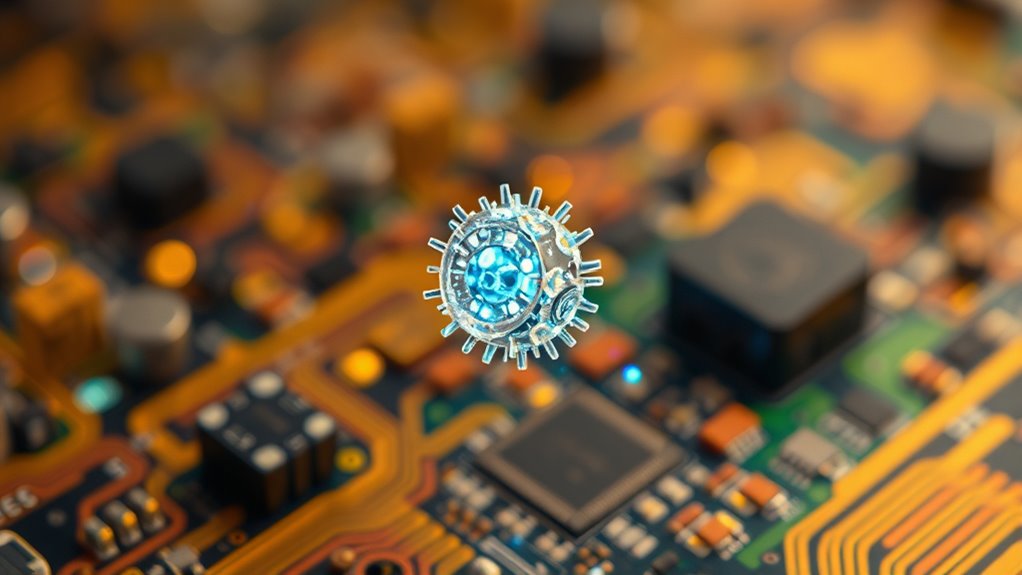
The potential applications of picotechnology could revolutionize multiple fields by enabling unprecedented precision at the atomic and subatomic levels. In medicine, you could develop targeted therapies that precisely manipulate cellular components, repair tissues at the molecular scale, or deliver drugs directly to affected cells, minimizing side effects. In computing, picomachines might lead to quantum processors with increased stability, operating at room temperature, and vastly higher speeds. Chemical manufacturing could benefit from atom-by-atom synthesis, creating new materials with unique properties. Environmental sensing and cleanup would become more accurate, detecting and neutralizing pollutants at the molecular level. Overall, picotechnology promises to transform industries by enabling control over matter at a fundamental, atomic scale, *reveal* possibilities previously limited to theoretical physics.
The Role of Quantum Fields and Electron States

Quantum fields and electron states form the core mechanisms that enable picotechnology to manipulate matter at the subatomic level. By controlling electron orbitals and nuclear spins through these fields, you can precisely alter atomic properties and internal structures. This manipulation involves harnessing quantum phenomena like resonance, superposition, and entanglement to position atoms with unprecedented accuracy. You effectively program atoms as building blocks, modifying their electron clouds and energy states to create new materials or achieve specific functions.
Quantum fields and electron states enable precise atomic manipulation for advanced material design and nanoscale engineering.
- Quantum field effects allow control over atomic and subatomic forces
- Electron states can be excited or stabilized for precise manipulation
- Intraatomic interactions enable the construction of programmable matter
Future Technologies Needed for Picomachines

Advancing picomachines hinges on developing tools capable of manipulating matter at the atomic and subatomic levels with unparalleled precision. You’ll need instruments that can control electron states, nuclear spins, and intraatomic forces within attosecond timescales. Quantum field manipulation must become more refined, allowing for the precise tuning of atomic resonance and electron clouds. Innovations in ultra-stable, high-frequency lasers will be essential for exciting metastable states and controlling electron orbitals at picometer distances. Additionally, advanced microscopy techniques, such as enhanced atomic force microscopes with picometer resolution, are vital for real-time matter manipulation. You’ll also require computer models capable of simulating quantum interactions at this scale, guiding the actual engineering process. These combined technologies will pave the way for the atomic-level control necessary to build picomachines.
Ethical and Safety Considerations in Atomic-Level Engineering

As atomic-level engineering becomes more feasible, ethical and safety concerns must be addressed proactively, because manipulating matter at such a fundamental scale carries profound implications. You need to contemplate risks like unintended consequences, environmental impacts, and potential misuse. Small mistakes could cause unpredictable reactions or harm biological systems. The technology might be exploited for malicious purposes, such as creating harmful nanodevices or weaponized materials. To prevent this, you should prioritize developing strict regulations and oversight.
Addressing atomic-level engineering risks requires strict regulations, transparency, and proactive international oversight to prevent misuse and unintended consequences.
- Establish international standards for safety and ethics
- Monitor and control research to prevent misuse
- Promote transparency and public engagement in development
Frequently Asked Questions
Can Current Technology Manipulate Matter at Picometer Scales Reliably?
Currently, your technology can’t reliably manipulate matter at picometer scales. While atomic force microscopes can approach these dimensions, achieving consistent, precise control at the subatomic level remains a challenge. Techniques like laser excitation and electron state manipulation show promise, but they’re not yet refined enough for everyday applications. Significant advancements in quantum control and attosecond pulses are needed before reliable picometer-scale manipulation becomes a reality.
What Are the Primary Physical Limitations Preventing Picomachines Today?
Can you imagine controlling matter at the atomic level? Today, your biggest hurdles are the lack of tools that can reliably manipulate atoms with sub-picometer precision and overcoming quantum uncertainties. The extreme sensitivity to environmental disturbances and the need for ultra-stable, high-energy systems add to these challenges. Without breakthroughs in quantum field control and attosecond technology, building functional picomachines remains an elusive goal.
How Close Are Scientists to Achieving Room-Temperature Quantum Control?
You’re still a ways from achieving room-temperature quantum control. Scientists have made progress with cryogenic systems that stabilize qubits, but maintaining coherence at room temperature remains a significant challenge. Efforts focus on developing new materials, like topological insulators, and innovative error correction techniques. While promising advances are on the horizon, practical room-temperature quantum control for applications like picomachines is still a goal for the future, not an immediate reality.
What Safety Risks Exist With Atomic-Level Manipulation of Biological Systems?
You should be aware that manipulating biological systems at the atomic level poses safety risks like unintended mutations, cellular damage, or immune reactions. Precise control might accidentally alter critical molecules, leading to unpredictable consequences. There’s also the danger of off-target effects, which could harm healthy tissues. To avoid harm, rigorous testing, oversight, and ethical considerations are essential before applying such advanced atomic-level techniques in medicine or biology.
Could Picotechnology Revolutionize Computing Faster Than Nanotech?
Think of picotechnology as a rocket launching us into a new universe of computing. It could revolutionize faster than nanotech by manipulating matter at the subatomic level, allowing you to create ultra-precise quantum states and atomic structures. With such control, you might develop room-temperature quantum computers, drastically boosting speed and efficiency. This leap could transform data processing, encryption, and AI, making current tech seem like a slow horse in comparison.
Conclusion
As you explore the possibilities of picomachines, remember that manipulating at the picometer scale could revolutionize industries. Currently, only about 0.1% of nanotech advancements have reached this level of precision, showing how groundbreaking yet challenging it is. While the journey is complex, your curiosity drives innovation. With continued research, you’ll see how picotechnology might unseal new frontiers, transforming medicine, electronics, and beyond—pushing the boundaries of what’s scientifically possible.