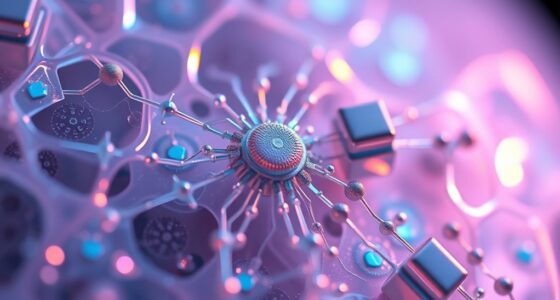

To design nanovalves and nanoswitches, you should select biocompatible materials like polymers or inorganic compounds and use precise fabrication techniques such as self-assembly or electron beam lithography. Incorporate mechanisms like molecular gating and stimuli responsiveness, allowing control through chemical interactions or environmental cues. Focus on enhancing selectivity with recognition elements and reliability through signal amplification. By combining these strategies, you’ll create robust, smart devices that respond accurately and reliably—learning more will reveal how these innovations shape future nanotechnology.

Get the latest gadgets delivered free — and shop member deals
- Fast, free delivery on millions of items
- Access to Prime Big Deal Days deals on October 6–7
- Prime Video, Amazon Music and more included
Key Takeaways
- Utilize biocompatible materials and nanoscale fabrication techniques to ensure precise, stable, and safe nanovalve and nanoswitch designs.
- Incorporate molecular gating mechanisms that respond to specific stimuli like pH, temperature, or light for controlled opening and closing.
- Enhance selectivity and reliability through molecular recognition elements such as aptamers or antibodies, coupled with signal amplification strategies.
- Integrate recognition and energy transduction pathways via self-assembly and directed placement for seamless system functionality.
- Explore quantum tunneling and biomimetic actuation for rapid, energy-efficient switching and adaptive control in advanced nanodevice designs.
Materials and Structural Foundations of Nanovalves and Nanoswitches

The performance of nanovalves and nanoswitches heavily depends on the materials and structural designs used. You need to select biocompatible materials that guarantee safety and stability within biological environments. These materials, such as certain polymers, lipids, or inorganic compounds, are vital for maintaining functionality without adverse effects. Nanoscale fabrication techniques, like electron beam lithography or self-assembly, enable precise control over the structures at the atomic level. The structural design determines how effectively the device can control flow or signal transmission. You should focus on creating robust, versatile architectures that support responsiveness and durability. Combining suitable biocompatible materials with advanced nanoscale fabrication methods lays the foundation for reliable, efficient nanovalves and nanoswitches in diverse applications. High refresh rates enhance the overall performance and responsiveness of these nanoscale devices, ensuring they can operate effectively in dynamic biological environments.
Mechanisms Governing Nanoscale Control and Responsiveness

Building on the materials and structural foundations of nanovalves and nanoswitches, understanding how these devices achieve precise control at the nanoscale requires examining their underlying mechanisms. Molecular gating plays a central role, acting as the core process that opens or closes pathways in response to specific signals. Stimuli responsiveness enables nanodevices to react to various triggers like pH, temperature, or light, ensuring adaptable control. Key mechanisms include:
Molecular gating and stimuli responsiveness enable nanodevices to achieve precise, adaptable control at the nanoscale.
- Conformational changes triggered by stimuli, altering the gating state.
- Chemical interactions that modulate pore or channel openings.
- External signals inducing shifts in molecular structures for rapid response.
- Emotional support strategies can enhance the effective functioning of nanodevices by reducing operational stress and increasing reliability.
These mechanisms ensure nanovalves and nanoswitches operate with high precision, enabling targeted delivery and controlled release at the nanoscale.
Strategies for Enhancing Selectivity and Reliability

Enhancing the selectivity and reliability of nanovalves and nanoswitches is essential for their effective application in targeted delivery and sensing. You can achieve this by improving molecular recognition, guaranteeing the device responds only to specific stimuli. Incorporating highly selective recognition elements, like aptamers or antibodies, helps distinguish target molecules from similar ones. To boost reliability, you should utilize signal amplification strategies, such as enzymatic reactions or nanomaterial-enhanced signals, which enhance detection sensitivity and reduce false positives. Fine-tuning recognition elements and amplification methods ensures consistent performance under varying conditions. Additionally, implementing robust cybersecurity measures can protect nanoscale devices from malicious interference, ensuring their integrity and safe operation. By focusing on these strategies, you’ll increase the precision and dependability of nanoscale devices, making them better suited for complex biological environments and demanding applications.
Integration Techniques in Nanoscale Devices and Systems

How can nanoscale devices be seamlessly integrated into larger systems to function reliably? Achieving this requires precise techniques that ensure compatibility and efficiency. First, you focus on molecular recognition, enabling nanoscale components to selectively interact with specific targets, ensuring accurate signaling and control. Second, you optimize energy transduction pathways to efficiently convert energy between different forms, powering the devices reliably. Third, you utilize advanced assembly methods like self-assembly and directed placement to position nanovalves and nanoswitches accurately within complex systems. These techniques help maintain stability, prevent interference, and ensure consistent performance. By combining molecular recognition with effective energy transduction, you create robust integration strategies that make nanoscale devices work harmoniously with larger systems, paving the way for practical applications in nanotechnology. Additionally, implementing material compatibility considerations ensures the durability and longevity of integrated nanoscale components within diverse environments.
Future Perspectives and Emerging Trends in Nanoscale Actuation

Advancements in integration techniques are paving the way for innovative approaches to nanoscale actuation. You’ll see a growing interest in leveraging quantum tunneling to achieve rapid, energy-efficient switching mechanisms at the molecular level. This phenomenon enables precise control over nanovalves and nanoswitches, pushing their responsiveness to new heights. Additionally, biomimetic actuation is emerging as a promising trend, as researchers mimic natural systems to develop more adaptable and sustainable nanodevices. Future nanoscale actuators will likely combine quantum effects with bio-inspired strategies, creating devices capable of complex, autonomous functions. As the development of AI security measures continues, integrating robust safety measures will be crucial for ensuring the reliable deployment of these advanced nanodevices. These emerging trends will expand the potential for smart, responsive nanodevices across medicine, electronics, and environmental monitoring, transforming how you design and deploy nanoscale systems.
Frequently Asked Questions
How Do Nanovalves Compare to Biological Molecular Switches?
You find that nanovalves mimic biological molecular switches through synthetic mimicry, but they often have functional differences. Unlike natural switches, nanovalves can be engineered for specific triggers and controlled release, offering more versatility. However, they may lack the complex responsiveness and adaptability of biological systems. You can tailor nanovalves for various applications, but they still don’t fully replicate the dynamic functionality of their biological counterparts.
What Are the Environmental Impacts of Nanoswitch Deployment?
You might not realize it, but over 60% of nanomaterials could pose environmental toxicity risks if released. When deploying nanoswitches, you need to take into account potential ecological disruption and toxicity, which can harm wildlife and contaminate ecosystems. While they promise advancements, improper disposal or leakage could lead to long-term environmental impacts. Responsible management and thorough testing are vital to minimize these risks and protect our environment.
Can Nanovalves Operate in Extreme Temperature or Pressure Conditions?
Yes, nanovalves can operate in extreme temperature and pressure conditions. Their design often includes temperature resilience, allowing them to withstand high or low temperatures without malfunctioning. Additionally, pressure stability ensures they maintain functionality under intense pressure variations. You should select nanovalves specifically engineered for your application’s environmental conditions, guaranteeing they perform reliably whether exposed to thermal extremes or significant pressure changes.
How Scalable Are Current Nanovalve Fabrication Techniques?
You can scale up nanovalve fabrication, but scaling challenges exist due to complex manufacturing methods. As you increase production, maintaining precision and consistency becomes harder. Current techniques like lithography or self-assembly work well for small batches, but large-scale manufacturing requires innovations to improve efficiency and reduce costs. By addressing these challenges, you’ll make nanovalve production more feasible for widespread applications.
What Are the Cost Implications for Commercial Nanoswitch Applications?
Cost concerns carve a clear course for commercial nanoswitches, as manufacturing costs can creep higher with precision and complexity. You’ll find that scaling production can lower expenses, boosting market viability. However, initial investments in innovation and infrastructure might still inflate prices. To succeed, you need to balance breakthrough technology with budget-friendly manufacturing, ensuring nanoswitch applications become feasible and financially favorable in the fast-paced, future-focused marketplace.
Conclusion
As you explore nanovalves and nanoswitches, you’ll see how advances are shaping the future of nanotechnology, much like crafting a finely tuned pocket watch in a world rushing toward innovation. By understanding materials, mechanisms, and integration strategies, you can push the boundaries of nanoscale control. Stay curious and adaptable, because as history has shown, today’s tiny breakthroughs can become tomorrow’s revolutionary tools in this ever-evolving landscape.
Fall Picks
fall essentials
As an affiliate, we earn on qualifying purchases.