

Feynman imagined a tiny universe where controlling atoms and molecules would unlock incredible possibilities. In 1959, he challenged scientists to miniaturize devices and manipulate matter at the atomic level, inspiring breakthroughs like atomic force microscopy and nanotechnology. Though initially overlooked, his ideas eventually revolutionized science, leading to breakthroughs in materials, medicine, and tech. If you keep exploring, you’ll discover how his vision continues to shape the future of science and innovation.

Get the latest gadgets delivered free — and shop member deals
- Fast, free delivery on millions of items
- Access to Prime Big Deal Days deals on October 6–7
- Prime Video, Amazon Music and more included
Key Takeaways
- Richard Feynman envisioned manipulating and engineering at the atomic scale long before nanotechnology was realized.
- His 1959 speech challenged scientists to miniaturize and control matter at the nanoscale, inspiring future innovations.
- Feynman’s ideas laid the foundation for tools like scanning probe microscopy and atomic force microscopy.
- The concept of nanotechnology gained recognition in the 1980s, confirming Feynman’s visionary predictions.
- His pioneering vision continues to influence scientific research and technological development in nanoscience.
As an affiliate, we earn on qualifying purchases.
Feynman’s Vision of a Minuscule World

Feynman’s vision of a minuscule world was groundbreaking because it challenged the idea that the small scale was beyond human control and manipulation. He saw a universe below our usual perception, where atoms and molecules could be directly handled and engineered. Instead of accepting the tiny world as a mysterious, inaccessible domain, he proposed it as an open frontier for scientific and technological exploration. You would be able to shrink devices, encode vast information in tiny spaces, and even build machines at the atomic level. Feynman believed that mastering this microscopic universe would open incredible possibilities, from creating perfect copies of tiny machines to advancing medicine with nanorobots. His vision fundamentally redefined what was possible in the fields of physics and engineering, inspiring innovations like nanotechnology that continue to shape modern science.
As an affiliate, we earn on qualifying purchases.
The Bold Challenges and Prizes of 1959

In 1959, a series of bold challenges and prizes was proposed to turn Feynman’s visionary ideas into reality, inspiring scientists and engineers to push the boundaries of miniaturization. Feynman offered a $1,000 prize to miniaturize page text to be readable by an electron microscope, and another for building a functioning electric motor in a tiny cube. These challenges aimed to stimulate innovation and demonstrate feasibility. Feynman predicted that such prizes wouldn’t take long to claim, with William McLellan claiming the first in 1985. His provocative proposals spurred experimental efforts, like electron beam patterning, and motivated researchers to explore atomic-scale manipulation. These challenges laid the groundwork for future breakthroughs, transforming visionary ideas into tangible scientific progress. The pursuit of miniaturization continues to drive advancements in nanotechnology, building upon the foundations laid by Feynman’s visionary challenges. Additionally, the development of visualization techniques has been crucial in enabling scientists to observe and manipulate structures at the atomic level. Recent innovations in atomic-scale imaging have further expanded our ability to see and work at these tiny dimensions, opening new frontiers for research and application.
As an affiliate, we earn on qualifying purchases.
Overlooked Beginnings and Later Recognition

Why did Feynman’s groundbreaking ideas go largely unnoticed for decades? Despite delivering his lecture in 1959, few paid immediate attention. His vision of manipulating matter at the atomic scale seemed far-fetched, and the technological landscape wasn’t ready to realize it. The concept was ahead of its time, buried under skepticism and limited scientific tools. It wasn’t until the 1980s that researchers rediscovered his talk, recognizing its profound foresight. The subsequent rise of nanotechnology confirmed his insights, with journals, conferences, and Nobel recognition acknowledging Feynman’s influence. Today, his ideas are foundational, and history rightly credits him as the visionary who, decades earlier, glimpsed the vast potential of the nanoscale world—long before it became a scientific reality.
As an affiliate, we earn on qualifying purchases.
Technology Predictions That Changed the Course of Science

Many of the groundbreaking technological predictions Feynman made in his 1959 lecture have profoundly shaped modern science, often before the tools to fully realize them even existed. You can see his influence in the development of atomic force microscopy and scanning probe techniques, which allow us to manipulate individual atoms and molecules. His idea of miniaturizing vast amounts of information on tiny scales inspired advances in data storage and electron microscopy, now capable of resolving 0.5 Å. Feynman’s challenge to build tiny machines sparked innovations in nanofabrication, leading to atomic-level control and the creation of nanoscale devices. His vision also motivated the pursuit of direct atom manipulation, ultimately transforming fields like materials science, chemistry, and medicine. These predictions didn’t just inspire; they laid the groundwork for technologies revolutionizing science today. Additionally, his pioneering concepts contributed to the development of prairie scenery and contributed to a broader understanding of how intricate systems can be constructed and controlled at the smallest scales. Furthermore, ongoing research continues to expand upon his ideas, pushing the boundaries of what is possible with nanotechnology.
From Concept to Reality: The Rise of Nanotechnology

You’ve seen how Feynman’s ideas sparked a revolution in nanotechnology, turning bold concepts into tangible breakthroughs. Advances like atomic force microscopy and electron microscopes now allow us to manipulate and observe at the atomic level. His vision continues to shape innovations that transform science and industry today, supported by ongoing research efforts that expand our understanding of nanoscale phenomena. Notably, the development of quantum dot technology exemplifies how fundamental principles are being applied to create new materials with remarkable properties. As research progresses, the integration of green‑chemistry principles is helping to develop more sustainable manufacturing processes for nanomaterials, aligning with modern energy management strategies to reduce environmental impact. Furthermore, emerging regulatory frameworks are guiding the safe development and application of nanotechnologies across various sectors.
Technological Breakthroughs Unveiled
The journey from Feynman’s visionary ideas to tangible nanotechnologies has been remarkable, transforming concepts once considered science fiction into everyday tools. Advances in electron microscopy now allow you to see atoms clearly, making atomic manipulation feasible. Techniques like scanning probe microscopy enable you to position individual atoms precisely, turning Feynman’s dreams into reality. Researchers have built tiny machines capable of assembling molecules, and atomic-scale fabrication has become more reliable. For example, in 1989, scientists demonstrated the ability to move xenon atoms with a scanning tunneling microscope, proving Feynman’s prediction of atom-by-atom construction. These breakthroughs have accelerated progress, opening new frontiers in medicine, materials, and electronics. Today, nanotech is no longer just a concept; it’s an impactful, evolving technological landscape.
Feynman’s Enduring Influence
Feynman’s visionary ideas have profoundly shaped the development of nanotechnology, transforming once-fanciful concepts into tangible scientific achievements. His bold proposals sparked a new field that continues to evolve rapidly today. You can see his influence in key areas like:
- The creation of scanning probe microscopes, allowing atomic-scale imaging and manipulation
- Advances in molecular assembly, enabling precise control of atoms and molecules
- The development of nanoscale machines and devices that push the boundaries of miniaturization
His challenge to miniaturize and control matter at the atomic level inspired researchers worldwide. Feynman’s foresight laid the foundation for technological breakthroughs, turning his predictions into everyday tools and revolutionary innovations. His enduring influence drives current research, shaping the future of science and industry.
Pioneering Experiments and Breakthroughs
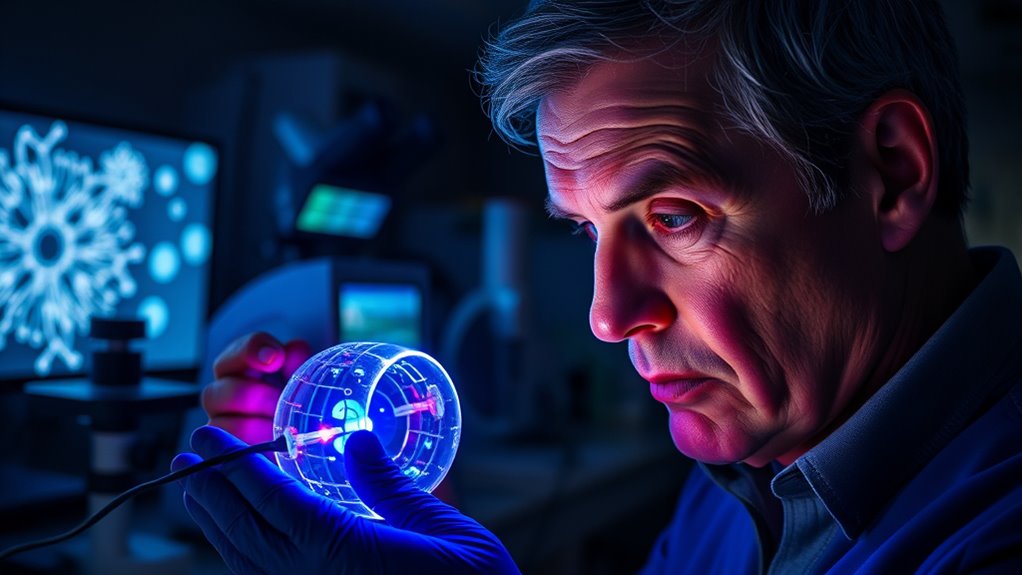
You see how early experiments like electron beam patterning proved that atomic precision was achievable. Atomic-scale manipulation techniques transformed the way we control individual atoms, turning Feynman’s ideas into practice. Advances in atomic force microscopy now allow you to visualize and interact with surfaces at sub-angstrom resolution, pushing the boundaries of nanotechnology. These innovations are grounded in vetted scientific methods, ensuring reliability and progress in the field. Moreover, ongoing research in precise atom placement continues to expand the possibilities of nanofabrication techniques, supported by comprehensive peer-reviewed studies. The development of 16PF personality assessment tools further underscores the importance of validated methodologies in advancing scientific understanding, fostering trust and accuracy. Additionally, the popularity of forsale 100 indicates a growing market for nanotech-related products and innovations.
Electron Beam Patterning
Focused electron beams to modify surfaces with nanometer accuracy have been instrumental in advancing haute couture techniques, where precision and craftsmanship are paramount. Enabled patterning of materials for nanoscale electronic components. Laid groundwork for atomic force microscopy and scanning probe techniques. Additionally, these electron beam patterning methods have expanded into various industrial applications, demonstrating their versatility and importance in nanotechnology development. The ability to manipulate surfaces at such a small scale has also contributed to the development of cryptid mysteries, where precise imaging techniques help distinguish between hoaxes and genuine phenomena. These advancements exemplify how nanotechnology continues to push the boundaries of scientific exploration and practical innovation. Moreover, the development of focused electron beams has improved resolution and efficiency, further accelerating research and commercial applications in the field.
Atomic-Scale Manipulation Techniques
Since the pioneering experiments in atomic-scale manipulation, researchers have developed techniques that allow precise control over individual atoms and molecules. Early efforts relied on electron beam patterning to position atoms, demonstrating that atoms could be moved deliberately. The breakthrough came with scanning tunneling microscopy (STM) in the 1980s, which enabled scientists to visualize and manipulate atoms directly. STM uses a sharp tip to sense and apply forces at the atomic level, allowing for atom-by-atom assembly. This technique revolutionized nanotechnology, proving Feynman’s vision of building structures from the bottom up. It also paved the way for atomic force microscopy (AFM), which expanded manipulation capabilities to non-conductive surfaces. These methods transformed our ability to control matter at the smallest scales, opening new frontiers in material science and molecular engineering.
Atomic Force Microscopy Advances
Atomic force microscopy (AFM) has revolutionized nanoscale manipulation by allowing scientists to image and interact with surfaces at atomic resolution. You can now directly observe individual atoms, measure forces between surfaces, and even manipulate nanostructures. Breakthroughs include:
- Developing high-speed AFM techniques to capture dynamic processes in real-time.
- Enhancing resolution to visualize single molecules and atomic lattices with unprecedented clarity.
- Creating specialized tips to manipulate atoms and assemble nanoscale devices with precision.
These advances enable detailed surface characterization, atom-by-atom assembly, and new insights into material behavior at the nanoscale. AFM’s evolution continues to push the boundaries of what’s possible in nanotechnology, bringing Feynman’s visionary ideas closer to reality and opening doors for innovations across science and engineering.
The Cultural and Scientific Impact of Feynman’s Ideas

Feynman’s ideas have profoundly shaped both the scientific community and popular culture by inspiring a new era of technological innovation and scientific curiosity. His vision ignited interest in manipulating matter at the atomic scale, leading to the birth of nanotechnology. This shift changed how scientists approach problem-solving, encouraging miniaturization and precision. Feynman’s provocative challenges and concepts sparked widespread enthusiasm, motivating researchers worldwide. His influence extended beyond labs, permeating education, science fiction, and public imagination, making complex ideas accessible and exciting. The term “nanotech” and associated breakthroughs often trace back to his pioneering speech. Today, his visionary thinking continues to inspire breakthroughs, shaping economic and technological landscapes. nanotechnology emerged as a direct result of his ideas, transforming industries and scientific research. Feynman’s impact remains a testament to how bold ideas can transform science and culture alike, fostering a technological revolution that continues to evolve.
Today’s Nanotech: Achievements and Future Prospects

Today, nanotechnology has evolved from Feynman’s visionary ideas into a vibrant field that impacts numerous industries. You can now manipulate atoms with tools like atomic force microscopes and scanning probe techniques, turning theoretical concepts into real-world applications. Key achievements include:
Nanotechnology transforms Feynman’s visions into real-world breakthroughs across industries today.
- Developing nanoscale machines capable of precise atom assembly
- Creating targeted drug delivery systems for medicine
- Advancing materials with exceptional strength, flexibility, and conductivity
- Integrating encryption solutions into nanodevices to enhance security and privacy
As the field progresses, researchers are also exploring molecular manufacturing techniques to enable even greater control over atomic placement and assembly. Future prospects involve building smarter nanodevices, enabling synthetic chemistry at atomic precision, and revolutionizing electronics and healthcare. Researchers aim to miniaturize devices further, improve manufacturing techniques, and discover new capabilities like nanoscale robotics. As nanotech continues to grow, it promises to reshape industries and solve complex problems, fulfilling Feynman’s early visions of a tiny, controlled world.
Feynman’s Legacy in Modern Science and Engineering

Feynman’s pioneering ideas have fundamentally shaped modern science and engineering by transforming abstract visions into tangible technological advancements. His concept of manipulating matter at atomic scales sparked the development of nanotechnology, influencing areas like materials science, electronics, and medicine. Today, nanoscale machines and tools, such as atomic force microscopes, owe their existence to his foresight. His challenge to miniaturize and control devices inspired generations of scientists and engineers, leading to innovations like targeted drug delivery and quantum dots. Feynman’s vision also pushed the boundaries of imaging and fabrication, enabling unprecedented precision. Nanotechnology’s evolution continues to build upon his groundbreaking concepts, and his legacy endures through these breakthroughs, cementing his role as a catalyst for the technological revolution that continues to evolve. You recognize his profound impact on shaping the scientific landscape we navigate today.
Frequently Asked Questions
How Did Feynman’s 1959 Ideas Influence Modern Nanotechnology Research?
Feynman’s 1959 ideas laid the groundwork for modern nanotech by inspiring you to miniaturize devices, manipulate atoms precisely, and develop nanoscale machines. His vision of atom-by-atom assembly and atomic-level imaging fueled advancements like electron microscopy and scanning probe techniques. You now benefit from these innovations, which have transformed fields like medicine, materials science, and electronics, proving Feynman’s foresight was truly revolutionary for nanotechnology research.
What Technological Advances Were Directly Inspired by Feynman’s Visionary Proposals?
You see, Feynman’s visionary proposals directly inspired advances like atomic force microscopy, scanning tunneling microscopes, and nanoscale manipulation techniques. His ideas prompted scientists to develop tools that view and manipulate individual atoms, enabling precise assembly and control at the nanoscale. These breakthroughs have revolutionized material science, electronics, and medicine, proving that his early visions laid the groundwork for today’s cutting-edge nanotechnology innovations.
Why Was Feynman’s Lecture Largely Ignored Initially Despite Its Significance?
Your eyes might see a hidden gem buried in plain sight, but Feynman’s groundbreaking lecture was largely ignored initially because it was ahead of its time, like a whisper in a storm. People struggled to grasp the potential of manipulating matter at tiny scales, and the scientific community focused on immediate priorities. Its visionary ideas took decades to gain recognition, proving that groundbreaking insights often need patience to be truly appreciated.
How Did Feynman’s Challenges Accelerate Developments in Atomic-Scale Engineering?
Your understanding of Feynman’s challenges shows how they pushed the field forward by setting concrete goals that inspired innovation. By offering prizes for miniaturization and building tiny machines, he motivated researchers to develop new tools and techniques like electron beam patterning and atomic force microscopy. These efforts led directly to breakthroughs in atomic-scale engineering, making Feynman’s vision a reality and accelerating progress in nanotechnology.
What Is the Current State of Nanotechnology Compared to Feynman’s Original Vision?
Today, nanotechnology has far exceeded Feynman’s original vision. You can manipulate atoms with scanning probe microscopes, create nanoscale devices, and develop targeted drug delivery systems. Advances in materials, electronics, and medicine showcase how you’ve turned his ideas into reality. While challenges remain, the field’s rapid progress means you’re now working at the atomic level, transforming industries and enabling innovations Feynman only envisioned.
Conclusion
You’ve witnessed how Feynman’s tiny ideas sparked a revolution that transformed science. His vision ignited a wildfire of innovation, turning the impossible into everyday marvels. Today, nanotech’s advancements seem like futuristic dreams brought to life, shaping our world in ways once thought unimaginable. Feynman’s genius continues to inspire, proving that even the smallest sparks can ignite the brightest flames of progress—changing our universe in ways you can hardly fathom.
Fall Picks
fall essentials
As an affiliate, we earn on qualifying purchases.