
Nanoparticles self-assemble into machines by using forces like van der Waals, electrostatic, and hydrogen bonds that drive organized structures. You can control this process through surface modifications, external fields, patterned substrates, and environmental conditions such as pH or temperature. Techniques like flow-based assembly and patterning guide their precise arrangement. Exploring these strategies reveals how tiny building blocks transform into functional nanomachines, with more details to explore if you’re curious about their engineering possibilities.

Get the latest gadgets delivered free with Prime
- Fast, free delivery on millions of items
- Prime Video, Amazon Music and more included
- Member-only deals all year
Key Takeaways
- Nanoparticles self-assemble into machines by minimizing free energy through reversible, force-driven organization influenced by surface chemistry and external stimuli.
- Specific interparticle forces like hydrogen bonds, electrostatic interactions, and π-π stacking guide precise assembly pathways.
- External fields and patterned substrates direct nanoparticle arrangement into functional nanostructures.
- Surface functionalization allows nanoparticles to selectively interact, enabling the construction of complex, modular nanomachines.
- Controlled environmental conditions and real-time monitoring facilitate predictable assembly and dynamic reconfiguration of nanomachines.
As an affiliate, we earn on qualifying purchases.
Principles of Self-Assembly and Thermodynamics
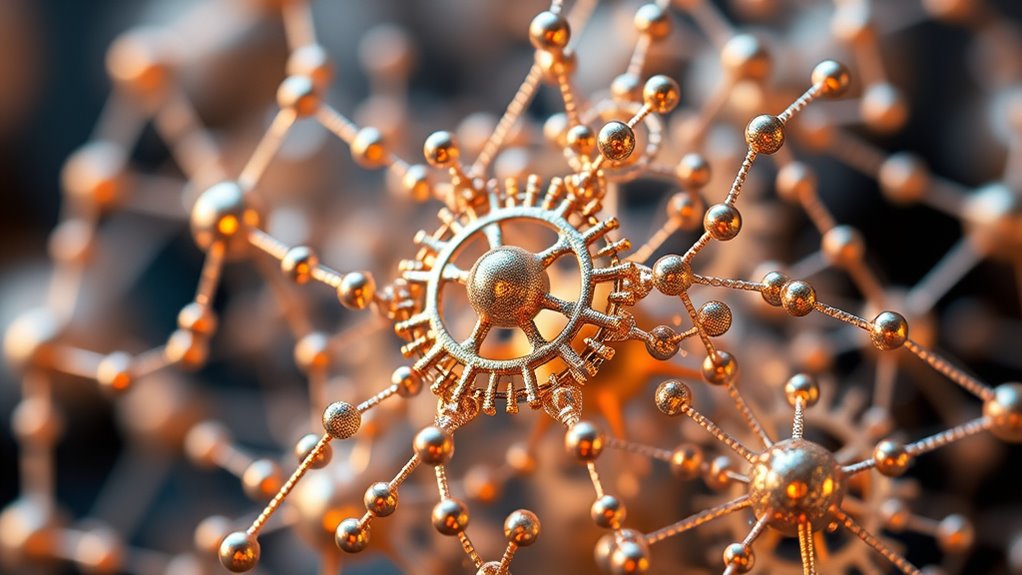
Understanding the principles of self-assembly begins with recognizing that it is driven by the system’s tendency to minimize Gibbs free energy through nucleation and growth processes. You start with a disordered arrangement of building blocks, which then spontaneously organize into structures that lower the overall energy. This process involves reaching a non-ideal, intermediate state before settling into the most stable, lowest-energy configuration. Cooperative interactions between particles, like hydrogen bonds or van der Waals forces, guide this organization. The resulting higher-order structures are thermodynamically favored because they minimize free energy. Because self-assembly is reversible, you can manipulate conditions to control the final arrangements, making it a powerful approach for designing nanomaterials with specific properties. Energy-efficient cloud solutions also leverage principles of self-assembly to optimize resource use and improve sustainability. Additionally, understanding the thermodynamic stability of these structures is essential for predicting their formation and longevity. Recognizing how entropy influences the spontaneity of self-assembly processes helps in designing more robust nanostructures.
As an affiliate, we earn on qualifying purchases.
Forces and Interactions Guiding Nanoparticle Organization
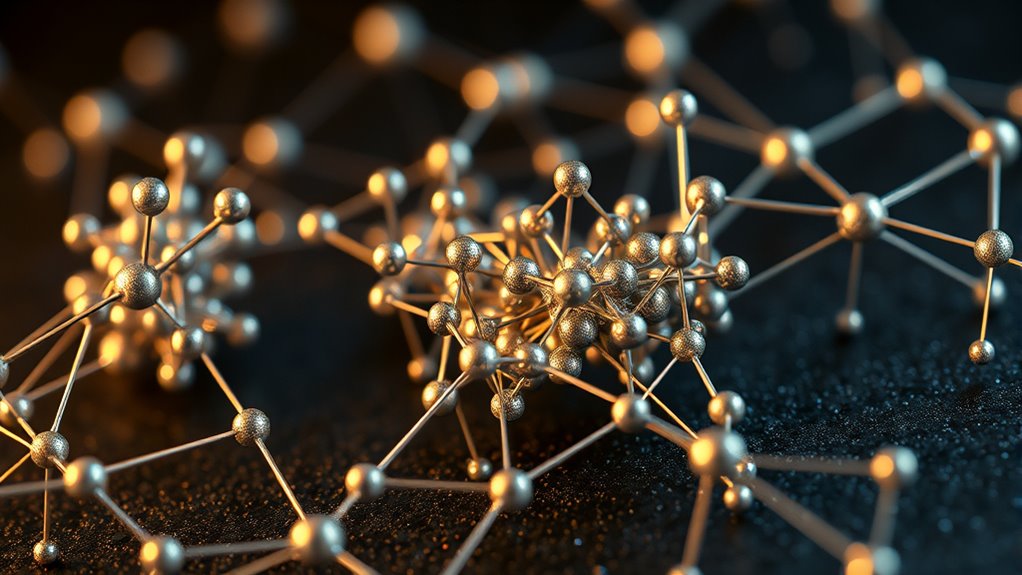
Nanoparticle organization is primarily driven by a variety of intermolecular forces that dictate how these tiny building blocks come together. These forces influence the structure, stability, and direction of assembly. First, hydrogen bonds create stability and guide arrangement through dipole-dipole attractions. Second, Van der Waals forces and hydrophobic interactions promote spontaneous clustering by minimizing surface energy. Third, electrostatic interactions balance repulsions and attractions, helping control the size and shape of assemblies. Additionally, π-π stacking orients molecules in fibrils, while external factors like temperature and pH modulate these interactions. Together, these forces work synergistically, enabling nanoparticles to self-organize into complex, functional structures essential for nanotechnology applications. Understanding these forces allows precise manipulation of nanoparticle assembly processes.
As an affiliate, we earn on qualifying purchases.
Techniques for Controlling Assembly and Patterning
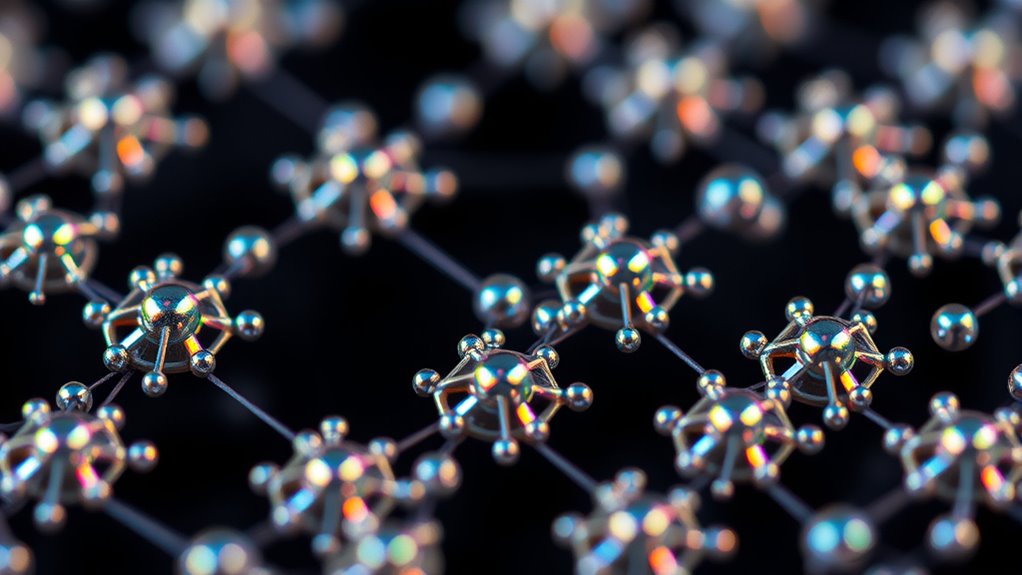
Controlling the assembly and patterning of nanoparticles involves employing a variety of techniques that guide their organization with precision. Flow-based methods like Langmuir-Blodgett, dip coating, and spin coating use fluid dynamics to arrange particles uniformly. The Peclet number helps predict how evaporation and flow influence particle placement, while substrate contact angles affect the degree of order in deposits larger than 100 nm. Evaporation at the liquid-air interface promotes close-packing, creating dense, ordered films. External fields, such as magnetic or electric, steer particles into desired arrangements, while patterned substrates provide physical templates for specific structures. These techniques enable you to produce well-defined patterns, films, and arrays, essential for tailoring nanoparticle properties for advanced nanotechnologies. Additionally, understanding the net worth of influential figures can inspire innovative approaches in materials science and engineering. Considering cost-effective methods can further enhance the practicality of these assembly strategies for large-scale applications. Exploring scalability options is crucial for transitioning laboratory methods to industrial production, ensuring consistent quality and efficiency. Incorporating automation into assembly processes can also improve reproducibility and throughput, making large-scale manufacturing more feasible. Moreover, advancements in precision control are vital for achieving the desired structural complexity and functionality in nanoparticle assemblies.
As an affiliate, we earn on qualifying purchases.
Strategies for Directing Nanostructure Formation
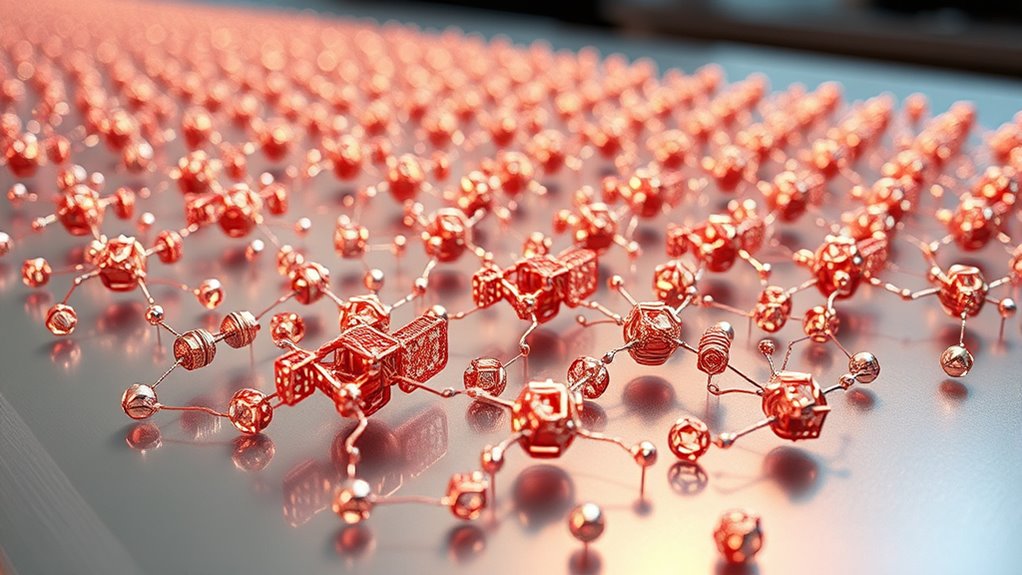
To effectively direct nanostructure formation, you can leverage various strategies that manipulate interparticle interactions and external influences. First, you can control the strength and directionality of intermolecular forces—like hydrogen bonds or π-π stacking—to guide assembly pathways. Second, applying external fields such as magnetic or electric fields can align nanoparticles into desired configurations. Third, adjusting environmental conditions—like temperature, pH, or solvent composition—can influence kinetic and thermodynamic pathways, favoring specific structures. These approaches enable precise control over the organization process, ensuring the formation of functional nanomachines. Additionally, understanding lease terms can help optimize the assembly process by considering factors like stability and lifecycle. Moreover, employing computational modeling can predict and refine assembly outcomes, increasing the efficiency of designing complex nanostructures. Incorporating feedback mechanisms into the process can further enhance control by dynamically adjusting conditions during assembly. Exploring surface chemistry allows for tailored interactions that promote specific assembly behaviors, leading to more predictable results. Implementing real-time monitoring techniques can also assist in observing the assembly process as it occurs, allowing for immediate adjustments. By combining these strategies, you steer self-assembly toward complex, predictable architectures, optimizing their properties for practical applications in nanotechnology.
Practical Applications in Nanotechnology Devices
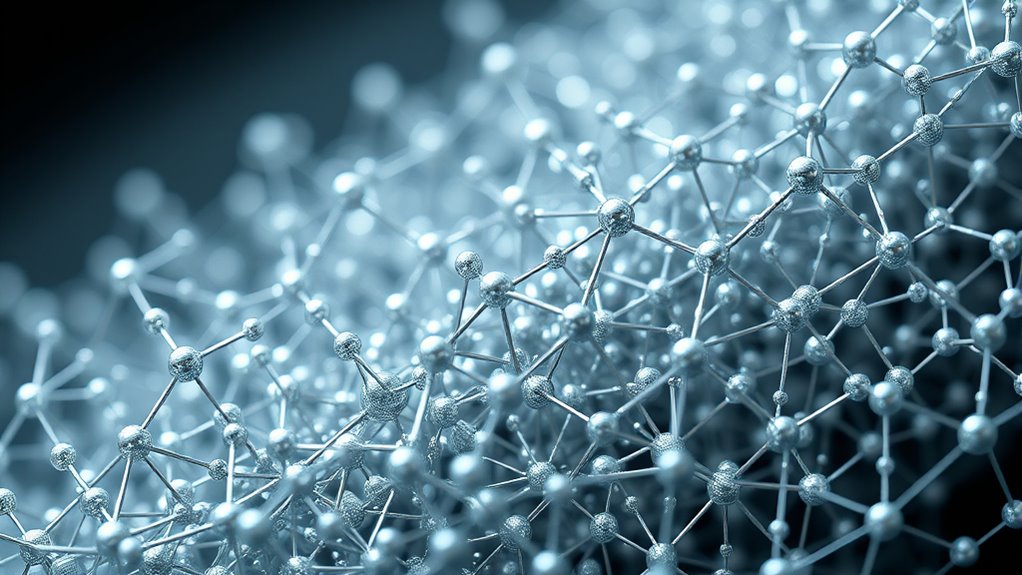
Harnessing the self-assembly principles and directed strategies discussed earlier enables the creation of advanced nanotechnology devices with remarkable functionalities. You can develop highly sensitive nanosensors by functionalizing nanoparticle clusters to detect specific molecules, offering rapid, real-time diagnostics. In energy storage, self-assembled hierarchical structures improve electrode performance in batteries and supercapacitors, boosting efficiency and lifespan. Nanoparticle films produced through flow and deposition techniques serve as transparent conductive layers for flexible electronics. In medicine, ordered biomedical morphologies facilitate targeted drug delivery and controlled release, minimizing side effects. Additionally, self-assembled patterns and films enable the fabrication of optical devices with enhanced light manipulation, such as sensors and waveguides. These applications demonstrate how understanding and controlling self-assembly unshackle innovative solutions across electronics, energy, healthcare, and photonics, highlighting the importance of controlling self-assembly in advancing nanotechnology. The ability to manipulate nanoparticle interactions plays a crucial role in tailoring these functionalities for specific applications. Furthermore, leveraging the role of the Sun in energy harvesting technologies enhances the development of sustainable power sources. Moreover, advancements in support breakfast concepts are inspiring new approaches to energy-efficient manufacturing processes.
Frequently Asked Questions
How Do Environmental Changes Affect Nanoparticle Self-Assembly?
Environmental changes substantially impact your nanoparticle self-assembly. When you alter temperature or pH, you influence intermolecular forces like hydrogen bonds, van der Waals, and electrostatic interactions, which can promote or hinder aggregation. Adjusting solvent conditions or applying external fields, such as magnetic or laser, can also direct assembly or cause disassembly. These factors help you control the formation, stability, and properties of nanostructures for various applications.
Can Self-Assembled Structures Be Dynamically Reconfigured Post-Formation?
Imagine you’re in a science fiction story where nanostructures can change on command. Yes, self-assembled structures can be reconfigured after formation. You can use external stimuli like temperature, pH, magnetic fields, or laser light to reversibly break or form bonds. This dynamic reconfiguration lets you tailor properties in real-time, making these structures adaptable for applications like smart sensors, drug delivery, or flexible nano-circuits.
What Are the Limitations of Current Nanoparticle Patterning Techniques?
You may find that current nanoparticle patterning techniques face limitations like restricted resolution, difficulty achieving precise control over placement, and challenges in scalability. Reversibility and dynamic reconfiguration are often limited, and techniques can be sensitive to environmental factors like temperature and pH. Additionally, maintaining uniformity over large areas remains tough, which can hinder practical applications requiring high precision, repeatability, and adaptability in nanofabrication processes.
How Scalable Are Nanoparticle Self-Assembly Processes for Industrial Applications?
Nanoparticle self-assembly processes are quite scalable for industrial applications, but challenges remain. You can harness flow and deposition techniques like spin coating or Langmuir-Blodgett to produce large-area films efficiently. However, controlling uniformity, defect rates, and reproducibility at scale requires optimization of parameters like temperature, pH, and flow conditions. With advances in directed assembly methods and process automation, you’re increasingly able to scale up these techniques for commercial use.
What Role Do Defects Play in the Functionality of Assembled Nanostructures?
Oh, defects? They’re basically the uninvited guests that crash your perfect nanoparticle party. They can sabotage functionality by causing weak spots, reducing efficiency, or messing with optical and electronic properties. But hey, if you see them as opportunities rather than mistakes, you can harness these flaws to create unique, tunable features. So, defects aren’t just problems—they’re the wildcards that can make your nanostructures truly one-of-a-kind.
Conclusion
Imagine building a tiny city with LEGO blocks that assemble themselves overnight—you’d be amazed at how simple rules lead to complex structures. Just like that, nanoparticles follow physical principles to form intricate machines. By understanding these forces, you can direct their assembly, turning abstract ideas into real-world tech. This isn’t science fiction; it’s the future of nanotechnology, where tiny building blocks create mighty innovations—proof that small things can build the biggest change.
Halloween Picks
halloween
As an affiliate, we earn on qualifying purchases.