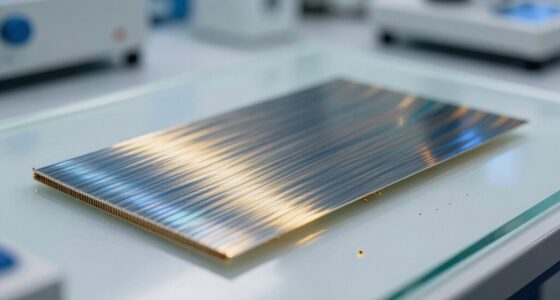

Nanomaterials like graphene, silver nanowires, and carbon nanotubes make bendable phones possible by providing super-thin, lightweight, and highly conductive components. These materials keep screens bright, flexible, and durable even when you bend or fold your device. They form transparent, stretchable circuits that maintain performance during movement. If you want to discover how these advanced nanomaterials are transforming mobile tech and what future innovations await, you’ve come to the right place.
Key Takeaways
- Nanomaterials like graphene and silver nanowires create flexible, transparent conductive films essential for bendable phone displays.
- Their high electrical conductivity and mechanical strength allow screens to bend without losing performance.
- Nanomaterial-based coatings and nanocomposites distribute stress, preventing cracks during repeated flexing.
- Solution processing and printing techniques enable scalable manufacturing of flexible, nanomaterial-enhanced display components.
- Integration of nanostructures into flexible circuits and sensors improves durability, responsiveness, and user comfort in bendable phones.
graphene flexible display film
As an affiliate, we earn on qualifying purchases.
As an affiliate, we earn on qualifying purchases.
The Role of Nanomaterials in Flexible Phone Screens
Nanomaterials play a crucial role in enabling flexible phone screens by providing exceptional electrical, optical, and mechanical properties. You benefit from their high conductivity, which allows screens to remain clear and responsive even when bent or stretched. Graphene and silver nanowires create transparent, flexible electrodes that maintain brightness and touch sensitivity during deformation. Their lightweight and thin structures ensure screens stay slim without sacrificing durability. Nanomaterials also enhance mechanical strength, preventing cracks and damage under repeated bending. Because of their solution processability, manufacturers can produce large-area, flexible displays efficiently. These nanomaterials enable seamless integration of electronics onto soft, curved surfaces, making your devices more durable, lightweight, and adaptable. The development of advanced manufacturing techniques further optimizes the production of flexible displays, reducing costs and improving quality. Additionally, nanomaterials contribute to energy efficiency in flexible screens by reducing power consumption and enabling longer device usage. Their environmentally friendly nature supports sustainable production practices, aligning with the goals of eco-conscious innovation. Thanks to their scalability in production, manufacturers can meet the growing demand for flexible devices worldwide. Ultimately, nanomaterials are essential in transforming rigid screens into flexible, resilient displays for modern smartphones.
silver nanowire touchscreen replacement
As an affiliate, we earn on qualifying purchases.
As an affiliate, we earn on qualifying purchases.
Key Types of Nanomaterials Used in Bendable Devices

Building on how nanomaterials enable flexible screens, various types are tailored to meet the demands of bendable devices. You’ll encounter carbon nanotubes, known for their strength and conductivity, forming macrofilms for stretchable supercapacitors. Graphene stands out in transparent conductors, transistors, and battery electrodes, thanks to its exceptional electrical properties. Silver nanowires create flexible transparent electrodes for touchscreens, offering high transparency and conductivity. Other key nanomaterials include nanowires, nanotubes, and engineered organic molecules, which provide tunable performance and mechanical flexibility. These materials often combine to enhance device durability and functionality. [Understanding the mechanical flexibility] of these nanomaterials is crucial for optimizing bendable device performance.
carbon nanotube flexible electronics
As an affiliate, we earn on qualifying purchases.
As an affiliate, we earn on qualifying purchases.
Fabrication Techniques for Flexible Nanomaterial Components

To fabricate flexible nanomaterial components effectively, engineers employ a range of techniques that control structure and properties at the nanoscale. Top-down methods like photolithography, soft lithography, nanoimprint lithography, and transfer printing shape nanomaterials with precision, enabling integration onto soft substrates. These techniques allow for patterning nanoscale features essential for electronic performance. Conversely, bottom-up approaches involve growth, assembly, and chemical vapor deposition (CVD), which build nanostructures atom-by-atom or molecule-by-molecule. Additive manufacturing and ink-based printing also play vital roles, supporting large-area, flexible, and curved device fabrication. These methods guarantee uniformity, electrical conductivity, and mechanical resilience, which are essential for flexible electronics. Understanding nanoscale control is crucial for optimizing the properties of flexible nanomaterials. Additionally, advancements in nanomaterial synthesis significantly improve the performance and durability of bendable devices by enabling precise material customization. Incorporating scalable manufacturing processes ensures that flexible electronics can be produced efficiently and cost-effectively at commercial scales.
bendable smartphone screen repair kit
As an affiliate, we earn on qualifying purchases.
As an affiliate, we earn on qualifying purchases.
Enhancing Durability and Flexibility in Smartphone Displays

Enhancing the durability and flexibility of smartphone displays requires integrating advanced nanomaterials that can withstand repeated bending and impact. You’ll want to incorporate materials like graphene and silver nanowires, which provide high strength and conductivity without sacrificing flexibility. These nanomaterials form networks that disperse stress evenly, preventing cracks and fractures during frequent use. Using nanocomposites, you can create ultra-thin, resilient coatings that protect the display’s core components while maintaining transparency. Nanostructured layers also improve resistance to scratches and impacts, extending the device’s lifespan. Additionally, understanding the material properties involved in material performance can help optimize their performance in flexible electronics. Selecting materials with optimal mechanical strength and elasticity ensures the display remains durable through extensive use. By combining these materials with innovative fabrication methods, such as additive printing or chemical vapor deposition, you’ll produce displays that flex effortlessly, resist damage, and retain clarity. Incorporating advanced manufacturing techniques can further enhance the uniformity and reliability of these nanomaterial-based layers. This approach guarantees your device remains durable and functional through countless bends and everyday use, especially when considering the material strength required for long-term durability.
Transparent Conductive Films: Nanowires and Graphene

Nanowires offer high transparency and flexibility, making them ideal for transparent conductive films in flexible devices. Graphene stands out with exceptional conductivity and strength, providing a durable alternative to traditional materials. Comparing their performance helps you understand which material best fits your application’s needs for transparency, flexibility, and electrical efficiency. Modern kitchen technology continues to evolve, integrating these advanced materials into everyday appliances to enhance durability and functionality. Additionally, ongoing research into nanomaterial integration is expanding possibilities for even more innovative flexible electronics. As development progresses, understanding material properties becomes crucial for optimizing device performance and longevity. Recognizing material durability is essential for selecting the most suitable material for long-term device reliability.
Nanowire Transparency Benefits
Nanowire-based transparent conductive films offer significant advantages for flexible electronics by providing high optical transparency combined with excellent electrical conductivity. This signifies your devices can maintain clear displays and efficient performance even when bent or stretched. Silver nanowires form networks that allow light to pass through while carrying electrical signals effectively, making them ideal for touchscreens, displays, and wearable sensors. Their random, mesh-like structure minimizes light scattering, ensuring minimal glare and high clarity. Unlike traditional materials, nanowire films are thin, lightweight, and flexible, enabling seamless integration into curved surfaces. This transparency and conductivity balance helps your devices stay visually appealing and responsive, even after repeated bending. Additionally, the percolation threshold of nanowire networks is low, allowing for efficient electrical conduction with minimal material usage. The mechanical flexibility of nanowire films also contributes to their durability in various applications. In essence, nanowire transparency benefits lead to more durable, high-performance flexible electronics that look and function better.
Graphene Conductivity Advantages
Graphene stands out as a highly effective material for transparent conductive films because of its exceptional electrical conductivity combined with remarkable optical transparency. Its single-atom thickness allows it to conduct electricity efficiently while letting most light pass through, making it ideal for flexible displays and touchscreens. Unlike traditional materials, graphene maintains conductivity even when bent or stretched, ensuring durability in bendable devices. Its high electron mobility enables fast signal transmission, which improves device responsiveness. Additionally, graphene’s chemical stability resists corrosion and environmental damage, prolonging the lifespan of electronic components. Its compatibility with various fabrication methods supports scalable production, helping you create lightweight, flexible electronics without compromising performance. Overall, graphene offers a unique combination of conductivity, transparency, and flexibility, making it a game-changer for next-generation bendable devices. Moreover, its research-backed properties align with the need for materials that can sustain performance under mechanical stress, ensuring long-term device reliability. Recent advancements in nanomaterial synthesis further enhance graphene’s potential in flexible electronics, enabling even more innovative applications.
Comparative Material Performance
When comparing transparent conductive films, nanowire networks and graphene each offer distinct advantages that make them suitable for flexible electronics. Nanowire networks, especially silver nanowires, provide excellent conductivity, high transparency, and ease of solution-based processing, making them ideal for touchscreens and flexible displays. They form sparse, flexible networks that maintain performance under deformation. Graphene, on the other hand, excels in transparency, mechanical strength, and electrical conductivity. It offers superior flexibility and can be integrated into ultra-thin devices, making it suitable for wearable sensors and transparent transistors. While nanowires are easier to produce at large scales, graphene’s durability and high performance make it a promising candidate for long-term applications. Additionally, ongoing research into material stability aims to enhance the longevity and reliability of these nanomaterials in commercial devices. Advances in scalable fabrication methods are also key to bringing these materials into widespread practical use, ensuring that their benefits can be fully realized in the future. Both materials continue to evolve, pushing the boundaries of flexible electronics technology.
Integrating Nanomaterials Into Flexible Circuitry and Sensors

Integrating nanomaterials into flexible circuitry and sensors involves carefully embedding advanced nanostructures like carbon nanotubes, graphene, and silver nanowires into soft, stretchable substrates to enhance electrical performance and mechanical durability. You use techniques such as solution processing, inkjet printing, and transfer printing to create uniform, conductive networks on flexible materials. These nanomaterials enable high transparency, excellent conductivity, and elasticity, which are essential for bendable devices. By manipulating nanoscale structures, you can design sensors that detect strain, pressure, or biochemical signals with high sensitivity. Combining different nanomaterials, like silver nanowire-carbon nanotube hybrids, further boosts flexibility and electrical stability. This integration allows your flexible circuits and sensors to perform reliably under repeated bending, stretching, and twisting, making them suitable for next-generation wearable tech and foldable electronics.
Challenges and Solutions in Commercializing Bendable Phones
| Challenge | Solution |
|---|---|
| Durability of nanomaterial coatings | Developing robust, flexible nanocomposites |
| High production costs | Scaling manufacturing and optimizing materials |
| Consistent quality control | Implementing advanced in-line inspection techniques |
| Integration with existing electronics | Creating compatible fabrication processes |
| Device reliability over time | Improving encapsulation and protective layers |
Despite the promising potential of bendable phones, bringing them to mass-market production faces significant challenges. You need durable nanomaterials that withstand repeated bending, which calls for advanced composites. High costs hinder widespread adoption, but economies of scale and process optimization can help. Ensuring consistent quality requires precise manufacturing controls. Compatibility with current electronic components demands adaptable fabrication techniques. Finally, device reliability over time depends on improved protective layers. Addressing these issues with innovative solutions is key to shifting bendable phones from prototypes to mainstream products, making flexible tech accessible and dependable for users worldwide.
Future Innovations Driven by Nanotechnology in Mobile Devices

Nanotechnology is poised to transform mobile devices by enabling unprecedented levels of flexibility, performance, and functionality. You can expect exciting innovations driven by nanomaterials, such as:
- Ultra-thin, flexible screens that bend without damage, making devices more durable and versatile.
- High-performance sensors integrated into wearables for real-time health monitoring.
- Advanced energy storage solutions like stretchable supercapacitors to extend battery life.
- Smarter, more adaptive electronics that seamlessly conform to your body or environment.
These innovations will make your devices more resilient, lightweight, and capable of supporting complex functions. As nanotechnology matures, it will open new possibilities in robotics, healthcare, and beyond—delivering smarter, more intuitive experiences right in your hands.
The Impact of Nanomaterials on the Next Generation of Flexible Electronics
Nanomaterials are revolutionizing the development of flexible electronics by enabling devices that are lighter, more durable, and highly adaptable. With nanomaterials like graphene, carbon nanotubes, and silver nanowires, you can create ultra-thin, transparent, and highly conductive components that bend and stretch without losing performance. These materials allow for faster, more reliable sensors and energy storage solutions integrated into flexible systems. They also improve manufacturing processes, making large-area production more efficient and sustainable through techniques like inkjet printing and chemical vapor deposition. As a result, your future devices will be more versatile, combining high performance with exceptional flexibility. This progress paves the way for innovative applications in wearables, healthcare, and smart systems, transforming how you interact with technology daily.
Frequently Asked Questions
How Do Nanomaterials Improve the Durability of Flexible Phone Screens?
Nanomaterials improve your flexible phone screens‘ durability by providing exceptional mechanical strength and flexibility. When incorporated into the screen’s layers, they distribute stress evenly, preventing cracks and damage during bending. Materials like carbon nanotubes, graphene, and silver nanowires create highly conductive, stretchable networks that withstand repeated flexing. This innovation enhances your device’s lifespan, ensuring your screen remains resilient, clear, and functional even with continuous use and bending.
What Environmental Impacts Are Associated With Nanomaterial Production?
The production of nanomaterials can have significant environmental impacts, including energy consumption, chemical waste, and potential toxicity. You might release hazardous substances during synthesis, which can contaminate water and soil. Manufacturing processes often require high temperatures and chemicals, increasing carbon footprint. Proper disposal and recycling are essential to minimize pollution. As you develop flexible electronics, consider sustainable practices to reduce environmental harm and promote eco-friendly nanomaterial production.
Can Nanomaterials Be Recycled or Reused in Devices?
Yes, you can recycle and reuse nanomaterials in devices, but it’s challenging. You need specialized processes to recover them from complex systems without damaging their properties. Techniques like chemical separation, thermal treatment, and mechanical recycling help extract nanomaterials. Reusing nanomaterials reduces waste and environmental impact, but the process is still evolving. As a user, supporting sustainable practices and proper disposal methods guarantees these advanced materials are reused effectively.
How Do Nanomaterials Affect the Cost of Manufacturing Bendable Phones?
You’ll find that nanomaterials can increase manufacturing costs by up to 30%, mainly due to their complex fabrication processes. However, their unique properties, like high conductivity and flexibility, can reduce other expenses, such as material waste and assembly time. This trade-off means that, although initial costs rise, you might save money in the long run through improved device performance and durability, making nanomaterials a smart investment for bendable phones.
Are There Health Risks Associated With Nanomaterial Exposure in Devices?
Yes, there are health risks associated with nanomaterial exposure in devices. You might be exposed during manufacturing or if nanomaterials are released from the device over time. Tiny particles can penetrate skin, lungs, or even the bloodstream, potentially causing inflammation or toxicity. To safeguard yourself, follow safety guidelines, wear protective gear, and ensure proper disposal and containment of nanomaterials during production and maintenance.
Conclusion
By embracing breakthroughs in nanomaterials, you propel your phone’s flexibility, forging future-forward, flawless, and fascinating devices. These tiny technologies transform fragile screens into durable, dynamic displays that delight and defy expectations. As you explore this exciting evolution, remember that nanotechnology’s innovative influence ignites inspiring, interactive experiences. Get ready to witness a world where wearable, workable, and wondrous gadgets redefine your digital domain—delivering delight through daring, durable design.