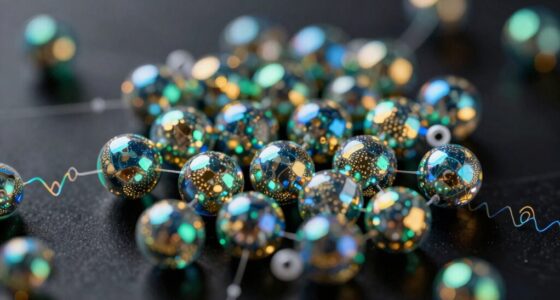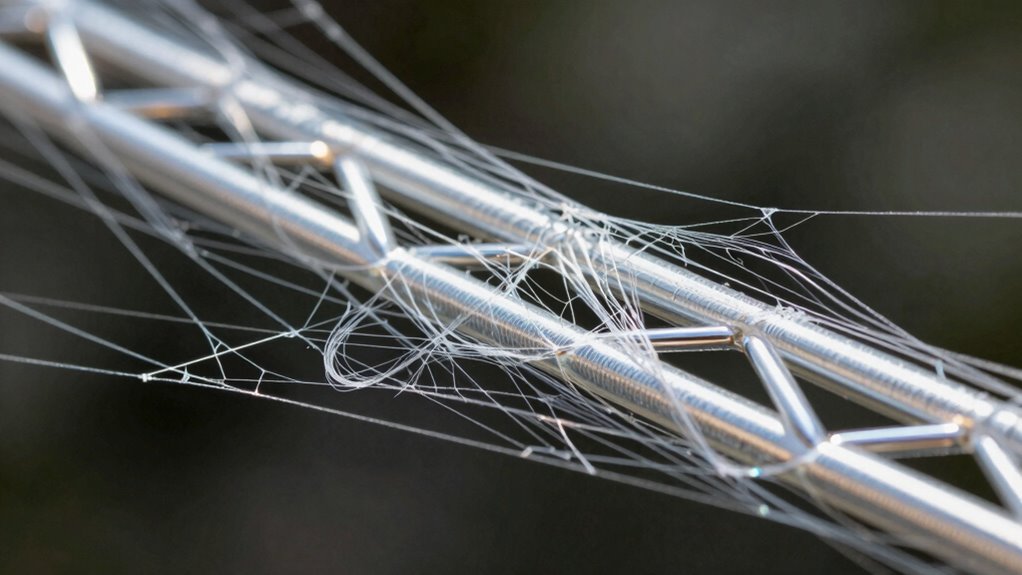
By combining spider silk with carbon nanotubes, scientists create a hybrid material that offers exceptional strength, toughness, and multifunctionality. This composite leverages silk’s hierarchical structure and nanotubes’ nanoscale reinforcement, resulting in lightweight yet durable fibers capable of dissipating energy and transferring loads efficiently. When properly fabricated and surface-functionalized, these hybrids can also exhibit electrical, optical, and catalytic properties. If you continue exploring, you’ll discover how this cutting-edge science is shaping next-generation protective armor.
Key Takeaways
- Combining spider silk’s hierarchical structure with carbon nanotubes creates lightweight, high-strength hybrid materials ideal for super armor.
- Proper surface functionalization and dispersion of nanotubes enhance interfacial bonding and energy dissipation in silk-based composites.
- CNT integration improves load transfer, toughness, and impact resistance, mimicking natural silk’s energy absorption capabilities.
- Advanced fabrication techniques align nanotubes within silk fibers, enabling scalable production of multifunctional, protective hybrid materials.
- Such bio-inspired composites offer promising potential for lightweight, durable, and multifunctional armor solutions.

Carbon Nanotube Reinforced Composites: CNT Polymer Science and Technology (Plastics Design Library)
As an affiliate, we earn on qualifying purchases.
As an affiliate, we earn on qualifying purchases.
The Exceptional Strength and Toughness of Natural Spider Silk
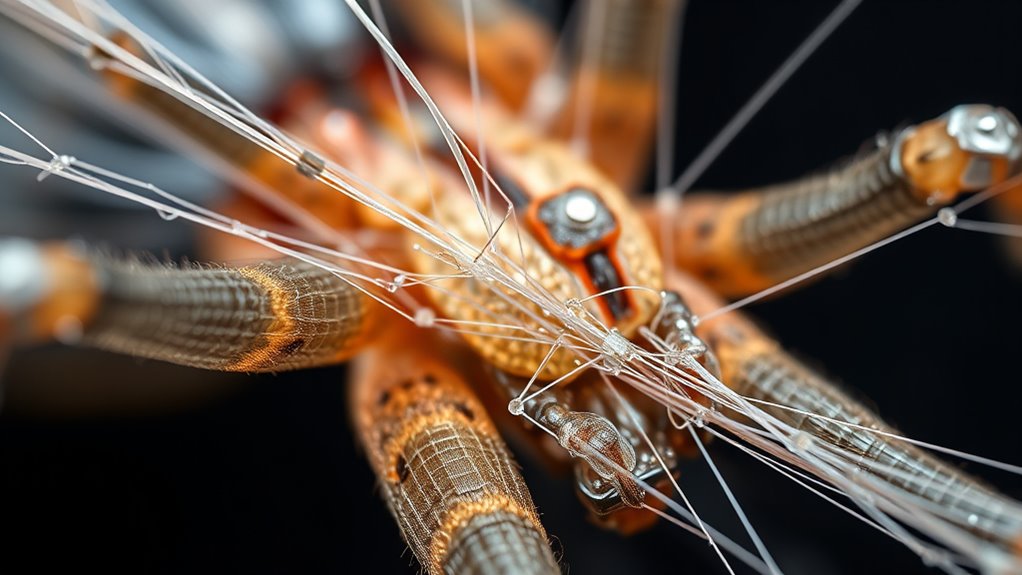
Natural spider silk stands out because of its remarkable combination of strength and toughness, making it one of the most impressive biological materials. Its tensile strength rivals steel, yet it remains lightweight and flexible. This balance results from its hierarchical structure, which includes crystalline β-sheets that bear loads and amorphous regions that enable extensibility. Spider silk can absorb high amounts of energy before breaking, with toughness values around 100–160 MJ·m−3. Its exceptional energy absorption and ability to deform without failure make it ideal for applications requiring resilience. The silk’s ability to dissipate energy through molecular mechanisms, such as β-sheet stretching and fibril sliding, underpins its durability. This natural synergy of strength and toughness inspires efforts to replicate or enhance these properties through hybrid materials. Additionally, its periodic design and molecular architecture serve as a blueprint for developing advanced synthetic composites with similar resilience. Recent advances in bioengineering aim to mimic these hierarchical features to create materials with enhanced performance comparable to natural silk.

Silk: Processing, Properties and Applications (The Textile Institute Book Series)
As an affiliate, we earn on qualifying purchases.
As an affiliate, we earn on qualifying purchases.
Enhancing Silk With Carbon Nanotubes: a Nano-Scale Reinforcement

You can improve silk’s toughness by leveraging nanoscale load sharing, where carbon nanotubes (CNTs) transfer stress efficiently across the fiber. Achieving strong interfacial bonding through surface functionalization enhances load transfer and prevents premature failure. To maximize reinforcement, it’s vital to control dispersion, as aggregation of CNTs creates stress concentrators that weaken the material. Furthermore, understanding Free Floating concepts can help optimize the overall design and integration of these hybrid materials. Incorporating European cloud innovation principles can also facilitate the development of scalable manufacturing processes for these advanced composites. Additionally, considering color accuracy in the design process can ensure consistent quality and performance of the final material. Recognizing net worth and other personal metrics of key figures involved can also provide useful insights into the commercial potential of these innovations. Exploring scalability challenges is essential for transitioning from laboratory research to real-world applications.
Nanoscale Load Sharing
Nanoscale load sharing is a key mechanism that enhances the mechanical performance of silk nanocomposites through the strategic incorporation of carbon nanotubes (CNTs). When well-dispersed, CNTs act as high-modulus reinforcements that bear load alongside silk’s crystalline β-sheets, distributing stress across the fiber. This effective load transfer reduces stress concentrations at nanoscale defects, preventing crack initiation and propagation. The hierarchical architecture of silk, with nanofibrils and amorphous regions, works synergistically with CNTs, combining stiffness and extensibility. During mechanical loading, CNTs can bridge microcracks, dissipating energy and increasing toughness. Proper functionalization of CNT surfaces guarantees strong interfacial bonding, which is essential for effective load transfer, maximizing load sharing. Additionally, the interfacial bonding between CNTs and silk matrix plays a crucial role in optimizing stress transfer efficiency. Recent research suggests that nanocomposite fabrication techniques can further improve the integration and performance of these hybrid materials. Furthermore, the development of scalable manufacturing processes is vital for translating these nanocomposites into real-world applications. Overall, this nanoscale synergy results in fibers that outperform natural silk in strength, toughness, and energy absorption.
Interfacial Bonding Strategies
Achieving strong interfacial bonding between carbon nanotubes (CNTs) and silk proteins is essential for maximizing load transfer and enhancing the mechanical performance of hybrid fibers. You can improve bonding by functionalizing CNT surfaces with groups like carboxyl or hydroxyl, which form chemical interactions with silk’s amino acids. Ensuring uniform dispersion prevents aggregation, reducing stress concentration points and enabling effective stress sharing during loading. You’ll want to optimize processing conditions—such as shear during spinning and post-spinning treatments like stretching or ethanol immersion—to promote β-sheet formation and align CNTs with silk fibrils. These strategies foster strong nanoscale interfaces where load transfer occurs efficiently, leading to tougher, more durable hybrid fibers. Proper interfacial chemistry ultimately determines whether the CNTs reinforce the silk matrix effectively or act as stress concentrators. Additionally, understanding AI-driven material design can help in predicting optimal surface functionalization methods to improve interfacial bonding further. Developing interfacial adhesion strategies is crucial to prevent debonding under stress and ensure long-term material stability.
Dispersion and Aggregation
Dispersion and aggregation of carbon nanotubes (CNTs) within silk matrices directly influence the overall performance of hybrid fibers. Proper dispersion guarantees CNTs effectively reinforce the silk’s nanostructure, improving load transfer, toughness, and energy absorption. When CNTs clump together, they create stress concentrators, reducing mechanical benefits and increasing the risk of failure. Achieving uniform distribution involves surface functionalization, sonication, and controlled processing conditions. Factors like shear forces during spinning and drying steps impact dispersion quality, affecting crystalline domain alignment and interfacial bonding. If aggregation occurs, it hampers nanoscale load sharing and crack bridging, limiting the material’s strength and toughness. Careful control over dispersion is essential for optimizing hybrid performance, especially when aiming to surpass natural silk’s protective capabilities. Additionally, understanding the nanostructure of these hybrid materials is key to tailoring their properties for advanced protective applications.
nanotube hybrid armor materials
As an affiliate, we earn on qualifying purchases.
As an affiliate, we earn on qualifying purchases.
Fabrication Techniques for Hybrid Silk–Nanomaterial Fibers
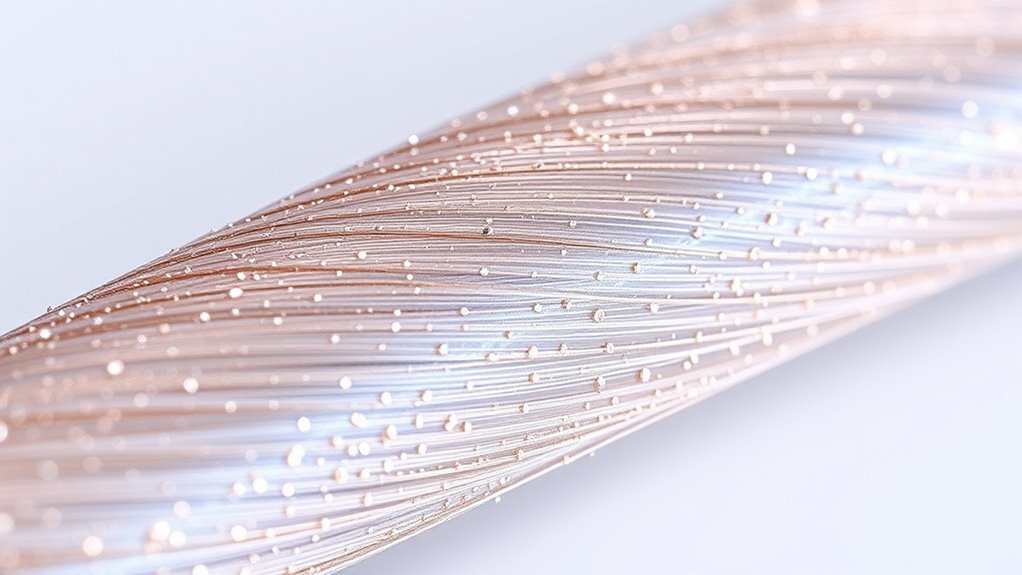
To create effective hybrid silk–nanomaterial fibers, you need to optimize spinning techniques like wet-spinning, electrospinning, or additive manufacturing to guarantee proper alignment and integration of nanomaterials. Controlling nanomaterial dispersion is vital; strategies such as functionalization, sonication, and surfactants help prevent aggregation and improve interfacial bonding. By fine-tuning these fabrication parameters, you can enhance the mechanical and functional properties of the resulting fibers.
Spinning Process Optimization
Optimizing the spinning process for hybrid silk–nanomaterial fibers involves carefully selecting and controlling fabrication techniques to guarantee uniform nanoparticle dispersion and strong fiber properties. To achieve this, focus on three key aspects:
- Shear and alignment control during spinning—applying ideal shear forces ensures proper nanoparticle orientation and minimizes aggregation.
- Post-spinning treatments—stretching and solvent exposure (like ethanol) induce β-sheet formation, enhancing strength and toughness.
- Nanoparticle functionalization and loading—using surface chemistries (carboxyl, hydroxyl) and maintaining low loadings (<1%) improve interfacial bonding and dispersion.
Additionally, controlling shear and alignment during spinning can significantly influence nanoparticle dispersion quality, leading to more uniform and reliable fiber performance.
Nanomaterial Dispersion Strategies
Effective nanomaterial dispersion is essential for fabricating high-performance silk–nanomaterial fibers, as it directly influences nanoparticle distribution, interfacial bonding, and ultimately, mechanical and functional properties. You can achieve this through methods like solution blending, where nanoparticles are mixed into silk solutions with surfactants or functionalization to improve compatibility. Ultrasonication helps break up agglomerates, ensuring uniform dispersion. During wet-spinning or electrospinning, controlling shear forces and flow rates aligns nanoparticles and prevents aggregation. Post-processing treatments like stretching or ethanol immersion promote β-sheet formation, further enhancing dispersion. Additionally, understanding nanomaterial dispersion strategies is crucial for optimizing fiber performance. Proper scaling techniques are also vital for transitioning from lab-scale experiments to industrial production. Mastering dispersion quality control ensures consistency and reliability in the final fibers, which is essential for commercial applications. Here’s a comparison of key strategies:
| Strategy | Key Feature | Advantages |
|---|---|---|
| Solution blending | Nanoparticles mixed in silk solution | Simple, scalable, customizable |
| Ultrasonication | High-frequency sound waves | Disperses agglomerates efficiently |
| Functionalization | Surface chemistry modification | Improves interfacial bonding |

Motorcycle Armor Vest for Men, Dirt Bike Body Armor Chest Protector, Motocross Riding Protective Gear for Off-Road Racing Cycling Skiing (Medium)
PP Armor: The outermost high-impact PP shockproof armor of the motorcycle armor vest effectively protects the most important…
As an affiliate, we earn on qualifying purchases.
As an affiliate, we earn on qualifying purchases.
Interfacial Chemistry and the Role of Surface Functionalization

Surface functionalization plays an essential role in enhancing the interfacial chemistry between carbon nanotubes (CNTs) and silk proteins, directly impacting the mechanical performance of hybrid materials. By adding specific chemical groups, you improve bonding, load transfer, and toughness.
- Functional groups like carboxyl or hydroxyl increase compatibility with silk’s amino acids, promoting strong covalent or hydrogen bonds.
- Better dispersion results from surface modifications, reducing nanotube aggregation and stress concentrators.
- Enhanced interfacial bonding facilitates stress sharing, crack bridging, and energy dissipation, boosting toughness and strength.
- Incorporating appliance maintenance plans can help preserve the integrity of these advanced materials by ensuring proper handling and storage conditions.
Effective surface functionalization ensures CNTs integrate seamlessly into silk matrices, optimizing load transfer and durability. This nanochemistry manipulation plays a critical role in developing high-performance hybrid fibers with superior mechanical and functional properties.
Multifunctionality: Electrical, Optical, and Catalytic Capabilities

Incorporating nanoparticles like carbon nanotubes (CNTs) into silk doesn’t just improve mechanical properties; it also imparts a range of multifunctional capabilities, including electrical conductivity, optical responsiveness, and catalytic activity. CNTs enable silk composites to conduct electricity, making them suitable for sensors or electromagnetic interference (EMI) shielding. Metal nanoparticles like gold or silver add optical features, antimicrobial effects, and catalytic functions, useful for self-healing or environmental sensing. These hybrid materials can respond to external stimuli or facilitate chemical reactions, expanding their application scope. The nanostructure of these composites plays a crucial role in determining their overall performance across these functions. Understanding the study techniques for analyzing these materials can further optimize their multifunctionality and practical use. Additionally, material characterization methods help tailor the properties of these composites for specific applications.
Improving Ballistic Resistance With Silk–Nanotube Hybrids

Enhancing ballistic resistance in silk–nanotube hybrids hinges on leveraging the unique energy absorption and load transfer capabilities of carbon nanotubes (CNTs). By integrating CNTs, you can improve the fiber’s ability to dissipate energy and resist penetration. Consider these key factors:
- Optimizing interfacial bonding through surface functionalization to guarantee effective load sharing.
- Dispersing CNTs uniformly to prevent stress concentrators that weaken the composite.
- Aligning CNTs during processing to maximize their high-modulus contribution for crack bridging and energy dissipation.
- Understanding the materials science principles behind composite reinforcement to better tailor the hybrid’s properties.
These strategies enhance toughness and strengthen the fiber’s ability to absorb impact energy. When properly controlled, CNT–silk hybrids can surpass natural silk’s ballistic performance, making them promising candidates for next-generation protective gear.
Challenges in Scaling Up and Commercializing Hybrid Silk Materials

Scaling up the production and commercialization of hybrid silk materials presents significant hurdles despite promising laboratory results. You’ll need reliable methods to produce consistent, high-quality silk proteins at industrial scales, often through recombinant techniques or regenerated silks. Incorporating nanotubes and nanoparticles demands advanced dispersion technologies—like sonication and surfactants—to prevent aggregation and guarantee uniform distribution. Regulatory concerns around nanomaterials, especially CNTs, pose health and environmental risks that require thorough safety assessments. Cost remains a barrier, as high-quality nanotubes and complex processing increase expenses; balancing performance with affordability is essential. Additionally, establishing standardized testing protocols for durability, ballistic performance, and environmental stability is critical before market deployment. Overcoming these challenges involves developing scalable, cost-effective, and safe manufacturing processes aligned with regulatory standards. Moreover, safety and compliance considerations are crucial to ensure successful commercialization and public acceptance of these advanced hybrid materials.
Future Perspectives: Towards Next-Generation Protective Gear

Advances in materials science and nanotechnology are paving the way for next-generation protective gear that surpasses current capabilities. You can expect these innovations to:
- Incorporate hybrid fibers with enhanced toughness, energy absorption, and ballistic resistance, providing superior protection with reduced weight.
- Integrate multifunctional features such as electrical conductivity, self-healing, or environmental responsiveness, enabling smarter armor systems.
- Utilize scalable manufacturing techniques like additive manufacturing and biomimetic spinning to produce complex, durable, and customizable protective layers. Additionally, scalable manufacturing techniques allow for cost-effective production and wider adoption of advanced protective materials.
- Harness nanotechnology to precisely control material properties at the molecular level, further advancing the performance of hybrid armor materials.
These developments will transform protective gear into lightweight, adaptable, and multifunctional solutions, meeting evolving safety standards. By harnessing hybrid silk–nanotube materials, you’ll benefit from armor that combines strength, flexibility, and added functionalities, pushing boundaries in personal protection technology.
Frequently Asked Questions
How Do Nanoparticle Dispersants Affect Long-Term Durability of Silk-Based Composites?
Dispersants improve the long-term durability of silk-based composites by preventing nanoparticle aggregation, ensuring consistent interfacial bonding, and reducing stress concentration sites. They promote stable dispersion, which maintains mechanical performance over time and resists environmental factors like humidity and temperature. However, if dispersants degrade or leach out, they can weaken interfaces and accelerate aging, so choosing stable, biocompatible dispersants is vital for preserving durability in demanding applications.
What Are the Environmental Impacts of Manufacturing Cnt-Silk Hybrid Armor?
Surprisingly, producing CNT-silk hybrids isn’t as eco-friendly as you’d hope. You might think high-tech armor sounds green, but manufacturing involves energy-intensive processes like functionalization, dispersion, and precise control, which generate waste and emissions. Toxic nanomaterials pose health risks, and disposal challenges linger due to environmental persistence. So, while it promises super strength, its environmental footprint could leave more scars than the armor’s defending you.
Can Silk–Nanomaterial Hybrids Be Self-Healing After Mechanical Damage?
Silk–nanomaterial hybrids can potentially self-heal after damage if designed with dynamic bonds or stimuli-responsive elements. You might incorporate reversible interactions like hydrogen bonds or embed healing agents within the matrix, allowing the material to recover its structure and properties. By optimizing interfacial chemistry and including self-healing mechanisms, you can develop composites that repair cracks or tears autonomously, enhancing durability and longevity in protective applications.
How Does Humidity Influence the Mechanical Performance of Hybrid Silk Fibers?
Humidity can critically impact your hybrid silk fibers’ performance, often reducing their strength and toughness. For instance, water absorption weakens hydrogen bonds within the silk’s β-sheet structures, leading to decreased stiffness and energy dissipation. When humidity rises, the amorphous regions become more plastic, lowering overall durability. Controlling environmental conditions during fabrication and use is essential to maintain ideal mechanical properties, ensuring your hybrid fibers perform reliably under varying humidity levels.
Are There Biocompatible Alternatives to CNTS for Military or Medical Applications?
You can consider biocompatible alternatives like cellulose nanocrystals, chitin nanofibers, or silk fibroin nanoparticles for military or medical uses. These materials offer good strength, toughness, and compatibility, making them suitable replacements for CNTs. They’re environmentally friendly, less toxic, and can be functionalized to enhance interfacial bonding. Using these options, you can develop lightweight, flexible, and safe composite materials that meet rigorous performance and safety standards.
Conclusion
By combining spider silk with nanotubes, you discover a material that’s stronger, tougher, and more versatile. You gain enhanced strength without sacrificing flexibility, improved functionality without added weight, and potential for innovation without limits. You push boundaries, challenge conventions, and open doors to new possibilities. In this hybrid, you find a future where lightweight armor, smarter textiles, and advanced technologies become reality — all driven by the power of nature and nano-engineering working together.