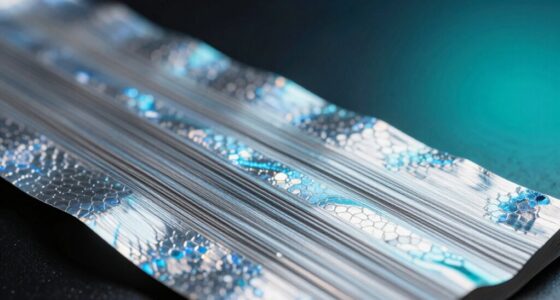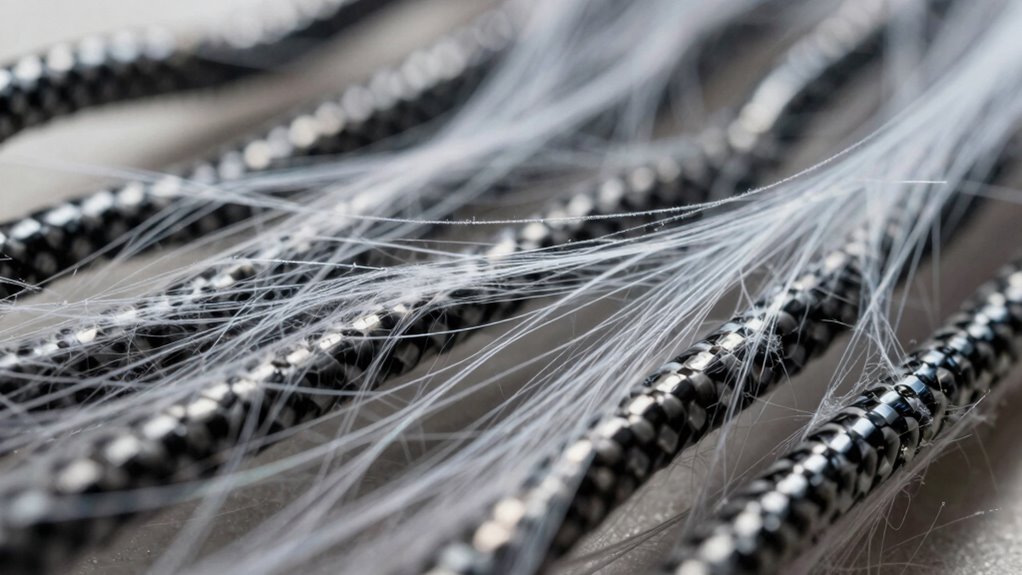

Hybrid materials blending spider silk with carbon nanotubes create strong, tough, and multifunctional fibers inspired by nature’s engineering. By integrating nanotubes into silk during eco-friendly fabrication processes like wet-spinning and 3D printing, you can enhance both strength and electrical conductivity. These composites can be used for lightweight, flexible electronics, sensors, and biointerfaces. If you explore further, you’ll discover how innovative techniques push biomimetic materials to new heights.
Key Takeaways
- Incorporation of carbon nanotubes into spider silk enhances mechanical strength, toughness, and electrical conductivity through molecular interactions.
- Wet-spinning fabrication enables eco-friendly production of hybrid fibers combining natural silk and nanomaterials.
- Functionalized nanotubes bond with silk proteins, creating composite materials with multifunctional properties like sensing and actuation.
- Nanomaterial integration replicates spider silk’s natural balance of strength and elasticity, inspired by molecular crystalline and amorphous structures.
- Advances focus on scalable, sustainable methods to develop high-performance, multifunctional hybrid materials for biomedical, electronic, and structural applications.
hybrid silk nanotube fibers
As an affiliate, we earn on qualifying purchases.
As an affiliate, we earn on qualifying purchases.
The Unique Mechanical Properties of Spider Silk

Spider silk stands out because of its remarkable combination of strength, toughness, and elasticity, making it one of nature’s most impressive materials. You’ll notice that its high breaking energy of around 160 MJ/m³ allows it to absorb significant energy before breaking. This is thanks to its unique molecular structure, where alanine blocks form crystalline domains, providing stiffness, while glycine blocks create amorphous regions that enable stretchability. When exposed to polar environments, the silk contracts, showcasing supercontracting capabilities. These properties make spider silk both durable and flexible, capable of handling dynamic forces without failing. Its natural design balances strength and elasticity perfectly, inspiring scientists to develop hybrid materials that mimic or surpass these exceptional mechanical traits. Additionally, understanding its molecular structure helps researchers engineer synthetic fibers with similar or enhanced properties, leading to potential advancements in material science. Researchers are also exploring biomimicry to replicate these natural features in engineered materials. Moreover, studying its molecular components offers insights into how to optimize synthetic fibers for various industrial applications. Furthermore, recent studies have revealed that nanostructures within the silk contribute significantly to its exceptional performance, opening new avenues for advanced material design.
carbon nanotube reinforced silk fabric
As an affiliate, we earn on qualifying purchases.
As an affiliate, we earn on qualifying purchases.
Enhancing Silk With Carbon Nanotubes

Integrating carbon nanotubes (CNTs) into silk fibers takes advantage of nanotechnology to substantially boost their mechanical and electrical properties. By adding less than 1% of functionalized CNTs, you can create hybrid fibers with remarkable strength and toughness. The wet-spinning process allows you to extrude these silk-CNT hybrids from regenerated silk, maintaining eco-friendly production. The carboxyl-functionalized CNTs bond effectively with silk proteins, enhancing electrical conductivity without compromising flexibility. These hybrid fibers can reach breaking energies over 130 MJ/m³, with some achieving up to 186 MJ/m³. They also exhibit increased tensile strength and strain, with fracture strengths tripling natural silk. Such enhancements open possibilities for advanced applications, combining the lightweight, resilient qualities of silk with the conductivity and strength of nanotubes. smart materials can be developed by tailoring these hybrid fibers for specific high-performance uses. Additionally, understanding the failure mechanisms of these composites is crucial for improving their durability in practical applications. Moreover, employing landscape integration techniques can help in creating sustainable environments that support the use of such innovative materials. Furthermore, ongoing research into nanocomposite fabrication techniques enables better control over the distribution and bonding of CNTs within silk fibers, leading to even more optimized properties. Expanding our knowledge of material compatibility is essential for ensuring the long-term stability of these hybrid fibers in various conditions.
biomimetic composite materials
As an affiliate, we earn on qualifying purchases.
As an affiliate, we earn on qualifying purchases.
Fabrication Techniques for Hybrid Silk-Nanotube Fibers
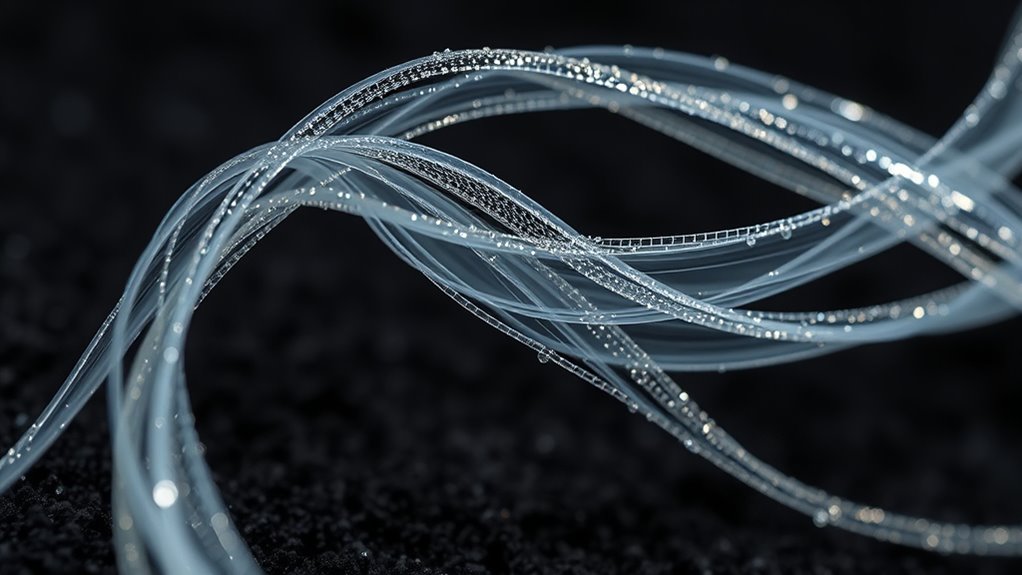
Fabrication of hybrid silk-nanotube fibers primarily relies on environmentally friendly processes like wet-spinning, which allows you to produce continuous, high-quality fibers by extruding a mixture of regenerated silk and functionalized carbon nanotubes. You prepare the silk solution by dissolving Bombyx mori silk in a benign solvent, then add a small percentage of carboxyl-functionalized CNTs to guarantee even dispersion. During wet-spinning, you extrude this mixture through a spinneret into a coagulation bath, usually containing a nonsolvent like methanol or water, which solidifies the fiber. This process aligns the nanotubes within the silk matrix, enhancing mechanical and electrical properties. Understanding fabrication techniques can help in optimizing the process for specific application needs. You can further optimize fiber properties by adjusting spinning parameters, such as flow rate and coagulation conditions, to produce fibers with desired strength, toughness, and conductivity. Additionally, controlling the dispersion quality of nanotubes ensures consistent fiber performance. Implementing environmentally friendly processes not only benefits sustainability but can also improve the overall quality and scalability of fiber production. Incorporating advanced characterization methods can assist in fine-tuning the fiber properties for targeted functionalities. Furthermore, utilizing innovative material integration techniques can lead to improved hybrid fiber performance.
flexible conductive fibers
As an affiliate, we earn on qualifying purchases.
As an affiliate, we earn on qualifying purchases.
Functionalities and Potential Applications of the Hybrids

The hybrid materials created by combining spider silk with nanotubes reveal a wide range of functional properties that can be tailored for diverse applications. You can leverage their exceptional toughness, with breaking energies surpassing natural silk, making them ideal for lightweight, durable fibers. Their enhanced electrical conductivity allows use in flexible electronics, sensors, and biointerfaces. The incorporation of nanomaterials introduces optical and catalytic functionalities, enabling advanced biomedical imaging or chemical sensing. Additionally, these hybrids can act as actuators or artificial muscles, providing rapid, efficient motion without oscillation. The tunable mechanical and electrical properties open new possibilities in high-performance composites, sustainable textiles, and smart materials. Understanding the power consumption of these advanced materials is essential for developing energy-efficient devices. Moreover, ongoing research into their scalability suggests promising avenues for commercial manufacturing and widespread adoption. Developing scalable production methods will be crucial for transitioning these hybrids from laboratory research to real-world applications. Advances in material processing techniques further facilitate their integration into existing manufacturing workflows. Exploring cost-effective manufacturing approaches will help make these innovative materials more accessible and practical for various industries. These functionalities position hybrid silk-nanotube materials as promising candidates for next-generation technologies across industries.
Future Perspectives in Biomimetic Material Development

Advancements in biomimetic materials are poised to revolutionize industries by harnessing nature’s strategies for resilience, adaptability, and multifunctionality. You’ll see future development focus on integrating nanomaterials like nanotubes and nanoparticles into natural proteins, creating stronger, smarter fibers. These hybrids could lead to sustainable, high-performance textiles, medical devices, and robotic components. You might also explore scalable fabrication methods, such as 3D printing and eco-friendly spinning techniques, making large-scale production feasible. Additionally, tunable properties—like electrical conductivity, optical features, and mechanical strength—will enable custom solutions. Material integration will be key to achieving these multifunctional capabilities, opening new avenues for biomimetic innovation. As research progresses, understanding the structure-property relationship in these composites will be essential for designing tailored materials with desired functionalities. Moreover, exploring sustainable manufacturing approaches will be crucial to ensure environmental compatibility as these technologies advance.
Frequently Asked Questions
How Do Carbon Nanotubes Improve the Electrical Conductivity of Spider Silk?
Carbon nanotubes improve the electrical conductivity of spider silk by acting as conductive pathways within the silk matrix. When functionalized and integrated into the silk fibers, they form a network that allows electrons to flow more easily, markedly enhancing conductivity. This synergy creates hybrid fibers that retain silk’s mechanical properties while gaining electrical functionality, opening doors for advanced bioelectronics, sensors, and wearable technologies.
What Environmental Conditions Influence the Supercontracting Behavior of Silk?
You’ll notice that supercontracting in silk is influenced mainly by humidity and water exposure. When exposed to polar environments, the silk contracts markedly due to water molecules interacting with its crystalline and amorphous regions. Increased moisture causes the hydrogen bonds within the silk to rearrange, resulting in contraction. So, higher humidity or direct water contact enhances supercontracting, making the silk more responsive to environmental changes.
Can Hybrid Fibers Be Produced at Industrial Scales Cost-Effectively?
Yes, hybrid fibers can be produced at an industrial scale cost-effectively. You can leverage environmentally friendly wet-spinning methods and simple feeding techniques, like directly giving spiders graphene or CNT solutions. This reduces process costs and enables large-scale production. As technology advances, integrating nanomaterials into silk becomes more affordable, making it feasible to create high-performance, sustainable fibers for various applications without breaking your budget.
How Does the Addition of Nanomaterials Affect the Biodegradability of Silk?
Adding nanomaterials like carbon nanotubes can slightly reduce silk’s biodegradability because these inorganic components are more resistant to microbial breakdown. However, the overall impact depends on the concentration and type of nanomaterials used. You’re less likely to see significant environmental persistence if the nanomaterials are well-integrated and kept at low levels, maintaining much of the silk’s natural biodegradability while enhancing its properties.
Are There Safety Concerns With Ingesting Nanotube Dispersions for Silk Production?
Coincidentally, ingesting nanotube dispersions raises safety concerns, as nanotubes can pose health risks like lung irritation or toxicity if inhaled or ingested in significant amounts. You should be cautious because the long-term effects aren’t fully understood, and bioaccumulation might occur. While some studies suggest low toxicity at small doses, it is crucial to handle these materials carefully and guarantee proper safety protocols during silk production to protect your health.
Conclusion
Imagine holding a web spun from the strength of steel and the flexibility of silk, infused with the tiny powerhouses of nanotubes. This hybrid material isn’t just a leap forward—it’s a giant leap that could reshape everything from aerospace to medicine. By blending nature’s marvel with cutting-edge nanotech, you’re on the brink of creating materials so incredible, they’ll seem almost magical—redefining what’s possible and opening doors to a future beyond your wildest dreams.