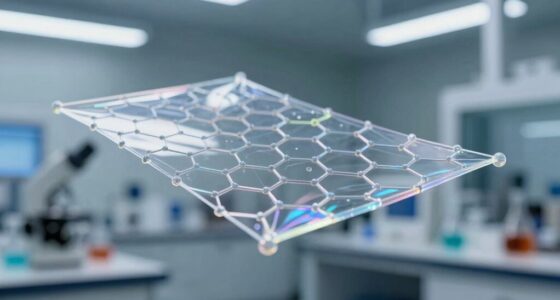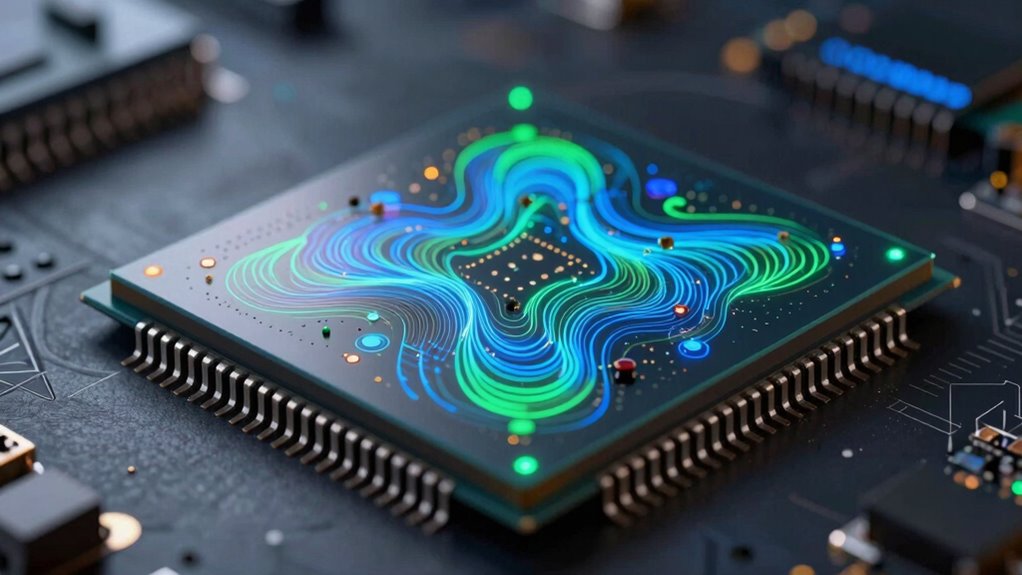

Spintronics uses electron spin to create devices that are faster, more energy-efficient, and capable of quantum operations, potentially replacing traditional electronics. By harnessing spin-based phenomena like GMR and spin-transfer torque, it enables new architectures such as spin transistors and quantum spin qubits. Overcoming challenges in material stability, spin injection, and coherence is key to commercial success. Exploring this technology further reveals how it might transform computing, data storage, and sensing in the future.

Get the latest gadgets delivered free — and shop member deals
- Fast, free delivery on millions of items
- Access to Prime Big Deal Days deals on October 6–7
- Prime Video, Amazon Music and more included
Key Takeaways
- Spintronics leverages electron spin, enabling faster, more energy-efficient data processing than traditional charge-based electronics.
- It offers nonvolatile memory and logic devices with higher density and lower power consumption, potentially replacing conventional electronics.
- Spin-based devices utilize quantum phenomena like spin–orbit coupling and topological states for advanced computational functionalities.
- Overcoming material and fabrication challenges is critical for scalable, room-temperature spintronic technologies to replace standard electronics.
- Spintronics could revolutionize electronics by integrating quantum properties, leading to ultra-fast, low-power, and highly sensitive computing systems.
As an affiliate, we earn on qualifying purchases.
Fundamentals of Electron Spin and Its Role in Future Technologies

Electron spin is a fundamental quantum property that gives each electron an intrinsic magnetic moment, enabling it to act like a tiny magnet. This magnetic moment allows spins to carry information beyond just electric charge, opening new possibilities for data storage and processing. Instead of relying solely on charge flow, you can manipulate spin states to transmit information more efficiently. Spin polarization and spin currents enable the transfer of data through spin orientation, reducing energy consumption and increasing speed. The stability of spin states, known as spin coherence time, determines how long information can be retained. Understanding these properties forms the foundation for developing advanced spintronic devices, which could revolutionize electronics by merging quantum physics with practical technology. Additionally, research into high-contrast materials can help optimize the detection and manipulation of spin states, further advancing the field, and exploring material properties is crucial for improving device performance and reliability. Moreover, ongoing studies into temperature effects are essential for enhancing the practical application of spintronics in everyday environments. New developments in material engineering are also helping to extend the longevity and robustness of spin-based components, making them more suitable for real-world applications. Furthermore, ongoing research into spin coherence time is vital for increasing the stability and reliability of spintronic systems over longer periods.
Spin transistors for electronics
As an affiliate, we earn on qualifying purchases.
As an affiliate, we earn on qualifying purchases.
Milestones in Commercial Spintronic Devices and Market Adoption
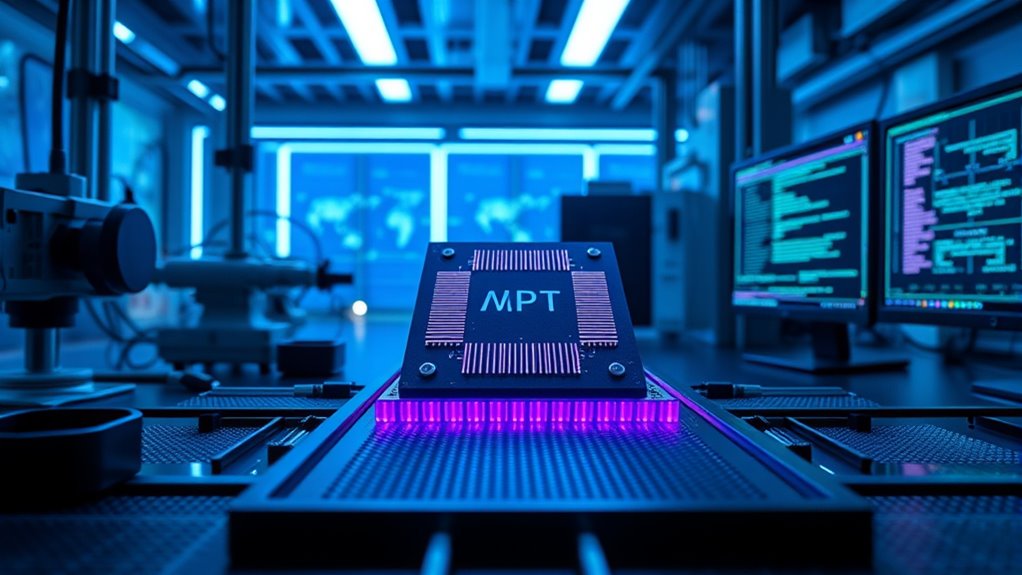
You’ve seen how GMR technology revolutionized data storage with high-density read heads, marking a key milestone in commercial spintronics. Since then, MRAM has gained traction, offering fast and energy-efficient memory solutions across various markets. However, challenges like scalability and integration still slow widespread adoption, keeping market growth cautious. Sound healing science research continues to uncover innovative ways to harness electromagnetic frequencies for improved device functionality and health benefits. Additionally, ongoing advancements in natural pool design and eco-friendly landscaping techniques could influence sustainable practices in backyard transformation. Furthermore, ongoing research into spintronic materials aims to address current limitations and accelerate market adoption of these promising technologies, highlighting the importance of materials engineering in advancing the field. The development of scalable fabrication techniques is crucial for overcoming manufacturing hurdles and enabling broader commercial deployment.
GMR Technology Breakthroughs
The development of giant magnetoresistance (GMR) technology marked a pivotal milestone in commercial spintronics, transforming how magnetic data storage and sensing are performed. You should know that GMR’s breakthrough enabled high-density, fast, and reliable hard-disk read heads, revolutionizing data storage. Its impact is evident through:
- The 2007 Nobel Prize awarded for discovering GMR, recognizing its significance.
- The widespread adoption of GMR-based read heads in hard drives, vastly increasing capacity.
- The integration of GMR sensors in automotive and industrial applications, enhancing precision and reliability.
- Regular advancements in spintronic materials continue to expand GMR’s applications and performance capabilities. These innovations are driven by ongoing research into magnetic multilayers, which are fundamental to GMR functionality.
- The ongoing development of manufacturing techniques ensures that GMR technology remains scalable and cost-effective for commercial use. Additionally, improvements in fabrication processes are further supporting the commercial viability of large-scale GMR applications. Advances in quality control are also helping ensure consistency and performance in mass-produced devices.
These milestones helped establish spintronics as a practical technology, paving the way for advanced memory and sensor devices. GMR’s success set the stage for future innovations, demonstrating spintronics’ commercial viability.
MRAM Deployment Growth
Recent years have seen rapid growth in MRAM deployment, driven by its advantages of nonvolatility, fast switching speeds, and low power consumption. Major tech companies and memory manufacturers have increasingly adopted MRAM for diverse applications, from cache memory in data centers to automotive sensors. The technology’s ability to replace traditional DRAM and flash in certain niches accelerates market penetration. Industry milestones include the launch of high-density, CMOS-compatible MRAM chips and the integration of MRAM into consumer electronics and industrial systems. As manufacturing processes improve and costs decrease, MRAM’s market share continues to expand. These milestones demonstrate MRAM’s proven reliability and performance, fueling confidence in its potential to become a mainstream nonvolatile memory solution. The deployment growth marks a significant step toward widespread commercialization. Additionally, advancements in body jewelry materials and measurements ensure better compatibility and durability for various applications.
Market Adoption Challenges
Despite significant technological advancements, commercial spintronic devices still face hurdles in widespread adoption, primarily due to inconsistent performance metrics and manufacturing challenges. To overcome these barriers, focus on:
- Improving spin injection efficiency and achieving stable, high spin polarization at room temperature, essential for reliable device operation.
- Scaling fabrication processes for complex heterostructures and 2D materials, ensuring reproducibility and cost-effectiveness across wafer-scale production.
- Standardizing key performance metrics like switching energy, endurance, and read/write speed, enabling fair comparisons and industry confidence.
Addressing these issues requires collaboration between researchers and manufacturers, along with investment in advanced fabrication techniques. Only then can spintronics realize its potential to transform mainstream electronics.
As an affiliate, we earn on qualifying purchases.
Emerging Spin-Based Architectures and Their Potential Advantages

Emerging spin-based architectures promise to revolutionize computing by leveraging unique quantum properties of electron spin to achieve faster, more energy-efficient, and highly scalable devices. You can harness spin transistors that modulate current through spin injection and manipulation, reducing power consumption compared to charge-based transistors. Spin–orbit torque (SOT) and spin-transfer torque (STT) memories enable rapid, non-volatile data storage with electrical write/read capabilities. Topological insulators and 2D materials exploit strong spin–momentum locking for efficient spin generation and control. Magnon logic uses wave-based spin excitations for low-dissipation computation and interconnects. These architectures, combined with advanced materials like TMDs and Heusler alloys, could lead to ultra-dense, high-speed, and energy-efficient devices, pushing beyond limitations of current electronics. Additionally, quantum coherence plays a vital role in enhancing the performance of spintronic systems by maintaining spin states over longer durations, which is crucial for scalable quantum devices and future quantum computing technologies.
As an affiliate, we earn on qualifying purchases.
Quantum Computing: Exploiting Spin Qubits for Robust Information Processing
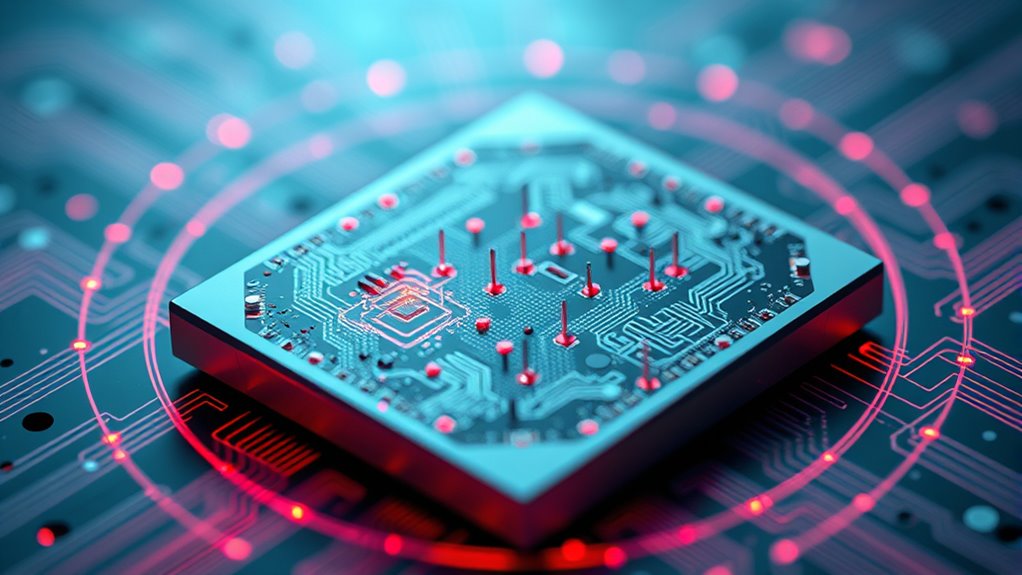
You can harness spin qubits for quantum computing because their coherence times are vital for reliable operations. Electrical control of spins enables fast, precise manipulation without complex magnetic setups. Improving coherence and control methods is key to making spin-based quantum processors practical and scalable.
Spin Qubit Coherence
Have you ever wondered why spin qubits are considered so promising for quantum computing? Their coherence time, or how long they retain quantum information, is vital. Longer coherence means more reliable computations. Here’s why it matters:
- Stability of Quantum States: Extended coherence reduces errors during operations, increasing fidelity.
- Scalability: Longer coherence times simplify error correction, enabling larger qubit systems.
- Material Advances: Research into materials like silicon and TMDs aims to minimize decoherence sources such as hyperfine interactions and spin-orbit coupling.
Achieving longer coherence times involves controlling environmental influences and material purity. Without this, spin qubits can lose their quantum information quickly, limiting practical quantum computing. Improving spin qubit coherence is essential for building robust, scalable quantum processors.
Electrical Spin Control
Electrical control of spin qubits has become a focal point in quantum computing research because it enables precise manipulation of quantum states without relying on magnetic fields. By applying electric fields, you can exploit spin–orbit coupling to rotate spins quickly and efficiently. Techniques like electric-dipole spin resonance (EDSR) allow you to switch between spin states using gate voltages, making the process more scalable and compatible with existing electronics. This electrical approach reduces device complexity and power consumption, essential for building large-scale quantum processors. Advances in material engineering, such as topological insulators and 2D materials, enhance the strength and speed of electrical spin control. Additionally, **material engineering** plays a crucial role in optimizing the properties of spin qubits for faster and more reliable operation. By mastering these techniques, you move closer to integrating robust, fast, and scalable spin qubits into practical quantum computing systems.
Advanced Materials Driving Next-Generation Spintronic Functionality
Advances in materials are pivotal to unblocking the full potential of next-generation spintronic devices. New materials enable improved spin injection, longer coherence, and efficient spin control. Here are three key developments:
- Topological insulators and 2D materials leverage spin–momentum locking for robust, low-dissipation spin currents. These materials are also notable for their unique electronic properties, which facilitate more efficient device operations. Enhanced material stability is crucial for practical applications and device longevity. Moreover, ongoing research aims to discover novel materials with superior performance to further enhance device capabilities.
- Heusler alloys and dilute magnetic semiconductors offer tunable spin polarization and high-temperature stability.
- Transition-metal dichalcogenides and layered magnets reduce dimensionality, enhancing spin–orbit effects and enabling efficient electrical manipulation. Additionally, emerging connected equipment in spintronics facilitates better integration and control of these materials within device architectures. These materials are transforming device architectures, making spintronic components more reliable, scalable, and energy-efficient. As research pushes boundaries, these advanced materials are essential for realizing practical spin-based electronics and quantum technologies, opening pathways to faster, smarter, and more sustainable devices. One significant challenge is material stability, which impacts device longevity and performance in real-world applications.
Overcoming Technical Challenges in Spin Injection, Coherence, and Integration
Overcoming the key technical hurdles in spin injection, coherence, and integration is essential for revealing the full potential of spintronic devices. Achieving efficient spin injection at room temperature remains a challenge due to impedance mismatches between ferromagnetic contacts and non-magnetic materials. Maintaining long spin coherence times is critical for quantum applications but is hampered by spin relaxation mechanisms like Elliott–Yafet and Dyakonov–Perel. Integrating spintronic components with existing CMOS technology requires scalable fabrication methods and minimizing stray magnetic fields that can disrupt device operation. Developing materials with high spin polarization and robust spin transport properties, alongside advanced interface engineering, helps address these issues. These efforts are crucial to unbolt reliable, energy-efficient, and high-density spin-based electronics for future technology.
Spintronic Sensors and Their Applications in High-Precision Measurement

Have you ever wondered how spintronic sensors achieve such remarkable sensitivity in detecting magnetic fields? These sensors rely on quantum spin properties to measure tiny magnetic variations with precision. Here’s how they excel:
- Giant Magnetoresistance (GMR): Changes in magnetic alignment alter electrical resistance, enabling detection of minute fields.
- Magnetic Tunnel Junctions (MTJs): Sensitive to magnetic orientation, providing high signal-to-noise ratios for precise measurements.
- Spin-Transfer Torque (STT): Facilitates electrical control and readout, improving responsiveness and energy efficiency.
These features make spintronic sensors ideal for applications like medical imaging, navigation, and industrial diagnostics. Their ability to detect weak magnetic signals with high accuracy surpasses traditional sensors, paving the way for breakthroughs in high-precision measurement technologies.
Pathways Toward CMOS-Compatible Spintronic Circuits and Systems

Integrating spintronic devices into conventional CMOS technology is essential for realizing scalable, energy-efficient circuits. To achieve this, you need to develop processes that enable efficient spin injection and detection compatible with CMOS fabrication steps. Using materials like topological insulators, 2D magnets, or Heusler alloys can improve spin current generation and control at room temperature. Layered heterostructures must be engineered for seamless integration, ensuring minimal interference with existing semiconductor components. Spin–orbit torque (SOT) and spin-transfer torque (STT) mechanisms can be harnessed for low-power switching within standard processes. Additionally, developing standardized metrics for performance and reliability will facilitate industry adoption. Overcoming material compatibility and fabrication challenges is key to embedding spintronic functionalities directly into CMOS chips and facilitating widespread implementation.
Future Outlook: Opportunities and Barriers in Replacing Conventional Electronics
Advancements in spintronics open exciting possibilities for transforming the way you design and use electronic devices. However, several hurdles remain before replacing conventional electronics becomes feasible.
Advances in spintronics promise revolutionary device innovations but face key technical challenges to become mainstream.
- Extending spin coherence times: You need longer spin lifetimes at practical temperatures to enable reliable quantum operations and classical logic.
- Achieving efficient spin injection and detection: The challenge is to generate high spin polarization at room temperature for practical device performance.
- Integrating with CMOS technology: Seamless, energy-efficient integration requires overcoming fabrication barriers and reducing stray magnetic fields.
Overcoming these barriers could *release* new opportunities in low-power electronics, quantum computing, and ultra-sensitive sensors. Still, addressing these technical challenges is *vital* for spintronics to realize its full potential as a mainstream technology.
Frequently Asked Questions
How Can Spintronics Achieve Room-Temperature Operation for Practical Devices?
You can achieve room-temperature spintronics by focusing on materials with high spin polarization, such as topological insulators, Heusler alloys, and 2D magnets that maintain robust spin properties at practical temperatures. Improving spin injection and detection efficiency, reducing spin relaxation, and engineering interfaces for better spin coherence are essential. Additionally, integrating these materials with CMOS technology and optimizing device architectures will help guarantee reliable, scalable, room-temperature operation for practical applications.
What Are the Main Barriers to Integrating Spintronic Components Into Existing CMOS Technology?
You face barriers like inefficient spin injection, making it hard to transfer spin signals seamlessly into CMOS. You struggle with maintaining high spin polarization at room temperature, risking signal loss. You encounter challenges in fabricating complex heterostructures reliably across wafers. You also deal with integrating magnetic components without disrupting existing circuits or causing stray fields. Finally, you need standardized metrics and scalable processes to guarantee spintronics fits smoothly into current chip manufacturing.
How Does Spin Coherence Time Compare Between Different Materials and Device Architectures?
You’ll find that spin coherence times vary considerably across materials and device architectures. For example, silicon quantum dots and diamond NV centers offer coherence times from milliseconds to seconds, ideal for quantum applications. In contrast, metallic systems like permalloy have much shorter coherence times, often nanoseconds, limiting their quantum utility. Choosing materials with longer coherence times is essential for reliable quantum operations and minimizing decoherence in device architectures.
What Strategies Are Being Developed to Scale up Spintronic Fabrication Processes?
Imagine building a vast, intricate city where each building must be perfectly placed. To scale up spintronic fabrication, you develop advanced techniques like wafer-scale epitaxy, ensuring uniform material growth. You also harness precision lithography and automation, reducing defects and increasing reproducibility. These strategies create a reliable blueprint for mass production, turning the dream of widespread spintronic devices into reality, much like constructing a thriving metropolis from tiny, carefully crafted bricks.
How Close Are Spintronic Technologies to Replacing Traditional Electronics in Consumer Products?
Spintronic technologies are making steady progress but aren’t ready to fully replace traditional electronics in consumer products yet. You’ll see spintronic components like MRAM in niche applications, but mainstream adoption requires overcoming challenges like longer spin coherence times, efficient room-temperature spin injection, and scalable fabrication. As research advances, expect gradual integration into high-performance, low-power devices, paving the way for broader use in the next decade.
Conclusion
As you explore the evolving landscape of spintronics, it’s clear this quantum tech holds the potential to revolutionize electronics beyond the age of the transistor. With ongoing breakthroughs and overcoming key hurdles, you’ll see devices that are faster, more efficient, and more versatile. Like an ancient mariner steering uncharted waters, you’ll be at the forefront of this transformative journey—pioneering a future where spin-based systems redefine how we process and sense information.
Fall Picks
fall essentials
As an affiliate, we earn on qualifying purchases.