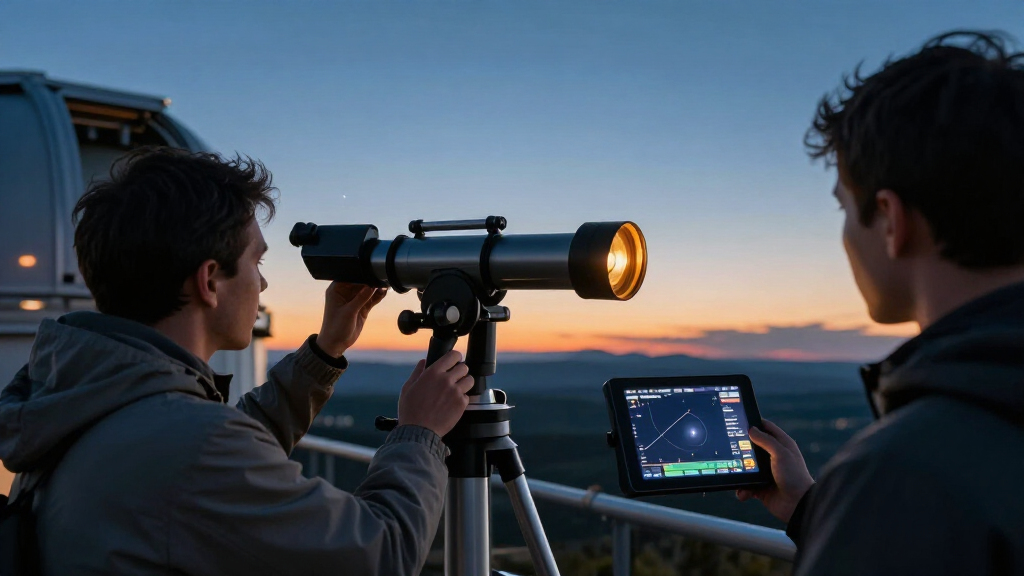

🔍 Read the full analysis: How To Capture The Held-Light Look Of “OORT — Comet Vigil For P/2043 K1 Vesper” on ThorstenMeyerAI.com

Get the latest gadgets delivered free with Prime
- Fast, free delivery on millions of items
- Prime Video, Amazon Music and more included
- Member-only deals all year
TL;DR
OORT — Comet Vigil for P/2043 K1 Vesper is an AI-built web artwork about a fictional comet and observatory. Its star trails accumulate during a visit, while scrolling changes an orbital illustration; the page presents these interactions as an artistic study of waiting, not as real astronomical observation.
OORT — Comet Vigil for P/2043 K1 Vesper is an AI-built web artwork that turns time spent on a page into part of its visual composition, as explored in the original analysis. The fictional observatory follows a fictional comet, with star trails that lengthen during a visit and an orbital diagram that changes as readers scroll.
The artwork’s central effect is a field of stars drawn on a canvas around a point below the visible screen. As time passes, the stars trace curved, lengthening arcs. The description says the field uses a repeatable seed on the visitor’s device, while local storage preserves elapsed time so the same local sky can resume when someone returns. The page pauses its animation when hidden and offers a still version for people who have enabled reduced motion.
A separate instrument uses scrolling to move the imagined comet along an inline SVG path. The ion tail points away from the sun, while the dust tail curves along the fictional orbit. Both paths share a progress value, linking the drawing to displayed distance and year. A range control adjusts a defocused view and its associated brightness estimate.
Visitors can also hold a control briefly to open a simulated shutter. The site records a timestamp, but it does not claim to show a real comet image: the comet remains unseen in the artwork’s fiction. The page is presented as an exhibition piece, accompanied by a design guide and the original art-direction brief.
A guide to the held-light effect
How to Capture the Held-Light Look of “OORT — Comet Vigil for P/2043 K1 Vesper”
OORT turns a visit into an exposure: star trails gather over time, while scrolling moves a fictional comet through an imagined orbit. The result is an artwork about waiting, not an astronomical observation.
P/2043 K1 Vesper and its observatory belong to the exhibition’s invented setting.
Elapsed time gives the canvas trails room to lengthen and accumulate.
The simulated shutter records a timestamp; the comet remains unseen.
01 / How the effect works
Waiting becomes the artwork
Duration is not a delay before the main event. It is the material the page uses to compose its observatory scene.
Trails that lengthen
A field of stars traces curved arcs around a point below the visible screen. As a visit continues, those arcs grow, making time visible.
A local sky that returns
The description says a repeatable seed shapes the visitor’s local star field, while local storage preserves elapsed time for a later return on the same device.
Motion with a pause
The animation pauses when the page is hidden and offers a still version for visitors who enable reduced motion.
02 / Scroll-linked instrument
One progress value, two tails
Scrolling advances the imagined comet along an inline SVG path, tying the illustration to displayed distance and year.
Geometry carries the story
The ion tail points away from the sun. The dust tail curves along the fictional orbit. Both paths respond to the same scroll progress, so the drawing and its readouts move together.
A range control adjusts a defocused view and its associated brightness estimate. These instrument-like controls strengthen the observatory fiction without turning it into real measurement.
03 / The visit as exposure
Follow the held-light sequence
Each interaction gives the visitor a role in the room’s fictional observing ritual.
Enter the room
A seeded local sky establishes the field of stars.
Stay and watch
Trails lengthen as elapsed visit time accumulates.
Scroll the orbit
The comet and its tail geometry move along the illustration.
Hold the shutter
A simulated capture marks attention with a timestamp.
“The page makes duration part of the artwork instead of treating it as time spent before the content.”
Exhibition description“The comet remains unseen and in transit.”
Exhibition description“Your visit is the exposure; leave for the guide and return, your trails remain.”
Art-direction brief04 / Fiction and fact
Know what the room is claiming
The astronomy cues shape the atmosphere. They do not establish real comet data or a verified observing history.
P/2043 K1 Vesper
The comet, observatory, decades-long vigil, “last seen 1608” story, amateur logs and approach toward perihelion are elements of the invented setting.
No verified observation
The designation, orbit details, observing history and brightness values should not be treated as real measurements or an astronomical forecast.
05 / What the brief does not verify
Design intent is not an audit
The supplied material describes intended behavior and points to a live room and guide. It does not independently confirm performance across devices, verify every feature, or establish whether stored timing works across browsers or devices. It describes persistence on the same local device. No publication date, visitor count, outside review, or later milestone is specified.
- Canvas drawing and persistent local state are described as part of the experience.
- Scroll-linked SVG geometry connects comet position with displayed distance and year.
- The build brief specifies pure HTML, CSS and JavaScript, with no frameworks, external requests or image assets; those remain brief specifications here.
- The supplied brief credits the FABLE/175 pipeline and Claude Fable 5 as art director, and calls OORT room 170 of 175.
06 / Key questions
Read the room clearly
Keep the artwork’s interactive cues separate from claims about the night sky.
Is P/2043 K1 Vesper real?
No. The exhibition describes the comet, observatory and observing history as fictional.
What does “held light” mean?
It refers to canvas star trails that grow with elapsed time. The seeded local sky is described as able to resume after a return on the same device.
Does the shutter reveal a comet image?
No. It simulates a shutter and records a timestamp; the comet remains unseen in the artwork.
Where are the build notes?
The source points to a design guide linked from the room and an original art-direction brief available through a “Prompt” link in the footer.
How Waiting Becomes the Artwork
OORT’s design makes a familiar interface behavior—remaining on a page—serve as its subject. Instead of presenting duration as time spent before the main content, it makes that duration visible through accumulating trails. Returning to the site becomes part of the work’s structure, since the stored elapsed time lets the local scene continue.
The distinction between fiction and observation matters. The site borrows visual cues from astronomy, including coordinates, instrument controls and orbital geometry, but its comet and observatory are invented. Its shutter interaction records attention rather than offering evidence of a sighting. That framing lets the project explore how code can represent patience without implying that it supplies live astronomical data.
For readers interested in creative coding, the room also presents a compact example of several techniques working together: canvas drawing, persistent local state, scroll-linked SVG geometry, accessibility settings and visibility-aware animation. The source describes the intended behavior, but does not provide independent performance testing or a technical audit.
As an affiliate, we earn on qualifying purchases.
The Fiction Behind P/2043 K1
The room identifies P/2043 K1 Vesper as fictional, as well as the observatory and its decades-long vigil. The brief supplies story details such as a claimed “last seen 1608,” imagined amateur logs and an approach toward perihelion. These are elements of the artwork’s invented setting, not verified comet history or an astronomical forecast.
The supplied brief says the work was created through the FABLE/175 pipeline and credits Claude Fable 5 as art director. It calls OORT room 170 of 175 and says the prompt is available through a link in the room’s footer. The requested build is described as pure HTML, CSS and JavaScript, without frameworks, external requests or image assets; those are specifications in the brief, rather than independently verified implementation details here.
“The page makes duration part of the artwork instead of treating it as time spent before the content.”
— The OORT exhibition description
LED light strips for gaming and ambiance
As an affiliate, we earn on qualifying purchases.
As an affiliate, we earn on qualifying purchases.
What the Brief Does Not Verify
The supplied material describes the site’s intended behavior and links to a live room, but it does not independently verify how the current version performs across devices or whether every requested feature works as specified. It also gives no publication date, visitor numbers or outside review of the project.
The comet’s designation, orbital details, observing history and brightness values belong to a fictional scenario. Readers should not treat the ephemeris-style material or shutter record as real-world astronomical measurements. The source does not establish whether the live page’s stored timing persists across browsers or devices; it describes persistence for the same local device.
As an affiliate, we earn on qualifying purchases.
Visit the Room and Guide
The source directs readers to the live OORT room and its design guide, which explains the seeded exposure, SVG orbit, palette and typography. Visitors can observe how the sky changes during a session and test the page’s scroll and shutter interactions, while keeping in mind that the subject is fictional.
The brief also points to the wider collection of 175 AI-built exhibition rooms. No further release, update or development milestone for OORT is specified in the supplied material.
scrolling comet animation projector
As an affiliate, we earn on qualifying purchases.
As an affiliate, we earn on qualifying purchases.
Key Questions
Is P/2043 K1 Vesper a real comet?
No. The exhibition describes P/2043 K1 Vesper as fictional, along with its observatory and observing history.
What does “held light” mean in OORT?
It describes the canvas effect in which star trails grow with elapsed time. The site also says the seeded local sky can resume after a visitor returns on the same device.
Does the shutter reveal an image of the comet?
No. Holding the control opens a simulated shutter and records a timestamp, but the artwork says the comet remains unseen.
How does scrolling change the comet illustration?
Scroll progress moves the comet through an inline SVG. The description says its ion tail points away from the sun and its dust tail bends along the imagined orbit, with both changing alongside the displayed distance and year.
Where can readers see the build notes?
The source points to a design guide linked from the room, as well as the original art-direction brief exposed through a “Prompt” link in the footer.
Source: ThorstenMeyerAI.com
Halloween Picks
halloween
As an affiliate, we earn on qualifying purchases.