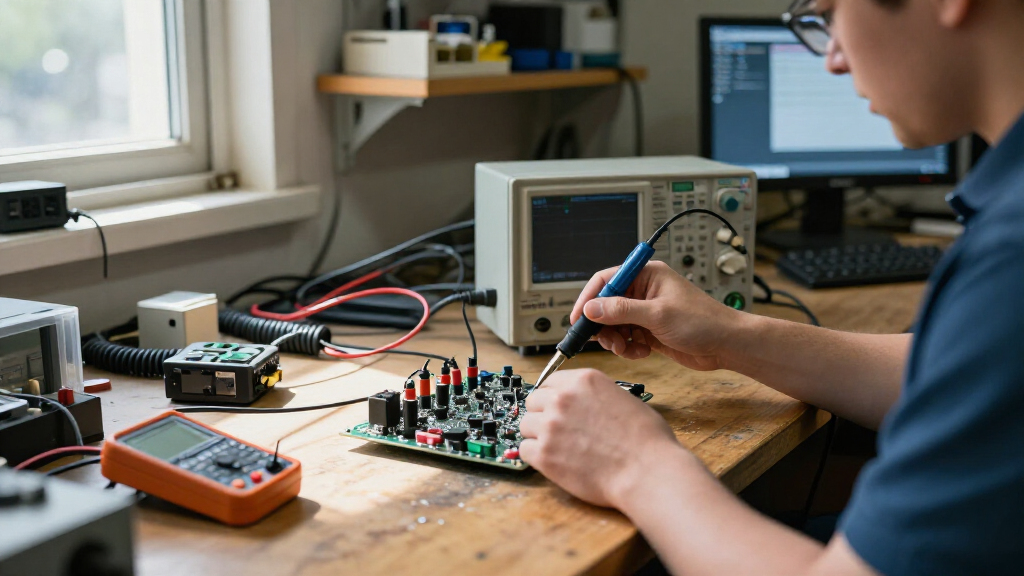
Choosing the best electronics instrumentation equipment requires balancing precision with portability. My top recommendation for general electrical work is the Fluke 17B+, which offers industry-standard safety and reliability for AC/DC voltage and resistance testing. For hobbyists and engineers needing deep component analysis, the FNIRSI LCR-P1 provides exceptional value in identifying transistors and measuring inductance. Meanwhile, the EspoTek Labrador stands out as a versatile, open-source solution for those who prefer software-driven diagnostics over bulky hardware. The main tradeoff in this category is between dedicated, rugged benchtop units and multifunction handheld devices that sacrifice some accuracy for convenience. Continue reading to see which tool fits your specific workflow and budget constraints.

Get the latest gadgets delivered free with Prime
- Fast, free delivery on millions of items
- Prime Video, Amazon Music and more included
- Member-only deals all year
Complete the kit



Key Takeaways
- Dedicated safety certifications (like CAT ratings) separate professional-grade multimeters like the Fluke 117 from consumer-grade handhelds.
- Multifunction handheld oscilloscopes offer convenience for field troubleshooting but lack the bandwidth and stability of benchtop units like the Rigol DM3058E.
- Open-source tools like the EspoTek Labrador provide unmatched flexibility for developers but require technical setup knowledge.
- Component testers such as the FNIRSI LCR-P1 are superior for component identification but cannot replace a full-featured multimeter for circuit diagnostics.
- Build quality and display readability are critical differentiators; industrial units prioritize screen visibility in bright environments, while hobbyist kits often do not.
| Fluke 17B+ Digital Multimeter |  | Best General Purpose Multimeter | Max Voltage: 1000V AC/DC | Max Current: 10A | Temperature Range: Up to 400°C | VIEW LATEST PRICE | See Our Full Breakdown |
| FNIRSI LCR-P1 Transistor Tester and LCR Meter |  | Best Component Tester | Measurement Types: LCR, ESR, Transistor, Diode, Battery | Display Size: 1.44 inch | Interface: USB Type-C | VIEW LATEST PRICE | See Our Full Breakdown |
| EspoTek Labrador: USB Oscilloscope and Lab Kit |  | Best for Students and Makers | Oscilloscope Channels: 2 Channel | Sample Rate: 750ksps | Waveform Generator: 1MSPS per channel | VIEW LATEST PRICE | See Our Full Breakdown |
| Rigol DM3058E 5.5-Digit Bench Digital Multimeter |  | Best Benchtop Precision | Resolution: 5.5 digits | DC Voltage Accuracy: 0.015% basic | Connectivity: USB, LAN, RS-232 | VIEW LATEST PRICE | See Our Full Breakdown |
| Fluke 117 True-RMS Digital Multimeter |  | Best for Electricians | Max Voltage: 600 V | Battery Life: 400 hours (no backlight) | Operating Temperature: -10°C to +50°C | VIEW LATEST PRICE | See Our Full Breakdown |
| Fluke 117/323 Multimeter & Clamp Meter Kit |  | Best Professional Combo Kit | Multimeter Model: Fluke 117 | Clamp Meter Model: Fluke 323 | Max AC Current: 400 A | VIEW LATEST PRICE | See Our Full Breakdown |
| Korg Nu:Tekt NTS-2 DIY Oscilloscope Kit |  | Best for Synthesis and Audio Enthusiasts | Channels: 4 | Assembly: DIY; no soldering required | Functions: Oscilloscope, waveform generator, spectrum analyzer, tuner | VIEW LATEST PRICE | See Our Full Breakdown |
| FNIRSI LC1020E 100 kHz LCR Meter with 2.8-Inch Color TFT Display | 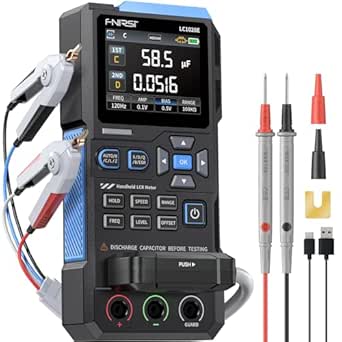 | Best Component Testing Tool | Measurement types: Capacitance, resistance, inductance | Test frequencies: 100 Hz, 120 Hz, 1 kHz, 10 kHz, 100 kHz | Display count: 19,999 counts | VIEW LATEST PRICE | See Our Full Breakdown |
| FNIRSI 2D15P 100 MHz 3-in-1 Oscilloscope, Multimeter, and DDS Signal Generator |  | Best All-in-One Portable Lab | Oscilloscope Bandwidth: 100 MHz | Sampling Rate: 500 MS/s | Multimeter Count: 19,999-count TRMS | VIEW LATEST PRICE | See Our Full Breakdown |
| FNIRSI 2C53T 3-in-1 50MHz 2CH Oscilloscope Multimeter DDS Signal Generator |  | Best Budget Starter Kit | Oscilloscope Bandwidth: 50 MHz | Sampling Rate: 250 MSa/s | Multimeter Count: 19,999 Counts | VIEW LATEST PRICE | See Our Full Breakdown |
| FNIRSI DSO152 Handheld Oscilloscope |  | Best Ultra-Compact Entry Point | Bandwidth: 200 kHz | Sampling Rate: 2.5 MS/s | Display: 2.8″ HD LCD (320×240 resolution) | VIEW LATEST PRICE | See Our Full Breakdown |
| Hantek DSO2D15 Digital Storage Oscilloscope, 150MHz Bandwidth, 2 Channels |  | Best Benchtop Value | Bandwidth: 150MHz | Channels: 2 | Sample Rate: 1GSa/s | VIEW LATEST PRICE | See Our Full Breakdown |
| IMARS HO-3S Dual-Channel Handheld Oscilloscope, Multimeter, and Signal Generator |  | Best Portable All-in-One | Oscilloscope bandwidth: 70 MHz | Sampling rate: 200 MS/s | Channels: 2 | VIEW LATEST PRICE | See Our Full Breakdown |
| electronics instrumentation equipment | Weight |
|---|---|
| Fluke 17B+ Digital Multimeter | 470 g |
| FNIRSI LCR-P1 Transistor Teste | 2.72 ounces |
| EspoTek Labrador: USB Oscillos | 20 g |
| Rigol DM3058E 5.5-Digit Bench | 2.93 kg |
| Fluke 117 True-RMS Digital Mul | 689 g |
| Fluke 117/323 Multimeter & Cla | — |
| Korg Nu:Tekt NTS-2 DIY Oscillo | 130 g |
| FNIRSI LC1020E 100 kHz LCR Met | — |
| FNIRSI 2D15P 100 MHz 3-in-1 Os | — |
| FNIRSI 2C53T 3-in-1 50MHz 2CH | — |
| FNIRSI DSO152 Handheld Oscillo | 3.53 ounces |
| Hantek DSO2D15 Digital Storage | — |
| IMARS HO-3S Dual-Channel Handh | 7.8 oz |
More Details on Our Top Picks
Fluke 17B+ Digital Multimeter
This model stands out as a reliable workhorse for general electrical troubleshooting. Unlike the specialized component testers in this lineup, the Fluke 17B+ covers the core measurements that define daily field work: voltage, current, and resistance. Its CAT III 600V safety rating provides peace of mind when working on residential or commercial circuits, a feature often missing in cheaper hobbyist meters. While it lacks the benchtop precision of the Rigol DM3058E, it offers unmatched portability and ruggedness for technicians on the move. The inclusion of temperature measurement via a thermocouple adds utility for HVAC technicians, though the non-True-RMS capability means it may struggle with noisy power supplies compared to the Fluke 117.
Pros:- CAT III 600V safety rating for residential and commercial work
- Rugged design with one-handed operation
- Includes temperature measurement capability
- Wide range of basic electrical measurements
Cons:- Average Response Time (Arms) rather than True-RMS
- No non-contact voltage detection
- Lacks advanced connectivity options for data logging
Best for: Electricians and facility maintenance technicians who need a durable, safe, and versatile meter for everyday troubleshooting.
Not ideal for: Electronics engineers needing high precision or True-RMS accuracy for non-linear loads.
- Max Voltage:1000V AC/DC
- Max Current:10A
- Temperature Range:Up to 400°C
- Weight:470 g
- Dimensions:8.46 x 2.76 x 5.91 inches
Our verdict“This pick makes the most sense for professionals who prioritize safety and durability over advanced digital features.”
FNIRSI LCR-P1 Transistor Tester and LCR Meter
The FNIRSI LCR-P1 serves a distinct niche: automated component identification. While the Fluke 17B+ requires manual range selection, this device automatically detects pinouts and parameters for transistors, diodes, and capacitors, drastically reducing identification time. It is an indispensable tool for hobbyists repairing boards with unmarked components. However, its utility is limited compared to full-featured multimeters like the Fluke 117, as it cannot measure live circuit voltages or currents. The small 1.44-inch screen can be cramped for detailed data reading, and the 40°C temperature limit restricts its use in hot environments. This is a specialist tool, not a primary meter.
Pros:- Automatic pinout and parameter identification
- USB-C charging and anti-burn protection
- Supports both SMD and through-hole components
- Includes IR remote decoding capabilities
Cons:- Cannot measure live circuit voltage or current
- Small display size limits data visibility
- Low maximum operating temperature
Best for: Electronics hobbyists and repair technicians who frequently encounter unmarked or unknown discrete components.
Not ideal for: Users who need to measure live AC/DC voltage or current in powered circuits.
- Measurement Types:LCR, ESR, Transistor, Diode, Battery
- Display Size:1.44 inch
- Interface:USB Type-C
- Weight:2.72 ounces
- Max Temperature:40 °C
- Dimensions:3.19 x 2.56 x 0.98 inches
Our verdict“This model is better suited to component-level repair than general electrical troubleshooting.”
EspoTek Labrador: USB Oscilloscope and Lab Kit
The EspoTek Labrador transforms a computer into a versatile electronics lab. Unlike standalone units like the FNIRSI 2D15P, this device relies on external software, which offers a larger, more flexible display for analyzing waveforms. It integrates an oscilloscope, signal generator, and power supply, making it an excellent entry point for students learning circuit design. The open-source nature allows users to modify and understand the underlying code, a feature absent in closed commercial tools. However, the 0.75W power supply limit is insufficient for driving larger loads, and the 750ksps sample rate is too slow for high-frequency RF work compared to dedicated benchtop scopes.
Pros:- All-in-one functionality (scope, generator, power supply)
- 100% open-source hardware and software
- Large display via connected device
- Low power consumption via USB
Cons:- Requires a connected PC or mobile device
- Limited power supply output (0.75W)
- Lower sample rate compared to dedicated scopes
Best for: Students, educators, and hobbyists learning electronics who need a multi-function tool connected to a PC.
Not ideal for: Professionals requiring high-speed signal analysis or portable, standalone operation.
- Oscilloscope Channels:2 Channel
- Sample Rate:750ksps
- Waveform Generator:1MSPS per channel
- Power Supply Output:4.5 to 15V, 0.75W max
- Logic Analyzer:2 Channel, 3MSPS
- Weight:20 g
Our verdict“This option stands out for its educational value and integration with existing computing devices.”
Rigol DM3058E 5.5-Digit Bench Digital Multimeter
When accuracy is the primary concern, the Rigol DM3058E outperforms handheld options like the Fluke 17B+ with its 5.5-digit resolution. This benchtop unit is designed for lab environments and production testing, where repeatability and remote control are vital. The dual display allows simultaneous viewing of two parameters, speeding up complex measurements. Connectivity via USB, LAN, and RS-232 enables integration with automated test systems, a capability completely lacking in portable meters. However, its corded power requirement and bulk make it unsuitable for field work. It is a precision instrument, not a troubleshooting tool.
Pros:- 5.5-digit resolution for high precision
- Remote control via USB, LAN, and RS-232
- Dual display for simultaneous measurements
- Stable benchtop form factor
Cons:- Requires AC power outlet
- Not portable or rugged for field use
- Larger footprint than handheld meters
Best for: Lab technicians and engineers who need high precision and automated data logging in a fixed workspace.
Not ideal for: Field technicians who need a portable, battery-operated device for on-site repairs.
- Resolution:5.5 digits
- DC Voltage Accuracy:0.015% basic
- Connectivity:USB, LAN, RS-232
- Display Type:Dual Display
- Weight:2.93 kg
- Power Source:Corded Electric
Our verdict“This model is better suited to controlled laboratory settings than dynamic field environments.”
Fluke 117 True-RMS Digital Multimeter
The Fluke 117 is engineered specifically for commercial electricians who need speed and safety. Its VoltAlert technology provides non-contact voltage detection, reducing the need to expose test leads unnecessarily. Unlike the Fluke 17B+, this model features True-RMS measurement, ensuring accurate readings on non-linear loads common in modern buildings. The Low Input Impedance (LoZ) mode actively prevents false readings from ghost voltages, a frequent issue in complex wiring systems. While it lacks the temperature measurement found in the 17B+, its specialized features for voltage troubleshooting make it a superior choice for electrical diagnostics in noisy environments.
Pros:- True-RMS accuracy for non-linear loads
- Non-contact VoltAlert voltage detection
- LoZ mode eliminates ghost voltage readings
- AutoVolt function simplifies operation
Cons:- No temperature measurement capability
- Limited to 600V max rating
- Backlight significantly reduces battery life
Best for: Electricians and building maintenance staff working on complex commercial wiring with potential ghost voltage issues.
Not ideal for: Electronics hobbyists who need component-level testing or temperature measurement.
- Max Voltage:600 V
- Battery Life:400 hours (no backlight)
- Operating Temperature:-10°C to +50°C
- Weight:689 g
- Dimensions:6.67 x 3.31 x 1.82 inches
- Warranty:3 years
Our verdict“This pick makes the most sense for professionals who prioritize accurate voltage detection in complex electrical systems.”
Fluke 117/323 Multimeter & Clamp Meter Kit
This kit stands out as the best professional combo for electricians who need reliable, high-safety tools without assembling separate units. The inclusion of the Fluke 117 provides True-RMS accuracy and VoltAlert, which significantly reduces the risk of false readings compared to standard multimeters. Unlike the standalone Fluke 17B+, this pair adds the Fluke 323 clamp meter, allowing for non-invasive current measurements up to 400 A. While the Fluke 117 lacks frequency and capacitance modes, its robust build and safety certifications make it superior for field work where durability is paramount. The carrying case ensures both units remain protected, a feature often missing in budget kits. This option is better suited to users who prioritize electrical safety and ruggedness over advanced electronic component testing features.
Pros:- True-RMS technology ensures accurate readings on non-linear loads.
- VoltAlert non-contact voltage detection enhances safety during live checks.
- Low input impedance prevents false readings from ghost voltage.
- Includes a durable C115 soft carrying case for protection.
Cons:- The Fluke 323 clamp meter cannot measure DC current.
- The Fluke 117 multimeter lacks capacitance and frequency measurement modes.
Best for: Licensed electricians and field technicians who require True-RMS accuracy and high-current clamp measurements in a portable, certified kit.
Not ideal for: Electronics hobbyists who need to measure capacitance, frequency, or DC current with the clamp, as this kit lacks those specific capabilities.
- Multimeter Model:Fluke 117
- Clamp Meter Model:Fluke 323
- Max AC Current:400 A
- Max Voltage:600 VAC/DC
- Power Source:Alkaline
- Warranty:2 years
Our verdict“Choose this kit if you need a rugged, safety-certified toolset for electrical troubleshooting rather than general electronics repair.”
Korg Nu:Tekt NTS-2 DIY Oscilloscope Kit
The Korg Nu:Tekt NTS-2 serves a unique niche for those interested in modular synthesis and audio signal analysis, distinguishing itself from general-purpose scopes like the FNIRSI 2D15P. This kit requires no soldering, making assembly accessible, yet it results in a four-channel oscilloscope tailored for control voltage and audio work. While it lacks the high-frequency bandwidth needed for digital electronics debugging, its integration of a waveform generator and spectrum analyzer is highly valuable for sound designers. Compared to the EspoTek Labrador, the Korg unit is self-contained and does not rely on a computer connection, offering greater portability for live setups. However, the compact aluminum body limits screen visibility, making it less ideal for detailed waveform analysis than larger benchtop or handheld units.
Pros:- No soldering required for assembly, making it beginner-friendly.
- Combines oscilloscope, waveform generator, and spectrum analyzer functions.
- Compact and portable design with a sturdy aluminum chassis.
- Stereo inputs and through outputs support studio and live signal paths.
Cons:- Requires initial assembly before it can be used.
- Small screen size limits the ability to view complex waveforms clearly.
Best for: Modular synthesists and audio engineers who need a portable, self-contained tool for analyzing CV and audio signals.
Not ideal for: Electronics students or repair technicians who need high-bandwidth measurement for digital circuits or microcontrollers.
- Channels:4
- Assembly:DIY; no soldering required
- Functions:Oscilloscope, waveform generator, spectrum analyzer, tuner
- Connectivity:Dual stereo IN, dual stereo THRU/OUT, two separate OUTPUTs
- Weight:130 g
- Warranty:1 year
Our verdict“This kit is the ideal choice for audio professionals who want a specialized, portable tool for signal monitoring and generation.”
FNIRSI LC1020E 100 kHz LCR Meter with 2.8-Inch Color TFT Display
For those focused on component-level diagnostics, the FNIRSI LC1020E offers capabilities that standard multimeters like the Fluke 117 simply cannot match. This battery-powered meter measures capacitance, resistance, and inductance across five frequencies, displaying primary and secondary parameters like ESR and Q factor simultaneously. The inclusion of Kelvin measurement connections ensures accuracy with low-resistance components, a significant advantage over two-terminal meters. While the FNIRSI 2D15P combines multiple tools, it lacks the specialized LCR depth of this unit. The 2.8-inch TFT display is clear and adjustable, though the device requires components to be fully discharged before testing, which adds a step to the workflow compared to in-circuit multimeter checks.
Pros:- Displays two measurement parameters simultaneously for deeper analysis.
- Supports component sorting with adjustable nominal values and tolerances.
- Offers open/short calibration and four-terminal Kelvin connections.
- USB-C charging and firmware updates provide modern convenience.
Cons:- Components must be fully discharged before measurement to avoid damage or errors.
- On-board components must be tested with the circuit powered off.
Best for: Electronics repair technicians and engineers who need precise LCR measurements and component sorting capabilities.
Not ideal for: General electricians who primarily measure voltage and current, as this device is too specialized for basic electrical work.
- Measurement types:Capacitance, resistance, inductance
- Test frequencies:100 Hz, 120 Hz, 1 kHz, 10 kHz, 100 kHz
- Display count:19,999 counts
- Capacitance range:1 pF–100 mF
- Connections:3-pin sockets and 5-slot jacks for four-terminal Kelvin measurements
- Battery capacity:3000 mAh
Our verdict“Select this meter if your work revolves around identifying and validating individual electronic components with high precision.”
FNIRSI 2D15P 100 MHz 3-in-1 Oscilloscope, Multimeter, and DDS Signal Generator
The FNIRSI 2D15P consolidates three essential tools into a single handheld unit, offering a 100 MHz oscilloscope, TRMS multimeter, and signal generator. This integration makes it far more versatile than the FNIRSI 2C53T, which offers lower bandwidth and fewer channels. The 4.3-inch IPS touchscreen provides a large, clear interface for waveform analysis, while the 500 MS/s sampling rate captures fast-changing signals effectively. Although it weighs 907 g, making it heavier than some competitors, the tradeoff is a robust build and extensive features like math functions and waveform export. It is a better choice than the Korg NTS-2 for general electronics debugging due to its higher bandwidth and broader measurement range.
Pros:- Combines oscilloscope, multimeter, and DDS signal generator in one unit.
- Offers waveform measurements, math functions, and waveform export.
- Rechargeable battery and USB-C charging support extended portable use.
- High sampling rate captures detailed waveform data.
Cons:- The oscilloscope bandwidth can be limited to 20 MHz when using the bandwidth-limit feature.
- The unit weighs 907 g, which is heavier than many handheld competitors.
Best for: Hobbyists and field engineers who need a comprehensive, portable toolkit for general electronics repair and signal generation.
Not ideal for: Users needing benchtop accuracy or high-current clamp measurements, as this unit focuses on voltage and low-current signals.
- Oscilloscope Bandwidth:100 MHz
- Sampling Rate:500 MS/s
- Multimeter Count:19,999-count TRMS
- Signal Generator Frequency:10 MHz
- Display:4.3-inch IPS touchscreen
- Battery Capacity:5,000 mAh
Our verdict“This device is the best value for users who want to replace multiple instruments with a single, capable portable unit.”
FNIRSI 2C53T 3-in-1 50MHz 2CH Oscilloscope Multimeter DDS Signal Generator
As an upgraded version of the 2C23T, the FNIRSI 2C53T provides an accessible entry point into oscilloscope usage, contrasting with the higher-end FNIRSI 2D15P. It combines a 50 MHz oscilloscope, multimeter, and signal generator, which is sufficient for most audio and low-frequency digital applications. The addition of math operations and persistence mode enhances its utility for analyzing complex signals. While the 2.8-inch LCD is smaller than the 2D15P’s touchscreen, it remains legible and portable. This unit is ideal for students and beginners who need core functionality without the higher cost and complexity of 100 MHz bandwidth. It lacks the advanced export features of its sibling but offers solid performance for basic troubleshooting.
Pros:- Combines oscilloscope, multimeter, and signal generator functions.
- Includes math operations, cursor measurement, and persistence mode.
- Compact and lightweight design with a long-lasting battery.
- Supports waveform image storage and export via Type-C.
Cons:- The 2.8-inch LCD screen is smaller than competitors, limiting visibility.
- 50 MHz bandwidth is lower than other options in the lineup.
Best for: Students, beginners, and hobbyists who need a compact, affordable tool for learning electronics and basic circuit debugging.
Not ideal for: Professionals working with high-speed digital circuits, as the 50 MHz bandwidth may miss fast signal transitions.
- Oscilloscope Bandwidth:50 MHz
- Sampling Rate:250 MSa/s
- Multimeter Count:19,999 Counts
- Signal Generator Frequency:50 kHz
- Display:2.8 inch LCD
- Battery Capacity:3000 mAh
Our verdict“This is the smart choice for newcomers who want a versatile, cost-effective instrument for learning and basic repairs.”
FNIRSI DSO152 Handheld Oscilloscope
This device stands out for its pocketable form factor, weighing just 3.5 ounces, making it far more portable than benchtop units like the Hantek DSO2D15. While it lacks the bandwidth for high-speed digital work, its 200kHz bandwidth is sufficient for automotive diagnostics and low-frequency analog circuits. The one-key auto configuration removes the intimidation factor for beginners who might struggle with complex trigger settings. However, the 2.8-inch screen feels cramped when analyzing detailed waveforms, forcing users to rely heavily on the automatic mode rather than manual tweaking. It serves as a dedicated signal viewer rather than a comprehensive analysis tool.
Pros:- Extremely lightweight and pocketable design
- Simple one-key auto-setup reduces learning curve
- USB-C charging adds convenience for modern workflows
Cons:- Limited 200kHz bandwidth restricts modern electronic applications
- Small display size hinders detailed waveform inspection
- Lower sampling rate compared to mid-range competitors
Best for: Automotive technicians and hobbyists needing a quick, throw-in-the-toolbag scope for checking sensor signals and low-frequency analog circuits.
Not ideal for: Engineers working with digital clocks, USB signals, or any application requiring bandwidth above 200kHz.
- Bandwidth:200 kHz
- Sampling Rate:2.5 MS/s
- Display:2.8″ HD LCD (320×240 resolution)
- Battery:1000 mAh Lithium Polymer (approx. 4 hours runtime)
- Connectivity:USB Type-C
- Dimensions:3.78 x 2.64 x 0.79 inches
- Weight:3.53 ounces
- Max Voltage (10x Probe):800 VPP (280 V AC)
Our verdict“Choose this if you prioritize extreme portability and basic signal verification over analytical depth.”
Hantek DSO2D15 Digital Storage Oscilloscope, 150MHz Bandwidth, 2 Channels
The Hantek DSO2D15 offers a significant leap in capability over handheld options like the IMARS HO-3S, providing 150MHz bandwidth and a 1GSa/s sample rate. This makes it suitable for debugging microcontrollers and medium-speed digital interfaces. The 8M memory depth allows for capturing long signal bursts without missing details, a feature absent in most portable scopes. However, it is a dedicated oscilloscope, meaning you still need a separate multimeter for general testing. The 2-channel limit can also feel restrictive when comparing multiple signals simultaneously, unlike 4-channel bench models.
Pros:- High 1GSa/s sample rate captures fast signal details
- Large 8M memory depth supports long capture times
- Includes built-in arbitrary waveform generator for testing
Cons:- Limited to 2 channels restricts complex multi-signal analysis
- Bulky form factor is not suitable for field mobility
- 150MHz bandwidth may miss very high-frequency RF signals
Best for: Students and electronics engineers who need a dedicated, high-resolution desktop scope for lab work and complex circuit debugging.
Not ideal for: Field technicians who need a multi-function tool or users requiring more than two simultaneous channels for complex bus analysis.
- Bandwidth:150MHz
- Channels:2
- Sample Rate:1GSa/s
- Memory Depth:8M
- Waveform Generator:1CH
- Trigger Modes:14 kinds
- Serial Protocol Triggers:5 kinds
- Product Dimensions:12.44 x 4.33 x 5.91 inches
Our verdict“This is the smart choice for static lab environments where signal fidelity matters more than portability.”
IMARS HO-3S Dual-Channel Handheld Oscilloscope, Multimeter, and Signal Generator
Unlike the single-function FNIRSI DSO152 or the benchtop Hantek DSO2D15, the IMARS HO-3S consolidates three essential tools into one handheld unit. It combines a 70 MHz oscilloscope with a 20,000-count True RMS multimeter and a signal generator. This integration saves space in a field kit and reduces the need to switch devices. The replaceable 18650 battery is a practical feature for long shifts, allowing quick swaps. However, the 2.4-inch display is smaller than the FNIRSI’s, and the 70 MHz bandwidth sits comfortably between basic and professional scopes, potentially leaving advanced users wanting more speed.
Pros:- Integrates scope, multimeter, and signal generator functions
- Replaceable 18650 battery allows for extended field use
- Strong safety features including dual fuse protection
Cons:- Smaller 2.4-inch screen limits simultaneous data visibility
- 70 MHz bandwidth is lower than dedicated mid-range scopes
- Battery runtime listed as up to 4 hours may vary under load
Best for: Field service technicians and maintenance engineers who need to switch between voltage checks and signal analysis rapidly without carrying multiple instruments.
Not ideal for: Users who require high-bandwidth oscilloscope performance or those who prefer dedicated, high-resolution displays for each function.
- Oscilloscope bandwidth:70 MHz
- Sampling rate:200 MS/s
- Channels:2
- Multimeter resolution:20,000 counts, True RMS
- Display:2.4-inch color TFT with 8-level adjustable backlight
- Battery:Replaceable 18650 lithium battery
- Safety standard:IEC 1010-1
- Weight:7.8 oz
Our verdict“Pick this if you value consolidating tools for fieldwork over having the highest performance in any single category.”
How We Picked
I evaluated these thirteen instruments based on four primary criteria: measurement accuracy, build durability, functional versatility, and user interface clarity. I prioritized devices that offer clear traceability in their specifications, ensuring that the stated bandwidth or voltage ratings reflect real-world performance rather than marketing fluff. Safety standards were a non-negotiable filter for multimeters intended for mains voltage work, eliminating uncertified devices from the top rankings.
Ranking logic favored reliability and long-term usability over raw feature counts. A device with fewer functions but superior stability and ease of use ranked higher than a feature-heavy unit with ambiguous specs. I also considered the ecosystem support, such as software compatibility for oscilloscopes and availability of replacement probes, to ensure these tools remain useful over several years of ownership.
Factors to Consider When Choosing Best Electronics Instrumentation Equipment
Selecting the right instrumentation depends heavily on your specific application environment and technical requirements. Here are the key factors to weigh before making a purchase.Accuracy vs. Resolution
It is common to confuse resolution with accuracy, but they are distinct concepts that impact your results differently. Resolution refers to the smallest change in input the device can display, while accuracy describes how close the measurement is to the true value. A high-resolution multimeter that displays six digits might still be inaccurate if its calibration drifts or its input offset is high. For calibration work or precise component matching, prioritize accuracy specifications over raw digit count. Conversely, for basic troubleshooting, a lower-accuracy device with sufficient resolution is often more cost-effective and easier to read.
Safety Ratings and Isolation
Never compromise on safety when measuring live circuits, especially those connected to mains power. Look for instruments rated for CAT III or CAT IV applications, which indicate the device can withstand transient voltage spikes. Cheaper handheld meters often lack proper internal isolation, posing a risk of arcing or electric shock during fault conditions. If you work with high-voltage systems, a certified professional meter like those from Fluke is a necessary investment. Hobbyist kits and uncertified tools should be restricted to low-voltage DC circuits to maintain personal safety.
Bandwidth and Sample Rate for Oscilloscopes
Oscilloscope performance is defined by its analog bandwidth and sample rate, which determine the highest frequency signal it can accurately capture. A rule of thumb is to choose an oscilloscope with a bandwidth at least three to five times the maximum frequency of the signals you intend to measure. Insufficient bandwidth results in attenuated signal amplitudes and rounded edges, leading to misinterpretation of waveforms. For digital logic analysis, a higher sample rate is often more critical than bandwidth to capture fast transitions and glitches. Match these specs to your most demanding project, not your average one.
Portability vs. Benchtop Stability
Decide whether your work occurs primarily in the field or at a fixed workstation. Handheld units offer convenience and battery operation but often suffer from smaller displays, limited bandwidth, and lower input impedance. Benchtop instruments provide superior stability, larger screens, and robust power supplies but require dedicated space and mains power. For field service technicians, a rugged handheld multimeter and compact oscilloscope are indispensable. For R&D engineers, the precision and connectivity of benchtop equipment outweigh the convenience of portability.
Software Integration and Data Logging
Modern instrumentation increasingly relies on software for analysis and reporting. Check if the device supports USB or Ethernet connectivity for transferring data to a computer. Some open-source tools, like the EspoTek Labrador, rely entirely on PC software, offering advanced visualization but requiring a connected laptop. Dedicated hardware units often have limited onboard memory but superior real-time display performance. Consider whether you need automated data logging for long-duration tests or if manual visual inspection meets your needs. This factor heavily influences workflow efficiency in complex debugging scenarios.
Frequently Asked Questions
What is the difference between a true-RMS multimeter and a standard average-responding multimeter?
A true-RMS multimeter calculates the root-mean-square value of a signal, providing accurate readings for non-sinusoidal waveforms like square waves or pulses. Standard average-responding meters assume the input is a pure sine wave and apply a fixed correction factor, leading to significant errors on distorted signals. If you work with variable frequency drives, switching power supplies, or digital circuits, a true-RMS meter is necessary for reliable data. For simple battery or resistive load testing, an average-responding meter is sufficient and typically cheaper.Can I use a multimeter as an oscilloscope for debugging fast digital signals?
No, a multimeter cannot replace an oscilloscope for debugging fast digital signals. Multimeters average measurements over time, meaning they display a steady voltage value rather than the rapid fluctuations that occur in digital data lines. An oscilloscope captures voltage changes over microseconds, allowing you to see timing issues, noise, and signal integrity problems. Using a multimeter on high-speed signals will only show you a misleading average voltage, hiding the actual behavior of the circuit.Are component testers like the FNIRSI LCR-P1 better than using a multimeter for identifying parts?
Yes, for component identification, dedicated testers like the FNIRSI LCR-P1 are far superior. They automatically determine the type of component (resistor, capacitor, inductor, diode, transistor) and measure specific parameters like beta gain or ESR without requiring you to know the part type in advance. A multimeter requires you to manually select the correct mode and often cannot identify complex semiconductors or measure inductance accurately. However, a multimeter is still needed for measuring voltage and current in a live circuit, which component testers cannot do.Why do some oscilloscopes have two channels while others have four?
The number of channels determines how many simultaneous signals you can view. Two-channel oscilloscopes are adequate for most basic debugging tasks, such as comparing input and output signals or checking clock and data lines. Four-channel models are necessary for analyzing complex digital buses, SPI/I2C protocols, or multi-phase power systems where you need to correlate four distinct signals simultaneously. If your work involves only analog audio or power supply ripple, two channels are sufficient and cost less.Is it worth buying a kit like the Korg Nu:Tekt NTS-2 instead of a pre-assembled oscilloscope?
Buying a kit is only worth it if your primary goal is learning about electronics assembly and circuit design. You will gain hands-on experience soldering and troubleshooting the instrument itself, but the final product will have limited bandwidth and functionality compared to a commercial unit. For professional diagnostics, a pre-assembled oscilloscope from a reputable brand offers calibrated accuracy, warranty support, and ruggedness that a DIY kit cannot match. Choose a kit for education, not for production-grade testing.Conclusion
Selecting the best electronics instrumentation equipment ultimately depends on matching the tool’s strengths to your specific professional needs. For professional electricians and field technicians, the Fluke 17B+ or Fluke 117 remains the best overall choice due to its safety certifications and durability. Hobbyists and students will find the FNIRSI LCR-P1 and EspoTek Labrador to be the best value options, offering extensive functionality at a fraction of the cost of industrial gear. For R&D engineers requiring precision, the Rigol DM3058E provides the accuracy and stability needed for calibration tasks. If you are just starting out and want a versatile, low-cost entry point, the FNIRSI 2D15P offers a good balance of oscilloscope and multimeter features without a steep learning curve. Evaluate your primary use case—whether it is safety, precision, or versatility—and choose the tool that aligns with that priority.