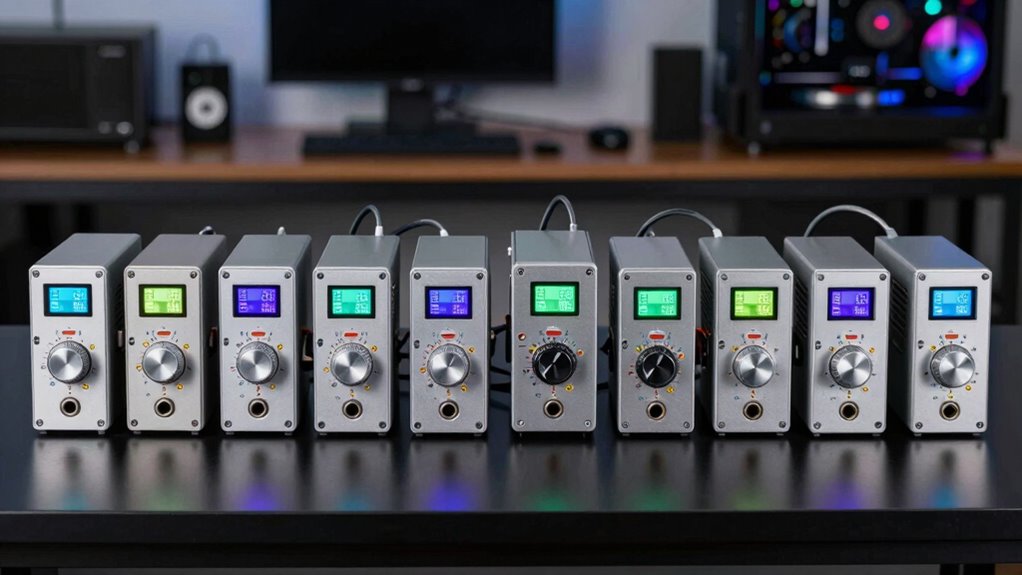

Bench power supplies differ mainly in voltage and current range, output stability, and how precisely you can dial in a setpoint — and those differences decide which model fits your bench. The Jesverty SPS-3010CII earns my best overall pick for its dual-output design that can run in series for 62 V or parallel for 20 A, covering scenarios single-channel units simply cannot. If you regularly work above 30 V, the HYELEC HY50-06A (0–50 V) and the Jesverty SPS-6005V (0–60 V with USB-C quick charge) give you headroom without a big price jump. The main tradeoff you’ll face in this category is coarse-versus-fine adjustment quality, display resolution, and whether USB charging ports are a convenience or a gimmick. Read on for the full breakdown of all 15 models and which one belongs on your workbench.

Get the latest gadgets delivered free with Prime
- Fast, free delivery on millions of items
- Prime Video, Amazon Music and more included
- Member-only deals all year
Complete the kit



Key Takeaways
- Jesverty dominates this lineup with six of the 15 spots, but its models are not interchangeable — the SPS-3010CII’s series/parallel dual output justifies its premium, while the base SPS-3010 is the better plain-value choice.
- Maximum voltage was the single biggest dividing line: nine of these supplies top out at 30–32 V, so anyone testing 48 V rails or higher-voltage circuits should narrow their shortlist to the HYELEC HY50-06A and the SPS-6005 family.
- Encoder-based coarse and fine adjustment (found on the SPS-3010C/3010V and the 30V 10A encoder model) matters more in daily use than raw wattage — preset-style button adjustment on cheaper units gets tedious fast.
- Built-in USB-A and USB-C quick-charge ports proved genuinely useful across the lineup for powering the device under test or charging tools, not just marketing filler — the SPS-6005V’s 20 W USB-C output is the standout.
- At the 30 V/10 A tier, the differences came down to display resolution and memory presets rather than power specs, which are nearly identical across NANKADF, NICE-POWER, WANPTEK, and Jesverty.


| bench power supplie | Output Voltage | Output Current | Display | Input Voltage |
|---|---|---|---|---|
| NANKADF Variable DC Bench Powe | — | — | 4-digit LED, 0.01 V / 0.001 A resolution | — |
| Jesverty SPS-3010C Variable DC | 0–32 V | 0–10 A | 4-digit LED, 0.01V / 0.001A resolution | 115V / 230V selectable |
| HYELEC HY50-06A Variable DC Po | 0–50 V | 0–6 A | — | 110V only |
| Jesverty SPS-6005V Variable DC | 0–60 V | 0–5 A | — | AC 115V / 230V selectable |
| FNIRSI DPS-150 DC Power Supply | 0–30 V DC | 0–5 A | 2.8-inch IPS color screen, 90° flip | — |
| NICE-POWER SPS-E3010 Adjustabl | 0–30 V | 0–10 A (15 V max at 10 A; 5 A max at 30 V) | — | 100–240 V AC, 50–60 Hz |
| Adjustable DC Bench Power Supp | 0–30 V | 0–10 A | — | 110V or 220V ±10% AC |
| Jesverty SPS-6005C Variable DC | 0–60 V | 0–5 A | 4-digit LED | AC 115V/230V selectable |
| Jesverty SPS-6005 DC Power Sup | 0–60 V | 0–5 A | 4-digit LED, 0.01 V / 0.001 A / 0.1 W resolution | — |
| Jesverty SPS-3010 Adjustable D | 0–30 V | 0–10 A | Four-digit LED; 0.01 V / 0.001 A / 0.1 W resolution | 120 V AC |
| HANGELL DC Power Supply Variab | 0-30V | 0-10A | 4-digit LED, 0.01V / 0.001A resolution | — |
| WANPTEK TPS-C3010 30V 10A Vari | 0-30V | 0-10A | 4-digit LED | — |
| NICE-POWER 30V 10A Adjustable | — | — | 4-digit LED; 0.01V and 0.001A resolution | 110V AC only |
| Jesverty SPS-3010V Variable DC | 0-32V | 0-10A | — | — |
| Jesverty SPS-3010CII Dual Outp | 0-32V DC per channel (62V in serial mode) | 0-10A per channel (20A in parallel mode) | — | — |
More Details on Our Top Picks
NANKADF Variable DC Bench Power Supply, 0–30 V, 0–10 A, Black
For hobbyists who want full 0–30 V / 0–10 A range without paying extra for bells and whistles, this NANKADF unit covers the essentials well. The encoder knob with digit-by-digit adjustment makes dialing in exact values faster than multi-turn pots, and the dedicated output button means you can set your target before power ever reaches your circuit — a habit worth building. Compared with the Jesverty SPS-3010C, you give up 2 V of headroom and the dual USB-C port, keeping only a single 18 W USB-A charger. The four-digit LED readout matches the Jesverty’s precision at 0.01 V and 0.001 A. This model is better suited to general bench troubleshooting and DIY projects than anything demanding, and that’s exactly its appeal: no features you’ll never use.
Pros:- Encoder knob allows precise digit-by-digit adjustment
- Dedicated output button prevents unintended power delivery
- Overcurrent protection with an audible short-circuit alert
- Full 0–30 V and 0–10 A range at an accessible price point
Cons:- USB charging limited to a single 18 W port
- No selectable 230V input for international use
Best for: Budget-conscious hobbyists and electronics students who need a full 30V/10A range for breadboarding and basic troubleshooting
Not ideal for: Buyers who want faster 20W+ USB charging or more than 30V of headroom for higher-voltage circuits
- Voltage Range:0–30 V
- Current Range:0–10 A
- Display:4-digit LED, 0.01 V / 0.001 A resolution
- Operating Modes:Constant voltage (CV) and constant current (CC)
- Protection:Overcurrent protection with audible alert
- USB Charging:18 W fast-charging port
Our verdict“A straightforward, safe, and capable 30V/10A supply for anyone who needs dependable performance at a lower price than feature-laden rivals.”
Jesverty SPS-3010C Variable DC Bench Power Supply, 0–32V, 0–10A
This is the pick I’d point most buyers toward, because it balances range, safety, and everyday convenience better than anything else in this lineup. The 320 W maximum output means you can actually draw high current at high voltage simultaneously — something the NANKADF can’t guarantee and the HYELEC HY50-06A (150 W max) certainly can’t. Its standout feature is intelligent battery charging with reverse-connection protection, which automatically stops when a battery is full; that alone makes it the safer choice for anyone reviving lead-acid or lithium packs. Dual 20 W USB-A and USB-C ports beat the NANKADF’s single 18 W port, and the selectable 115V/230V input makes it travel-friendly where the HYELEC is locked to US outlets. The tradeoff: 32 V caps you out for some industrial and 48 V-rail work.
Pros:- True 320 W output allows full current draw at high voltage simultaneously
- Intelligent charging with automatic cutoff and reverse-connection protection
- Dual 20W USB-A and USB-C quick-charge ports
- Compact 2.5 lb design with selectable 115V/230V input
Cons:- 32V ceiling rules out higher-voltage applications
- Plastic enclosure feels less rugged than metal-case supplies
Best for: Serious hobbyists and repair technicians who want maximum practical power (320W) plus safe, automated battery charging in one unit
Not ideal for: Anyone working above 32V, such as 48V rail testing or telecom equipment repair
- Output Voltage:0–32 V
- Output Current:0–10 A
- Maximum Power:320 W
- USB Charging:20W USB-A and USB-C
- Input Voltage:115V / 230V selectable
- Protection:Over-current and reverse-connection protection
- Display:4-digit LED, 0.01V / 0.001A resolution
- Dimensions:7.1 × 3.6 × 6.2 inches, ~2.5 lbs
Our verdict“The most well-rounded choice here — buy it if you want one supply that handles prototyping, repair, and battery charging without compromises under 32V.”
HYELEC HY50-06A Variable DC Power Supply, 0-50V 0-6A
What separates the HY50-06A from nearly everything else here is its three memory presets (M1/M2/M3). If you regularly test the same boards at the same voltages, recalling a saved setting beats re-dialing values on the Jesverty SPS-3010C every single time — a real time-saver in production or QA work. The 50 V ceiling also opens up automotive (12/24/48 V systems) and op-amp circuit testing that 30 V-class units simply can’t reach. Precision is solid too, with coarse and fine adjustment from one encoder plus 0.01 V resolution. The tradeoffs are real: 150 W max means you can’t combine 50 V and 6 A (only 3 A at full voltage), and the 110V-only input makes it useless on 220 V mains. The manual’s rough translation doesn’t help newcomers either.
Pros:- Three memory presets for instant recall of frequently used settings
- 50V output reaches automotive and 48V rail work beyond 30V-class rivals
- Coarse and fine encoder adjustment with 0.01V precision
- Comprehensive protection suite including surge and over-voltage cutoff
Cons:- 110V input only — no 220V compatibility
- 150W cap limits current to ~3A at maximum voltage
- Instruction manual suffers from translation issues
Best for: Technicians and QA testers who repeatedly power the same devices and want one-touch preset recall plus 48V-rail capability
Not ideal for: International users on 220V mains, or anyone needing sustained high current above 3A at elevated voltages
- Output Voltage:0–50 V
- Output Current:0–6 A
- Max Power:150 W
- Memory Presets:3 (M1/M2/M3)
- USB Port:5V / 2A
- Input Voltage:110V only
- Protections:Surge, short circuit, over-voltage, over-current, temperature-controlled fan
Our verdict“The right choice if preset recall and 50V headroom matter more to you than raw power output or international voltage support.”
Jesverty SPS-6005V Variable DC Bench Power Supply, 0-60V 0-5A
When your projects live above 50 V — phantom-powered audio gear, telecom boards, high-voltage LED strings — the SPS-6005V is the only 60 V option in this batch, and it delivers that range with 300 W of headroom versus the HYELEC’s 150 W. Its coarse and fine encoder pair makes large voltage jumps quick while still allowing 0.01 V nudges, and the dual 20 W USB-A/USB-C ports match the SPS-3010C for charging convenience. Compared with that sibling model, you trade 5 A of maximum current for double the voltage ceiling — the classic series-versus-parallel decision, and this unit picks voltage correctly for its target user. Be aware the included test leads are the weak link; at sustained high current they’ll drop voltage and heat up, so budget for a decent lead set. The plastic enclosure is also lighter-duty than a metal chassis.
Pros:- 60V ceiling is the highest in this lineup, covering telecom and high-voltage LED work
- 300W output supports meaningful current even at elevated voltages
- Dual 20W USB-A and USB-C fast-charge ports
- Coarse and fine encoder knobs make wide-range adjustment efficient
Cons:- Included test leads can’t handle sustained high current and should be replaced
- Plastic enclosure feels less durable than metal-cased alternatives
Best for: Repair techs and builders working on 48–60V circuits like telecom hardware, audio equipment, and series LED configurations
Not ideal for: Low-voltage, high-current projects — a 30V/10A unit like the SPS-3010C serves those far better
- Output Voltage:0–60 V
- Output Current:0–5 A
- Output Wattage:300 W
- Input Voltage:AC 115V / 230V selectable
- USB Charging:20W USB-A and USB-C quick-charge
- Protection:OCP over-current protection
- Dimensions:7.1 × 3.6 × 6.2 inches, 2.5 lbs
Our verdict“Choose this when 60V capability is non-negotiable and your current needs stay at or under 5A — and plan to upgrade the stock leads.”
FNIRSI DPS-150 DC Power Supply, Variable 30V 5A
At 6.24 ounces and pocket-sized dimensions, the FNIRSI DPS-150 isn’t really competing with benchtop units — it’s competing with the idea of carrying one. Powered via PC, QC/PD, or DC input, it can run from a power bank or laptop, which makes it genuinely useful for field diagnostics where the Jesverty SPS-3010C is dead weight. Its sub-20 mV ripple is the cleanest output in this roundup, protecting sensitive analog and RF boards where noisier switching supplies could cause trouble. The rotating 2.8-inch IPS display with curve graphing adds monitoring depth none of the LED-digit units offer. Two caveats matter: there’s no power adapter in the box, and battery charging requires adding an external reverse-current protection diode — extra steps the Jesverty handles internally.
Pros:- Low ripple under 20mV protects noise-sensitive precision electronics
- PC, QC/PD, and DC input modes enable fully portable operation
- PC-programmable output with 6 presettable parameter groups
- Rotating IPS color display with curve visualization for real-time monitoring
Cons:- No power adapter included — factor in the extra purchase
- Requires an external reverse-current protection module for battery charging
Best for: Field technicians and precision-analog work needing an ultra-clean, pocketable supply that runs from a power bank or laptop
Not ideal for: Anyone wanting a self-contained bench station — no adapter is included, and 5A max limits heavier test loads
- Output Voltage:0–30 V DC
- Output Current:0–5 A
- Maximum Power:150 W
- Ripple:<20 mV
- Display:2.8-inch IPS color screen, 90° flip
- Input Modes:PC, QC (PD), DC
- Modes:CC/CV switchable
- Dimensions:4.06 × 3.07 × 1.18 inches, 6.24 oz
Our verdict“Buy it for clean, portable power on the go; skip it if you need a plug-and-play bench station with included everything.”
NICE-POWER SPS-E3010 Adjustable DC Bench Power Supply, 0–30 V, 0–10 A, 150 W
At under 1 kg and roughly the size of a paperback stack, the NICE-POWER SPS-E3010 is the most portable option in this lineup — a category where even the compact Jesverty SPS-6005 weighs 2.5 lbs. Encoder controls give it 0.1 V / 0.01 A adjustment resolution, which is decent for dialing in supply voltages on the go. The catch is the 150 W ceiling: you can pull 10 A only at 15 V or below, and full 30 V output drops the current limit to 5 A. Compared with the 300 W Jesverty SPS-3010, this model trades headroom for size. The three-digit display also reads less precisely than the four-digit panels on the Jesverty units.
Pros:- Smallest and lightest footprint in this batch at under 1 kg
- Encoder knobs allow finer adjustment than cheap potentiometer dials
- Automatic-start fan keeps the unit cool without constant noise
- 100–240 V AC input works internationally without a converter
Cons:- 150 W cap means you can never get full 30 V and 10 A simultaneously
- Three-digit display is less precise than the four-digit panels on rival models
Best for: Field technicians and hobbyists with cramped benches who mostly work on low-voltage circuits like 5V or 12V logic boards
Not ideal for: Anyone running sustained higher-wattage loads above 150 W or needing precise four-digit readouts
- Model:SPS-E3010
- Output Power:150 W
- Output Voltage:0–30 V
- Output Current:0–10 A (15 V max at 10 A; 5 A max at 30 V)
- Adjustment Resolution:0.1 V / 0.01 A
- Input Voltage:100–240 V AC, 50–60 Hz
- Cooling:Automatic-start fan
- Weight:Under 1 kg
Our verdict“A sensible pick if portability matters more than raw power, but skip it if your projects need the full 300 W.”
Adjustable DC Bench Power Supply, 0–30V 0–10A, with USB-C Charging and Overcurrent Protection
This unbranded 0–30V/10A unit delivers a full 300 W across the entire range, something the smaller NICE-POWER SPS-E3010 simply cannot match with its 150 W ceiling. The coarse and fine encoder knobs mirror the control scheme of pricier Jesverty models, and the four-digit display puts it ahead on readout precision too. Its differentiator is convenience: USB-A and USB-C charging ports let you top up a phone or power a small 5V device without touching the main output. The USB output is capped at 5V/3.6A — slower than the 20W fast charging on the Jesverty SPS-6005C — and the spec sheet confusingly lists both 110V/220V compatibility and a 115V maximum input, so verify your wiring before plugging in.
Pros:- Full 300 W output available across the whole voltage range
- Coarse and fine encoder knobs for precise dial-in
- Both USB-A and USB-C convenience ports included
- Short-circuit alarm plus multiple protection features
Cons:- USB charging limited to 5V/3.6A — no fast-charge protocol support
- Conflicting input voltage documentation (115V max listed alongside 110V/220V claims)
Best for: Budget-conscious makers who want maximum wattage per dollar with full 30V/10A capability
Not ideal for: Buyers who need fast USB charging or a clearly documented input voltage spec for 230V regions
- Output Voltage:0–30 V
- Output Current:0–10 A
- Output Wattage:300 W
- USB Output:5V/3.6A USB-A and USB-C
- Input Voltage:110V or 220V ±10% AC
- Cooling:Temperature-controlled fan and heat sink
- Weight:2.6 lbs
Our verdict“The smart choice when 300 W of clean adjustable power is the priority and brand polish is not.”
Jesverty SPS-6005C Variable DC Power Supply, 0-60V 0-5A with Intelligent Charging Mode
The Jesverty SPS-6005C stands apart from every other supply in this roundup because of its intelligent charging mode: set a voltage and current, connect a battery, and the unit charges automatically and shuts off when done — with reverse-connection protection as a safety net for mistakes. Its 0.01 V / 0.001 A resolution matches the standard SPS-6005, but the charging logic and 20W USB-A/USB-C fast-charge ports justify the step up. The 60 V range also covers tasks 30 V-class units like the Jesverty SPS-3010 can’t touch. One annoyance: input voltage is manually selectable between 115V and 230V, so setting it wrong before first power-up is a real risk, and the bundled leads are basic.
Pros:- Intelligent battery charging with automatic shutoff
- Reverse connection protection prevents damage from wiring mistakes
- 20W USB-A and USB-C fast charging beats the 5V/2A ports on most rivals
- 60 V output range handles high-voltage circuits beyond 30 V units
Cons:- Manual 115V/230V input selection is easy to get wrong
- Bundled test leads and power cord are entry-level quality
Best for: Electronics hobbyists who regularly charge or condition battery packs and want auto-stop protection
Not ideal for: Users who need more than 5 A of current for low-voltage, high-draw loads
- Output Voltage:0–60 V
- Output Current:0–5 A
- Setting Resolution:0.01 V / 0.001 A
- USB Charging:20W USB-A and USB-C fast charge
- Input Voltage:AC 115V/230V selectable
- Display:4-digit LED
- Protections:OCP over-current, reverse connection, temperature-regulated fan
- Weight:~2.5 lbs
Our verdict“If battery work is part of your routine, the auto-stop charging mode alone makes this worth choosing over cheaper 30 V models.”
Jesverty SPS-6005 DC Power Supply Variable, 0-60V 0-5A with 4-Digit LED Display
Where the NICE-POWER SPS-E3010 settles for a three-digit panel, the Jesverty SPS-6005 shows voltage, current, and wattage simultaneously at 0.01 V / 0.001 A / 0.1 W resolution — genuinely useful when you’re characterizing a circuit’s draw or verifying a regulator’s dropout. Automatic C.V./C.C. mode switching keeps output stable as loads change, behavior consistent with the rest of the Jesverty family like the SPS-3010. Compared with its sibling the SPS-6005C, you give up the intelligent battery-charging mode and fast USB ports (down to 5V/2A) in exchange for a lower price. The plastic enclosure feels lighter-duty than metal-cased alternatives, and the included leads should be replaced before any sustained high-current work.
Pros:- Simultaneous voltage, current, and wattage display with 0.01 V resolution
- Automatic C.V./C.C. switching for stable output under varying loads
- 60 V range covers applications 30 V supplies cannot reach
- Compact 2.5 lb footprint leaves bench space free
Cons:- Plastic enclosure feels less durable than metal alternatives
- Included test leads are too thin for sustained high-current use
Best for: Engineers and serious hobbyists who need precise simultaneous voltage, current, and power readings on a 60 V rail
Not ideal for: Users who want battery-charging automation or a rugged metal chassis for workshop abuse
- Output Voltage:0–60 V
- Output Current:0–5 A
- Maximum Power:300 W
- Display:4-digit LED, 0.01 V / 0.001 A / 0.1 W resolution
- USB Port:5V/2A
- Enclosure Material:Plastic
- Weight:2.5 lbs (1.4 kg)
Our verdict“The best choice when measurement precision and the 60 V range matter more than charging features or a tank-like case.”
Jesverty SPS-3010 Adjustable DC Bench Power Supply, 0–30V 0–10A
The Jesverty SPS-3010 pairs a familiar 0–30 V / 10 A / 300 W envelope with the beginner-friendly polish the Jesverty line is known for: automatic CV/CC switching means you set limits and the supply manages itself, and the four-digit display shows real-time voltage, current, and power without menu diving. Compared with the unbranded 30V/10A unit earlier in this roundup, it offers cleaner documentation and a more coherent protection suite, though its 5V/2A USB port trails that model’s dual USB-A/USB-C ports. Unlike the SPS-6005C, there’s no battery-charging mode, and the test leads included in the box aren’t rated for sustained 10 A draws — an inexpensive upgrade fixes that. Input is 120 V AC only, so it’s a North American bench unit.
Pros:- Full 10 A output for power-hungry projects like motor testing
- Automatic CV/CC mode switching makes it hard to misuse
- Four-digit display with 0.01 V and 0.001 A resolution
- Short-circuit, overload, and thermal protection included as standard
Cons:- Included test leads not suitable for sustained high-current use
- 120 V AC input only — no 230 V compatibility
Best for: Beginners and intermediate hobbyists building a first serious bench who want 10 A headroom with foolproof operation
Not ideal for: International users on 230 V power or anyone running continuous max-current loads with the stock leads
- Output Voltage:0–30 V
- Output Current:0–10 A
- Maximum Power:300 W
- Input Voltage:120 V AC
- Display:Four-digit LED; 0.01 V / 0.001 A / 0.1 W resolution
- USB Output:5V/2A
- Operating Modes:Automatic constant-voltage and constant-current
- Protection:Short-circuit, overload, temperature-regulated fan
Our verdict“A well-rounded 300 W supply that earns its spot by making high-current bench work simple for newcomers.”
HANGELL DC Power Supply Variable, 30V 10A Bench Power Supply with Encoder Coarse & Fine Adjustments
Where most budget 30V/10A units make you fight a single coarse knob, this HANGELL model separates itself with a precision encoder offering coarse and fine adjustment, which means you can dial in 5.000V without overshooting and drifting back. The 0.01V / 0.001A display resolution backs that up with readings you can actually trust when trimming current limits on sensitive boards. Compared with the WANPTEK TPS-C3010, it trades away memory presets in exchange for a broader protection suite — overvoltage, overtemperature, and a short-circuit alarm rather than OCP alone. The output on/off switch is the feature I’d highlight for repair work, since you can set limits before the load ever sees power. The tradeoff: the alarm buzzer can be intrusive during normal bench operation, and there’s no preset recall for repetitive tasks.
Pros:- Coarse and fine encoder adjustment enables genuinely precise setpoints
- Output on/off switch lets you verify settings before the load is powered
- Broad protection stack: OCP, OVP, overtemperature, overload, short-circuit alarm
- High-resolution 4-digit LED display stays readable in dim workshop lighting
Cons:- No memory presets, so recurring test setups must be re-entered manually
- Buzzer alarm can be intrusive during routine operation
Best for: Technicians repairing sensitive circuit boards who need fine-grained voltage and current control before applying power
Not ideal for: Users running repetitive test sequences — the lack of memory presets means manually re-entering settings every time, unlike the WANPTEK TPS-C3010
- Output Voltage:0-30V
- Output Current:0-10A
- Display:4-digit LED, 0.01V / 0.001A resolution
- USB Output:18W USB & Type-C quick charge
- Protection:OCP, OVP, overtemperature, overload, short-circuit alarm
- Modes:Constant Voltage (C.V.) / Constant Current (C.C.)
- Brand:HANGELL
Our verdict“This pick makes the most sense for precision-focused repair work where setpoint accuracy and layered protection matter more than workflow shortcuts.”
WANPTEK TPS-C3010 30V 10A Variable DC Bench Power Supply
The TPS-C3010’s defining feature is its three memory presets, something neither the HANGELL 30V/10A nor the NICE-POWER 30V/10A offers. If your bench routine involves cycling between, say, 3.3V, 5V, and 12V test points all day, recall buttons eliminate constant knob-twiddling and reduce the risk of powering a 3.3V rail at the wrong setting. The digit-by-digit encoder is a step up from basic potentiometers for the same reason. The key lock is a thoughtful touch for shared workspaces or when curious hands are nearby. On the downside, the bundled test leads won’t survive heavy daily current draw, so budget for a proper set. Also note the rear 115V/230V input switch — it must be set correctly before first power-up, a classic gotcha for units shipped internationally.
Pros:- Three memory presets enable instant recall of common test setups
- Digit-by-digit encoder control for accurate setpoints
- Output switch, OCP, and key lock cover safety and workspace basics
- Compact footprint with a USB charging port for powering auxiliary devices
Cons:- Included test leads are lightweight and not suited to heavy sustained use
- Rear input voltage switch must be manually set to 115V for US operation
Best for: Bench technicians and hobbyists who repeat the same voltage/current setups and want one-button recall
Not ideal for: Anyone who forgets to check the rear input switch — plugging into US mains on the 230V setting risks damage, and the stock leads can’t handle sustained 10A work
- Model:TPS-C3010
- Output Voltage:0-30V
- Output Current:0-10A
- Presets:3 memory settings
- Display:4-digit LED
- Protection:Overcurrent protection (OCP)
- Input Voltage Switch:115V/230V
Our verdict“Choose this one if preset recall would genuinely speed up your workflow; skip it if you’d rather spend the difference on better leads and a simpler unit.”
NICE-POWER 30V 10A Adjustable DC Bench Power Supply
At 2.6 lbs and 8.4 inches wide, this NICE-POWER unit is one of the most portable full-range options in this roundup, and it suits a first bench or a crowded workbench where the Jesverty SPS-3010CII dual-output would simply take up too much room. The real-time display of voltage, current, and power simultaneously is a nice teaching feature — beginners learn to read the relationship between the three instead of guessing. The output switch lets you stage settings before the circuit sees anything, and the temperature-controlled fan only spins up when needed rather than running constantly. The limitation is firm, though: it’s 110V input only, so anyone with 220/230V mains or travel plans is out of luck, unlike the WANPTEK or Jesverty units with selectable input. Protection coverage is broad for the class.
Pros:- Simultaneous voltage, current, and power readout helps beginners understand circuit behavior
- Compact and lightweight enough to move between workspaces or store easily
- Output switch allows setting limits before the load is energized
- Six-mode protection coverage plus temperature-controlled cooling
Cons:- 110V AC input only — no 220V support for international use
- USB port limited to 5V/2A, slower than the 20W charging on Jesverty models
Best for: Beginners and home hobbyists on US power who want a light, simple, full-featured first bench supply
Not ideal for: Anyone outside 110V regions or planning international use — there’s no 220V input option at all
- Brand:NICE-POWER
- Max Output Voltage:30V
- Max Output Current:10A
- Display:4-digit LED; 0.01V and 0.001A resolution
- USB Port:5V/2A
- Input Voltage:110V AC only
- Cooling:Temperature-controlled fan and heat sink
- Dimensions / Weight:8.4 × 3.3 × 5.5 in, 2.6 lbs
Our verdict“A sensible first bench supply for US-based hobbyists who value portability and clear readouts over expandability.”
Jesverty SPS-3010V Variable DC Bench Power Supply, 0-32V 0-10A
The SPS-3010V quietly out-specs the 30V competition: that extra 2V of headroom matters more than it sounds, covering 32V rail testing and lead-acid float charging that 30V units like the HANGELL or NICE-POWER models can’t quite reach. Add 20W USB-A/USB-C quick charging — double the HANGELL’s 18W and well past NICE-POWER’s 5V/2A — and you can power a Raspberry Pi or fast-charge a phone straight from the bench. The coarse and fine encoder pair matches the HANGELL’s precision, and selectable 115V/230V input beats the NICE-POWER’s US-only limitation. What you give up versus the Jesverty SPS-3010CII is any dual-output or series/parallel flexibility — this is strictly one channel. The included leads also aren’t rated for sustained 10A draws, and factory input settings vary by destination, so verify the switch before plugging in.
Pros:- 32V maximum output reaches rails and battery voltages 30V units can’t touch
- 20W USB-A and USB-C quick charging powers boards and phones at full speed
- Coarse and fine encoders support 0.01V / 0.001A setpoint precision
- Selectable 115V/230V input for US and international benches
Cons:- Included test leads may not handle sustained high-current loads
- Factory input switch position varies by destination and needs verification
Best for: Value-minded makers who want 32V headroom, fast USB charging, and precise control in one compact single-channel unit
Not ideal for: Anyone needing dual rails or combined series/parallel output — the SPS-3010CII covers that for not much more bench space
- Model:SPS-3010V
- Output Voltage:0-32V
- Output Current:0-10A
- Setting Resolution:0.01V / 0.001A
- Charging Ports:USB-A and USB-C, 20W
- Input:Selectable 115V/230V AC
- Protection:Over-current protection
- Dimensions / Weight:7.1 × 3.6 × 6.2 in, approx. 2.5 lbs
Our verdict“The strongest all-around single-channel choice here if you don’t need dual outputs — more voltage, faster charging, and equal precision for the footprint.”
Jesverty SPS-3010CII Dual Output Variable DC Bench Power Supply, 0-32V 0-10A (Serial 62V/10A, Parallel 32V/20A)
This is the most capable unit in the batch, and it isn’t close. With two independent 32V/10A channels that combine to 62V/10A in series or 32V/20A in parallel, it handles jobs none of the single-channel models can: dual-rail op-amp circuits, 48V and 60V bus testing, and high-current battery charging that would choke the SPS-3010V. At 620W total capacity, it replaces two separate supplies while occupying a modest 8.46 × 7.36 inch footprint. The shared 20W USB-A/USB-C quick charging and precision encoder match the SPS-3010V’s strengths, so you’re not sacrificing refinement for capability. The main frustration is operational: series/parallel mode activates only via CH1, which isn’t intuitive and will trip up users expecting symmetric channel control. Being a newer model, there’s also little long-term ownership feedback available, so early adopters carry some risk.
Pros:- Series mode reaches 62V/10A and parallel mode delivers 32V/20A from one box
- Two independent channels support true dual-rail circuit testing
- 20W USB-A/USB-C quick-charge ports power phones and boards like a Raspberry Pi
- 620W capacity in a compact, 4.5 lb benchtop chassis
Cons:- Series/parallel combination is controlled only through CH1, which can confuse users
- Newer model with limited long-term ownership feedback from the community
Best for: Intermediate and advanced users needing dual independent rails, 62V series output, or 20A parallel current in one compact unit
Not ideal for: Beginners who only need one adjustable rail — the dual-channel controls and CH1-only series/parallel activation add complexity they’ll never use
- Brand / Model:Jesverty SPS-3010CII
- Output Voltage:0-32V DC per channel (62V in serial mode)
- Output Current:0-10A per channel (20A in parallel mode)
- Maximum Power:620 watts
- Form Factor:Benchtop, dual output
- USB Charging:20W USB-A and USB-C quick-charge
- Cooling:Temperature-regulated fan
- Dimensions / Weight:8.46 × 7.36 × 4.45 in, 4.5 lbs
Our verdict“If your work genuinely needs dual outputs or combined voltage and current beyond 32V/10A, this is the pick; everyone else can save money and complexity with the SPS-3010V.”

How We Picked
My ranking logic starts with output range and regulation, because a bench supply exists to deliver stable, clean power — a model that drifts or has noisy output undermines every project connected to it. I then weighed setpoint control: models with encoder knobs and coarse/fine adjustment ranked above button-only units because precision at the bench saves time and protects components. Third, I judged readout quality, favoring 4-digit displays that show exactly what the supply is delivering rather than rounded approximations.
From there, I scored feature density relative to price tier — USB charging ports, memory presets, output on/off switches, and intelligent charging modes separated otherwise similar units. Finally, I considered versatility across use cases: hobby electronics, repair work, battery charging, and product testing all demand different voltage ceilings and current budgets, which is why the dual-output SPS-3010CII claims the top spot while 60 V single-channel models fill a specialist role.
Factors to Consider When Choosing Bench Power Supplies
Before committing to any of the 15 models above, step back and think about how you actually work at the bench. The most common mistake buyers make is chasing maximum wattage while ignoring the specs that affect everyday use.Match Voltage Ceiling to Your Real Projects
The 30 V ceiling on most of these supplies covers the majority of hobby and repair work — Arduino, LEDs, amplifiers, and 12/24 V automotive circuits all fit comfortably. But if you service equipment with 48 V PoE injectors, telecom gear, or e-bike controllers, a 30 V supply becomes a hard limit you cannot work around, which is exactly why the HYELEC 0–50 V and Jesverty SPS-6005 series (0–60 V) exist. A useful rule: buy at least 20 percent more voltage headroom than your highest expected rail, because running any supply at its absolute ceiling stresses both regulation and reliability. Also note that higher-voltage models in this lineup trade current for volts — 60 V units cap at 5 A — so check the wattage rating, not just the two headline numbers. A 30 V/10 A supply and a 60 V/5 A supply both deliver 300 W, but into very different loads.
Adjustment Method Shapes Your Daily Experience
How you set voltage and current affects your workflow more than almost any other spec. Encoder knobs with coarse and fine modes, like those on the Jesverty SPS-3010C and SPS-3010V, let you sweep quickly to a rough value and then trim precisely — invaluable when you’re creeping up on a current limit to find a fault. Button-only adjustment on budget models works, but stepping through 0–30 V in fixed increments gets old the hundredth time you do it. If you plan to alternate between several test voltages regularly, memory presets (offered on the HYELEC and several Jesverty models) eliminate repeated setup entirely. Beginners often underrate this factor at purchase and regret it within a month of real bench time.
Display Resolution Protects Your Work
A 4-digit display showing voltage to 0.01 V and current to 0.001 A lets you verify exactly what your circuit is drawing — critical when hunting shorts or characterizing power consumption. Three-digit displays round off the last digit, and that rounding can hide a slow current creep that precedes component failure. The FNIRSI DPS-150’s IPS flip display takes readability further with wide viewing angles, useful when your supply sits below eye level on a crowded bench. When comparing two otherwise equal models, give the edge to the one with the finer readout; you’ll consult it thousands of times over the life of the unit. Also check whether the display updates fast enough to catch transient events — slow refresh rates mask brief current spikes entirely.
Output Switches and Protection Circuitry
An independent output on/off switch lets you set voltage and current limits with the load disconnected, then energize the circuit deliberately — a small feature that prevents a lot of fried components. Every model in this roundup includes overcurrent protection of some kind, but implementation quality varies: some clamp cleanly and recover, others latch off and require a manual reset. If you charge batteries or test unproven designs, favor supplies with adjustable current limiting that behaves predictably, since that current limit is effectively your safety net. The Jesverty SPS-6005C’s intelligent charging mode is worth a look specifically for battery work, as it manages the charge profile rather than dumping constant voltage into a pack. Never rely on protection circuits as your only safeguard, though — fuse the load side too.
USB Ports: Convenience or Gimmick?
Many of these supplies now include USB-A and USB-C outputs, and my take is that they’re genuinely useful when rated above 10 W — powering a Raspberry Pi during testing or topping up a phone without occupying a wall charger. The SPS-6005V and SPS-3010CII’s 20 W quick-charge ports can actually run small devices under test, while basic 5 V/2 A ports (as on the HYELEC and base SPS-6005) are limited to light duty. What USB ports should not do is influence your decision between two models that differ in regulation quality or adjustment precision — a supply is bought for its DC output, not its secondary charging role. Consider them a tiebreaker, not a headline feature. One caution: USB output on some budget units shares the main transformer, so heavy USB loads can slightly perturb the primary output.
Single vs. Dual Output
Most buyers default to a single-channel supply and never look back, but dual-output units like the SPS-3010CII unlock projects single channels cannot handle: powering both rails of an op-amp circuit, driving a 62 V load via series mode, or supplying 20 A in parallel for low-voltage high-current work. If you repair audio gear, work with bipolar supplies, or test power electronics, dual output pays for itself quickly. The tradeoffs are cost, bench footprint, and added complexity in the interface — a beginner wiring their first LED circuit doesn’t need two channels fighting for attention. A reasonable middle path for budget-limited buyers is one solid single-channel unit now, with a second identical unit later, since many models can be wired in series. Just verify the manufacturer permits grounding considerations before stacking supplies.
Frequently Asked Questions
Is a 30V/10A bench supply enough, or should I pay more for higher voltage?
For most hobby electronics, repair work, and 12/24 V projects, 30 V and 10 A covers everything you’ll realistically encounter, and it’s why nine of the fifteen models here cluster at that ceiling. Higher voltage only earns its premium if you work with 48 V PoE equipment, telecom hardware, LED array drivers, or series battery packs — in that case the HYELEC 50 V or Jesverty SPS-6005 60 V models are the right tools. Remember the wattage math: a 60 V/5 A supply delivers the same 300 W maximum as a 30 V/10 A unit, just into different loads. If your current-heavy work is at low voltage (motors, heated beds, automotive circuits), favor amperage over volts. Buyers who choose 60 V for bragging rights and then never exceed 25 V have paid for headroom they’ll never use.
What’s the practical difference between the Jesverty SPS-3010 models — they all look similar?
The SPS-3010 family shares the same 0–30/32 V, 0–10 A core, and the differences are all in the control interface and extras. The base SPS-3010 uses straightforward adjustment and suits buyers who want reliable fundamentals at the lowest entry point. The SPS-3010C adds encoder-based adjustment, and the SPS-3010V builds further with refined fine-tuning — both are meaningfully faster to operate when you’re changing setpoints frequently. The SPS-3010CII is a different animal entirely: dual outputs that combine to 62 V series or 20 A parallel, plus 20 W quick-charge USB. If you’ll never run two channels, the CII’s extra capacity is wasted money; if you might, it’s cheaper than buying two separate supplies.
Do I really need a 4-digit display on a bench power supply?
A 4-digit display resolves voltage to 10 mV and current to 1 mA, and that resolution directly affects how well you can diagnose circuits. Seeing a load draw creep from 0.152 A to 0.158 A over a minute tells you something is warming up and drifting toward failure — a 3-digit display would show the same measurement as a flat 0.15 A or 0.16 A. For casual LED and hobby work, the coarser display is rarely a problem, which is why budget models can still be defensible picks. But for repair technicians, embedded developers measuring sleep currents, or anyone characterizing power consumption, the finer readout is one of the most-used features on the bench. Among these fifteen models, favor the 4-digit units — the FNIRSI’s IPS panel is the easiest to read at an angle — unless price is the deciding factor.
Can I use these bench supplies to charge lithium batteries safely?
Only with care, and only with a proper understanding of lithium chemistry. A bench supply is a constant-voltage source with an adjustable current limit, so you can replicate a CC/CV charge profile manually: set the current limit to your pack’s safe charge rate and the voltage to 4.2 V per cell (series), then watch the current taper. The Jesverty SPS-6005C’s intelligent charging mode automates parts of this and stops when the battery is full, making it the safest choice in this lineup for battery work. What no bench supply provides is cell balancing or per-cell monitoring, so multi-cell packs need a separate balance lead or you risk overcharging individual cells. For single-cell experimentation and lead-acid topping, any of these supplies with a working current limit will do the job; for expensive multi-cell lithium packs, a dedicated charger remains the safer tool.
Are the unbranded generic models (like the no-name 30V 10A supplies) worth the savings?
The generic 30 V/10 A units in this roundup, including the encoder-equipped model and the USB-C variant, deliver the headline specs competently and make sense for occasional use, education, or a second bench position. Where they typically fall short of branded equivalents is in the details: display calibration accuracy out of the box, long-term setpoint stability, and documentation if something goes wrong. If your work involves precision measurements or the supply will run for hours daily, the branded Jesverty, NICE-POWER, or HYELEC options give you more confidence in regulation quality and consistency between units. A reasonable strategy is using a trusted multimeter to verify any supply’s actual output against its display, regardless of brand — drift of 1–2 percent is common on budget units and worth knowing about. For hobby budgets, a verified generic supply beats no supply at all.
Conclusion
After comparing all fifteen models, the right choice comes down to what your bench actually demands. For best overall, the Jesverty SPS-3010CII stands apart — its dual outputs, 62 V series and 20 A parallel capability, and quick-charge USB make it the most flexible supply here, and the one that won’t be outgrown. The best value pick is the Jesverty SPS-3010, which delivers the same 30 V/10 A fundamentals as pricier siblings without paying for interface refinements you may not need. Best for beginners goes to the FNIRSI DPS-150, whose readable IPS flip display and simple operation lower the learning curve for first-time bench work.
For specific needs: high-voltage work points to the Jesverty SPS-6005V with its 60 V ceiling and 20 W USB-C output, while the HYELEC HY50-06A suits budget-minded buyers who need 50 V plus memory presets. Battery enthusiasts should shortlist the SPS-6005C for its intelligent charging mode, and anyone building a second bench station on a tight budget will find the generic 30V 10A encoder model a capable workhorse. Whichever you choose, verify its output with a trusted multimeter before it earns a permanent place on your bench.
Columbus Day / Indigenous Peoples' Day Picks
long weekend sales
As an affiliate, we earn on qualifying purchases.