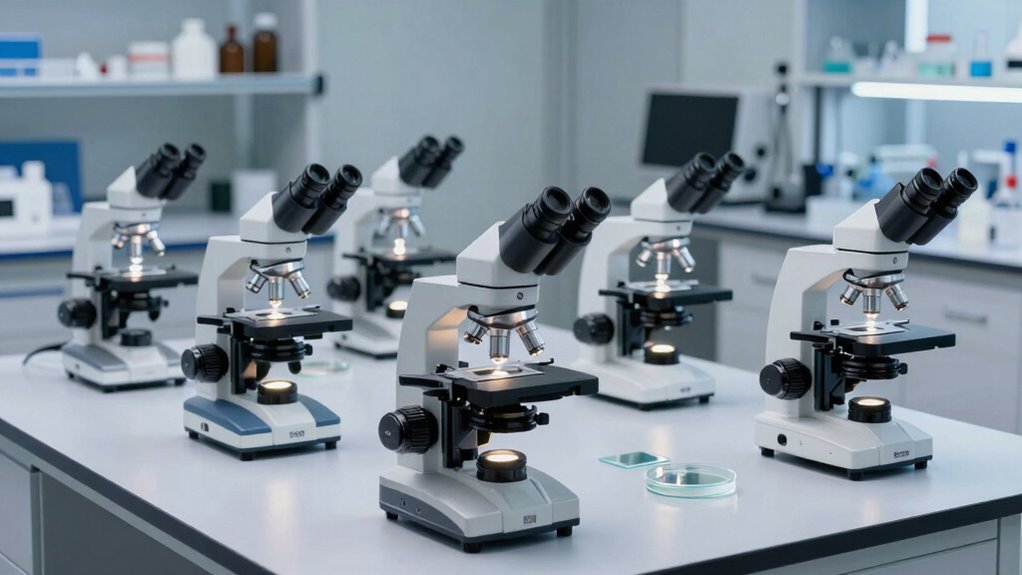

Inverted microscopes for labs are the standard choice when you need to observe living cells, culture flasks, or taller vessels from below — something upright scopes simply can’t accommodate. After comparing seven models across optics, illumination, working distance, and documentation capability, the AmScope IN480TC-FL stands out as the best overall pick for serious lab work thanks to its phase contrast and fluorescence in one platform. The Globe Scientific Euromex Oxion Inverso is the strongest premium alternative with research-grade PLPH optics and true portability, while the iQcrew IN50C-PB10 wins on value for teaching settings. The main tradeoff in this category is between contrast techniques and budget: models with phase contrast and fluorescence cost more but reveal live unstained cells that basic brightfield scopes cannot show. Keep reading for the full breakdown, including which models suit cell culture work versus classroom use.

Get the latest gadgets delivered free — and shop member deals
- Fast, free delivery on millions of items
- Access to Prime Big Deal Days deals on October 6–7
- Prime Video, Amazon Music and more included
Complete the kit



Key Takeaways
- Phase contrast was the biggest divider in this lineup — only the IN480TC-FL and Oxion Inverso support it, making them the only true options for observing live, unstained cell cultures.
- Long working distance (the AmScope IN300-series) matters more than magnification range if your lab observes cells through thick culture flask walls or plates.
- The IN300TA and IN300TC differ mainly in illumination type and accessories, so buyers should compare lighting technology rather than assuming the higher-numbered model is better.
- The iQcrew IN50C-PB10 is the only kit designed for students — its 40X–500X range and bundled accessories suit teaching labs but not research-grade imaging.
- Documentation capability varies sharply: trinocular heads on four models allow camera attachment, but only the IN480TC-FL ships with a 6MP camera ready out of the box.
| AmScope IN480TC-FL-MF603 Inverted Phase-Contrast Fluorescence Microscope with 6MP Camera |  | Best Overall | Magnification Range: 40X-1500X | Optical System: Color-corrected infinity system (CSIS) with Plan optics | Phase Contrast Settings: 100X, 200X, 250X, 400X, 500X, 1000X | VIEW ON AMAZON | See Our Full Breakdown |
| AmScope IN300TA Long Working Distance Inverted Trinocular Microscope |  | Best for Live Culture Observation | Microscope Type: Inverted trinocular compound | Eyepieces: 10x and 15x high-eyepoint super-widefield | Objectives: 4x, 10x phase, 20x phase, 40x long-working-distance plan | VIEW ON AMAZON | See Our Full Breakdown |
| iQcrew IN50C-PB10 Inverted Student Microscope Kit, 40X–500X |  | Best for Beginners | Microscope Type: Inverted compound microscope | Magnification: 40X-500X | Included Accessories: Eyepieces, prepared and blank slides, sample prep tools, frost crystal experiment | VIEW ON AMAZON | See Our Full Breakdown |
| AmScope IN300TC Inverted Trinocular Microscope | | Best Value for Phase Contrast | Microscope Type: Inverted compound, trinocular | Eyepieces: Interchangeable 10x and 25x high-eyepoint super-widefield pairs | Objectives: 4x, 10x phase, 20x phase, 40x DIN long-working-distance plan | VIEW ON AMAZON | See Our Full Breakdown |
| JHNKOJ XIB200 Inverted Biological Microscope |  | Best High-Magnification Workhorse | Magnification Range: 500X-1500X | Drawtube: Trinocular | Optics: Advanced high-definition biological optics | VIEW ON AMAZON | See Our Full Breakdown |
| Globe Scientific Euromex Oxion Inverso Inverted Trinocular Microscope PLPH 10/20/40x with 5W LED and Transport Case | 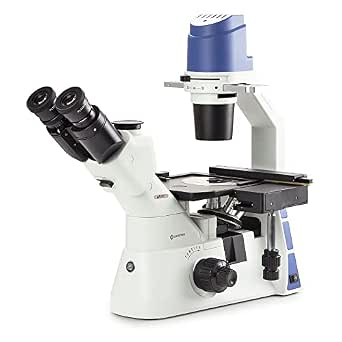 | Best Premium Build | Head: Trinocular, 45° inclined, diopter adjustment, 54–75mm interpupillary | Eyepieces: HWF Plan 10x/22mm | Objectives: Plan Phase 10x/0.25, 20x/0.40, 40x/0.60 IOS | VIEW ON AMAZON | See Our Full Breakdown |
| AmScope IN300T Long Working Distance Inverted Trinocular Microscope |  | Best Versatile Workhorse | Head: Trinocular, Siedentopf mount, 45° inclination, 50–75mm interpupillary | Eyepieces: Pair of 10x/22mm high-eyepoint super-widefield | Objectives: 4x, 10xPH, 20xPH, 40x DIN long working-distance plan | VIEW ON AMAZON | See Our Full Breakdown |
| inverted microscopes for lab | Illumination | Eyepieces | Objectives | Condenser |
|---|---|---|---|---|
| AmScope IN480TC-FL-MF603 Inver | 30W Kohler | — | — | — |
| AmScope IN300TA Long Working D | 30W halogen, rheostat-controlled | 10x and 15x high-eyepoint super-widefield | 4x, 10x phase, 20x phase, 40x long-working-distance plan | 0.3 NA Abbe with iris diaphragm |
| iQcrew IN50C-PB10 Inverted Stu | — | — | — | — |
| AmScope IN300TC Inverted Trino | Rheostat-controlled 30W halogen | Interchangeable 10x and 25x high-eyepoint super-widefield pairs | 4x, 10x phase, 20x phase, 40x DIN long-working-distance plan | Movable 0.3 NA Abbe with iris diaphragm |
| JHNKOJ XIB200 Inverted Biologi | — | — | — | — |
| Globe Scientific Euromex Oxion | 5W NeoLed LED, transmitted, corded electric | HWF Plan 10x/22mm | Plan Phase 10x/0.25, 20x/0.40, 40x/0.60 IOS | A.N. 0.30 with iris diaphragm and PH slider rings |
| AmScope IN300T Long Working Di | Upper-mounted 30W halogen, rheostat-controlled | Pair of 10x/22mm high-eyepoint super-widefield | 4x, 10xPH, 20xPH, 40x DIN long working-distance plan | 0.3 NA Abbe condenser with iris diaphragm |
More Details on Our Top Picks
AmScope IN480TC-FL-MF603 Inverted Phase-Contrast Fluorescence Microscope with 6MP Camera
This AmScope stands out as the only model in the lineup with fluorescence capability, which immediately separates it from the IN300TC and IN300TA for any lab doing live-cell or labeled-specimen work. The color-corrected infinity optical system with Plan objectives delivers flatter fields than the DIN plan objectives on the IN300 series, and the 30W Kohler illumination gives more even, controlled lighting than the halogen setups on those cheaper models. The included 6MP camera with a temperature-controlled sensor is the real differentiator — it is built for low-light, low-noise imaging, so fluorescence captures come out cleaner than what an add-on C-Mount camera on the IN300TC would produce. The tradeoff is complexity and cost: this is a serious instrument, and the Mac/Linux software is a stripped-down version of the Windows suite.
Pros:- Combines fluorescence and phase-contrast in one instrument
- Magnification up to 1500X with nine brightfield settings
- Temperature-controlled 6MP camera for low-noise imaging
- Kohler illumination produces even, controllable lighting
Cons:- Mac and Linux software lacks the full processing features of the Windows version
- Product information is inconsistent about whether the sensor is CCD or CMOS
- More instrument than basic brightfield labs need
Best for: Research and university labs that need fluorescence plus phase-contrast imaging with documentation capability in one system
Not ideal for: Teaching labs or hobbyists — it costs far more than the iQcrew student kit and offers capabilities they will never use
- Magnification Range:40X-1500X
- Optical System:Color-corrected infinity system (CSIS) with Plan optics
- Phase Contrast Settings:100X, 200X, 250X, 400X, 500X, 1000X
- Illumination:30W Kohler
- Camera:6MP low-light digital camera with temperature-controlled sensor
- Connectivity:USB 2.0
- Power Supply:90-240V
Our verdict“If your lab needs fluorescence imaging and documentation out of the box, this is the one to buy — everyone else can spend less.”
AmScope IN300TA Long Working Distance Inverted Trinocular Microscope
Where the IN300TC pairs interchangeable 10x and 25x eyepieces with phase contrast, the IN300TA takes a different approach: it emphasizes long-working-distance plan objectives and high-eyepoint 10x/15x eyepieces, making it the more comfortable choice for extended sessions watching cultures in petri dishes and well plates. The double-layer mechanical stage with 0.1 mm vernier resolution lets you return to the exact same colony or field of cells day after day — a genuine advantage for routine culture monitoring that the iQcrew student kit cannot touch. Phase contrast at 10x and 20x means unstained living cells are visible without staining. Two caveats hold it back: like its sibling, the camera is sold separately, and the 30W halogen lamp runs hotter and has a shorter lifespan than LED alternatives such as the Euromex Oxion Inverso.
Pros:- Long-working-distance objectives handle thick containers easily
- Phase contrast for viewing unstained living specimens
- Vernier-precise mechanical stage for repeatable positioning
- Anti-mold coatings protect optics in humid labs
Cons:- Camera sold separately
- Halogen illumination runs hot and needs bulb replacement
Best for: Cell culture labs that need to track specimens in dishes and plates over multiple sessions with precise stage positioning
Not ideal for: Labs that need to capture images immediately — the trinocular port is ready but the camera costs extra
- Microscope Type:Inverted trinocular compound
- Eyepieces:10x and 15x high-eyepoint super-widefield
- Objectives:4x, 10x phase, 20x phase, 40x long-working-distance plan
- Illumination:30W halogen, rheostat-controlled
- Condenser:0.3 NA Abbe with iris diaphragm
- Stage:Double-layer mechanical, 0.1 mm vernier resolution
- Camera Port:23 mm or C-Mount (camera sold separately)
Our verdict“This pick makes the most sense for culture work where going back to the same field matters more than having a camera on day one.”
iQcrew IN50C-PB10 Inverted Student Microscope Kit, 40X–500X
Compared with the professional IN300 series, this kit trades capability for accessibility — and that is exactly the point. The 40X–500X magnification range covers the basics of slide, liquid, and crystal viewing without overwhelming a first-time user, and the inverted design means students can examine liquids and crystals in natural containers rather than fighting with slide prep on an upright scope. What makes it genuinely classroom-ready is the bundled material: prepared and blank slides, sample prep tools, and a frost crystal experiment give an instructor a ready-made lesson out of the box, something no other product here provides. The five-year warranty is generous for an entry-level instrument. Do not expect phase contrast, fluorescence, or a camera port — this is strictly an optical starter scope, and the JHNKOJ XIB200 or IN480TC-FL are the upgrades when students outgrow it.
Pros:- Inverted design handles slides, liquids, and crystals
- Complete kit with prepared slides and prep tools
- Frost crystal experiment adds hands-on learning value
- Five-year warranty
Cons:- Magnification caps at 500X, limiting fine detail work
- No camera port or digital documentation option
- No phase contrast for unstained specimens
Best for: Students, homeschoolers, and educators who want a complete inverted microscope starter kit with experiments included
Not ideal for: Any lab doing research or diagnostics — no phase contrast, no camera port, no documentation capability
- Microscope Type:Inverted compound microscope
- Magnification:40X-500X
- Included Accessories:Eyepieces, prepared and blank slides, sample prep tools, frost crystal experiment
- Application:Slides, liquids, and crystals
- Warranty:5 years
- Model:IN50C-PB10
Our verdict“The right first inverted microscope for a student — buy it for learning, not for laboratory work.”
AmScope IN300TC Inverted Trinocular Microscope
Think of the IN300TC as the most cost-effective route to phase-contrast imaging in this lineup. It shares the IN300TA’s long-working-distance objectives, 30W halogen illumination, and vernier-precise mechanical stage, but its interchangeable 10x and 25x eyepiece pairs push maximum magnification higher, giving more flexibility for detail work on cultures. Compared with the IN480TC-FL-MF603, you give up fluorescence and the included camera — but if your lab only needs to view unstained cells in well plates and petri dishes, paying for those extras is wasted budget. The trinocular head accepts a C-Mount or 23 mm camera, so documentation can be added later on your own terms. The halogen lamp is the main compromise versus LED-equipped rivals like the Euromex Oxion Inverso: expect heat and periodic bulb replacements.
Pros:- Phase-contrast objectives for unstained live specimens
- Interchangeable 10x and 25x eyepieces for magnification flexibility
- Trinocular port ready for a C-Mount camera
- Long-working-distance plan objectives suit dishes and plates
Cons:- Camera sold separately
- Halogen illumination runs hotter than LED alternatives
Best for: Budget-conscious labs that need phase contrast for unstained cultures and want to add a camera later
Not ideal for: Labs needing fluorescence or high-magnification work above 1000X — the IN480TC-FL covers that ground
- Microscope Type:Inverted compound, trinocular
- Eyepieces:Interchangeable 10x and 25x high-eyepoint super-widefield pairs
- Objectives:4x, 10x phase, 20x phase, 40x DIN long-working-distance plan
- Illumination:Rheostat-controlled 30W halogen
- Condenser:Movable 0.3 NA Abbe with iris diaphragm
- Stage:Double-layer mechanical, 0.1 mm vernier resolution
- Camera Port:C-Mount or 23 mm (camera sold separately)
- Interpupillary Adjustment:50-75 mm
Our verdict“The sensible middle ground — phase contrast and a camera-ready port without paying for fluorescence you may not need.”
JHNKOJ XIB200 Inverted Biological Microscope
The XIB200 carves out a niche between the AmScope IN300 models and the IN480TC-FL by focusing on pure high-magnification optical performance: its 500X–1500X range starts where the iQcrew student kit tops out, and it reaches the same ceiling as the IN480TC-FL without that model’s fluorescence premium. The trinocular drawtube leaves a documentation path open, and the aluminum body is built for shared, high-traffic university environments where lighter plastic-bodied scopes take abuse. The honest tradeoff is digital: there is no smart connectivity, no bundled camera, and no software, so labs that want turnkey image capture should look at the IN480TC-FL-MF603 instead. It is also the least documented product here, with sparse published specifications — worth confirming condenser and illumination details with the seller before committing.
Pros:- 500X-1500X magnification for fine structural detail
- High-definition optics for clear visualization
- Durable aluminum construction for demanding environments
- Trinocular drawtube allows future camera integration
Cons:- No digital connectivity or bundled imaging software
- Published specifications are sparse compared with established brands like AmScope
Best for: Universities and shared research facilities that need durable, high-magnification optical viewing without digital extras
Not ideal for: Labs requiring image capture or connectivity — there is no camera included and no smart features
- Magnification Range:500X-1500X
- Drawtube:Trinocular
- Optics:Advanced high-definition biological optics
- Construction:Aluminum
- Application:Optical labs, universities, research facilities
- Smart Device:No
- Model:XIB200
Our verdict“A durable high-magnification workhorse for optical viewing — skip it if documentation and connectivity are part of your workflow.”
Globe Scientific Euromex Oxion Inverso Inverted Trinocular Microscope PLPH 10/20/40x with 5W LED and Transport Case
The Oxion Inverso sits at the serious-lab end of this lineup, and its Plan Phase IOS objectives are the reason. They optically compensate for 1.2mm thick culture dish bottoms, which means clearer phase contrast on thick plasticware than the AmScope IN300T can deliver with its standard long working distance objectives. Compared with the IN300T’s halogen lamp, the 5W NeoLed illumination runs cooler and holds color temperature steadily across intensity changes — a real advantage when documenting live cultures over long sessions.
The tradeoffs are mostly practical. It’s corded only, with no battery or field option, and the phase-only objective set starts at 10x, so labs wanting a low-mag 4x overview like the IN300T provides will feel the gap. Still, the quintuple nosepiece leaves room to grow, and the 10-year warranty plus transport case signals a build meant to outlast budget alternatives.
Pros:- Plan Phase IOS objectives correct for 1.2mm petri dish bottoms for sharper live-cell imaging
- Cool-running 5W NeoLed illumination with stable color temperature for long documentation sessions
- Trinocular head with quintuple nosepiece supports camera attachment and future objective upgrades
- 10-year warranty, transport case, and alignment telescope included as standard
Cons:- Corded power only — no battery option for mobile or field work
- No 4x low-magnification objective, limiting quick whole-dish overviews
- Overkill in capability and cost for general hobbyist or classroom use
Best for: Cell culture and tissue culture labs that need reliable phase contrast observation of live specimens in thick plastic dishes and flasks
Not ideal for: Hobbyists or teaching labs on a budget — this is a specialized research instrument, and general slide work doesn’t justify its cost or phase-only optics
- Head:Trinocular, 45° inclined, diopter adjustment, 54–75mm interpupillary
- Eyepieces:HWF Plan 10x/22mm
- Objectives:Plan Phase 10x/0.25, 20x/0.40, 40x/0.60 IOS
- Nosepiece:Quintuple revolving
- Stage:250x230mm with 120x78mm XY mechanical travel
- Condenser:A.N. 0.30 with iris diaphragm and PH slider rings
- Illumination:5W NeoLed LED, transmitted, corded electric
- Warranty:10 years, CE certified
Our verdict“This pick makes the most sense for dedicated cell culture labs that need premium phase contrast on thick plasticware and a warranty built for daily professional use.”
AmScope IN300T Long Working Distance Inverted Trinocular Microscope
The IN300T earns its spot through flexibility that the phase-specialized Oxion Inverso lacks. Its objective set spans 4x through 40x with phase contrast on the 10x and 20x positions, so you can scan an entire well plate at low magnification, then switch to phase for unstained live cells — a workflow the Oxion’s 10x-minimum setup can’t match. The oversize double-layer mechanical stage with 0.1mm vernier readouts gives precise positioning for multi-well plate mapping.
Two caveats temper the value. The 30W halogen lamp runs noticeably hotter than the LED systems on the Oxion Inverso, which matters for temperature-sensitive cultures during extended viewing, and it burns through bulbs. The trinocular port also requires a separately purchased C-Mount camera, unlike the camera-included AmScope IN480TC-FL-MF603. For labs that want one scope handling both routine inspection and phase work, though, this is the most capable all-rounder here.
Pros:- 4x–40x magnification range with phase contrast on 10x and 20x for both scanning and live-cell work
- Oversize double-layer mechanical stage with 0.1mm vernier resolution for precise well-plate navigation
- Anti-mold coatings protect optics in high-humidity incubator-adjacent environments
- High-eyepoint super-widefield eyepieces stay comfortable for glasses wearers during long sessions
Cons:- 30W halogen illumination runs hot and requires periodic bulb replacement
- Camera for the trinocular port is sold separately, adding to real-world cost
- Only 10x and 20x objectives are phase-contrast; 4x and 40x are brightfield only
Best for: Academic and clinical labs that need one microscope to handle both low-magnification plate scanning and phase-contrast live-cell observation
Not ideal for: Labs doing long time-lapse or fluorescence documentation — the halogen heat and missing camera push you toward LED fluorescence models like the IN480TC-FL-MF603
- Head:Trinocular, Siedentopf mount, 45° inclination, 50–75mm interpupillary
- Eyepieces:Pair of 10x/22mm high-eyepoint super-widefield
- Objectives:4x, 10xPH, 20xPH, 40x DIN long working-distance plan
- Nosepiece:Quadruple
- Stage:Oversize double-layer mechanical, 1.0mm divisions, 0.1mm vernier
- Illumination:Upper-mounted 30W halogen, rheostat-controlled
- Condenser:0.3 NA Abbe condenser with iris diaphragm
- Camera Port:Accepts C-Mount or 23mm camera (sold separately)
Our verdict“A smart choice for labs that want broad magnification flexibility plus phase contrast in one durable instrument, provided they can live with halogen heat and add their own camera.”
How We Picked
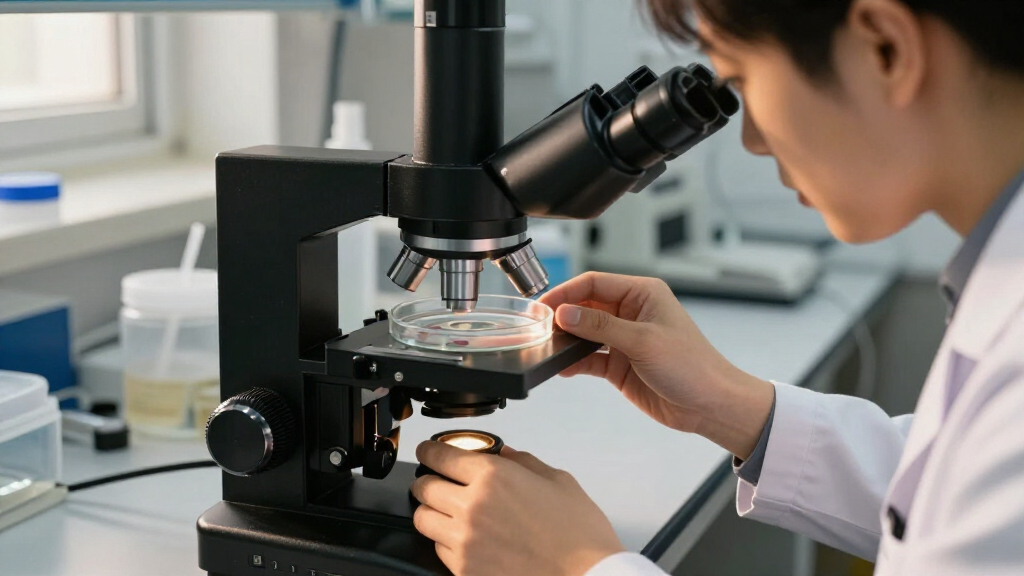
I ranked these inverted microscopes by the factors that actually determine daily lab usability: contrast capability (brightfield vs. phase contrast vs. fluorescence), working distance for culture vessels, optical quality of objectives and condensers, illumination technology, and documentation readiness through camera ports or included cameras. Because inverted scopes serve very different buyers — research labs, clinical settings, and teaching environments — I also weighed versatility and total package value rather than raw spec counts.
The ranking logic follows a clear hierarchy: models that support phase contrast for live-cell work rank highest because that capability defines what inverted microscopes are bought for in the first place. Premium optics and portability (the Euromex Oxion Inverso) come next, followed by the long-working-distance AmScope models that trade contrast techniques for vessel flexibility. Budget and student options rank lower not because they are poorly built, but because they serve narrower use cases that most lab buyers will eventually outgrow.
Factors to Consider When Choosing Inverted Microscopes For Labs
Choosing an inverted microscope involves more than comparing magnification numbers. These are the factors that most often decide whether a purchase succeeds or frustrates a lab for years.Contrast Technique: The Decision That Shapes Everything
The single most consequential choice is whether you need brightfield only, phase contrast, or fluorescence. Many buyers assume magnification is the key spec, but unstained living cells are nearly transparent — without phase contrast, you will see little more than outlines at any magnification. If your lab does cell culture viability checks, migration studies, or any live-cell observation, phase contrast is not optional; it is the reason to buy an inverted scope at all. Brightfield-only models remain legitimate for stained samples, microorganisms in broth, and inspection work, and they cost considerably less. A common mistake is buying a brightfield model to save money, then discovering six months later that live-cell work requires an upgrade. Match the contrast technique to your actual samples on day one.
Working Distance and Vessel Compatibility
Working distance determines what you can physically place under the objective. Standard inverted objectives are designed for thin glass bottoms, but culture flasks, multi-well plates, and Petri dishes have thicker walls that demand long-working-distance (LWD) objectives. Check the maximum vessel height your condenser and stage can accept — usually listed in millimeters — before buying, not after. Labs that move between flask sizes and plate formats benefit from stages with removable center plates and adjustable inserts. A scope with brilliant optics but insufficient working distance for your flasks is functionally useless. If your workflow involves 25cm² flasks or taller vessels, prioritize LWD models over higher magnification.
Illumination Technology and Lifetime Costs
Modern inverted scopes use LED illumination, which offers long bulb life, low heat output, and stable color temperature — preferable to older halogen systems for live-cell work where heat can affect specimens. Pay attention to whether the light source is integrated or external, since external units add footprint and cabling complexity to crowded benches. Fluorescence capability, if you need it, introduces a second light source entirely and a filter cube system, which substantially changes both price and maintenance expectations. Also check replacement-part availability: obscure brands may offer attractive prices but limited support for bulbs, fuses, and electronics down the road. Budget for the illumination ecosystem, not just the microscope.
Head Configuration and Documentation Path
Binocular, trinocular, and monocular heads serve different workflows. A trinocular port lets you attach a camera without removing an eyepiece, which matters for any lab doing documentation, training, or quantitative analysis. Some cameras mount into the trinocular tube while others replace an eyepiece — confirm compatibility before purchasing a camera separately. If documentation is central to your work, a bundled camera saves compatibility headaches, though bundled cameras often lag behind dedicated scientific cameras in sensitivity. Teaching labs with multiple observers may also consider whether simultaneous viewing accessories exist for the model. Skipping the trinocular port to save money is one of the most commonly regretted decisions in microscope buying.
Objective Quality and Magnification Realism
Objective quality affects image clarity far more than the magnification range printed in listings. A 40X plan objective from a reputable optical design will outperform a cheap 100X objective every time, so plan achromatic (PL) objectives deserve priority over headline magnification. Most live-cell lab work happens between 100X and 400X total magnification; 1000X oil immersion is rarely used on inverted stands except in specialized microbiology. Look at the objective classes included — PLPH or plan phase objectives indicate research-grade flatness and contrast. Also consider whether the nosepiece has open positions, giving you room to add objectives as your work evolves rather than replacing the entire set.
Build, Serviceability, and Lab Environment Fit
An inverted microscope is a decade-plus purchase, so parts availability and serviceability matter as much as initial performance. Established brands maintain parts inventories and published specifications; lesser-known imports may be harder to repair when a condenser or stage insert breaks. Consider physical footprint if bench space is tight, and whether a transport case matters for shared or multi-site facilities. Stage mechanics deserve hands-on evaluation if possible — smooth coaxial controls and a stable stage are what you interact with hundreds of times per week. Finally, think about who will use the scope: a shared instrument in a multi-user lab benefits from simple, robust controls, while a dedicated single-user workstation can justify more complex configurations.
Frequently Asked Questions
Do I need phase contrast, or is brightfield enough for my lab?
If you observe living, unstained cells — the core use case for most inverted microscopes — you need phase contrast, because transparent cells are almost invisible under plain brightfield. Phase contrast converts tiny differences in optical density into visible contrast, letting you see cell borders, nuclei, and morphology without stains that kill the sample. Brightfield is adequate for fixed and stained specimens, microorganisms in colored media, or general inspection tasks. The practical compromise in this roundup is that phase-contrast models cost substantially more, so labs doing only occasional live-cell checks may start with brightfield. But if cell culture observation is a routine part of your week, buying phase contrast from the start avoids a costly second purchase.
What is the advantage of a trinocular head on an inverted microscope?
A trinocular head adds a dedicated third port for a camera, so you can document or stream images while continuing to view through the eyepieces. This matters for labs that need photographic records of cultures, share findings with colleagues, use image analysis software, or train students by projecting the view to a screen. Without a trinocular port, the only camera option is replacing an eyepiece, which interrupts viewing and often degrades image quality. Models like the AmScope IN300 series and the Euromex Oxion Inverso include this port, while student kits typically do not. If documentation is even a occasional need, the trinocular head is worth the price difference — it is far cheaper to buy it upfront than to upgrade the head later.
Can I use an inverted microscope with culture flasks and multi-well plates?
Yes, but only if the objectives have sufficient working distance and the stage accepts your vessel height. Standard inverted objectives are designed for thin coverslips or glass-bottom dishes, and thick plastic flask walls can prevent focus entirely. Long-working-distance (LWD) objectives, like those on the AmScope IN300-series, are built specifically for observing through flask walls and plate bottoms. Check the manufacturer’s stated maximum vessel height and whether the stage has a removable or adjustable center plate to accommodate different container formats. Labs working with tall flasks should treat working distance as a pass/fail criterion before comparing any other feature.
Are budget inverted microscopes suitable for real lab work, or only for teaching?
It depends entirely on the application. A sub-$500 model like the iQcrew IN50C-PB10 can genuinely serve teaching labs, hobbyist microbiology, and basic inspection, where the goal is learning to handle samples and recognize structures. The limitations appear in contrast capability, objective quality, and mechanical refinement — budget models typically lack phase contrast, use simpler achromatic objectives, and have less precise stage controls. For research, clinical, or any documentation-driven work, the optical and mechanical gaps become apparent quickly. A reasonable rule: if results from the scope will inform decisions or publications, invest in a phase-capable research-grade model; if it will train hands and eyes, a good student kit performs its job well.
Is fluorescence worth the extra cost on an inverted microscope?
Fluorescence is worth it only if your protocols actually use fluorescent labels, stains, or proteins — for example, GFP expression work, immunofluorescence staining, or viability dyes like fluorescein. Adding fluorescence means a second light source, filter cubes, and more complex alignment, which explains the price jump seen in models like the IN480TC-FL. If your lab currently does only phase-contrast cell culture checks, a dedicated phase-contrast scope will serve better per dollar. However, if there is a realistic chance of fluorescence work within the scope’s lifetime, buying the combined phase-and-fluorescence platform upfront is more economical than replacing a phase-only system. The deciding question is your research roadmap, not the feature list.
Conclusion
Mapping these seven models to buyer types makes the decision straightforward. For best overall, the AmScope IN480TC-FL earns the top spot because it combines phase contrast, fluorescence, and an included 6MP camera — the most complete research capability in this lineup. The Globe Scientific Euromex Oxion Inverso is the best premium choice for labs wanting research-grade PLPH optics, LED illumination, and a transport case for multi-site use. For best value in a working lab, the AmScope IN300TC delivers a trinocular head and solid brightfield performance at a mid-range price, while the IN300TA suits labs prioritizing long working distance with different illumination preferences. Best for beginners and teaching labs goes to the iQcrew IN50C-PB10, whose bundled kit format gets students observing immediately without a large investment. For specific needs: the IN300T is the lean pick when you want long working distance without paying for accessories you won’t use, and the JHNKOJ XIB200 covers basic inverted brightfield observation where budget is the primary constraint. Choose based on your samples and documentation needs — not the spec sheet — and the right model becomes obvious.
Fall Picks
fall essentials
As an affiliate, we earn on qualifying purchases.