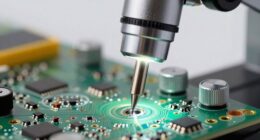

Breaking nanotech barriers is challenging because precise control of atoms and molecules remains unachievable at scale. Manufacturing tiny devices reliably and assembling trillions of nanomachines is beyond current tech. Nanoelectronic components face speed and stability issues, and large-scale integration presents significant hurdles. Fabrication methods struggle with control and throughput, while regulatory uncertainties slow progress. To understand how these obstacles are being addressed and what future breakthroughs might bring, explore the details further.
Key Takeaways
- Precise atom-by-atom manipulation remains unscalable, limiting the assembly of functional nanomachines at industrial levels.
- Current nanoelectronic components face speed and performance constraints due to quantum effects and interface traps.
- Scaling nanodevices into complex macro-systems is hindered by assembly challenges and material stability issues.
- Fabrication techniques like nanolithography and self-assembly struggle with throughput, accuracy, and atomic-level control.
- Regulatory uncertainties and market risks slow investment, delaying advancements and commercialization of nanomachines.
atomic force microscope for nanomanipulation
As an affiliate, we earn on qualifying purchases.
As an affiliate, we earn on qualifying purchases.
Fundamental Challenges in Molecular-Scale Control

Controlling motion at the molecular scale remains a fundamental challenge because current methods lack the precision needed to manipulate individual atoms or molecules reliably. You can’t just use bulk techniques like pH adjustments or chemical reactions; these methods are too coarse for precise control. Building useful nanomachines requires positioning atoms or molecules with atomic-scale accuracy, which current tools can’t consistently achieve. While atomic-scale manipulation is possible in controlled lab environments, scaling this to practical manufacturing remains out of reach. You’d need trillions of precisely assembled devices to create functional systems, but our current technology isn’t capable of this level of exponential assembly. Additionally, precise control mechanisms are essential for advancing nanotechnology, but such mechanisms are still under development. Without reliable control at this scale, developing complex nanomachines that perform specific tasks is still a significant hurdle. Moreover, scaling up laboratory techniques to industrial levels continues to pose substantial technical challenges.

Portable Coil & Inductance Tester for Motherboard Repair, Professional Circuit Board Diagnostic Tool Kit, Battery Sensor Tester for Rapid Troubleshooting & Electronics Maintenance
- Universal Compatibility: Compatible with leading electronics brands
- Reduces Downtime: Streamlines diagnostics to save time
- Ultra-Portable Design: Lightweight and compact for on-the-go use
As an affiliate, we earn on qualifying purchases.
As an affiliate, we earn on qualifying purchases.
Limitations of Nanoelectronic Components

Nanoelectronic components face fundamental limitations that hinder their performance and scalability. Low on-state currents in tunnel FETs reduce switching speeds, while interface traps exceeding 10^12 cm^-2 limit subthreshold performance. Radiation-hardened electronics deteriorate beyond 10 Mrad, challenging long-term space applications. The diffraction limit constrains on-chip optoelectronic interconnects, preventing miniaturization of interconnects at nanoscale. Additionally, there’s no exhaustive nanotheory to predict how quantum effects influence macro-scale material behavior, complicating design and reliability. These issues collectively restrict the development of high-performance, durable, and scalable nanoelectronic devices. Overcoming them requires breakthroughs in materials, fabrication techniques, and theoretical understanding—steps that currently lag behind the rapid progress needed for advanced nanomachines. Moreover, the scaling challenges associated with physical and quantum effects further impede the integration of nanoelectronic components into practical systems. Advancements in materials science are crucial to address these fundamental issues and unlock the full potential of nanotechnology. Without a comprehensive understanding of quantum influences, designing reliable nanoscale devices remains a significant hurdle. Developing effective modeling techniques could significantly aid in predicting device behavior under various quantum phenomena.

The 2023 Report on Nanolithography Equipment: World Market Segmentation by City
As an affiliate, we earn on qualifying purchases.
As an affiliate, we earn on qualifying purchases.
Scaling Up: From Nanosensors to Macro-Devices

Bridging the gap from nanosensors to full-scale devices presents significant challenges because the exponential scaling required involves complex integration, precise assembly, and reliable performance at each level. You need to coordinate countless tiny components while maintaining functionality. Scaling demands assembling trillions of units, which is difficult with current methods. The table below highlights key hurdles:
| Challenge | Impact |
|---|---|
| Precise atom placement | Difficult at large scale, risking errors |
| Material stability | Low tensile strength hampers durability |
| Assembly automation | Limited, slows mass production |
Without breakthroughs in assembly and material control, moving from nanoscale to macroscale remains a formidable barrier, hindering widespread adoption of macro-devices based on nanotech. Achieving material stability at larger scales is essential for durable and reliable macro-devices, especially considering the scaling complexities involved in integrating multiple nanostructures into cohesive systems. Moreover, advances in nanomanufacturing techniques are crucial to overcome current limitations and enable seamless transition from nanoscale components to functional macro-devices. Developing scalable fabrication methods that can handle large volumes efficiently is vital for practical deployment of nanotechnology-based systems. Additionally, progress in precision assembly is necessary to ensure the accurate and repeatable construction of complex nanostructures at scale.
As an affiliate, we earn on qualifying purchases.
Precision in Fabrication and Material Engineering

Achieving precise fabrication at the nanoscale requires advanced techniques that can reliably manipulate materials with atomic-level accuracy. Currently, methods like nanolithography, self-assembly, and bottom-up approaches are emerging, but each faces limitations. Nanolithography offers high resolution but struggles with throughput and scalability. Self-assembly allows for spontaneous organization of molecules, yet controlling the exact placement remains challenging. Atomic-layer deposition and transfer techniques enable stacking nanosheets precisely, but demand stringent control over atomic layers. Two-photon polymerization can produce complex nanostructures, yet the resulting features are often hundreds of nanometers, not truly atomic. To build functional nanomachines, you need to control material properties at the atomic level, which remains a significant engineering hurdle. Improving fabrication precision is vital for unlocking nanomachine potential. Advances in material engineering] are essential to overcoming current limitations and achieving atomic-level control.
Regulatory and Market Hurdles Impeding Progress

Regulatory and market hurdles substantially slow down nanotechnology development because the lack of a unified global framework creates uncertainty and delays investment. Without clear standards, companies hesitate to fund R&D, fearing legal repercussions or market rejection. Different countries debate definitions, safety assessments, and approval processes, making international collaboration difficult. This fragmented landscape discourages innovation and hampers scaling from lab concepts to commercial products. Safety concerns and potential risks intensify scrutiny, leading to lengthy testing and approval delays. Additionally, investors view nanotech as high-risk due to unpredictable regulations and uncertain market demand. As a result, funding gaps persist, stalling progress. Overcoming these hurdles requires international cooperation to establish harmonized standards, streamline approval pathways, and build confidence in nanotech’s safety and economic potential. Navigation and mapping explainers can help create more precise regulation and safety protocols, further facilitating development. Establishing international standards is essential for fostering trust and accelerating commercialization. Effective regulatory frameworks are critical to reducing uncertainty and encouraging investment in this emerging field.
Frequently Asked Questions
Can Current Nanotech Research Overcome Atomic Precision Limitations?
Current nanotech research struggles to fully overcome atomic precision limitations. You’ll find that controlling individual atoms and molecules with perfect accuracy remains challenging due to fabrication constraints and material stability issues. While advances like atomic-layer growth and self-assembly help, achieving consistent, atomically precise manufacturing at scale still eludes you. Significant breakthroughs are needed in materials science and fabrication techniques before you can reliably reach the atomic precision required for advanced nanomachines.
What Breakthroughs Are Needed to Achieve Functional Nanorobots?
You need breakthroughs in precise atomic control and scalable manufacturing. While current methods fall short, innovations like advanced atomically precise fabrication, improved self-assembly, and AI-driven design could revolutionize nanorobots. Overcoming material stability and integration challenges is essential. These advances will enable you to build functional nanorobots capable of complex tasks, transforming medicine, manufacturing, and beyond. Without them, reaching true nanoscale automation remains an ambitious goal.
How Can Nanomanufacturing Scale Cost-Effectively for Mass Production?
You can scale nanomanufacturing cost-effectively by developing advanced self-assembly techniques, leveraging machine learning for process optimization, and investing in scalable, precise fabrication methods like atomic-layer deposition. Standardizing protocols and creating modular, reusable components will reduce costs. Additionally, fostering collaborations between industry and academia can accelerate innovation, while government support and regulatory clarity will lower risks, making large-scale production more feasible and affordable for the mass market.
What Global Standards Will Regulate Nanotechnology Safety?
Think of nanotechnology safety standards as a global traffic system guiding tiny vehicles. You’ll see international organizations crafting rules, much like traffic lights and signs, to prevent crashes and chaos. These standards will define safe materials, testing protocols, and risk assessments. As a driver in this microscopic world, you must adhere to these guidelines to ensure smooth, safe journeys for nanodevices worldwide, fostering trust and innovation without accidents.
Is There a Realistic Timeline for Nanomachines to Impact Daily Life?
You might see nanomachines impacting daily life in the next 20 to 30 years, but widespread use depends on overcoming several challenges. You’ll need breakthroughs in precise atom control, scalable manufacturing, and safety regulations. Currently, these hurdles slow progress, so don’t expect full integration soon. However, incremental advances in sensors, medicine, and electronics could become part of your routine within a decade, shaping your daily experiences gradually.
Conclusion
You face the challenges of mastering molecular control, overcoming electronic limitations, and scaling innovations. You must refine fabrication techniques, engineer better materials, and navigate regulatory hurdles. You need to push boundaries, break barriers, and embrace collaboration. Only by addressing these core issues can you unseal the full potential of nanomachines. Together, you can transform possibilities into realities, shaping a future where nanotechnology revolutionizes industries and improves lives at every scale.