
Acoustic metamaterials let you create invisible barriers that control sound waves beyond traditional methods. They use engineered structures with microresonators and periodic patterns to manipulate parameters like density and bulk modulus. These effects enable sound to bend, reflect, or bypass objects without detection, creating effective soundproofing and cloaking solutions. If you want to discover how these advanced materials harness resonance and microstructures for incredible sound control, you’ll find plenty of fascinating details ahead.
Key Takeaways
- Acoustic metamaterials manipulate sound waves using engineered microstructures to achieve soundproofing beyond conventional barriers.
- They can create negative effective parameters, bending or redirecting sound around objects for invisibility.
- These materials utilize resonant modes like Helmholtz resonators to absorb or reflect specific sound frequencies.
- Acoustic cloaking devices redirect sound waves, rendering objects acoustically invisible.
- Advanced designs enable broadband sound attenuation and stealth applications by controlling wave propagation precisely.

Focusound 52 Pack Acoustic Foam Panels 1" x 12" x 12" Sound Proof Foam Panles Soundproofing Noise Cancelling Wedge Panels for Home Office Recoding Studio with 300PCS Double-Side Adhesive
Soundproofing – Acoustic foam panels triangular grooves structure for better noise absorption, helps to reduce and absorb unwanted…
As an affiliate, we earn on qualifying purchases.
As an affiliate, we earn on qualifying purchases.
Understanding the Core Principles of Acoustic Metamaterials
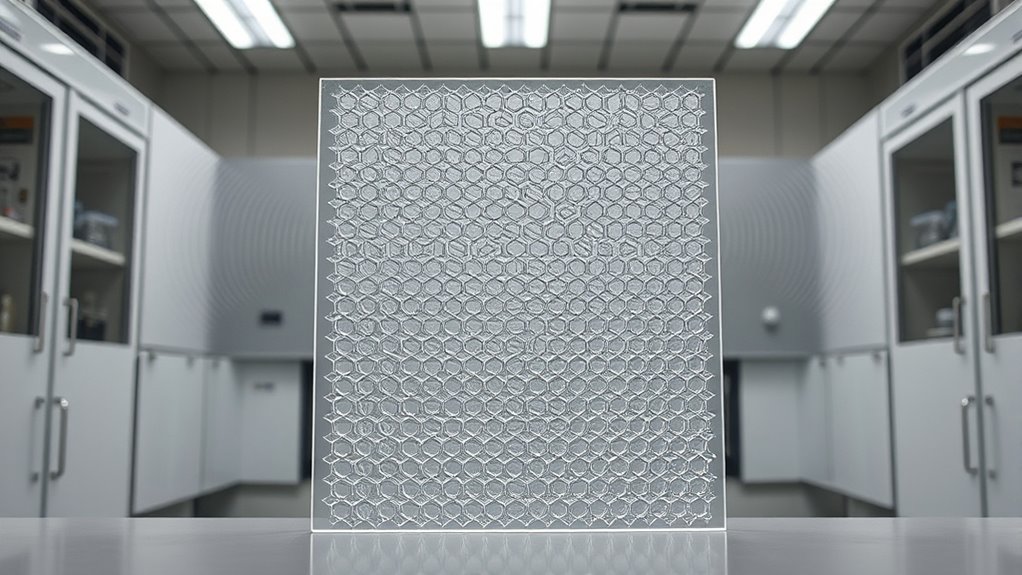
To understand the core principles of acoustic metamaterials, you need to recognize that these are artificially engineered structures designed to control sound waves in ways natural materials cannot. They achieve this by manipulating parameters such as bulk modulus, density, and chirality to transmit, trap, or block specific frequencies. These materials are made up of sub-wavelength unit cells that periodically modify the acoustic refractive index, similar to photonic crystals. By adjusting their microstructure, you can create unusual properties like negative refraction and acoustic cloaking. Unlike natural substances, these metamaterials can exhibit negative effective mass density or bulk modulus, allowing you to bend, absorb, or steer sound waves with high precision. Their design principles enable innovative applications in soundproofing, imaging, and wave control. Understanding the principles of wave manipulation allows for the development of advanced acoustic devices with unprecedented capabilities, especially when leveraging metamaterial microstructures to achieve tailored sound control. Additionally, ongoing research into adaptive metamaterials aims to introduce tunability, further expanding their potential uses in dynamic environments. This adaptability can be particularly useful in creating reconfigurable sound barriers, which respond to changing acoustic conditions in real time. Moreover, exploring material properties can help optimize their performance for specific applications.
Focusound 52 Pack Acoustic Foam Panels 1" x 12" x 12" Sound Proof Foam Panles Soundproofing Noise Cancelling Wedge Panels for Home Office Recoding Studio with 300PCS Double-Side Adhesive
Soundproofing – Acoustic foam panels triangular grooves structure for better noise absorption, helps to reduce and absorb unwanted…
As an affiliate, we earn on qualifying purchases.
As an affiliate, we earn on qualifying purchases.
Unique Properties That Make Sound Barriers Invisible

Have you ever wondered how some materials can make sound waves fundamentally disappear from sight? Acoustic metamaterials achieve this by possessing unique properties that defy natural behavior. For example, negative density or bulk modulus allows sound waves to bend or slow down unexpectedly, effectively steering or canceling them out. Negative refraction bends waves opposite to normal laws, enabling waves to bypass objects without detection. Acoustic cloaking uses these properties to create invisible barriers, redirecting sound around an area. Flat slab imaging with sub-wavelength resolution makes objects appear invisible to sound waves. Double-negative parameters enable broad frequency control, while high energy density absorption dampens sound efficiently. These extraordinary properties allow sound barriers to become invisible, manipulating sound waves in ways nature simply can’t replicate. Understanding these metamaterial properties can lead to innovative soundproofing solutions and advanced acoustic devices. Additionally, the ability to tailor these properties for specific frequencies opens new avenues for customized sound control in various applications. Researchers are continually exploring metamaterial fabrication techniques to enhance the practical deployment of these sound-manipulating structures, making sound manipulation more precise and adaptable.

Audimute Peacemaker Sound Barrier – 3 mm Soundproofing Sound Barrier (2' x 25')
Excellent Sound Barrier: Great for soundproofing walls, ceilings, and floors.
As an affiliate, we earn on qualifying purchases.
As an affiliate, we earn on qualifying purchases.
Innovative Designs and Structures in Soundproofing

Innovative designs in soundproofing leverage the unique properties of acoustic metamaterials to achieve superior noise attenuation. By incorporating microstructures like membrane-type resonators, Helmholtz resonators, and metamolecules, you can target specific frequencies and block sound more effectively than traditional materials. These structures often rely on local resonances that absorb or reflect sound waves, creating high energy density zones that dampen noise. You might use periodic arrangements, such as cubic lattices or layered composites, to produce bandgaps that prevent sound transmission within certain frequency ranges. Fluid-based metafluids or solid-based configurations further enhance control over wave propagation. Understanding the importance of material properties allows for the design of more efficient and adaptable soundproofing solutions. The application of frequency targeting in these structures enables precise noise control tailored to specific environments. Additionally, advances in structural design facilitate the development of customizable and lightweight barriers. Incorporating adaptive mechanisms can further optimize these structures for dynamic noise environments. Moreover, ongoing research into wave manipulation techniques continues to expand the capabilities of acoustic metamaterials, opening new avenues for innovative noise control solutions. Overall, these designs allow you to craft lightweight, compact sound barriers that outperform conventional solutions, opening new possibilities for noise control in various environments.

Acoustic Metamaterials: Negative Refraction, Imaging, Lensing and Cloaking (Springer Series in Materials Science Book 166)
As an affiliate, we earn on qualifying purchases.
As an affiliate, we earn on qualifying purchases.
How Resonance and Microstructures Control Sound Waves
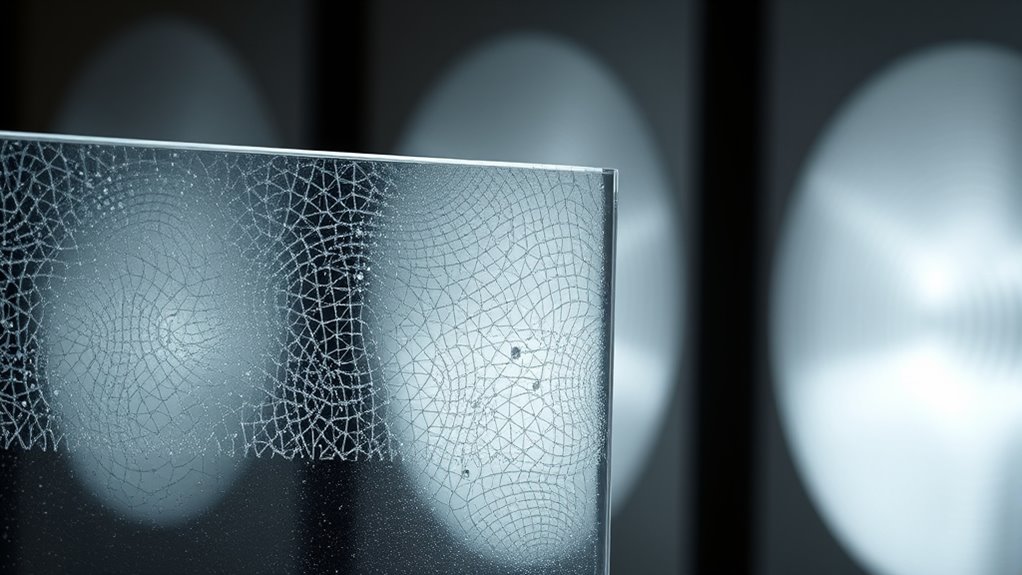
You can control sound waves by designing microstructures that resonate at specific frequencies, causing sound energy to be absorbed or reflected. Resonance-induced sound attenuation occurs when these structures trap energy, reducing noise effectively. By tailoring these microstructures, you influence wave paths and achieve precise sound manipulation. Understanding acoustic metamaterials enables engineers to develop innovative solutions for noise reduction and sound control applications. The ability to engineer these materials relies on a deep understanding of wave interactions at the microstructural level, allowing for highly customized soundproofing solutions. Additionally, advances in microstructure design are expanding the possibilities for customized acoustic environments and noise mitigation techniques. Moreover, research into resonance phenomena helps optimize these microstructures for diverse practical uses.
Resonance-Induced Sound Attenuation
Resonance plays a crucial role in acoustic metamaterials by enabling precise control over sound wave propagation through carefully designed microstructures. When sound waves match the natural frequency of these structures, intense energy builds up locally, leading to effective attenuation. This resonance causes sound waves to be absorbed or reflected rather than transmitted.
You should focus on these key aspects:
- Localized Resonances: Microstructures like membranes or Helmholtz resonators trap energy at specific frequencies, reducing sound transmission.
- Frequency Targeting: By tuning geometries, you can target particular sound frequencies for attenuation, such as low-frequency noise.
- Energy Absorption: Resonance creates high energy densities within microstructures, leading to broadband or narrowband sound absorption.
This resonance-induced mechanism profoundly enhances sound blocking in thin, engineered barriers.
Microstructure Wave Manipulation
Microstructures in acoustic metamaterials are engineered to actively manipulate sound waves through their specific geometries and material properties. By designing unit cells with tailored shapes, sizes, and compositions, you can control wave behavior at multiple frequencies. These microstructures, such as Helmholtz resonators, membranes, and complex lattice arrangements, create localized resonances that influence how sound propagates. When sound interacts with these structures, their resonant modes can bend, reflect, or trap waves, enabling effects like negative refraction or wave steering. Adjusting parameters like tension, shape, or material contrast allows you to target specific frequencies for absorption or redirection. This precise microstructure control opens pathways for advanced soundproofing, focusing, and cloaking applications, making sound waves behave in ways that natural materials can’t achieve.
Real-World Applications of Acoustic Metamaterials

Have acoustic metamaterials revolutionized practical applications by enabling precise control over sound waves? Absolutely. They’re transforming industries with innovative solutions. Here are three key applications:
- Noise Reduction and Soundproofing: You can use metamaterials to create ultra-thin barriers that block low-frequency noise, making environments quieter without bulky materials. Their ability to manipulate sound at sub-wavelength scales is directly linked to acoustic wave control, which has been enhanced through research in metamaterial design. This progress has opened up new possibilities for home environment noise management, allowing for quieter living spaces. The development of metamaterial fabrication techniques continues to expand their practical uses.
- Medical Imaging: These materials enable sub-wavelength imaging, helping doctors detect anomalies with unprecedented precision, improving diagnostics.
- Acoustic Cloaking: Metamaterials can hide objects from sound waves, useful in stealth technology or protecting sensitive equipment from noise interference. Additionally, ongoing research explores their potential to integrate into modern kitchen technology for noise management and improved acoustic environments.
Advancements in Cloaking and Sub-Wavelength Imaging
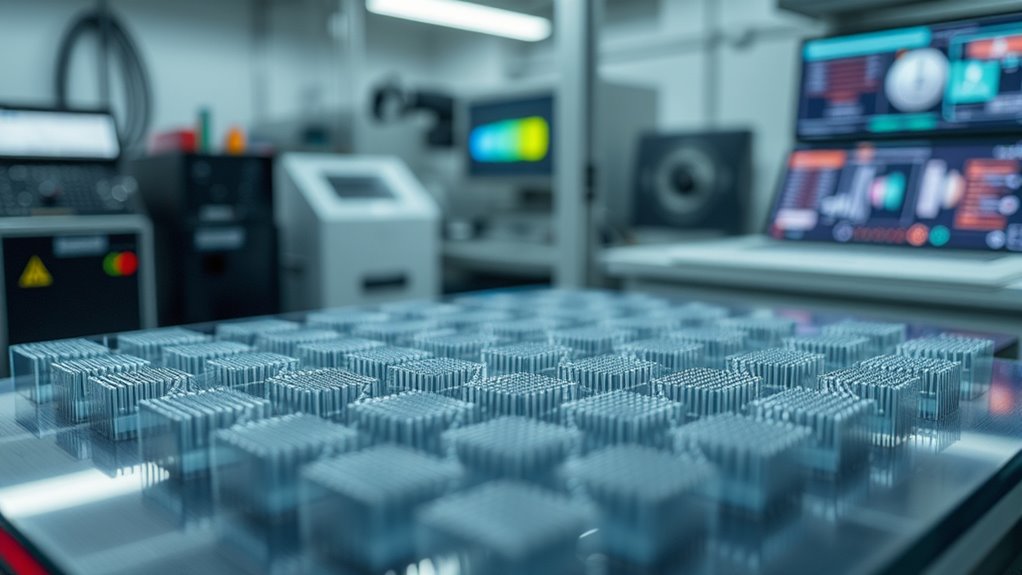
Recent advances in acoustic metamaterials have made cloaking and sub-wavelength imaging more practical than ever. You can now manipulate sound waves to conceal objects or achieve imaging beyond traditional diffraction limits. These breakthroughs rely on innovative wave manipulation strategies that control sound with extraordinary precision. Understanding sound wave behavior is key to developing these sophisticated materials and expanding their applications. Additionally, researchers are exploring material design techniques to optimize acoustic performance and broaden their practical uses.
Cloaking With Metamaterials
Advancements in acoustic metamaterials have made it possible to achieve cloaking and sub-wavelength imaging by precisely controlling sound waves at scales smaller than their wavelength. You can now hide objects or distort sound paths with remarkable accuracy. Key innovations include:
- Transformation acoustics: Redirects sound waves around objects, creating an invisible barrier.
- Negative refraction: Bends sound opposite to conventional laws, enabling perfect cloaking.
- Superlenses: Use double-negative parameters to surpass diffraction limits and achieve sub-wavelength imaging.
These technologies manipulate effective parameters like bulk modulus and density, enabling sound waves to bypass or focus on objects with minimal scattering. As a result, cloaking devices are becoming more practical, paving the way for advanced stealth, non-invasive sensing, and acoustic imaging applications.
Super-Resolution Imaging Techniques
Super-resolution imaging techniques in acoustic metamaterials have revolutionized the way you visualize objects at scales smaller than the wavelength of sound. By leveraging sub-wavelength structures, these techniques overcome traditional diffraction limits, enabling detailed imaging of tiny features. Acoustic metamaterials use engineered unit cells with resonant properties, such as negative density or bulk modulus, to focus sound waves tightly. This allows you to achieve high-resolution images with resolutions below half the wavelength, similar to optical super-resolution microscopy. Metamaterial-based lenses and hyperlenses exploit anisotropic and double-negative parameters to bend and concentrate sound waves, revealing features previously unresolvable. These advancements open new possibilities for non-invasive diagnostics, material characterization, and biological imaging, providing unprecedented clarity at microscopic scales, and pushing the boundaries of acoustic wave control and sensing.
Wave Manipulation Strategies
Building on the principles of super-resolution imaging, wave manipulation strategies in acoustic metamaterials focus on controlling sound waves beyond conventional limits. You can achieve remarkable effects like cloaking and sub-wavelength imaging through innovative designs. These strategies include:
- Acoustic Cloaking: Bending sound waves around objects, rendering them invisible to detection.
- Negative Refraction: Reversing sound wave direction to focus or steer waves precisely.
- Super-Resolution Imaging: Using flat lenses and metamaterials to visualize details smaller than the wavelength.
Future Trends and Emerging Technologies in Sound Manipulation
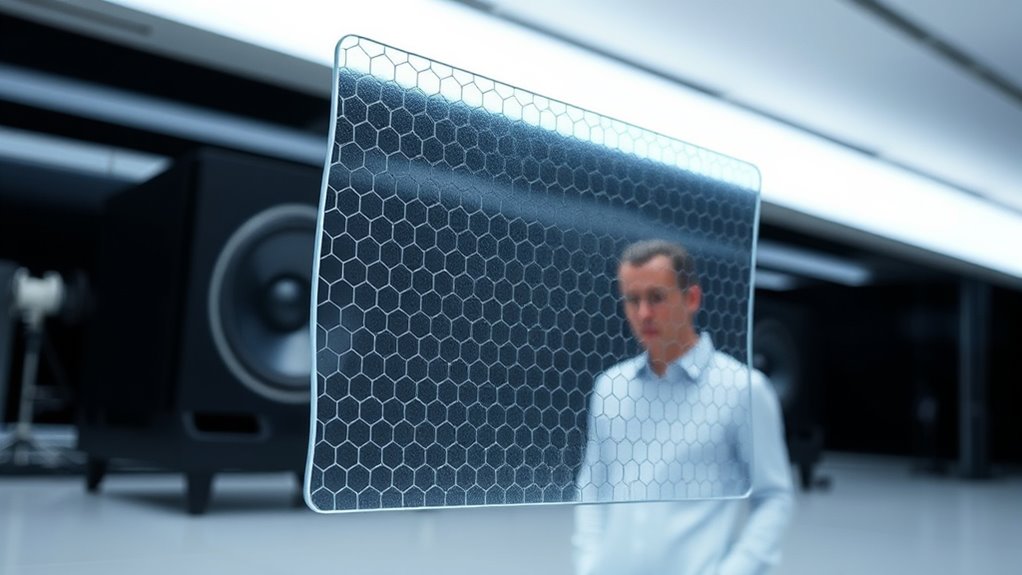
Emerging technologies in sound manipulation are poised to revolutionize how you control and utilize acoustic waves. Advances like tunable acoustic metasurfaces will enable dynamic, real-time modulation of sound, allowing you to release, focus, or cloak waves on demand. Topological acoustics will provide robust, defect-immune pathways for sound, enhancing noise control and signal integrity. Integration of smart materials and machine learning will make adaptive metamaterials that self-adjust to environmental changes, optimizing soundproofing or sound focusing. Quantum acoustic devices could unleash ultra-sensitive sensors and novel communication methods. Additionally, the development of multi-functional, multi-band metamaterials will give you versatile platforms for applications ranging from medical imaging to underwater communication. These trends will push sound manipulation beyond current limits, opening new horizons for innovation and practical use.
Frequently Asked Questions
How Do Acoustic Metamaterials Differ From Traditional Soundproofing Materials?
You’ll find that acoustic metamaterials differ from traditional soundproofing materials because they manipulate sound waves actively, rather than just absorb or block them. They use engineered microstructures to control wave propagation, achieving effects like negative refraction or cloaking. This allows for precise, broadband sound attenuation and wave steering. Unlike conventional materials, they can be designed for specific frequencies and functions, making them more versatile and effective in advanced noise control applications.
Can Acoustic Metamaterials Be Used for Soundproofing in Outdoor Environments?
Yes, acoustic metamaterials can be used for outdoor soundproofing, but it’s not straightforward. They’re highly effective at blocking specific frequencies using resonances and negative refraction, creating invisible barriers that traditional materials can’t match. However, their performance depends on design and environmental conditions. You might wonder if they’ll withstand weather or cover large areas, but with ongoing advancements, they’re becoming increasingly practical for outdoor noise control.
What Are the Cost and Manufacturing Challenges of Acoustic Metamaterials?
You’ll face high costs and manufacturing challenges when working with acoustic metamaterials. They often require precise, microstructured components, which are expensive and complex to produce at scale. Achieving consistency in their intricate designs, like periodic unit cells or resonators, demands advanced fabrication techniques. Additionally, materials used, such as lead or specialized polymers, can be costly, making commercial deployment difficult unless manufacturing processes become more efficient and affordable.
Are Acoustic Metamaterials Safe and Environmentally Friendly?
You’ll be glad to know that acoustic metamaterials are generally safe and environmentally friendly. They don’t emit harmful chemicals or radiation, and their materials often include eco-friendly options like biodegradable polymers. notably, some designs use recycled components, reducing waste. As they mainly manipulate sound waves rather than produce energy, they pose minimal health risks, making them a sustainable choice for noise control and other applications in eco-conscious environments.
How Scalable Are Acoustic Metamaterials for Large-Scale Applications?
You can scale acoustic metamaterials for large applications, but it requires careful design and manufacturing. As you increase size, maintaining precise microstructures becomes challenging, but advances in fabrication techniques like 3D printing help. You’ll also need to take into account cost and material choices to guarantee practicality. With ongoing research, integrating these materials into infrastructure—like walls, ceilings, or barriers—is becoming more feasible, making large-scale sound control increasingly achievable.
Conclusion
As you explore the world of acoustic metamaterials, you’ll discover a subtle elegance in how they gently manipulate sound. These innovations quietly redefine what’s possible in noise control and sound cloaking, hinting at a future where barriers become almost invisible. While the journey is ongoing, each breakthrough brings you closer to mastering the art of sound invisibility, opening doors to sophisticated, unobtrusive environments. Embrace this evolving field, where science quietly transforms sound into a subtle, almost imperceptible force.