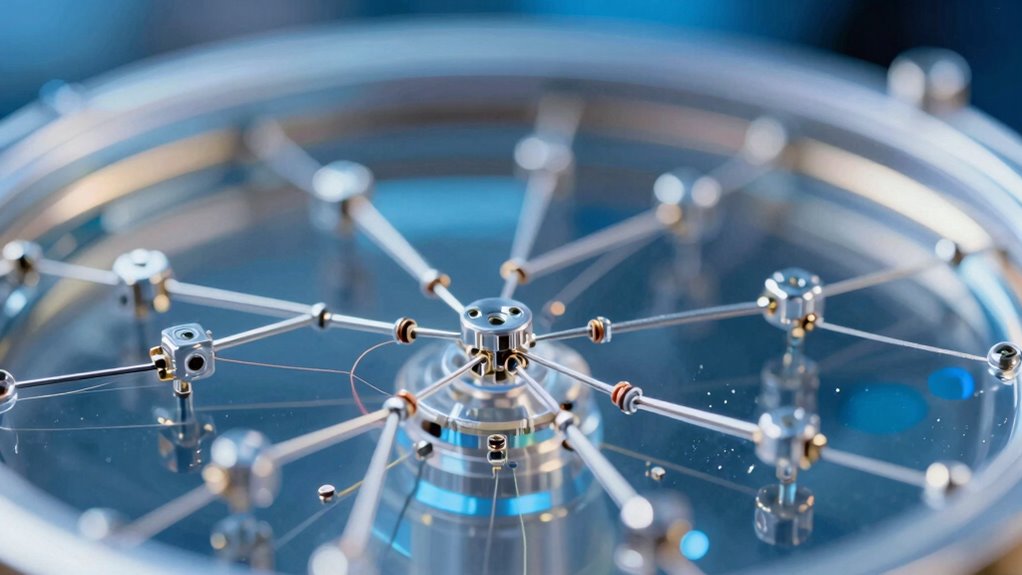

Bringing nanorobotics into practice is tough because controlling quantum effects like tunneling at such tiny scales is complex and unpredictable. Manufacturing at the nanoscale also faces hurdles, as traditional techniques are too slow, expensive, and hard to scale up reliably. These scientific and engineering challenges are intertwined, making it difficult to develop stable, predictable nanorobots for real-world use. Keep exploring, and you’ll see how breakthroughs could finally overcome these obstacles.

Get the latest gadgets delivered free with Prime
- Fast, free delivery on millions of items
- Prime Video, Amazon Music and more included
- Member-only deals all year
Key Takeaways
- Quantum effects like tunneling and superposition cause unpredictable behavior, complicating precise control of nanorobots.
- Developing scalable manufacturing techniques that ensure uniformity and cost-effectiveness remains a significant challenge.
- Managing quantum states and shielding nanorobots from quantum disturbances is technically complex.
- Material engineering at the nanoscale to withstand or manipulate quantum phenomena is still evolving.
- Integrating advancements across physics, engineering, and materials science is necessary but difficult for practical deployment.

Nanorobotics, the field involving the design and construction of robots at a nanometer scale, faces numerous significant challenges that hinder its full potential. One of the biggest hurdles is dealing with quantum effects. At such a tiny scale, the classical physics you’re used to no longer applies straightforwardly. Instead, quantum phenomena like superposition and tunneling become prominent, making precise control and predictable behavior difficult. These effects can cause nanorobots to behave unpredictably, disrupting their intended functions. For example, quantum tunneling might lead to unintended electron flow, interfering with delicate operations. Overcoming this requires innovative approaches to shielding or controlling quantum states, which remains a complex, largely unresolved problem. This unpredictability complicates designing reliable nanorobots, especially for medical or industrial applications where consistency is essential. Additionally, understanding quantum behavior at this scale is still an ongoing scientific challenge that impacts practical development, and advances in quantum measurement are crucial for progress. Developing effective quantum control techniques is crucial for managing these phenomena and advancing nanorobotics. Furthermore, researchers are exploring novel materials that could better withstand or manipulate quantum effects, which adds another layer of complexity but also potential solutions. Recent studies suggest that progress in material engineering at the nanoscale could help mitigate some of these quantum challenges. Manufacturing scalability is another major obstacle. While you might develop a tiny, functional prototype in a lab, mass-producing nanorobots at a practical scale presents enormous challenges. Traditional manufacturing techniques simply aren’t suited for such tiny structures, and current methods often lack the precision, efficiency, and cost-effectiveness needed for large-scale production. Techniques like top-down lithography or bottom-up self-assembly can be slow, expensive, and difficult to control uniformly across large batches. This limits the ability to produce nanorobots in the quantities necessary for real-world deployment. As a result, you’re faced with the dilemma of balancing high-quality, precise fabrication against the need for scalable, affordable manufacturing methods. Without advances here, the field remains largely in the research stage rather than ready for widespread commercial use. The interplay between these challenges compounds the difficulty. Quantum effects make designing stable, predictable nanorobots tricky, and manufacturing scalability hampers efforts to bring these designs into practical use. You need breakthroughs that address both issues simultaneously—innovations in quantum control techniques to mitigate unpredictability and new manufacturing processes that can produce large quantities reliably. Until then, nanorobotics will continue to face significant barriers, preventing it from progressing from promising research to transformative technology. Overcoming these challenges requires a multidisciplinary effort, combining physics, engineering, and materials science, to realize the full potential of nanorobots in medicine, manufacturing, and beyond.
nanorobotics manufacturing equipment
As an affiliate, we earn on qualifying purchases.
As an affiliate, we earn on qualifying purchases.
Frequently Asked Questions
What Are the Potential Medical Applications of Nanorobots?
You can envision nanorobots revolutionizing medicine by delivering nano drugs directly to targeted cells, increasing treatment precision. They could perform cellular repair, fixing damaged tissues or removing blockages, which reduces invasive procedures. These tiny devices might also detect early signs of diseases, enabling proactive care. While promising, challenges like safety, control, and manufacturing need solutions before nanorobots become routine in medical practice.
How Do Nanorobots Navigate Complex Biological Environments?
You control nanorobots by harnessing molecular movement and cellular interaction. They navigate complex biological environments through techniques like chemical gradients, magnetic guidance, or optical tracking, which help them move precisely. These robots detect signals from their surroundings, allowing them to respond to cellular cues and adapt their path accordingly. This intricate navigation requires sophisticated design to guarantee they can safely and effectively reach their target areas within the body.
Are There Ethical Concerns Surrounding Nanorobot Deployment?
Imagine it’s the 19th century, and you’re worried about privacy concerns with nanorobots. You should be—ethical issues are significant. You face regulatory challenges, like ensuring safety and preventing misuse. Concerns about autonomy, consent, and potential misuse keep everyone on edge. As you develop nanorobotics, you must balance innovation with ethics, making sure regulations keep pace. Addressing these concerns now helps prevent future problems and builds public trust in this cutting-edge technology.
What Materials Are Used to Build Functional Nanorobots?
You use materials like gold, silver, carbon nanotubes, and specialized polymers to build functional nanorobots. During nano assembly, you focus on material compatibility to guarantee components interact seamlessly at tiny scales. These materials provide the necessary strength, flexibility, and conductivity. Balancing these qualities is challenging because not all materials behave predictably at the nanoscale, making precise construction and reliable function difficult in developing effective nanorobots.
How Close Are We to Commercial Nanorobotics Products?
Right now, commercial nanorobotics products are still in development stages, facing significant scalability challenges and manufacturing hurdles. For example, creating medical nanorobots that can precisely target cancer cells requires complex, reliable fabrication methods. While some prototypes exist, mass production remains difficult due to the tiny scale and intricate materials involved. So, widespread use in everyday applications is still years away, though steady progress keeps hope alive.
As an affiliate, we earn on qualifying purchases.
Conclusion
You stand on the brink of a tiny world, where nanorobots dance like shimmering insects in a vast, intricate jungle of molecules. But as you reach out, you realize the path is cluttered with impossible puzzles—precise control, reliable power, and seamless integration. The future beckons with shimmering promise, yet each step feels like treading through fog, where breakthroughs are as elusive as catching fireflies in the dark. The journey to bring nanorobotics to life remains a formidable, shimmering horizon.
nanoscale material engineering tools
As an affiliate, we earn on qualifying purchases.
As an affiliate, we earn on qualifying purchases.
scalable nanofabrication techniques
As an affiliate, we earn on qualifying purchases.
As an affiliate, we earn on qualifying purchases.
Fall Picks
fall essentials
As an affiliate, we earn on qualifying purchases.