
When designing practical nanomachines, you must balance size, energy efficiency, and multifunctionality. Smaller components may enhance maneuverability but make achieving structural integrity harder. Improving energy use often involves tradeoffs, like increased complexity or reduced stability. Adding functions like sensing or communication increases power demands, risking efficiency. Steering these conflicting demands requires innovative materials and clever design choices. To master these challenges and develop reliable nanomachines, understanding these core tradeoffs is essential; explore further to uncover more insights.

Get the latest gadgets delivered free with Prime
- Fast, free delivery on millions of items
- Prime Video, Amazon Music and more included
- Member-only deals all year
Key Takeaways
- Balancing miniaturization with structural integrity and manufacturability at the nanoscale.
- Managing energy efficiency while ensuring sufficient power for complex functionalities.
- Integrating multiple functions without compromising device stability or increasing energy demands.
- Addressing unique material behaviors and quantum effects that differ from bulk materials.
- Navigating tradeoffs between performance, durability, and fabrication limitations to achieve practical applications.
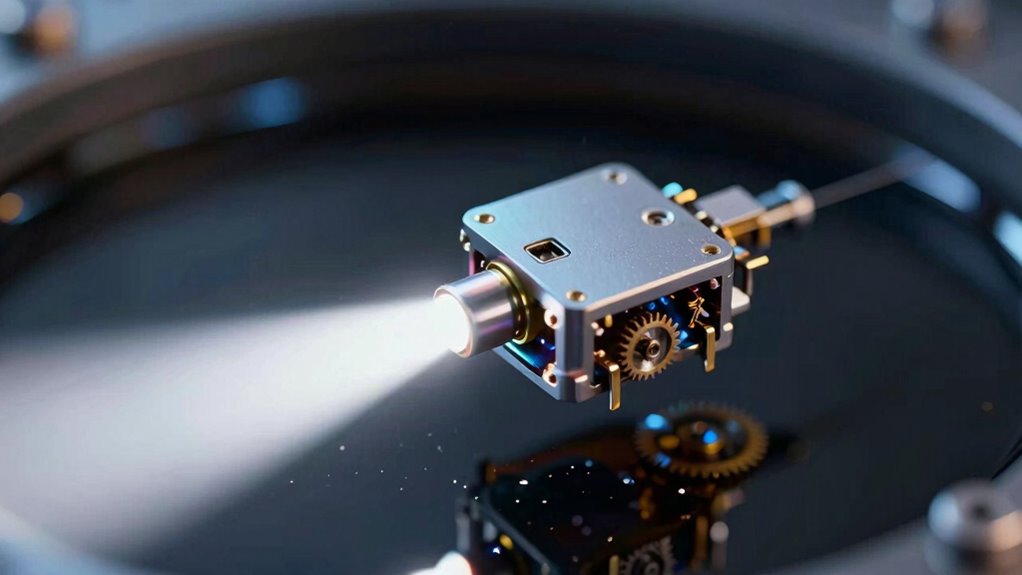
Have you ever wondered what challenges scientists face when designing nanomachines? One of the biggest hurdles involves overcoming scaling limitations. As you shrink devices down to the nanoscale, traditional engineering principles don’t always apply. Materials behave differently at this scale, and phenomena like quantum effects or surface forces can dominate, making it difficult to predict how a nanomachine will perform. This means that designing reliable, functional systems becomes a complex balancing act. You need components small enough to operate at the nanoscale, but not so small that they lose structural integrity or become uncontrollable. Achieving this balance requires innovative approaches, often pushing the boundaries of existing manufacturing techniques. Additionally, understanding the physics at the nanoscale is essential for predicting material behavior and device performance accurately. The unique properties of nanomaterials, such as enhanced strength or conductivity, also play a critical role in overcoming some of these challenges. For example, advances in nanomaterial fabrication can help address some of the scaling and performance issues faced at this level.
Another critical tradeoff centers on energy efficiency. When you miniaturize machines to the nanoscale, energy consumption becomes a double-edged sword. On one hand, nanomachines are designed to perform specific tasks with minimal energy, which is essential since their tiny size limits the amount of power they can store or generate. On the other hand, many nanomachines struggle with energy transfer and dissipation. You might find that while a nanomachine can operate with impressive precision, it consumes disproportionate amounts of energy relative to its size, reducing overall efficiency. This creates a dilemma: do you prioritize high energy efficiency to extend operational life, or do you design for maximum performance, accepting higher energy costs? Managing this tradeoff is key to creating practical nanomachines that can function effectively in real-world applications.
Furthermore, you must consider the complexity of integrating multiple functions into a single nanomachine without compromising its energy profile or stability. Adding features like sensing, actuation, or communication often increases energy demands and introduces new challenges related to scaling limitations. You need to find innovative ways to optimize energy use, perhaps through smarter control algorithms or energy harvesting techniques, to guarantee that the nanomachine remains efficient and durable over time. Incorporating adaptive control systems can help balance performance and energy consumption effectively, especially in dynamic environments.
Ultimately, designing practical nanomachines involves maneuvering these tradeoffs carefully. You must balance the constraints imposed by scaling limitations with the need for energy efficiency, all while ensuring that the device can perform its intended functions reliably. This delicate balancing act requires not only advanced materials and fabrication methods but also a deep understanding of physics at the nanoscale. By mastering these tradeoffs, you move closer to realizing nanomachines that are truly functional, efficient, and capable of transforming fields like medicine, environmental monitoring, and manufacturing.
Popular right now

Dyson V8 Cyclone Cordless Vacuum

Vitamix 5200 Professional-Grade Blender, 64 oz. Container, Black

Ninja Foodi DZ201 8-Quart DualZone 6-in-1 Air Fryer
As an affiliate, we earn on qualifying purchases.
Frequently Asked Questions
How Do Nanomachine Designs Vary Across Different Industries?
You’ll notice nanomachine designs differ across industries based on material customization and power efficiency needs. In medicine, you prioritize biocompatible materials for safe interactions inside the body, focusing on minimal power consumption for prolonged operation. In manufacturing, stronger, customizable materials are essential for durability, with power efficiency balancing energy use during high-intensity tasks. These variations warrant nanomachines meet specific industry demands effectively.
What Are the Ethical Considerations in Nanomachine Deployment?
Imagine tiny guardians patrolling your body, their presence raising questions about ethics. You must consider informed consent, ensuring individuals understand and agree to nanomachine use, and address privacy concerns, protecting personal data from misuse. Deploying nanomachines responsibly means weighing benefits against potential risks, respecting autonomy, and establishing transparency. If overlooked, these ethical issues could erode trust and cause harm, making careful oversight essential for safe, fair deployment.
How Do Environmental Factors Influence Nanomachine Stability?
Environmental factors critically influence nanomachine stability by affecting their environmental durability. You need to take into account variables like temperature, humidity, and chemical exposure, which can cause degradation or malfunction. To guarantee consistent performance, focus on stability optimization by selecting resistant materials and protective coatings. Regularly monitoring environmental conditions helps maintain nanomachine integrity, allowing them to operate effectively even in challenging settings.
What Are the Long-Term Health Impacts of Nanomachine Exposure?
You might face long-term health impacts from nanomachine exposure, especially if biocompatibility concerns aren’t fully addressed. Toxicity risks could lead to cellular damage or immune responses over time. It’s vital to guarantee that nanomachines are designed with safe materials and proper testing. Without this, you risk potential health issues like inflammation or toxicity buildup, which could have serious, lasting effects on your well-being.
How Is Scalability Addressed in Nanomachine Manufacturing?
Imagine building a skyscraper, but on a microscopic scale—that’s how nanomachine manufacturing tackles scalability. You focus on manufacturing consistency, ensuring each nanomachine meets strict standards, while optimizing for cost efficiency to make production viable. By developing advanced automation and modular designs, you can scale up production without sacrificing quality. This balance helps bring nanotechnology from lab breakthroughs to widespread practical use, ensuring reliable, affordable nanomachines for future applications.
Conclusion
In designing nanomachines, you face a delicate balancing act—every tradeoff shapes their potential. You must weigh power against precision, stability against flexibility, and efficiency against complexity. It’s a puzzle so intricate, it rivals the universe itself in complexity. Yet, embracing these compromises harnesses revolutionary capabilities that could transform medicine, energy, and beyond. Ultimately, your mastery of these tradeoffs determines whether nanomachines become mere marvels or the backbone of future technological wonders.