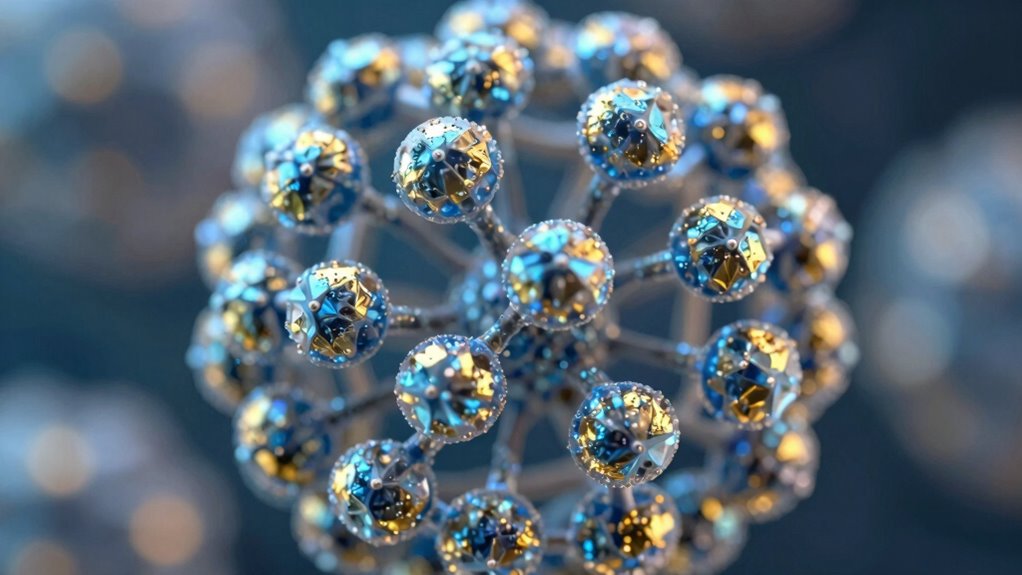

Nano catalysts are highly efficient at small scales because their tiny size creates a large surface area with many active sites, enabling faster reactions. They also have unique electronic properties that improve electron transfer, boosting reaction rates and efficiency. Additionally, their surface chemistry can be tailored for specific processes, increasing selectivity and reducing energy requirements. This combination of features not only saves costs but also minimizes environmental impact. Keep exploring to discover more about how these tiny catalysts revolutionize chemical processes.

Get the latest gadgets delivered free with Prime
- Fast, free delivery on millions of items
- Prime Video, Amazon Music and more included
- Member-only deals all year
Key Takeaways
- Nano catalysts have a vastly increased surface area, providing more active sites for reactions.
- Their small size facilitates rapid electron transfer, enhancing catalytic efficiency.
- Enhanced surface chemistry allows for targeted reactions and improved selectivity.
- Lower reaction temperatures and pressures are possible, reducing energy consumption.
- Reduced catalyst quantity leads to cost savings and minimized environmental impact.

Nano catalysts have revolutionized the field of chemical reactions by markedly boosting efficiency. When you work with nanoscale materials, you’re dealing with particles that are incredibly small—typically less than 100 nanometers in size. This tiny scale dramatically increases the surface area of the catalyst, which is a key factor in its enhanced performance. The larger the surface area, the more active sites are available for reactions to occur. Unlike bulk materials, where only the outer surface is reactive, nano catalysts expose a vast number of active sites, making reactions faster and more efficient. You’ll notice that this increased surface area allows molecules to interact more readily with the catalyst, reducing the energy needed to activate reactions.
Another *essential* aspect that makes nano catalysts so effective is their ability to facilitate electron transfer. In chemical reactions, electron transfer often determines how quickly and efficiently a process proceeds. Because of their small size, nano catalysts have unique electronic properties, including a high density of electrons and quantum effects that aren’t present in larger particles. These properties enable more effective electron transfer between the catalyst and reactant molecules. When you’re working with nano catalysts, you’ll observe that they often provide a more direct and rapid pathway for electrons to move, which accelerates reaction rates. This improved electron transfer also leads to higher selectivity and fewer unwanted by-products, making the process cleaner and more cost-effective. Additionally, the surface chemistry of nano catalysts plays a crucial role in their ability to promote specific reactions, further enhancing their efficiency. Moreover, the tunable surface properties of nano catalysts allow for customization to target particular reactions, increasing their versatility across different applications. The stability of nano catalysts under various reaction conditions further contributes to their long-term usefulness.
The combination of increased surface area and enhanced electron transfer capabilities means that nano catalysts are highly active even at lower temperatures and pressures. You don’t need as much energy input to drive reactions, which not only saves energy but also reduces wear and tear on equipment. Additionally, because nano catalysts are so efficient, they often require smaller amounts to achieve the same or better results compared to traditional catalysts. This efficiency translates into cost savings and less environmental impact.
As an affiliate, we earn on qualifying purchases.
Frequently Asked Questions
How Do Nano Catalysts Compare to Bulk Catalysts in Cost?
Nano catalysts tend to be more cost-effective than bulk catalysts because they require less material to achieve the same catalytic activity, thanks to their high surface area. However, you should consider manufacturing challenges, as producing uniform and stable nanomaterials can be complex and expensive. Overall, despite these hurdles, the increased efficiency and lower material usage make nano catalysts a promising, cost-effective option for various applications.
Can Nano Catalysts Be Used in All Types of Chemical Reactions?
You might think nano catalysts can’t be used for all reactions, but their size-dependent properties and surface area enhancement make them highly versatile. Their small size allows them to adapt to various chemical environments, speeding up reactions and improving efficiency. While some reactions may require specific conditions, nano catalysts generally serve a broad range of chemical processes, making them a powerful tool across many industries.
What Environmental Impacts Do Nano Catalysts Have?
You should know that nano catalysts can pose environmental risks like environmental toxicity and ecosystem disruption. Their tiny size allows them to easily enter water, soil, and air, potentially affecting organisms and disrupting ecological balances. If not properly managed or disposed of, these catalysts might accumulate in the environment, leading to harmful effects on wildlife and human health. Careful assessment and regulation are essential to minimize their environmental impact.
How Is the Stability of Nano Catalysts Maintained Over Time?
You can think of nano catalysts as delicate dancers on a stage, needing stability to keep their performance flawless. To maintain this, surface modification acts like a protective costume, shielding against degradation. Meanwhile, controlling particle aggregation keeps the ensemble from clumping together, ensuring each dancer’s role remains clear. Together, these strategies preserve the catalyst’s integrity over time, allowing it to perform its essential function with grace and persistence.
Are Nano Catalysts Safe for Human Health and Safety?
Nano catalysts pose potential health concerns due to their small size and high reactivity, which can lead to toxicity if inhaled or absorbed. You should follow safety regulations, like using proper protective equipment and containment measures, to minimize risks. Ongoing research aims to better understand their safety profile, but until then, handling them with caution is essential to protect human health and safety.
nanoparticle catalyst for chemical reactions
As an affiliate, we earn on qualifying purchases.
As an affiliate, we earn on qualifying purchases.
Conclusion
By harnessing their high surface area and unique properties, nano catalysts substantially boost reaction rates at small scales. Imagine a future where a tiny nano catalyst speeds up clean hydrogen production in a compact device, making renewable energy more accessible. This efficiency isn’t just science fiction; it’s the promising potential of nanotechnology. As you explore further, you’ll see how these tiny catalysts could revolutionize industries, making processes cleaner, faster, and more sustainable.
As an affiliate, we earn on qualifying purchases.
nano catalyst for energy efficiency
As an affiliate, we earn on qualifying purchases.
As an affiliate, we earn on qualifying purchases.
Halloween Picks
halloween
As an affiliate, we earn on qualifying purchases.