

The main reason nano material processing is so difficult is because quantum effects and the tiny scale cause unpredictable behaviors that standard manufacturing methods can’t manage. At this scale, tiny variations in size or surface chemistry substantially alter how materials behave, making control challenging. Achieving uniformity requires specialized tools and skilled operators, and small changes can lead to big problems. If you’re curious about how scientists overcome these hurdles, you’ll find the details coming up.
Open a free Amazon Business account
Business pricing, bulk buying and tax-exempt orders.
As an affiliate, we earn on qualifying purchases.
Key Takeaways
- Quantum effects at the nanoscale cause unpredictable material behaviors, complicating precise control and manufacturing consistency.
- Tiny variations in size, surface chemistry, and environmental conditions significantly impact nanoscale material properties.
- Conventional fabrication tools lack the precision needed, requiring advanced, costly equipment and highly skilled operators.
- Scaling laboratory processes to industrial production introduces contamination, stability, and safety challenges.
- The complexity of managing quantum phenomena and manufacturing limitations increases costs and hinders large-scale commercialization.
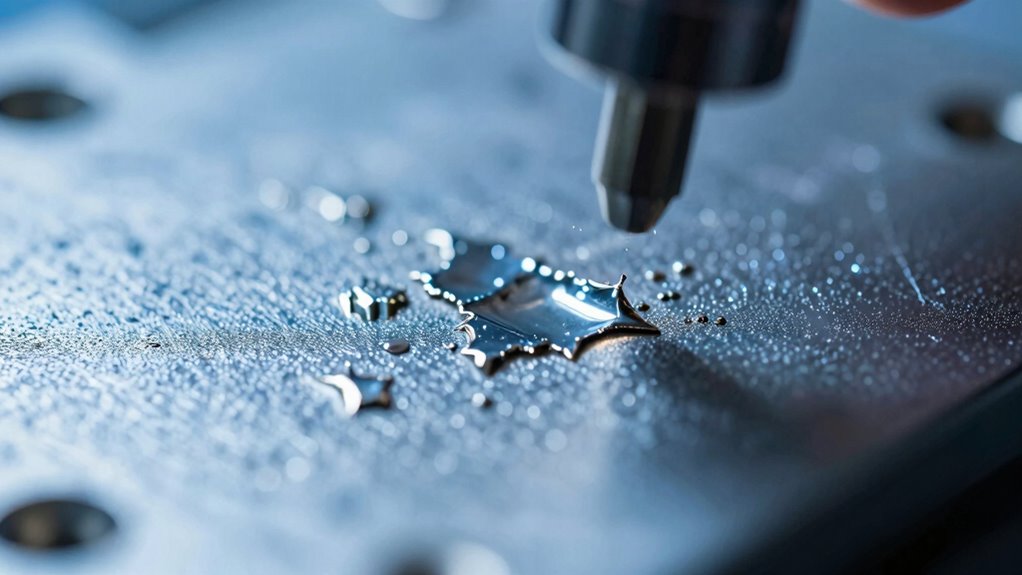
Processing nano materials presents significant challenges due to their incredibly small size and unique properties. When you work at the nanoscale, the rules of classical physics no longer fully apply. Instead, quantum effects become prominent, influencing how these materials behave and interact. These effects can cause unpredictable changes in electrical, optical, and mechanical properties, making it difficult to control and predict outcomes during manufacturing. You might find that the tiniest variation in size or surface chemistry dramatically alters a nanoparticle’s behavior, complicating efforts to produce consistent, reliable products.
One of the core reasons nano material processing is so difficult lies in these quantum effects. Unlike bulk materials, where atoms are arranged in predictable patterns, nanoparticles often exhibit behaviors driven by quantum mechanics. For example, electrons may exhibit wave-like properties, leading to phenomena such as quantum tunneling or size-dependent bandgap shifts. These effects can cause fluctuations in electrical conductivity or optical absorption, which are tricky to manage during manufacturing. As a result, you need specialized techniques and equipment to account for and harness these quantum behaviors, adding layers of complexity and cost to the process. Additionally, the sensitivity of nanoscale structures to environmental factors makes maintaining consistent conditions even more crucial for precision.
Manufacturing challenges further compound these issues. When handling materials at such a small scale, conventional fabrication methods often fall short. You face difficulties in achieving uniformity, as even minor inconsistencies in temperature, pressure, or chemical environment can lead to significant deviations in product quality. Controlling surface chemistry becomes critical because nanoparticles tend to agglomerate or react prematurely, disrupting the intended properties. Precise manipulation at the nanoscale demands advanced tools like atomic force microscopes or electron beam lithography, which are expensive and require highly skilled operators.
Moreover, scaling up nano manufacturing from laboratory experiments to industrial production introduces additional hurdles. Processes that work well on a small scale often become inefficient or unreliable when expanded, due to issues like contamination, process stability, and throughput. Handling such tiny materials also raises safety concerns, as nanoparticles can pose health risks if inhaled or ingested, demanding strict safety protocols. Understanding contamination control and adhering to safety standards is crucial for successful large-scale production.
In essence, the combination of quantum effects and manufacturing challenges makes processing nano materials a complex, delicate task. You must navigate unpredictable behaviors driven by physics at the atomic level while overcoming the technical limitations of current fabrication techniques. This dual challenge explains why, despite their promising applications, nano materials remain difficult to produce consistently and efficiently on a commercial scale.
Atomic force microscope for nano fabrication
As an affiliate, we earn on qualifying purchases.
As an affiliate, we earn on qualifying purchases.
Frequently Asked Questions
What Specific Nano Materials Are the Most Challenging to Process?
You find carbon nanotubes and quantum dots among the most challenging nano materials to process. Surface interactions at this scale are complex, making control difficult. Quantum effects further complicate manufacturing because they alter properties unpredictably. These factors demand precise techniques and advanced equipment. As a result, achieving consistent quality and scalability remains tough, requiring you to navigate intricate surface chemistry and quantum behaviors carefully during processing.
How Do Temperature Fluctuations Impact Nano Material Processing?
Think of temperature fluctuations as a wild storm disrupting delicate nano landscapes. They threaten thermal stability, causing unpredictable shifts that can ruin precise structures. You need fluctuation control to tame this chaos, maintaining a steady environment where nano materials can form and function flawlessly. When temperature stays consistent, your processing becomes smoother, ensuring the tiny world you’re building remains intact, and the extraordinary properties of nano materials shine through without compromise.
Are There Safety Concerns Unique to Nano Material Manufacturing?
You should be aware that nano material manufacturing poses unique safety concerns, including environmental hazards from nanoparticle release and potential health risks to workers. Regulatory challenges complicate safety measures, as existing standards often don’t fully cover nanomaterials. You require strict safety protocols, proper disposal methods, and ongoing monitoring to minimize environmental impact and guarantee compliance, making safety a critical focus in nano manufacturing processes.
What Recent Technological Advances Have Improved Nano Processing?
You see, recent advances like atomic layer deposition and high-precision microscopy act like microscopic brushes, painting tiny, precise structures. These innovations improve nano processing by enhancing control and reducing waste, but they also raise nanotechnology ethics questions about environmental impact. As you harness these cutting-edge tools, you balance innovation with responsibility, ensuring that the tiny worlds you create don’t leave a heavy footprint on our planet.
How Does Scale-Up Affect Nano Material Quality and Consistency?
When you scale up nano material processing, it introduces scaling complexities that can compromise quality and consistency. Larger production volumes often lead to variability in particle size, distribution, and surface properties. You must carefully control every step to manage these consistency challenges. Without precise adjustments, quality may fluctuate, making it hard to guarantee uniform nano materials suitable for advanced applications.
Electron beam lithography equipment
As an affiliate, we earn on qualifying purchases.
As an affiliate, we earn on qualifying purchases.
Conclusion
So, it’s no real surprise you find nano material processing so challenging—it’s almost like the universe conspired to keep it tricky. Just when you think you’ve cracked the code, new obstacles pop up, reminding you of the delicate dance between precision and chaos. But maybe, amidst all the coincidences and setbacks, that’s what makes breakthroughs so rewarding. Keep pushing forward, because someday, those tiny particles might just reveal enormous possibilities you never saw coming.
Nano surface chemistry analysis tools
As an affiliate, we earn on qualifying purchases.
As an affiliate, we earn on qualifying purchases.
Quantum effects measurement devices
As an affiliate, we earn on qualifying purchases.
As an affiliate, we earn on qualifying purchases.
NFL season / tailgating Picks
team gear
As an affiliate, we earn on qualifying purchases.