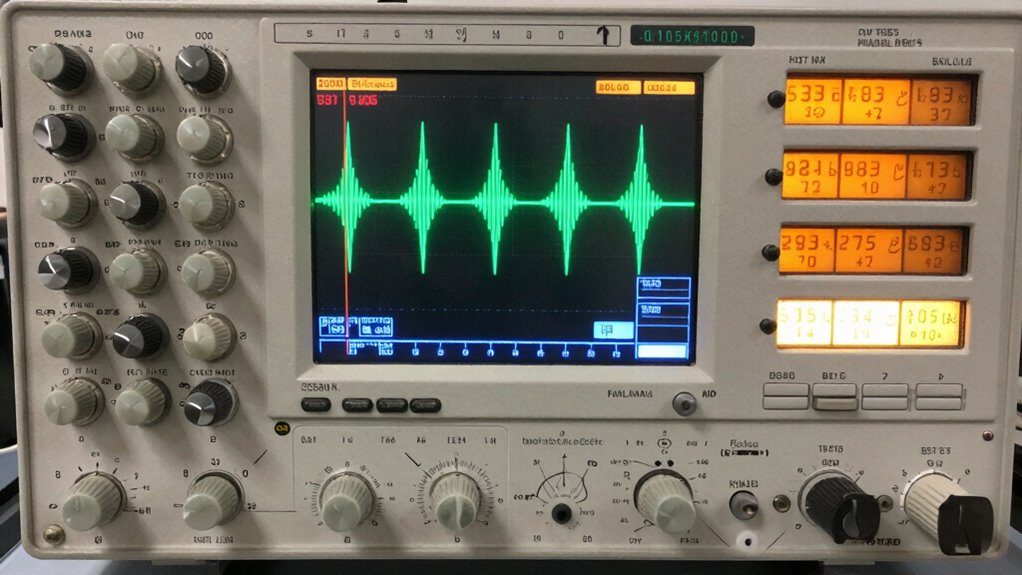

Oscilloscope specs can be confusing because manufacturers often list maximum bandwidth figures that are more theoretical than practical, making it hard to know if a scope will truly meet your needs. High bandwidth doesn’t always mean better performance for your specific signals, and specs can be misleading or misunderstood. To pick the right scope, you need to understand how these numbers relate to real-world performance. Keep exploring to learn how to make smarter choices based on actual application requirements.
Key Takeaways
- Manufacturers often present maximum bandwidth figures that don’t reflect real-world performance or measurement accuracy.
- Specs can be misleading or misunderstood, making it hard for buyers to assess actual capabilities.
- Bandwidth ratings may not align with the signal frequencies encountered in typical applications.
- Focusing solely on maximum specs overlooks how a scope performs under practical, everyday conditions.
- Buyers struggle to interpret technical specifications’ real-world implications for their specific measurement needs.
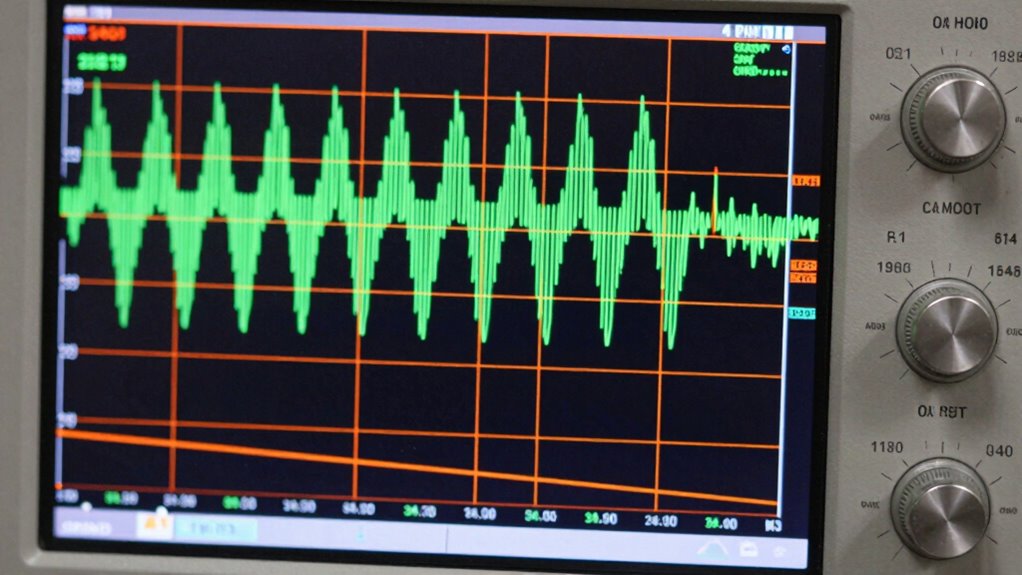
Choosing the right oscilloscope can be confusing because manufacturers often present specifications in ways that are hard to interpret. One key aspect that trips many buyers up is understanding bandwidth limitations. You might see a scope boasting a high bandwidth, but that doesn’t always translate to better performance for your specific needs. Manufacturers often list maximum bandwidths that are more theoretical than practical, and these figures can be misleading if you don’t take into account your signal frequencies. For example, a scope with 100 MHz bandwidth might suffice for certain applications, but if you’re working with signals that have higher frequency components, you’ll need a scope with a higher bandwidth to accurately capture those details. Without a clear understanding of bandwidth limitations, you risk choosing a scope that can’t handle your signals properly, leading to inaccurate measurements or missed details. Additionally, understanding how measurement accuracy is affected by these specs is crucial for making an informed decision. Recognizing that **bandwidth limitations** directly impact the scope’s ability to accurately represent signals can help prevent costly mistakes. Being aware of real-world performance can help buyers select a scope that truly meets their needs rather than just focusing on maximum specifications. Moreover, understanding how specifications translate into actual use can help you make more reliable choices for your specific application.

FNIRSI DSO152 Handheld Oscilloscope – 2.8" TFT Digital Oscilloscope Kit 200KHz Bandwidth 2.5MS/s High Sampling Rate Portable Pocket Oscilloscope, Trigger Function Auto/Nomal/Single
【Faster Sampling Speed】FNIRSI DSO152 handheld oscilloscope has a real-time sampling rate of 2.5 MS/s and a 200 KHz…
As an affiliate, we earn on qualifying purchases.
As an affiliate, we earn on qualifying purchases.
Frequently Asked Questions
How Do I Interpret a Bandwidth Specification Accurately?
To interpret a bandwidth specification accurately, you should understand that it indicates the highest frequency the oscilloscope can reliably measure. Check calibration standards to guarantee accuracy, and consider warranty coverage for added confidence. Remember, a higher bandwidth generally means better ability to capture fast signals. Always compare specs across models, and don’t forget to verify calibration and warranty details to ensure the scope meets your specific measurement needs.
What Does “Rise Time” Mean for Oscilloscope Performance?
Rise time shows how quickly an oscilloscope can display a signal’s shift from low to high. Faster rise times mean sharper, more accurate waveforms, which help you analyze fast-changing signals. Think of trigger sensitivity as your ability to catch quick signals, and display resolution as how clearly you see them. Both, like rise time, influence how precisely you interpret your data, making your measurements more reliable and your troubleshooting easier.
Is a Higher Sample Rate Always Better?
A higher sample rate isn’t always better because it can increase power requirements and impact calibration accuracy. While a faster sample rate captures more detail, it may demand more power, possibly affecting performance stability. If your measurements don’t involve extremely fast signals, a moderate sample rate suffices. Focus on balancing sample rate with calibration accuracy and power needs to guarantee reliable, precise results without unnecessary complexity or expense.
How Does Input Impedance Affect Measurements?
Input impedance affects your measurements’ accuracy by determining how much the oscilloscope loads the circuit. A high input impedance minimizes the circuit’s disturbance, ensuring your readings are more precise. Low input impedance can lower measurement accuracy by drawing more current and altering signals. Consequently, understanding an oscilloscope’s input impedance helps you select the right device for accurate, reliable measurements, especially in sensitive or high-impedance circuits.
What Are the Key Differences Between Analog and Digital Oscilloscopes?
You’ll notice that digital oscilloscopes dominate 80% of the market, offering clearer signal fidelity and higher display resolution than analog models. Analog oscilloscopes display signals in real-time, providing a continuous view perfect for quick assessments. Digital scopes convert signals into digital data, enabling precise measurements and storage. Choose based on your needs—analog for speed, digital for accuracy and detailed analysis.
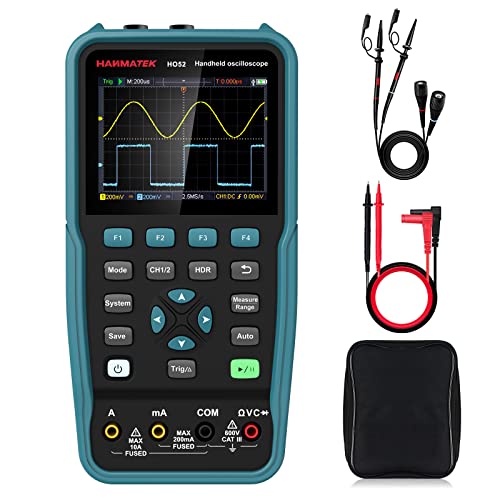
HANMATEK Handheld Digital Oscilloscope 50Mhz Bandwidth with 2 Channels HO52 3.5" TFT Mini Oscilloscope, 2 in 1 Oscilloscope and Multimeter, Backlit Screen, Auto-Calibration Function, Memory Function
【Scope Mode】: 1. The waveform refresh rate is up to 10000wfms / s; 2. Oscilloscope 2 channel input,…
As an affiliate, we earn on qualifying purchases.
As an affiliate, we earn on qualifying purchases.
Conclusion
Exploring oscilloscope specs is like trying to read a map in a foreign city—you might understand the language, but the symbols can still trip you up. Don’t let confusing numbers steer you wrong; instead, focus on what really matters for your needs. With a little patience, you’ll soon be guiding your projects smoothly, like a skilled captain steering familiar waters. Remember, understanding specs isn’t just technical—it’s your key to confidently mastering your measurements.

FNIRSI DSO-510 Handheld Oscilloscope/DDS Signal Generator 2 in 1, Digital Portable Automotive Oscilloscope 2.8 inch TFT, 10MHz Bandwidth, 48MS/s Sampling Rate, Trigger Function Auto/Nomal/Single
【10 MHz Oscilloscope】FNIRSI DSO-510 handheld oscilloscope 10 MHz bandwidth, 48 MS/s sampling rate, 50 ns-20 S time base…
As an affiliate, we earn on qualifying purchases.
As an affiliate, we earn on qualifying purchases.

SainSmart Micsig 12-bit High Resolution Tablet Oscilloscope MHO1, 100MHz Bandwidth, ≤3.5ns Rise Time, 4 Channels, Integrated 4 5/6 Digit Multimeter, 1GSa/s, 8” HD Touch Screen & 16000mAh Battery
100MHz High-Precision Performance: Featuring a 100MHz bandwidth and a ≤3.5ns rise time, the MHO1 is optimized for capturing…
As an affiliate, we earn on qualifying purchases.
As an affiliate, we earn on qualifying purchases.