

Manufacturing repeatable nanomaterials is trickier than it looks because tiny changes in synthesis conditions—like temperature, pH, or precursor amounts—can cause big differences in properties. Small shifts in surface chemistry or particle size can impact stability and performance, making consistency difficult to achieve. Precise process control, thorough characterization, and understanding the delicate interplay between variables are essential. If you keep exploring, you’ll discover just how complex and fascinating this challenge truly is.

Get the latest gadgets delivered free — and shop member deals
- Fast, free delivery on millions of items
- Access to Prime Big Deal Days deals on October 6–7
- Prime Video, Amazon Music and more included
Key Takeaways
- Small variations in synthesis parameters can significantly alter nanomaterial properties, making consistency challenging.
- Precise control of surface chemistry influences particle growth, stability, and uniformity.
- Batch-to-batch reproducibility requires meticulous process management and advanced automation.
- Real-time characterization and monitoring are essential to ensure quality and uniformity.
- Understanding the interplay between synthesis variables and surface chemistry is critical for reliable production.
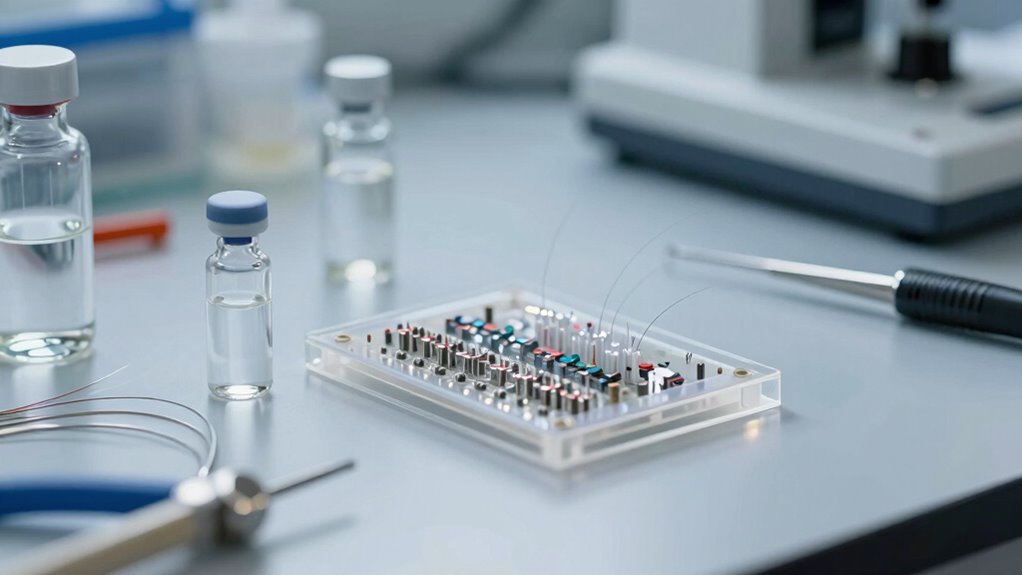
Creating nanomaterials that are consistently identical is far more complex than it appears. At this tiny scale, even the slightest variation can lead to significant differences in properties and performance. Your challenge lies in controlling every aspect of the synthesis process to guarantee uniformity. Surface chemistry plays a critical role here; it governs how particles interact with their environment and each other. Slight changes in surface chemistry can alter how nanomaterials assemble, their stability, and their reactivity. Achieving precise control over surface properties requires meticulous adjustment of reaction conditions, surfactants, and functionalization steps.
Synthesis control becomes your primary tool to manage these variables. You need to master parameters such as temperature, reaction time, precursor concentrations, and pH levels. Small deviations in these factors can result in variations in size, shape, or surface functionality, which undermine repeatability. For example, if you’re synthesizing metal nanoparticles, variations in temperature might cause inconsistent particle sizes, directly impacting the material’s performance. Your goal is to fine-tune the process so that every batch mirrors the last as closely as possible. This means establishing rigorous protocols and often employing automated systems to reduce human error.
But controlling synthesis isn’t just about setting parameters; it also involves understanding the underlying chemistry. Surface chemistry, in particular, influences how materials nucleate and grow. Controlling this aspect means selecting appropriate ligands or surfactants that can direct the growth process or stabilize the particles. Even subtle differences in the surface charge or functional groups can cause a cascade of effects, leading to non-uniformity. You must carefully characterize and monitor surface properties throughout synthesis to ensure consistency from batch to batch. Additionally, understanding the interplay of synthesis variables is crucial, as minor adjustments can lead to major differences in the final product. Recognizing the sensitivity of nanomaterial synthesis helps in developing more robust and reliable production methods. Employing thorough quality control measures, such as real-time monitoring, can further improve reproducibility.
Furthermore, achieving reproducibility requires a deep understanding of how synthesis variables interplay. Small changes in one parameter can have outsized effects, making the process highly sensitive. This complexity demands rigorous quality control measures—characterization techniques like electron microscopy, spectroscopy, and surface analysis become essential. These tools help you verify that your nanomaterials meet the same specifications every time, ensuring the same performance in applications.
In addition, understanding the optical properties of nanomaterials can provide insights into their uniformity and quality, as even minor variations can significantly influence their optical responses. Recognizing how material properties relate to synthesis conditions enables more precise control over the final product. In essence, making repeatable nanomaterials isn’t just about following a recipe; it’s about mastering the chemistry and process controls that influence every step. Surface chemistry and synthesis control are your guiding principles, and understanding their nuances allows you to produce nanomaterials with the consistency needed for real-world use. It’s a delicate balance, but with precision, patience, and expertise, you can overcome the hidden complexities and achieve true uniformity.
As an affiliate, we earn on qualifying purchases.
Frequently Asked Questions
What Are the Main Applications of Repeatable Nanomaterials?
You can use repeatable nanomaterials mainly for surface modification and functionalization techniques, which enhance material properties and enable targeted applications. They’re essential in medicine for drug delivery and imaging, in electronics for improved conductivity, and in energy storage for efficient batteries. These nanomaterials also find roles in environmental cleanup, sensors, and catalysis. Their consistent quality ensures reliability across these applications, making them indispensable in advancing technology and industry.
How Do Environmental Factors Influence Nanomaterial Consistency?
Environmental variability greatly affects nanomaterial consistency by introducing unpredictable factors during synthesis. You need to carefully control synthesis conditions like temperature, humidity, and pH, as fluctuations can alter nanoparticle size, shape, and properties. Variations in environmental factors can lead to inconsistent results, making it harder to produce repeatable nanomaterials. Maintaining strict environmental control guarantees synthesis precision, resulting in reliable, high-quality nanomaterials suitable for their intended applications.
What Are the Cost Implications of Producing Nanomaterials?
Ever wondered how expensive it is to produce nanomaterials? The cost implications are significant, involving detailed cost analysis that considers raw materials, specialized equipment, and precise processes. You need to evaluate economic feasibility to determine if large-scale production makes sense financially. While high initial investments are common, careful planning can optimize costs, making nanomaterial manufacturing more sustainable and profitable in the long run.
How Scalable Are Current Nanomaterial Manufacturing Processes?
Current nanomaterial manufacturing processes face significant scalability challenges due to manufacturing limitations. You’ll find that scaling up from lab to industry isn’t straightforward because precise control at a larger scale is difficult, often leading to inconsistent quality and higher costs. While some methods are adaptable, many still struggle with maintaining uniformity and efficiency, which hampers widespread commercialization and limits large-scale production.
What Safety Concerns Exist With Nanomaterial Production?
During nanomaterial production, safety concerns center around toxic exposure from airborne particles. You need to manage these tiny particles carefully, as they can easily become airborne and pose inhalation risks. Proper ventilation, protective gear, and strict handling protocols are essential to prevent health hazards. Ignoring these precautions can lead to respiratory issues or long-term health problems, so always prioritize safety measures when working with nanomaterials.
nanoparticle characterization tools
As an affiliate, we earn on qualifying purchases.
As an affiliate, we earn on qualifying purchases.
Conclusion
Understanding the hidden complexity of making repeatable nanomaterials reveals a delicate dance behind every tiny structure. Like a master chef juggling ingredients, you must balance countless variables to guarantee consistency. This intricate process reminds you that even the smallest details hold enormous weight, shaping the future of nanotechnology. As you navigate this labyrinth, remember that opens hidden potential—transforming chaos into order, one nanomaterial at a time.
automated chemical reactor for nanomaterials
As an affiliate, we earn on qualifying purchases.
As an affiliate, we earn on qualifying purchases.
surface chemistry analysis equipment
As an affiliate, we earn on qualifying purchases.
As an affiliate, we earn on qualifying purchases.
Fall Picks
fall essentials
As an affiliate, we earn on qualifying purchases.