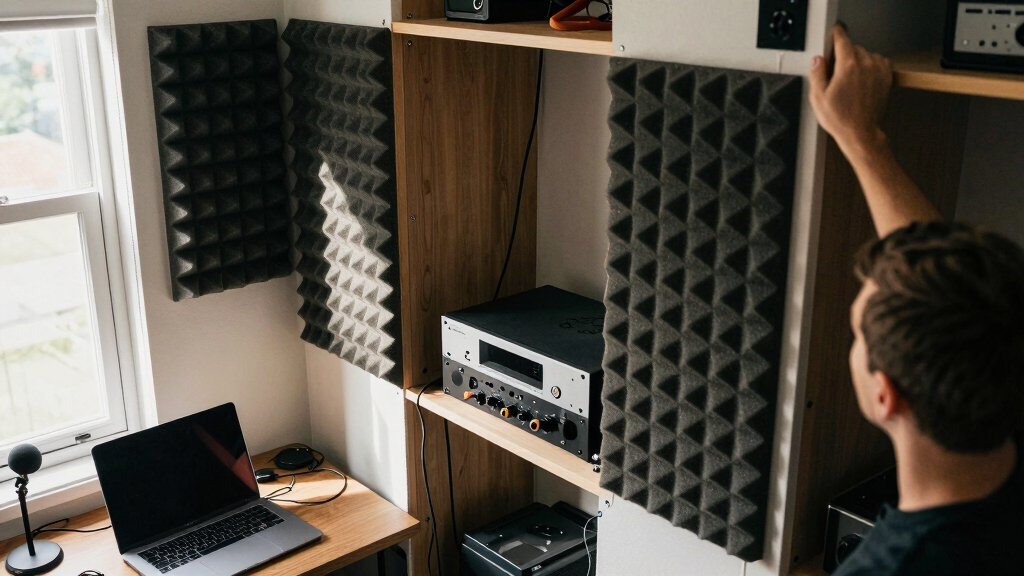

📊 Full opportunity report: Acoustic Dampening, Placement, and the “Rig in the Closet” Setup on ThorstenMeyerAI.com — validation score, market gap, and execution plan.

Get the latest gadgets delivered free — and shop member deals
- Fast, free delivery on millions of items
- Access to Prime Big Deal Days deals on October 6–7
- Prime Video, Amazon Music and more included
TL;DR
This article explains how to significantly reduce AI workstation noise by strategic placement and ventilation. Moving the rig to another room or using specialized enclosures can be more effective than acoustic foam alone.
Moving high-power AI workstations out of the workspace into separate rooms or enclosures is the most effective way to reduce noise, according to recent technical guidance. This approach can eliminate the need for acoustic treatment, making the workspace quieter and more comfortable.
Experts emphasize that the most impactful method for noise reduction is relocating the rig away from the user, such as into a closet, basement, or separate room, and operating it headless over a network connection. This strategy leverages distance and isolation, which are more effective than acoustic foam or barriers alone.
Placing a machine in a sealed or semi-sealed enclosure, like a closet or specialized soundproof cabinet, can significantly dampen airborne noise but introduces heat management challenges. Proper ventilation—passive vents or active exhaust fans—is essential to prevent overheating and maintain system performance.
The ‘rig in the closet’ setup is a viable solution for noise-sensitive environments, provided that airflow is carefully managed. Without adequate ventilation, trapped heat can cause thermal throttling, increasing fan noise and defeating the purpose of enclosure-based noise mitigation.
Additional measures such as anti-vibration pads and rubber feet can reduce structure-borne noise, further improving acoustic comfort. Combining placement strategies with ventilation and minimal acoustic treatment yields the best results in noise reduction.
Acoustic dampening
& the rig in the closet.
The most powerful noise fix isn’t a material — it’s a floor plan. A rig you can’t hear because it’s in another room beats any amount of foam. Tap the approaches in Part 1 to see what actually works.
(another room)
(levers 1–4)
(door / barrier)
(acoustic foam)
Contain the noise, not the heat
Why Placement and Ventilation Are Key in Noise Control
Effective noise management enhances workspace comfort, reduces distractions, and can improve productivity for users of high-performance AI rigs. Moving the rig into another room or a dedicated enclosure minimizes the need for costly acoustic foam and other treatments, making noise reduction more practical and scalable. Proper ventilation ensures system longevity and prevents overheating, which is critical for continuous operation. Overall, these strategies allow for quieter, more efficient AI workflows without sacrificing performance.
As an affiliate, we earn on qualifying purchases.
Recent Guidance on Noise Reduction for AI Workstations
Traditional approaches to noise reduction focus on acoustic foam, barriers, and vibration damping. However, experts increasingly recommend relocating the rig away from the workspace altogether, especially since most AI inference tasks are network-based and do not require the physical machine to be nearby. The 'rig in the closet' setup has gained popularity as a practical solution, combining physical separation with proper cooling methods.
This advice builds on established principles of airborne and structure-borne noise management, emphasizing that distance and ventilation are more effective than foam or barriers alone. The challenge remains in balancing noise containment with effective heat dissipation, particularly in enclosed spaces.
"Moving the rig into another room or closet is often the most effective way to reduce noise, especially since most AI inference work is network-based."
— Thorsten Meyer, AI workspace expert
As an affiliate, we earn on qualifying purchases.
Unresolved Challenges in Heat Management for Enclosed Rigs
While placing a rig in a closet or sealed enclosure effectively reduces noise, managing heat remains a primary concern. The optimal ventilation solutions and their impact on noise levels vary depending on the enclosure design and system load. It is not yet clear how best to balance thermal dissipation with noise containment in all scenarios, and further research or testing is ongoing.
As an affiliate, we earn on qualifying purchases.
Next Steps for Implementing Quiet AI Workstations
Practitioners are advised to experiment with different ventilation setups—such as ducted airflow, thermostatically controlled fans, or purpose-built soundproof cabinets—to find the best balance between noise reduction and cooling. Future developments may include more integrated, affordable solutions that combine acoustic treatment with thermal management. Monitoring system temperatures and noise levels during operation will help refine these setups for different environments.
As an affiliate, we earn on qualifying purchases.
Key Questions
Is it better to move the entire AI rig to another room or use an enclosure?
Moving the rig to another room or closet is generally more effective for noise reduction than just acoustic treatment, especially if the rig is operated headless over a network.
How can I prevent overheating if I place my rig in a closet?
Ensure proper ventilation through passive vents or active exhaust fans. Using purpose-built soundproof cabinets with temperature control can also help maintain safe operating temperatures.
Does acoustic foam help if the rig is in another room?
No, acoustic foam mainly reduces reflections within a room. If the rig is in another room, foam is unnecessary; distance alone can significantly reduce noise transmission.
What are the best practices for ventilation in enclosed setups?
Use ducted airflow, thermostatically controlled fans, and ensure vents are positioned to promote effective heat escape without increasing noise levels significantly.
Source: ThorstenMeyerAI.com
Fall Picks
fall essentials
As an affiliate, we earn on qualifying purchases.