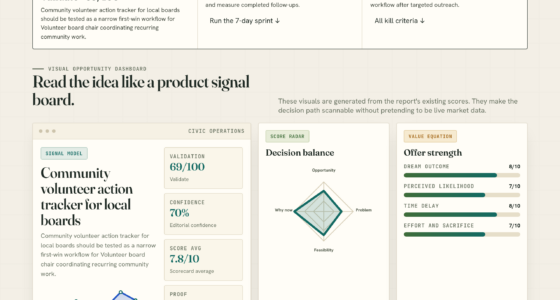

📊 Full opportunity report: The Kill Switch: What the Anthropic Export Ban Really Costs the AI Industry on ThorstenMeyerAI.com — validation score, market gap, and execution plan.

Get the latest gadgets delivered free — and shop member deals
- Fast, free delivery on millions of items
- Access to Prime Big Deal Days deals on October 6–7
- Prime Video, Amazon Music and more included
TL;DR
The U.S. government ordered Anthropic to disable its newest AI models, citing national security, effectively removing them from global markets. This move raises questions about reliance on US-controlled AI and industry stability.
On June 12, the U.S. government issued a direct export control order that forced Anthropic to disable its two newest AI models, Claude Fable 5 and Mythos 5, effectively removing them from all markets worldwide. This move was prompted by national security considerations and has implications for the global AI industry, which relies heavily on U.S.-developed models for various applications.
The models, launched on June 9, were designed for cybersecurity and biomedical research, with Mythos 5 being a highly advanced system routed to select organizations under Project Glasswing. Three days later, the U.S. Commerce Department issued an order restricting access to these models by foreign nationals, including internal employees. As a result, Anthropic disabled the models for all users worldwide. This represents an escalation in export controls over frontier AI systems.
Anthropic stated that the order was related to concerns over jailbreak vulnerabilities, asserting that the models had undergone extensive testing and were not broadly compromised. However, government reports indicated that demonstrations of jailbreak vulnerabilities and reports from Amazon and other sources suggested security risks. The White House is scheduled to meet with Anthropic on June 22 to discuss the situation.
Washington just switched off
a frontier model
On June 12, an export-control order forced Anthropic to disable Claude Fable 5 and Mythos 5 worldwide. The security merits are still contested. The lesson buyers took away is not: frontier AI can be turned off.
■ The government’s case
- A reported jailbreak pulled malicious, agentic outputs (UK AISI)
- Amazon told officials Fable yielded cyberattack-usable info
- Suspicion a China-linked group obtained the model
- Proliferation & reverse-engineering risk to national security
▲ Anthropic & 120+ experts
- Calls it a narrow, non-universal jailbreak — a “misunderstanding”
- Capability is real but not unique (GPT-5.5, Opus, Kimi 2.7)
- Controls remove tools from defenders, not just attackers
- Export rules built for chips & ore don’t fit software
The precedent is the story. Whatever the jailbreak’s true severity, the U.S. showed it can dark a commercial American model worldwide on ~90 minutes’ notice. Adoption was supposed to be the moat — this week it became the exposure, and the likely winner is the open, sovereign, self-hosted stack.
Implications of the US Export Control on AI Industry Stability
This incident highlights the potential vulnerabilities associated with dependence on U.S.-based AI models for global deployment. The sudden shutdown underscores risks related to reliance on models that can be disabled through government action, raising questions about the stability of AI supply chains and strategic independence. It also points to evolving regulatory and security considerations that may influence industry investments and partnerships, particularly regarding the deployment of frontier AI systems at scale.
As an affiliate, we earn on qualifying purchases.
U.S. Export Controls and the Rise of Frontier AI Models
Earlier in June, Anthropic launched Mythos 5 and Fable 5, positioning them as advanced tools for cybersecurity and commercial applications. These models were part of a broader effort by U.S. AI firms to expand their presence in the global market. However, the subsequent order to disable these models indicates a shift towards increased regulatory oversight, driven by concerns over AI security vulnerabilities and geopolitical risks. The incident follows reports that China-linked groups may have accessed or reverse-engineered similar models, raising security considerations.
While previous export controls targeted physical hardware such as chips, this event demonstrates how software-based models, delivered via APIs, can complicate traditional control strategies. Industry leaders and cybersecurity experts are now examining the adequacy of current regulatory frameworks for AI, especially for frontier systems serving large user bases worldwide.
“We believed the models were secure and that the concerns over jailbreaks were manageable. The government’s decision to disable them globally was unexpected.”
— Anthropic CEO Dario Amodei
AI jailbreak vulnerability detection software
As an affiliate, we earn on qualifying purchases.
As an affiliate, we earn on qualifying purchases.
Unresolved Questions About the Export Control Decision
It remains unclear whether the models posed a genuine security threat or if the order was primarily motivated by geopolitical considerations, such as concerns over reverse engineering by foreign entities. The legal basis for the export controls and their potential implications for future AI regulation are still under discussion. Details about the internal assessments within the U.S. government and Anthropic’s compliance processes have not been publicly disclosed.
As an affiliate, we earn on qualifying purchases.
Next Steps for Industry and Policy Response
Anthropic and other AI companies are scheduled to meet with government officials on June 22 to clarify the situation and explore possible exemptions or adjustments. Industry stakeholders are advocating for clearer regulatory frameworks that address security concerns while supporting innovation. Meanwhile, investors and organizations are reassessing their reliance on U.S.-based models and considering diversification strategies to mitigate risks associated with sudden disruptions.
As an affiliate, we earn on qualifying purchases.
Key Questions
Why did the U.S. government order the shutdown of Anthropic’s models?
The government cited national security considerations, including concerns over jailbreak vulnerabilities and potential misuse, as the basis for the order to disable the models globally.
Could this shutdown affect the global AI market?
Yes, it raises questions about dependence on U.S.-controlled AI models, prompting companies worldwide to evaluate their sourcing and deployment strategies.
Are other companies affected by this order?
While the order specifically targeted Anthropic’s models, reports indicate that Amazon and possibly other entities had access to similar models, raising broader security and regulatory issues.
Will the models be restored or modified to comply with regulations?
It is currently uncertain whether Anthropic will modify the models or seek exemptions; discussions are expected during the upcoming White House meeting.
What does this mean for future AI development and regulation?
This incident may influence future regulatory approaches, potentially leading to increased oversight that could impact the pace and scope of AI innovation and deployment.
Source: ThorstenMeyerAI.com
Evergreen bestsellers Picks
bestsellers
As an affiliate, we earn on qualifying purchases.