

📊 Full opportunity report: AI Changelog Digest For Open-source Maintainers on IdeaNavigator AI — validation score, market gap, and execution plan.
TL;DR
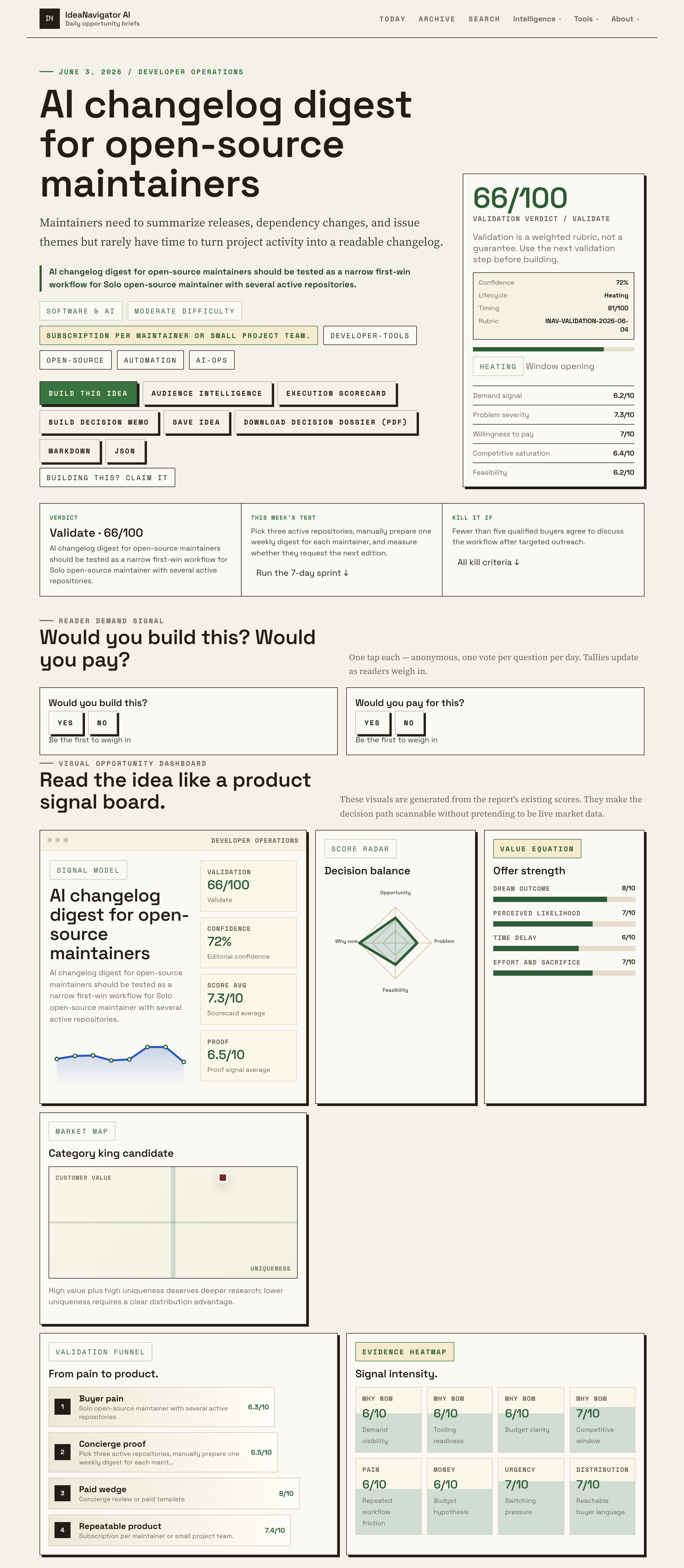
An AI-driven changelog digest tool is being tested for solo open-source maintainers managing multiple repositories. It automates release summaries, dependency changes, and issue themes, with plans for a subscription model. The development aims to streamline project communication and reduce manual effort.
AI changelog digest for open-source maintainers is being tested as a workflow designed specifically for solo maintainers managing multiple repositories. The tool aims to automate the summarization of releases, dependency changes, and issue themes, reducing manual effort and improving communication with contributors and stakeholders.
The proposed digest generator reads data from a repository’s release feeds, merged pull requests, and top issues, then drafts a concise changelog email for the maintainer’s review and approval. This initiative is targeted at solo open-source developers who lack dedicated developer relations teams but need to keep project documentation current. The project is in a testing phase, with plans to validate its effectiveness by selecting three active repositories and measuring whether maintainers request subsequent editions after initial manual review.
According to the developers, the tool leverages AI summarization capabilities and repository metadata to produce narrow, relevant digests on a weekly basis. The revenue model under consideration involves a subscription fee per maintainer or small project team, aiming to support sustainable development and ongoing maintenance of the tool. The market focus is on developer operations, with particular interest from solo maintainers managing several active projects.
Testing involves manual preparation of weekly digests for selected repositories, with success measured by maintainer engagement and requests for continued editions. The initiative is still in early stages, with ongoing development and validation efforts to refine the tool’s accuracy and usability.
Potential Impact on Solo Open-Source Maintenance
This development could significantly reduce the time and effort required for solo maintainers to produce accurate and timely project updates. Automating changelog summaries can improve transparency, foster community trust, and streamline communication without requiring additional staffing. If successful, the tool could become a standard part of open-source project workflows, especially for maintainers managing multiple repositories with limited resources.
AI-powered changelog generator for developers
As an affiliate, we earn on qualifying purchases.
As an affiliate, we earn on qualifying purchases.
Emergence of AI Tools for Developer Operations
The concept of automating project documentation and communication has gained momentum as AI technologies improve. Existing tools often focus on code analysis or issue triaging, but dedicated changelog digest solutions are less common. The initiative by IdeaNavigator AI reflects broader trends in using AI to support individual developers and small teams, especially as repository data becomes more accessible through APIs and feeds. Previous efforts have highlighted the challenge solo maintainers face in keeping project documentation current amid busy schedules, making this AI-driven approach a promising solution.
“Leveraging AI to automate changelog summaries could transform how solo maintainers communicate project updates.”
— an anonymous researcher
open-source project update automation tools
As an affiliate, we earn on qualifying purchases.
As an affiliate, we earn on qualifying purchases.
Uncertainties About Effectiveness and Adoption
It is not yet clear how accurately the AI will summarize complex release notes and issue themes, or how well maintainers will adopt the tool at scale. The validation process is ongoing, and user feedback will be critical to refine the system. Additionally, questions remain about long-term sustainability, pricing models, and integration with existing developer workflows.
As an affiliate, we earn on qualifying purchases.
Next Steps for Validation and Expansion
The immediate next step is to complete testing with the selected repositories and gather feedback from participating maintainers. Developers plan to iterate on the tool’s summarization accuracy and usability based on this feedback. If successful, they will expand testing to more repositories and consider launching a public beta. Long-term, the goal is to establish a subscription-based service that can serve a broad range of open-source projects and individual maintainers.
dependency update management software
As an affiliate, we earn on qualifying purchases.
As an affiliate, we earn on qualifying purchases.
Key Questions
How will the AI generate the changelog summaries?
The AI will analyze repository data, including release notes, pull requests, and issues, then produce a concise summary of recent activity aimed at the maintainer’s review.
Is this tool intended for large teams or solo maintainers?
The initial focus is on solo maintainers managing multiple repositories, with potential future expansion to small teams.
Will the tool be free or paid?
The developers plan to offer it as a subscription service, with pricing tailored for individual maintainers and small projects.
What repositories are being used for testing?
Three active repositories are currently selected for initial testing, with plans to expand based on feedback and performance.
When will the tool be publicly available?
There is no fixed release date yet; the focus is on validating the concept through testing and refining before a broader launch.
Source: IdeaNavigator AI