
For those working with PEEK, a high-performance thermoplastic requiring elevated printing temperatures, selecting the right 3D printer can be challenging. The ideal machine must sustain temperatures over 370°C, provide reliable temperature control, and accommodate large build volumes. The FlashForge Creator 5 Pro stands out as the overall top pick thanks to its heated chamber and multi-extruder setup, enabling complex PEEK prints. The QIDI PLUS4 offers a more affordable yet capable alternative for hobbyists, while the Creality K1C targets those needing carbon fiber compatibility. Tradeoffs often revolve around chamber heating, extruder temperature limits, and cost—read on to see which model fits your specific needs best.

Get the latest gadgets delivered free with Prime
- Fast, free delivery on millions of items
- Prime Video, Amazon Music and more included
- Member-only deals all year
Complete the kit


Key Takeaways
- High-temperature capability over 370°C is essential for successful PEEK printing, but not all printers in this roundup support it.
- Heated chambers significantly improve print quality and adhesion, especially for large or complex PEEK parts.
- Multiple extruders and multi-material support are common in top models, enabling more versatile and detailed prints.
- Tradeoffs often involve build volume versus machine complexity and price—larger chambers tend to cost more.
- Reliability and safety features like auto-leveling and air filtration are important considerations for consistent results.
| FlashForge AD5X Multi-Color 3D Printer, CoreXY, 600mm/s High-Speed, Auto Leveling, 300°C Extruder, 220x220x220mm Build Volume | 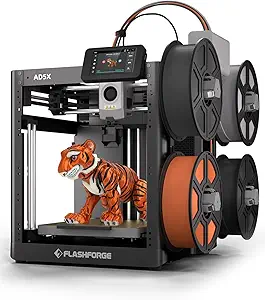 | Best Overall for Rapid Multi-Color Prototyping | Build Volume: 220x220x220mm | Max Printing Speed: 600mm/s | Extruder Temperature: 300°C | VIEW ON AMAZON | See Our Full Breakdown |
| FlashForge Creator 5 Pro Industrial 3D Printer, 65°C Active Heated Chamber, HEPA13 Air Filtration, 4-Extruder Independent System, 600mm/s High-Speed Printing, 256mm³ Build Volume |  | Best for Professional Multi-Material Production | Product Dimensions: 18.9 x 16.06 x 17.17 inches | Build Volume: 256mm³ | Active Chamber Temperature: 65°C | VIEW ON AMAZON | See Our Full Breakdown |
| QIDI PLUS4 3D Printer, 65°C Chamber Heating, 370°C Nozzle |  | Best for Large-Scale, High-Temp Material Printing | Build Volume: 12 x 12 x 11 inches | Chamber Heating: Yes, 65°C | Nozzle Temperature: 370°C | VIEW ON AMAZON | See Our Full Breakdown |
| Creality K1C 3D Printer Support Carbon Fiber Filament Auto Leveling |  | Best for High-Speed, Carbon Fiber Material Users | Printing Speed: 600mm/s | Acceleration: 20000mm/s² | Build Volume: 8.66 x 8.66 x 9.84 inches | VIEW ON AMAZON | See Our Full Breakdown |
| QIDI Q2C 3D Printer, 370°C Bimetal Hotend, High-Speed 600mm/s |  | Best for Professional-Grade Speed and Material Range | Hotend Temperature: 370°C | Build Volume: 270x270x256mm | Max Speed: 600mm/s | VIEW ON AMAZON | See Our Full Breakdown |
| QIDI Max4 Combo 3D Printer, 390×390×340mm Build Volume, 65℃ Heated Chamber |  | Best for Large-Scale and Industrial-Grade PEAK Printing | Build Volume: 390×390×340mm | Heated Chamber: 65℃ | Max Printing Speed: 800mm/s | VIEW ON AMAZON | See Our Full Breakdown |
| FlashForge AD5X Multi-Color & Material 3D Printer with IFS, 220x220x220mm |  | Best for Multi-Color and Multi-Material Printing in Compact Spaces | Build Volume: 220x220x220mm | Max Travel Speed: 600mm/s | Hotend Temperature: 300°C | VIEW ON AMAZON | See Our Full Breakdown |
| FLASHFORGE Creator 5 Pro 3D Printer with 4 Toolheads, Multi-Material & Color Printing, Heated Chamber, CoreXY System |  | Best for Multi-Color, Multi-Material Professional Manufacturing | Product Dimensions: 16 x 14 x 18 inches | Item Weight: 39 pounds | Heated Chamber: Up to 65°C | VIEW ON AMAZON | See Our Full Breakdown |
| SainSmart x WonderMaker ZR CoreXY Multicolor 3D Printer – 600mm/s High-Speed, 4-Color Printing, 300°C Nozzle, Auto-Leveling, 300×300×300mm Large Build Volume |  | Best for High-Speed Multicolor PEAK with Large Build Volume | Build Volume: 300×300×300mm | Max Nozzle Temperature: 300°C | Print Speed: 600mm/s | VIEW ON AMAZON | See Our Full Breakdown |
| FLASHFORGE AD5X 3D Printer with Multi-Color Printing and High Speed |  | Best for Versatile Multi-Color PEAK Projects in Compact Form | Filament Type: HS PLA | Color Printing: Multi-Color | Max Extruder Temperature: 300°C | VIEW ON AMAZON | See Our Full Breakdown |
| QIDI Plus5 Multi-Color 3D Printer, 320×320×300mm Large Build Volume |  | Best for Large-Scale and Multicolor Industrial Prototyping | Build Volume: 320×320×300mm | Maximum Extrusion Temperature: 370°C | Chamber Temperature: 65°C | VIEW ON AMAZON | See Our Full Breakdown |
| FlashForge Creator 5 Pro 3D Printer with 4 Toolheads and Multi-Material Printing |  | Best for Versatile Multi-Material and Multi-Color Professional Printing | Product Dimensions: 17.36 x 16.18 x 18.11 inches | Item Weight: 30.8 pounds | Supported Materials: Various filament types | VIEW ON AMAZON | See Our Full Breakdown |
| hightemperature 3d printers for peek | Build Volume |
|---|---|
| FlashForge AD5X Multi-Color 3D | 220x220x220mm |
| FlashForge Creator 5 Pro Indus | 256mm³ |
| QIDI PLUS4 3D Printer | 12 x 12 x 11 inches |
| Creality K1C 3D Printer Suppor | 8.66 x 8.66 x 9.84 inches |
| QIDI Q2C 3D Printer | 270x270x256mm |
| QIDI Max4 Combo 3D Printer | 390×390×340mm |
| FlashForge AD5X Multi-Color & | 220x220x220mm |
| FLASHFORGE Creator 5 Pro 3D Pr | — |
| SainSmart x WonderMaker ZR Cor | 300×300×300mm |
| FLASHFORGE AD5X 3D Printer wit | — |
| QIDI Plus5 Multi-Color 3D Prin | 320×320×300mm |
| FlashForge Creator 5 Pro 3D Pr | — |
More Details on Our Top Picks
FlashForge AD5X Multi-Color 3D Printer, CoreXY, 600mm/s High-Speed, Auto Leveling, 300°C Extruder, 220x220x220mm Build Volume
The FlashForge AD5X stands out for its blistering speed of up to 600mm/s, making it ideal for rapid prototyping where time is critical. Its multi-color capability with support for up to 4 colors simultaneously offers a level of versatility that surpasses many competitors like the QIDI Q2C, which focuses more on material variety and precision but at lower speeds. The auto bed leveling simplifies setup, yet the high-speed operation demands careful calibration to prevent quality loss, especially with complex geometries. This model is better suited for experienced users who need rapid turnaround rather than absolute fine detail, which might suffer at such high speeds without meticulous tuning.
Pros:- Supports multi-color printing with up to 4 colors at once
- Exceptional high-speed capabilities up to 600mm/s
- Auto bed leveling for simplified setup
- Flexible nozzle size options for different applications
Cons:- Complex setup may challenge less experienced users
- High-speed operation can compromise print quality if not carefully calibrated
Best for: Designers and engineers needing quick multi-color prototypes in a fast-paced environment
Not ideal for: Hobbyists seeking detailed, high-fidelity prints or those new to 3D printing who may struggle with complex setup
- Build Volume:220x220x220mm
- Max Printing Speed:600mm/s
- Extruder Temperature:300°C
- Nozzle Sizes:0.25mm to 0.8mm
- Auto Leveling:Yes
- Connectivity:Mobile app control
Our verdict“This printer excels for users prioritizing speed and multi-color capabilities over ultra-fine detail or beginner-friendliness.”
FlashForge Creator 5 Pro Industrial 3D Printer, 65°C Active Heated Chamber, HEPA13 Air Filtration, 4-Extruder Independent System, 600mm/s High-Speed Printing, 256mm³ Build Volume
The FlashForge Creator 5 Pro is tailored for professional environments that demand consistent, multi-material outputs, featuring an active heated chamber up to 65°C and four independent extruders. Compared with the QIDI PLUS4, which offers larger volume but fewer extruders, the Creator 5 Pro emphasizes multi-material versatility and safety, thanks to HEPA13 filtration and a sealed enclosure. Its high speed of 600mm/s makes it suitable for efficient production runs, but its weight and complexity might be daunting for newcomers. The advanced features, including automatic leveling and environmental controls, come with a steeper learning curve and higher price, making it ideal for experienced users needing reliable, multi-material capabilities.
Pros:- Four independent extruders enable complex multi-material prints
- High-speed operation at 600mm/s accelerates production
- Active heated chamber ensures stable high-performance material processing
- Effective HEPA13 filtration improves safety and environmental quality
Cons:- Heavy and large, requiring substantial workspace
- Setup and calibration are complex, demanding technical expertise
Best for: Industrial and professional users requiring multi-material, multi-color high-speed printing with safe operation
Not ideal for: Hobbyists or small-scale users who don’t need multiple extruders or advanced safety features
- Product Dimensions:18.9 x 16.06 x 17.17 inches
- Build Volume:256mm³
- Active Chamber Temperature:65°C
- Number of Extruders:4
- Max Printing Speed:600mm/s
- Filtration:HEPA13
Our verdict“This printer is best suited for high-volume, multi-material professional applications where speed and safety are priorities.”
QIDI PLUS4 3D Printer, 65°C Chamber Heating, 370°C Nozzle
The QIDI PLUS4 is designed for users who need a large build volume and high-temperature capabilities, supporting filaments like PEEK and other demanding materials. Its 12x12x11-inch workspace surpasses most in this roundup, making it ideal for complex, large models. The chamber heating up to 65°C and hotend support for 370°C enable printing with advanced high-performance filaments, similar in scope to the Creality K1C but with a focus on larger scale. While its remote monitoring and robust construction appeal to professionals, the setup process can be time-consuming, and multi-color printing features are still forthcoming. This model offers a good balance of size and temperature capability but requires a dedicated space for optimal use.
Pros:- Massive 12 x 12 x 11-inch build volume for large models
- Supports high-temperature filaments up to 370°C
- Remote monitoring with real-time updates
- Robust construction with durable components
Cons:- Setup and calibration can be complex and time-consuming
- Upcoming multi-color feature not yet available
Best for: Enthusiasts and professionals working on large, high-temp projects like aerospace or medical prototypes
Not ideal for: Small-scale or hobbyist users with limited space or those not needing large dimensions
- Build Volume:12 x 12 x 11 inches
- Chamber Heating:Yes, 65°C
- Nozzle Temperature:370°C
- Hotend Power:80W
- Connectivity:Remote print, mobile app
- Additional Features:Filament wrap, break detection
Our verdict“This printer is a strong choice for large-format, high-performance projects requiring high-temp materials and precise control.”
Creality K1C 3D Printer Support Carbon Fiber Filament Auto Leveling
The Creality K1C emphasizes rapid printing with speeds up to 600mm/s and auto-leveling for quick setup, making it an attractive choice for users working with demanding materials like carbon fiber. Its upgrade to a clog-free extruder and enhanced cooling improves reliability over earlier models. Compared to the FlashForge AD5X, which excels in multi-color capability, the K1C focuses on speed and material support, including high-temperature filaments up to 300°C. The integrated AI camera for real-time monitoring enhances its appeal for professional workflows, but the setup can be complex, and its size may be restrictive for smaller workspaces. It’s best for experienced users who need fast, high-temp, multi-material printing with monitoring features.
Pros:- Impressive print speeds up to 600mm/s
- Auto leveling and calibration for quick start
- Supports high-temp and carbon fiber filaments
- AI camera for real-time monitoring and failure detection
Cons:- Features may have a learning curve for new users
- Large size demands ample workspace
Best for: Professionals and advanced hobbyists working with carbon fiber or high-temp filaments needing speed and automation
Not ideal for: Beginners or those with limited space, as features require familiarity with complex setup
- Printing Speed:600mm/s
- Acceleration:20000mm/s²
- Build Volume:8.66 x 8.66 x 9.84 inches
- Max Temperature:300°C
- Auto Calibration:Yes
- Filament Support:Carbon fiber, various
Our verdict“This model caters to users who need fast, reliable high-temp printing with real-time monitoring, suited for advanced applications.”
QIDI Q2C 3D Printer, 370°C Bimetal Hotend, High-Speed 600mm/s
The QIDI Q2C offers a compelling combination of high speed, supporting up to 600mm/s, and a hotend capable of reaching 370°C, making it suitable for advanced material printing including composites like PPS-CF. Its straightforward CoreXY design and quick 15-minute setup appeal to professionals and experienced hobbyists alike. Unlike some larger-format options like the QIDI PLUS4, this model balances size and speed, fitting well into a typical workspace without sacrificing high-temp capabilities. The open-source platform encourages customization, but the absence of chamber heating limits some high-end material use, and the optional camera lacks AI detection features. Overall, it’s a versatile, fast machine for demanding filament types.
Pros:- Supports high speeds up to 600mm/s
- High-temperature hotend up to 370°C for advanced filaments
- Easy 15-minute setup with pre-assembled parts
- Open-source platform for modifications
Cons:- Lacks chamber heating for some high-temp materials
- Limited to supported filament types without additional modifications
Best for: Experienced users seeking fast, high-temp, multi-material prints with customization potential
Not ideal for: Beginners or users needing a chamber heating function for high-performance filaments
- Hotend Temperature:370°C
- Build Volume:270x270x256mm
- Max Speed:600mm/s
- Materials Supported:PLA, ABS, PETG, TPU, PA, PC, composites
- Connectivity:QIDI BOX
- Setup Time:15 minutes
Our verdict“This printer best serves users who value speed, material flexibility, and customization in a professional-grade platform.”
QIDI Max4 Combo 3D Printer, 390×390×340mm Build Volume, 65℃ Heated Chamber
The QIDI Max4 Combo stands out for its enormous 390×390×340mm build volume, making it ideal for printing sizable industrial parts and complex prototypes in high-performance materials like PEAK. Its high precision is supported by closed-loop motors and an anti-backlash Z-axis, ensuring accuracy at large scales. While the heated chamber reaches 65°C, enabling better adhesion and layer control for high-temperature filaments, the setup complexity increases with multi-material and multi-color configurations, especially since the Polar Cooler needs to be purchased separately. Compared to smaller, more streamlined options like the FlashForge AD5X, this model sacrifices ease of use for scale and versatility. The main tradeoff involves a more complex assembly process and higher cost for the added size and features.Pros:- Enormous build volume suitable for large industrial parts
- High precision with closed-loop motors and anti-backlash Z-axis
- Smart AI camera for automatic failure detection
- Supports high-temperature materials like PEAK
Cons:- Polar Cooler must be purchased separately, adding to costs
- Complex setup for multi-material configurations
- Maximum speed limited by print complexity and material
Best for: Manufacturers and researchers needing large-format, high-temperature PEEK or PEAK parts in a professional setting.
Not ideal for: Enthusiasts or small studios with limited space and simpler printing needs, as the size and setup complexity are significant.
- Build Volume:390×390×340mm
- Heated Chamber:65℃
- Max Printing Speed:800mm/s
- Acceleration:30,000mm/s²
- Hotend:40mm³/s high-flow hotend with hardened steel nozzle
- Material Compatibility:PLA, ABS, carbon fiber-reinforced nylon, high-temp materials like ABS-CF, PC, PPS-CF
Our verdict“This printer makes the most sense for professionals who require large-scale, high-temperature PEAK printing and are prepared for its setup complexity.”
FlashForge AD5X Multi-Color & Material 3D Printer with IFS, 220x220x220mm
The FlashForge AD5X excels in multi-color and multi-material printing within a compact 220x220x220mm volume, making it perfect for detailed prototypes and small batch productions. Its auto filament loading and up to 4kg filament capacity reduce downtime, while the advanced features like auto leveling and vibration compensation boost print stability. Compared with the larger QIDI Max4, it sacrifices size and advanced high-temp capabilities, but it offers a more user-friendly experience for those focused on multi-color PEAK or similar high-temp materials. The need for an additional camera kit for real-time monitoring represents an extra cost, and setup can be challenging for beginners unfamiliar with multi-filament workflows. Overall, this model balances multi-material versatility with ease of use for smaller-scale applications.Pros:- Supports multi-color and multi-material printing
- Auto filament loading and large filament capacity
- Stable, high-speed printing with advanced features
- Compact size suitable for limited space environments
Cons:- Requires additional camera kit for remote monitoring
- Setup can be complex for newcomers
- Limited build volume for large PEAK parts
Best for: Small-to-medium labs and creative professionals printing detailed, multi-color PEAK components in limited space.
Not ideal for: Large-scale industrial production or users seeking high-temperature chambers for extensive PEAK parts, due to its smaller build volume.
- Build Volume:220x220x220mm
- Max Travel Speed:600mm/s
- Hotend Temperature:300°C
- Filament Management:Auto loading/unloading, up to 4kg filament
- Connectivity:Wi-Fi
- Features:Auto leveling, vibration compensation
Our verdict“This printer is well-suited for multi-material, multi-color PEAK projects in small to medium setups where ease of use matters.”
FLASHFORGE Creator 5 Pro 3D Printer with 4 Toolheads, Multi-Material & Color Printing, Heated Chamber, CoreXY System
The Creator 5 Pro offers four independent toolheads, making it a powerhouse for multi-material and multi-color PEAK printing. Its heated chamber reaches up to 65°C, compatible with high-temp filaments, while the CoreXY system ensures fast, precise motion for complex parts. This model surpasses smaller or single-extruder printers like the AD5X for large-scale, multi-material projects; however, its size and weight demand substantial space and setup effort. While the learning curve is steeper, it provides a high level of control suitable for professional environments. The tradeoff involves increased complexity and cost, but for those needing multi-material PEAK prints, its capabilities are unmatched.Pros:- Supports four independent toolheads for multi-material printing
- High-speed, precise printing up to 600mm/s
- Heated chamber up to 65°C for high-temp filament compatibility
- Includes safety features like HEPA filtration
Cons:- Very large and heavy, requiring dedicated space
- Complex calibration and setup process
- Higher cost and maintenance for multi-toolhead system
Best for: Industrial users and advanced professionals producing multi-material PEAK parts requiring multi-color complexity.
Not ideal for: Hobbyists or small teams with limited space and simpler single-material needs, due to its size and learning curve.
- Product Dimensions:16 x 14 x 18 inches
- Item Weight:39 pounds
- Heated Chamber:Up to 65°C
- Number of Toolheads:4
- Max Speed:600mm/s
- Material Compatibility:Multiple including high-temp materials
Our verdict“This printer is designed for professional environments needing multi-material PEAK prints with complex color and material combinations, accepting the setup complexity.”
SainSmart x WonderMaker ZR CoreXY Multicolor 3D Printer – 600mm/s High-Speed, 4-Color Printing, 300°C Nozzle, Auto-Leveling, 300×300×300mm Large Build Volume
The WonderMaker ZR excels in high-speed, four-color printing with a 300×300×300mm build volume, ideal for detailed, multi-material PEAK projects where speed and color complexity are priorities. Its 600mm/s maximum speed is impressive, especially when paired with auto-leveling and smart filament management, reducing downtime and manual intervention. Compared to smaller, less capable models like the FlashForge AD5X, it offers a larger build capacity and faster throughput. Nevertheless, the high operational speed can generate more noise, and the setup requires some technical skill, especially configuring the MIFS filament system. This pick makes the most sense for demanding users focused on multi-color PEAK parts at scale.Pros:- Supports seamless 4-color printing with integrated filament system
- Maximum speed of 600mm/s for rapid production
- Auto-leveling and smart filament system for reduced downtime
- Large build volume suitable for complex projects
Cons:- Setup is technically demanding
- High operational noise at maximum speeds
- Requires familiarity with advanced firmware and software
Best for: High-speed, multi-color PEAK production environments requiring large build volumes and rapid turnaround.
Not ideal for: Beginners or small-scale hobbyists who prefer simpler, quieter, and more straightforward printers.
- Build Volume:300×300×300mm
- Max Nozzle Temperature:300°C
- Print Speed:600mm/s
- Auto-Leveling:Yes
- Connectivity:Wi-Fi
- Filament System:Multi-Color Integrated Filament System (MIFS)
Our verdict“This machine is ideal for high-speed, multi-color PEAK projects with large volumes and advanced workflow management, accepting its setup complexity and noise.”
FLASHFORGE AD5X 3D Printer with Multi-Color Printing and High Speed
The FLASHFORGE AD5X delivers high-speed multi-color printing up to 600mm/s, with auto calibration and vibration compensation, making it suitable for creative PEAK projects that demand speed and precision in a smaller footprint. Its direct drive extruder supports filament temperatures up to 300°C, enabling high-temp materials, though filament capacity is limited to 4x10g spools, which can require frequent refills. Compared to larger, multi-tool systems like the Creator 5 Pro, the AD5X offers simplicity and speed but cannot match the multi-material complexity or size. Setup is generally straightforward, but users unfamiliar with multi-filament workflows may face a learning curve. Overall, it favors users needing rapid, multi-color PEAK parts in a manageable size.Pros:- High-speed printing up to 600mm/s
- Supports multi-color printing with auto calibration
- Vibration compensation ensures accuracy at high speed
- Compact design fits limited spaces
Cons:- Limited filament capacity requiring frequent reloads
- Setup can be challenging for beginners
- Smaller build volume may restrict large PEAK parts
Best for: Creative professionals and small workshops focused on multi-color PEAK prototypes with high throughput demands.
Not ideal for: Large-scale manufacturing or users needing extensive multi-material options, due to limited filament capacity and smaller build volume.
- Filament Type:HS PLA
- Color Printing:Multi-Color
- Max Extruder Temperature:300°C
- Print Speed:600mm/s
- Auto Calibration:Yes
- Vibration Compensation:Yes
Our verdict“This printer is perfect for fast, multi-color PEAK projects in small to medium environments where speed and versatility are priorities.”
QIDI Plus5 Multi-Color 3D Printer, 320×320×300mm Large Build Volume
The QIDI Plus5 stands out for its expansive 320×320×300mm build volume, making it ideal for large prototypes and batch production. Compared to the FlashForge Creator 5 Pro, which offers the advantage of four preloaded toolheads for multi-material printing, the Plus5’s multi-color capability supports up to 16 colors with the optional QIDI BOX, catering to artistic and complex multi-material projects. Its active chamber heating reduces warping when working with engineering-grade materials like PC and carbon fiber composites. However, its bulky, heavy design demands ample workspace and can be intimidating for newcomers due to complex setup steps. The advanced features come at a higher price, but for those needing large, multi-color projects with high-performance filament support, this printer offers unmatched capacity.
Pros:- Large build volume ideal for big projects
- Supports high-performance engineering filaments
- Active chamber heating minimizes warping
- Multi-material multi-color capabilities
Cons:- Heavy and bulky, requires significant space
- Complex setup may challenge beginners
- Higher price point due to advanced features
Best for: Professionals and industrial users needing large, multi-color, high-performance prototypes or batch runs.
Not ideal for: Hobbyists or small-scale users with limited space or simpler project needs, due to its size and complexity.
- Build Volume:320×320×300mm
- Maximum Extrusion Temperature:370°C
- Chamber Temperature:65°C
- Item Dimensions:22 x 22 x 24 inches
- Item Weight:96.8 pounds
- Supported Materials:PLA, ABS, PETG, TPU, PA, PC, carbon/glass-fiber composites
Our verdict“This printer is best suited for professionals who require large-scale, multi-color, high-performance manufacturing capabilities despite its size and complexity.”
FlashForge Creator 5 Pro 3D Printer with 4 Toolheads and Multi-Material Printing
The FlashForge Creator 5 Pro offers a versatile setup with four preloaded, heated toolheads, making it highly suitable for multi-material and multi-color production. Unlike the QIDI Plus5, which emphasizes large volume and high-performance materials, the Creator 5 Pro excels in multi-material flexibility, supporting complex multi-color prints with four independent toolheads. Its advanced features like adaptive airflow and flow calibration boost print precision, especially for engineering parts. The setup with multiple toolheads can be daunting for beginners, and its weight still requires considerable space, but its simultaneous multi-material capability provides unique efficiency for complex projects. This pick makes sense for shops or professionals needing multi-material versatility in a relatively compact footprint.
Pros:- Supports multiple filament types and materials
- Four preloaded, heated toolheads enable multi-material printing
- Advanced features like adaptive airflow improve quality
- Large build chamber with uniform temperature for engineering parts
Cons:- Heavy and bulky, needs ample space
- Complex setup with multiple toolheads can be challenging
- Higher price with advanced multi-material features
Best for: Engineers, designers, and production teams needing multi-material, multi-color, high-precision parts in a compact form.
Not ideal for: Hobbyists or small-scale users who do not require multi-toolhead capabilities or have limited workspace, due to setup complexity.
- Product Dimensions:17.36 x 16.18 x 18.11 inches
- Item Weight:30.8 pounds
- Supported Materials:Various filament types
- Number of Toolheads:4
- Maximum Extrusion Temperature:Not specified
- Chamber Temperature:Not specified
Our verdict“This printer is best for professional teams demanding multi-material, multi-color production with high precision in a manageable footprint.”

How We Picked
The products were chosen based on their maximum extrusion temperature, chamber heating capabilities, build volume, and overall build quality. We prioritized models that explicitly support PEEK and other high-performance thermoplastics, focusing on those with proven high-temperature operation and reliable temperature control. Ease of use, safety features, and versatility in material handling also influenced the ranking, ensuring that both professional and dedicated hobbyist buyers find suitable options. Cost-effectiveness was considered but balanced against critical features necessary for successful PEEK printing, resulting in a curated list of machines that excel in high-temperature performance and reliability.Factors to Consider When Choosing Hightemperature 3d Printers For Peek
Choosing a high-temperature 3D printer for PEEK involves balancing several key factors. Beyond just the maximum extrusion temperature, considerations such as chamber heating, build volume, and extruder design can significantly impact print success. It’s important to understand how these elements interact to optimize print quality and consistency, especially given PEEK’s demanding printing requirements.Maximum Extrusion Temperature
PEEK requires an extrusion temperature of at least 370°C to extrude properly. Not all high-temperature printers support this level of heat, so verifying the maximum temperature is crucial. Opt for a machine that can reliably sustain these temperatures over extended periods without thermal fluctuations, as inconsistent heat can cause print failures or warping.
Chamber Heating
A heated chamber is nearly indispensable for PEEK printing because it minimizes warping and improves layer adhesion by maintaining a stable environment. Look for systems with chamber temperatures of at least 100°C, and ideally closer to 150°C or more for the best results. Keep in mind that larger chambers tend to be more expensive and complex but greatly benefit large or detailed parts.
Build Volume
PEEK parts often require larger dimensions, so consider a printer with a sizable build volume. However, larger chambers and beds usually increase the cost and complexity of the machine. Balance your project size needs with your budget and available workspace to select an optimal size without overpaying for unnecessary capacity.
Multi-Extruder and Material Compatibility
Some high-end models support multiple extruders or multi-material setups, which can expand design possibilities and streamline complex prints. However, these features add to the cost and maintenance needs. For most PEEK applications, a single high-temperature extruder with reliable performance suffices unless multi-material capability is a core requirement.
Safety and Reliability Features
High-temperature printing involves risks such as thermal runaway or chamber overheating. Features like auto-leveling, air filtration, and thermal shutoffs add safety layers and improve print consistency. Investing in a machine with proven safety features can save headaches and ensure longer-term reliability, especially in a professional setting.
Frequently Asked Questions
Can I print PEEK on a standard 3D printer?
Most standard 3D printers cannot handle PEEK due to its high melting point and the need for a heated chamber. Attempting to print PEEK on a machine not designed for high temperatures often results in warping, poor layer adhesion, or print failures. For successful PEEK printing, a dedicated high-temperature 3D printer with chamber heating and extrusion capabilities over 370°C is necessary.
How important is a heated chamber for PEEK printing?
A heated chamber is critical when working with PEEK because it minimizes warping and improves layer bonding by maintaining a consistent environment. Without chamber heating, PEEK tends to warp or crack as it cools rapidly. For large or detailed parts, a chamber temperature of at least 100°C is recommended, with higher temperatures offering even better results.
What safety features should I look for in a high-temperature 3D printer?
Safety features such as thermal runaway protection, automatic shutoff, and proper ventilation or air filtration are vital in high-temperature printing. These features help prevent accidents and ensure consistent operation, especially when working with materials like PEEK that require sustained high heat. Always choose a machine with certified safety protocols to reduce risks.
Is a larger build volume necessary for PEEK parts?
Not necessarily, but if your projects involve large or complex PEEK parts, a bigger build volume can be advantageous. Keep in mind that larger chambers tend to increase machine cost and complexity. For most users, a balance between build size and machine affordability should guide your choice, unless you regularly print large components.
How does chamber temperature affect print quality?
Higher chamber temperatures help prevent warping and improve layer adhesion, leading to better print quality for PEEK. Maintaining a stable environment reduces thermal stresses that cause deformation. However, controlling chamber temperature precisely can be challenging, so look for models with reliable heating systems and good temperature regulation.
Conclusion
For professional users demanding the highest reliability and performance, the FlashForge Creator 5 Pro offers a comprehensive solution with its heated chamber and multi-extruder system. Hobbyists and small-scale producers might find the QIDI PLUS4 to be a more affordable yet capable choice. Beginners or those new to high-temperature printing should prioritize models with safety features and straightforward operation, such as the Creality K1C. Ultimately, selecting the right machine depends on your project size, budget, and specific material needs—consider these factors carefully to choose the best fit.