
🔍 Read the full analysis: A Look At 9 Ultrawide Monitors For Gaming And Productivity In 2027 on ThorstenMeyerAI.com

Get the latest gadgets delivered free with Prime
- Fast, free delivery on millions of items
- Prime Video, Amazon Music and more included
- Member-only deals all year
TL;DR
A buying guide from ThorstenMeyerAI.com compares nine ultrawide monitors for gaming and productivity, weighing screen size, refresh rate, panel type, connectivity and ergonomics. It favors the Dell S3425DW for mixed use, while describing Samsung’s 49-inch Odyssey G9 as a large-screen option that needs substantial desk space. Prices, full model specifications and independent test results are not supplied in the source.
ThorstenMeyerAI.com’s ultrawide-monitor guide compares nine models for gaming and productivity, naming the Dell S3425DW its best overall pick for balancing a 120Hz refresh rate with USB-C connectivity. The guide also highlights the Samsung 49-inch Odyssey G9 for its broad workspace and the less expensive CRUA and Sceptre models for high refresh rates, while warning that screen size, desk depth and feature trade-offs should shape a purchase.
The guide’s recommendations span different priorities rather than identifying one monitor as right for every setup, much like these ultrawide monitors for work and gaming. It says the Dell S3425DW combines a curved screen and 120Hz refresh rate with a USB-C hub and power delivery, which can reduce cable clutter for laptop users. The source does not provide the power-delivery wattage, pricing or a detailed account of its testing.
For a single display with more horizontal workspace, the guide points to the Samsung 49-inch Odyssey G9, which it describes as offering a dual-QHD resolution of 5120 × 1440. Its 1000R curve and physical size are trade-offs: the guide says it calls for a deep desk, and notes that gaming at this resolution places greater demands on a computer’s graphics hardware.
The guide also includes CRUA 34-inch WQHD and Sceptre models, describing budget options in this group as offering refresh rates in the 165Hz–180Hz range, a feature also discussed in this guide to high-refresh gaming monitors. It cautions that some lower-cost models may have weaker color uniformity and less adjustable stands. The ninth-model list and the individual names and specifications for every pick are not fully provided in the supplied source material.
The 9 picks
- 1
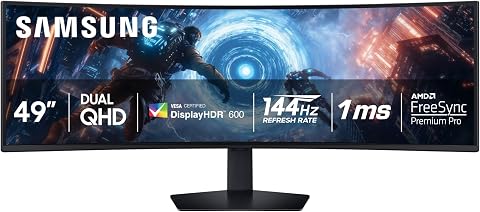 Samsung 49-Inch Odyssey G9 Curved Dual QHD Gaming Monitor, 144Hz, FreeSync Pr…View on Amazon →
- 2
 Z-Edge UG49W 49-Inch Curved Ultrawide Monitor, 5120×1440, 165HzView on Amazon →
- 3
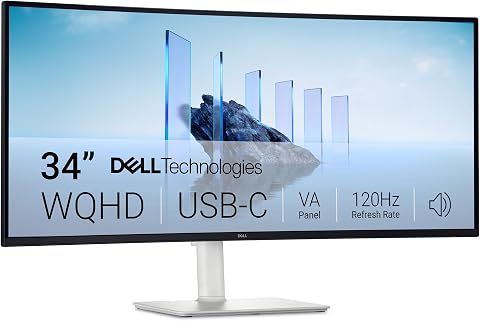 Dell 34 Plus USB-C Curved Monitor (S3425DW) – 34" WQHD, 120Hz, FreeSync PremiumView on Amazon →
- 4
 LG 34WR55QK-B 34-Inch Curved UltraWide WQHD MonitorView on Amazon →
- 5
 Samsung 34-inch ViewFinity S50GC Ultra-WQHD MonitorView on Amazon →
- 6
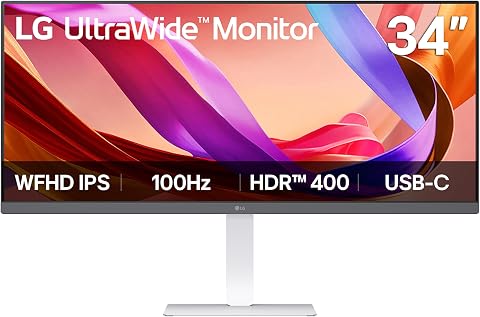 LG 34-inch UltraWide WFHD IPS Monitor, 100Hz, DisplayHDR 400, USB-C, HDMI and…View on Amazon →
- 7
 SANSUI 34-Inch Curved UWQHD Gaming Monitor (3440 x 1440, 200Hz)View on Amazon →
- 8
 CRUA 34-inch WQHD 165Hz Ultrawide Curved Gaming Monitor (1500R, FreeSync)View on Amazon →
- 9
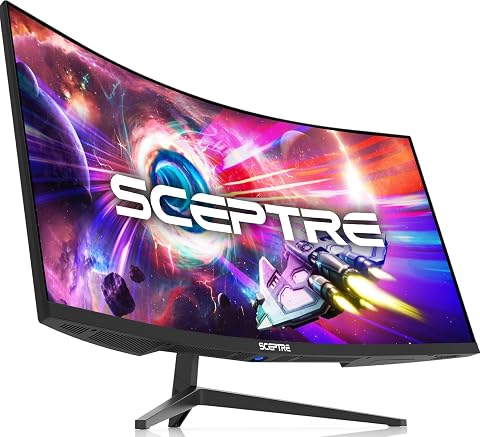 Sceptre 34-inch Curved Ultrawide WQHD Monitor (3440 x 1440), 180Hz, 1ms, Disp…View on Amazon →
Matching Screen Size to Your Setup
Ultrawide displays can give gamers a broader field of view and let office users keep more windows visible on one screen. Those benefits depend on whether a desk can accommodate the display and whether a computer can drive its resolution and refresh rate. The guide’s contrast between a 34-inch WQHD monitor and a 49-inch dual-QHD model illustrates that more screen space can also mean greater hardware and space requirements.
For people who work on a laptop, a monitor’s connections may matter as much as its panel. A USB-C connection with power delivery can carry video and charge a laptop over one cable, while budget monitors may rely on HDMI and DisplayPort instead. The guide’s picks are therefore best treated as a shortlist by use case, not as a universal ranking backed by disclosed lab measurements.
Popular right now

De'Longhi Stilosa Compact Manual Espresso Machine with Milk Frother

Roborock Robot Vacuum and Mop with LiDAR Navigation and Self-Empty Dock

TCL 55 T7 Series 4K 120Hz QLED Smart Google TV (55T7)
As an affiliate, we earn on qualifying purchases.
What the Guide Compares
The source says it evaluated monitors using refresh rate and response time for gaming, and color coverage and connectivity for productivity. It also considered panel technology, adaptive-sync support and stand adjustments such as height, tilt and swivel. However, the material supplied does not include measured test results, the full nine-model roster, or a dated methodology that readers could use to reproduce the rankings.
Two resolution categories frame its comparison: 3440 × 1440 WQHD, commonly associated in the guide with 34-inch screens, and 5120 × 1440 dual QHD on 49-inch displays. The source describes VA panels as a common choice for curved ultrawides, with stronger contrast but possible dark-motion smearing, while IPS panels generally offer wider viewing angles and lighter blacks. These are general panel trade-offs, not reported test results for every listed monitor.
“The Dell 34 Plus USB-C Curved Monitor stands out as the best overall pick.”
— ThorstenMeyerAI.com guide
Details Missing From the Comparison
The source material does not give the complete list of nine monitors, individual prices, purchase links or publication date. It also does not provide measured color results, response-time data, uniformity testing, or details on how the rankings were scored. The stated recommendations and performance trade-offs should be read as the guide’s assessments, not as independently verified findings.
It is also unclear which exact Sceptre model and which LG 34-inch WFHD IPS model the article discusses. The source identifies the LG as the only white-chassis IPS pick, but supplies no full model number. Monitor availability, prices and specifications can vary by region and change over time; the source does not establish what is currently in stock.
Check Models Before Buying
Readers considering one of the picks should verify the full model number, current price and regional specifications with the manufacturer or retailer. They should also check port versions, USB-C power-delivery output, stand adjustments, warranty terms and whether adaptive-sync features meet their needs. For a 49-inch screen, measuring desk depth and checking graphics-card capability are practical steps before purchase.
The source does not announce an update schedule or a subsequent testing milestone. Until a complete model list and test data are available, the guide is most useful as an overview of the trade-offs to compare rather than a definitive, independently tested ranking.
Key Questions
Which monitor does the guide recommend for mixed gaming and work?
The guide names the Dell S3425DW as its best overall pick, citing its 120Hz refresh rate and USB-C hub. The source does not include independent test results or current pricing.
What is the main drawback of the Samsung 49-inch Odyssey G9?
The guide says its 49-inch size and 1000R curve require substantial desk depth. Its 5120 × 1440 resolution can also demand more from a gaming PC than a 34-inch WQHD display.
Are the CRUA and Sceptre options suitable for gaming?
The guide describes budget models from these brands as offering 165Hz–180Hz refresh rates. It also warns that some may compromise on color uniformity and stand adjustability; the exact models and testing details are not supplied.
Does the source name all nine monitors?
No. The supplied material identifies the Dell, Samsung, CRUA and Sceptre lines, and refers to an LG 34-inch WFHD IPS model, but it does not provide a complete, model-by-model list of all nine picks.
Source: ThorstenMeyerAI.com