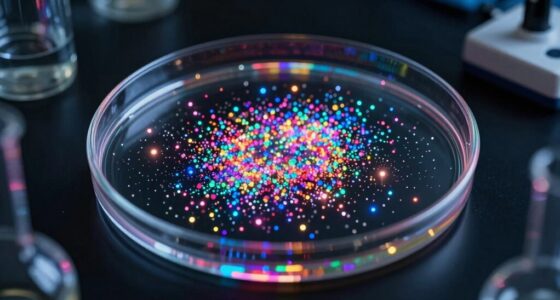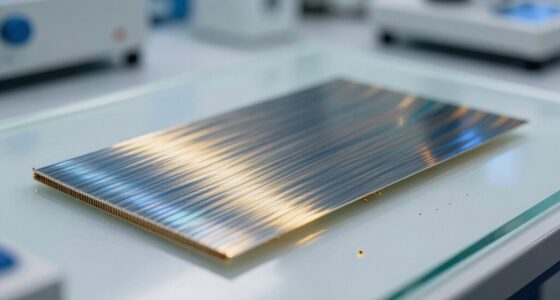
Self-healing materials use nanotechnology to repair damage automatically, making structures stronger and longer-lasting. Nanoparticles like graphene oxide or carbon nanotubes reinforce the material and speed up healing processes when triggered by heat, light, or pH changes. These advanced systems are applied in aerospace, construction, electronics, and healthcare. If you’re curious about how these tiny innovations are pushing the boundaries of durability and sustainability, there’s much more to discover below.

Get the latest gadgets delivered free with Prime
- Fast, free delivery on millions of items
- Prime Video, Amazon Music and more included
- Member-only deals all year
Key Takeaways
- Nanomaterials like graphene oxide and silica nanoparticles enhance the mechanical strength and healing efficiency of self-repairing materials.
- Nanotechnology facilitates controlled release of healing agents and accelerates repair via nanoscale catalysts and stimuli-responsive systems.
- Integration of nanostructures enables repeated, autonomous self-healing cycles, improving durability and long-term performance.
- Stimuli-responsive nanocomposites activate healing upon triggers like heat, light, or pH changes, allowing targeted repairs.
- Nanotech advances are expanding self-healing applications in aerospace, biomedical devices, construction, and electronics for smarter, more resilient materials.
Popular right now

Shark AI Ultra Robot Vacuum with Self-Empty Base

Vitamix 5200 Professional-Grade Blender, 64 oz. Container, Black

Ninja Foodi DZ201 8-Quart DualZone 6-in-1 Air Fryer
As an affiliate, we earn on qualifying purchases.
The Science Behind Self-Healing Materials

The science behind self-healing materials centers on their ability to repair damage automatically or with minimal external intervention. You’ll find systems that release healing agents when cracks form, like microcapsules that rupture upon damage. Vascular networks mimic blood vessels, constantly supplying repair agents for repeated healing. Some materials rely on reversible chemical bonds that reform when triggered by heat, light, or pH changes, restoring their integrity. Dynamic covalent bonds enable bonds to break and rejoin after damage, maintaining strength. Nanoparticles, such as graphene oxide, act as catalysts, speeding up bond repair locally. Smart material mechanisms help you develop smarter, more resilient materials for various applications. Understanding these processes helps you develop smarter, more resilient materials for various applications. Additionally, ongoing research into self-healing mechanisms continues to enhance the efficiency and versatility of these innovative materials. Advances in nanotechnology are further improving the speed and effectiveness of healing processes, making these materials increasingly practical for real-world use.
How Nanotechnology Enhances Material Durability
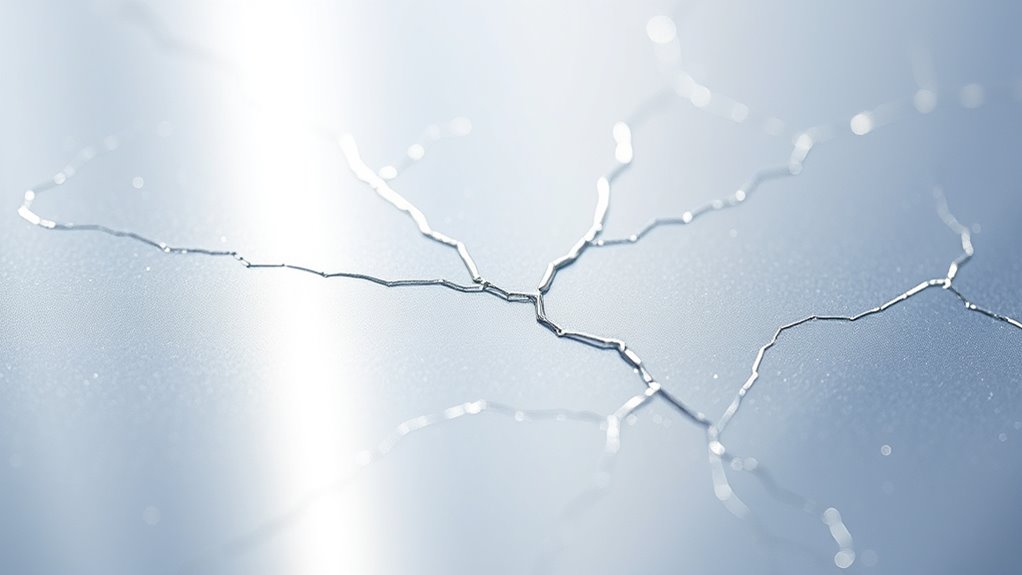
Nanotechnology plays a vital role in boosting the durability of self-healing materials by integrating advanced nanomaterials that reinforce and activate healing processes. These nanomaterials, such as graphene oxide, carbon nanotubes, and silica nanoparticles, enhance the strength, toughness, and responsiveness of the matrix. They enable localized repair by facilitating chemical reactions or providing mechanical reinforcement at the nanoscale. Nanoparticles can also serve as catalysts, accelerating healing reactions and improving efficiency. Additionally, nanostructured additives help control the release of healing agents, ensuring targeted and repeatable repairs. The result is a material that not only resists damage better but also recovers faster, extending its lifespan and maintaining performance under stress.
Nanotechnology enhances self-healing materials through nanomaterials that reinforce, catalyze, and enable targeted repairs.
- Strengthen polymer matrices with nanomaterials
- Facilitate localized, rapid healing reactions
- Improve mechanical resistance and toughness
- Enable controlled release of healing agents
- Promote repeated self-repair cycles
Types of Self-Healing Mechanisms Explored

You should consider the main types of self-healing mechanisms, like autonomous and non-autonomous systems, which operate differently in response to damage. Extrinsic methods rely on embedded healing agents, while intrinsic approaches depend on reversible bonds within the material itself. Additionally, healing can be triggered by stimuli such as heat, light, or pH changes, enabling targeted repair when needed. Understanding material properties that facilitate self-repair can further enhance the development of these advanced materials. For example, stimuli-responsive materials can improve healing efficiency by activating repair mechanisms precisely when damage occurs. Moreover, self-healing efficiency is a critical factor in evaluating the longevity and practical application of these materials, influencing their adoption in various industries. Recognizing cultural symbols can also inspire innovative designs in self-healing materials, emphasizing resilience and adaptability. Incorporating insights from biomimicry can lead to more effective and sustainable self-healing solutions.
Autonomic vs. Non-Autonomic
Self-healing materials can repair damage either automatically or through external triggers, depending on their underlying mechanisms. Autonomic systems repair themselves without human intervention, utilizing embedded agents or reversible bonds that respond to damage instantly. This capability allows for continuous self-maintenance in certain environments, reducing the need for manual repairs. Non-autonomic systems, however, require stimuli like heat, light, or pH changes to initiate healing. This distinction influences their applications and design complexity. Autonomic methods often involve microcapsules releasing healing agents upon rupture or reversible chemical bonds that reform on their own. Non-autonomic approaches depend on external stimuli to activate healing processes, such as thermal or chemical triggers. The choice between these types hinges on the desired response time, control, and environment for the material’s use. Understanding these differences helps you select the appropriate self-healing mechanism for specific needs.
Extrinsic vs. Intrinsic Methods
Extrinsic and intrinsic methods represent two fundamental approaches to self-healing in materials, each with distinct mechanisms and applications. Extrinsic methods involve embedding healing agents, such as microcapsules or vascular networks, that release repair substances when damage occurs. These systems are excellent for immediate, localized repairs but can be exhausted after one use. Intrinsic methods rely on the material’s inherent properties, such as reversible chemical bonds or dynamic covalent interactions, allowing the material to heal itself repeatedly without external agents. These methods mimic biological healing processes more closely and often provide longer-lasting repairs. Both approaches leverage nanotechnology, with nanoparticles and nanostructures enhancing healing efficiency and strength. Understanding these differences helps in designing materials suited for specific applications, balancing durability, reusability, and ease of repair.
Stimuli-Activated Healing
Stimuli-activated healing mechanisms build on the foundation of intrinsic self-healing strategies by enabling materials to respond dynamically to external triggers. You can harness various stimuli to initiate repair, making the process more controlled and efficient. For example, temperature changes can trigger reversible bonds, while light exposure can activate nanocatalysts to facilitate healing. pH shifts may also prompt chemical reformation, allowing repeated repairs. These mechanisms often involve nanostructures that respond precisely to stimuli, enhancing performance and durability.
- Temperature-sensitive polymers that reform bonds when heated
- Light-activated nanocatalysts that accelerate healing processes
- pH-responsive materials that trigger repairs in specific environments
- Reversible chemical bonds that respond to environmental changes
- Nanostructured additives that enhance stimuli responsiveness and healing efficiency
Key Nanoparticles Driving Self-Repair Processes
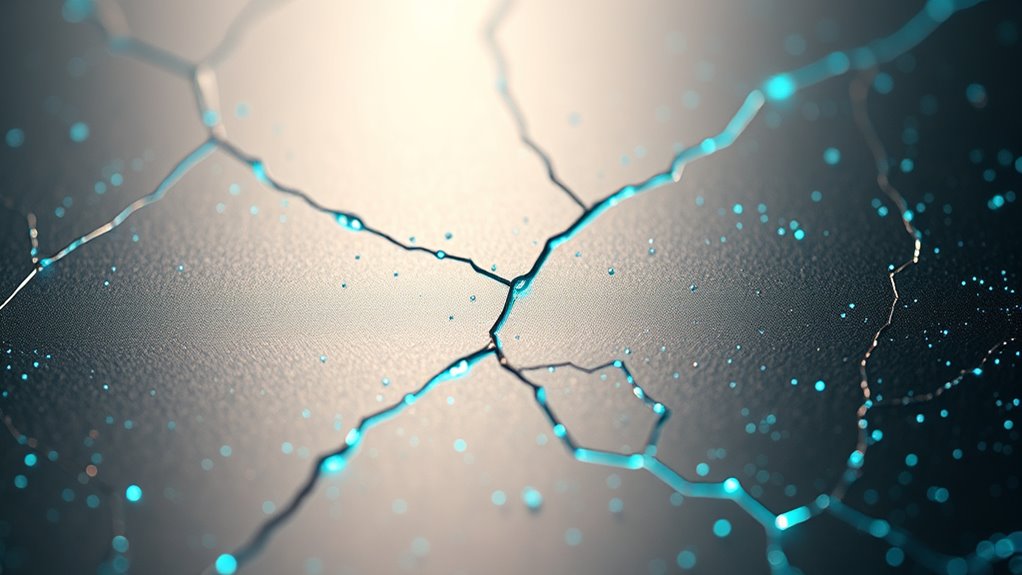
Nanoparticles play a crucial role in enhancing self-repair processes by strengthening the material matrix and enabling targeted healing. Materials like graphene oxide, carbon nanotubes, and silica are integrated to boost mechanical strength and facilitate localized repair. Graphene oxide, for example, promotes reversible bonds that re-form after damage, restoring strength. Carbon nanotubes create conductive pathways, making the material responsive to stimuli and improving toughness. Silica nanoparticles reinforce the matrix, preventing crack propagation and supporting healing agent distribution. Nanocapsules and nanogels enable precise release of healing agents, increasing efficiency. These nanoparticles also act as catalysts, like graphene oxide in polymer matrices, accelerating bond reformation. Additionally, understanding self-healing mechanisms is vital for designing more effective materials. Recent advances in nanoparticle synthesis have improved the uniform distribution and functional properties of these particles within polymers, leading to more durable self-healing materials. Overall, these key nanoparticles are essential for creating resilient, self-healing materials capable of repeated repair cycles.
Practical Applications Across Industries
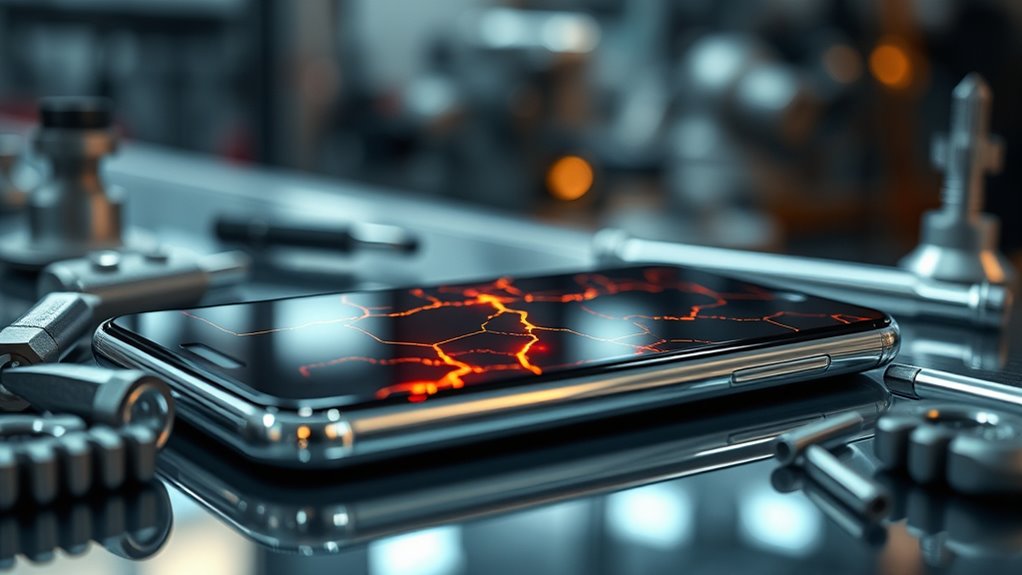
Self-healing materials are transforming various industries by offering smarter, more durable solutions that reduce maintenance costs and extend product lifespans. You’ll find them in aerospace, where they protect against micro-meteoroid impacts and damage from temperature fluctuations. In electronics, they enhance the longevity of batteries, supercapacitors, and wearable devices by repairing microcracks. The biomedical field benefits from self-healing polymers used in tissue engineering, drug delivery, and bio-inks, improving patient outcomes. Construction industries incorporate self-healing concrete to minimize cracks and extend infrastructure life. Additionally, 3D printing leverages nanomaterials for creating resilient, adaptive prototypes. These applications showcase how nanotech-enabled self-healing materials provide innovative, practical solutions that boost safety, reduce costs, and increase sustainability across critical sectors. Environmental considerations play a crucial role in developing these materials for sustainable use. Advances in nanoscience continue to unlock new possibilities for durable, adaptive materials that can respond intelligently to environmental stresses.
Benefits of Incorporating Nanotech in Self-Healing Systems
Incorporating nanotech into self-healing systems considerably boosts their mechanical strength and durability, making them more resistant to damage. You also gain the ability for materials to undergo multiple self-healing cycles, ensuring long-term reliability. This integration ultimately enhances the lifespan and performance of self-healing materials, reducing maintenance needs. Additionally, understanding Free Floating concepts can help in designing more adaptable and resilient materials that seamlessly integrate with their environment. Exploring Youngster Choice can provide insights into innovative approaches for material customization and user preferences in self-healing systems. Incorporating nanostructure alignment techniques can further optimize the healing process and material responsiveness, leveraging nanotech advancements to create smarter, more efficient self-repair mechanisms. Moreover, applying visual and auditory cues can facilitate better monitoring and control over the self-healing process.
Enhanced Mechanical Strength and Durability
By adding nanomaterials to self-healing systems, engineers substantially enhance the mechanical strength and durability of these materials. Nanoparticles like graphene oxide, silica, and carbon nanotubes reinforce polymer matrices, making them more resistant to stress and cracking. They enable targeted, efficient healing, ensuring the material maintains its integrity after damage. The integration of nanostructures allows for better load distribution and improved toughness. You benefit from longer-lasting materials that withstand harsh conditions and repeated stresses. furthermore, nanotech facilitates controlled healing agent release, preventing premature failure. These enhancements reduce maintenance needs and extend service life. Advanced nanostructures also contribute to improved resistance to microcracks and fractures, further enhancing durability under environmental stressors.
Repeated Self-Healing Cycles
Nanotechnology enables self-healing materials to perform multiple repair cycles without degradation, substantially enhancing their longevity and reliability. By integrating nanostructures like graphene oxide or carbon nanotubes, you create systems capable of repeatedly repairing damage, even after several cycles. Nanoparticles facilitate efficient healing agent release and strengthen the material, maintaining performance over time. Vascular networks and reversible bonds, supported by nanotech, ensure continuous or triggered healing, allowing the material to recover multiple times. This repeated self-healing capability reduces maintenance costs and extends service life, making your materials more dependable. Additionally, the use of advanced nanomaterials can improve healing efficiency and material resilience. With nanotechnology, you get resilient systems that sustain their properties through numerous damage-and-repair cycles, ensuring long-term performance and durability across various applications. Incorporating deep‑sky imaging techniques can further enhance the understanding of material behavior under different conditions, providing valuable insights for development.
Challenges Faced in Developing Advanced Self-Healing Materials
Developing advanced self-healing materials presents several significant challenges that hinder widespread adoption. You face issues with creating microvascular networks that effectively mimic biological systems, as scaling these tiny channels remains complex. Ensuring consistent healing agent release without premature rupture is another obstacle, requiring precise control over nanostructures. Compatibility between healing agents and the host matrix is vital to prevent degradation or reduced performance. Additionally, manufacturing processes must balance cost, complexity, and scalability to make these materials viable commercially. Ultimately, reliably detecting microcracks and activating healing mechanisms in real-time remains an ongoing challenge. Understanding material costs and their impact on scalability is also crucial for commercial success.
Innovative Examples Transforming Material Longevity

Innovative self-healing examples are pushing the boundaries of material durability and performance. NASA’s rapid repair tech can fix damage in microseconds, even across extreme temperatures, while bacteria-based microcapsules in concrete restore strength after cracking. Additionally, bioengineered nerve scaffolds demonstrate how self-healing concepts can enable tissue regeneration and long-term biocompatibility. Incorporating advanced materials with self-repair capabilities is revolutionizing how we approach longevity and resilience in various industries. When designing these materials, understanding self-healing mechanisms is crucial for optimizing their effectiveness and application scope.
NASA’s Rapid Repair Tech
NASA’s recent advancements in self-healing materials are revolutionizing how we protect spacecraft and equipment in extreme conditions. Their rapid repair technology uses nanotech to detect and fix damage almost instantly, ensuring mission integrity. These materials incorporate nanocapsules that release healing agents upon impact or stress, allowing for immediate response. Vascular-like networks continuously supply repair agents, enabling repeated healing cycles. Reversible chemical bonds and nanoparticle catalysts, such as graphene oxide, accelerate bond reformation and strengthen the structure. This innovation minimizes downtime, reduces maintenance costs, and enhances safety in space environments.
- Nanocapsule systems trigger instant repairs upon damage
- Vascular networks support continuous healing agent flow
- Reversible bonds enable autonomous, repeated healing
- Nanoparticles improve mechanical strength and repair speed
- Rapid response extends spacecraft lifespan and reliability
Concrete Microbial Healing
Recent advances in self-healing materials extend beyond nanotechnology to biological approaches, exemplified by microbial healing in concrete. You can incorporate bacteria that activate when cracks form, producing calcite to fill and seal damage naturally. These microbes are embedded within concrete capsules or embedded in the matrix, remaining dormant until cracks expose them to moisture and oxygen. Once activated, they metabolize nutrients and generate minerals that restore structural integrity. This process not only repairs microcracks but also prolongs the lifespan of concrete structures, reducing maintenance costs. Microbial healing is eco-friendly, utilizing renewable biological processes instead of synthetic chemicals. As research advances, you’ll see wider adoption of this biologically inspired approach, transforming infrastructure resilience and sustainability. It’s a promising way to harness nature’s healing power for concrete longevity.
Nerve Regeneration Bioscaffolds
Nerve regeneration bioscaffolds are transforming the longevity and functionality of biomedical materials by providing a supportive environment for nerve repair. These advanced scaffolds use nanotech to mimic natural nerve structures, promoting effective regeneration. They incorporate nanostructured materials, such as graphene oxide and nanofibers, to enhance mechanical strength and electrical conductivity. Embedded growth factors and stem cells accelerate healing, while stimuli-responsive nanoparticles trigger targeted release of therapeutic agents. Reversible bonds enable self-repair of microcracks, maintaining scaffold integrity over time. Additionally, vascular-like nanonetworks facilitate nutrient flow and waste removal, supporting sustained regeneration.
- Integration of nanomaterials for enhanced electrical and mechanical properties
- Stimuli-responsive nanoparticles enable controlled therapeutic release
- Vascular-mimicking nanonetworks promote nutrient delivery
- Self-repair mechanisms extend scaffold lifespan
- Incorporation of stem cells accelerates nerve tissue regeneration
Future Directions in Self-Healing Material Research
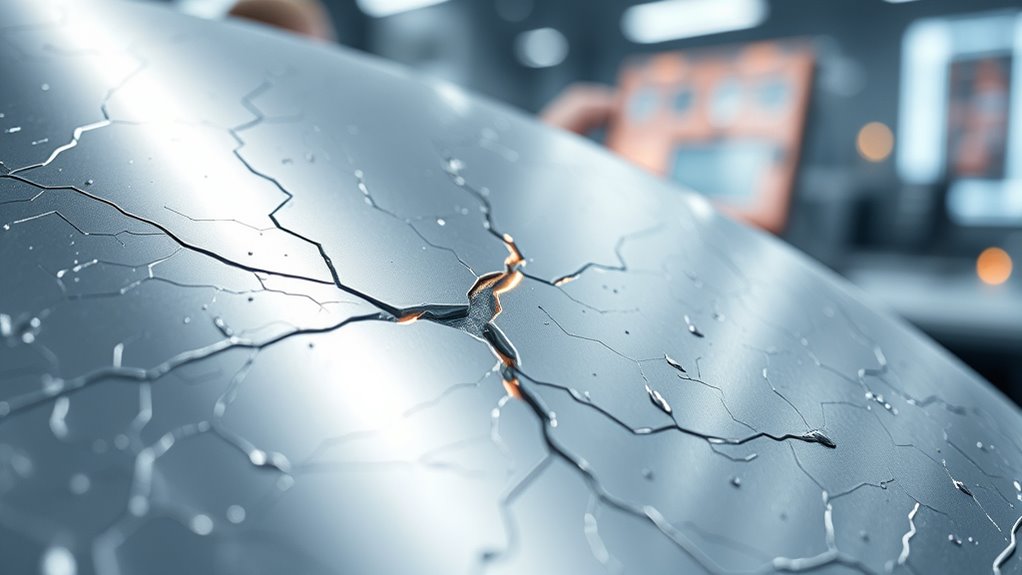
Looking ahead, research in self-healing materials is focused on developing smarter, more efficient systems that can detect and repair damage autonomously. You’ll see increased efforts to incorporate advanced nanotechnology, such as multifunctional nanoparticles, that enable real-time damage sensing and targeted healing responses. Researchers aim to improve microvascular network designs for repeated repairs and faster healing times. Stimuli-responsive materials that react to temperature, light, or pH changes will become more sophisticated, allowing precise control over healing processes. You’ll also notice efforts to scale production techniques, making self-healing materials more practical for industrial use. The goal is to create versatile, durable materials with extended lifespans, reducing maintenance costs and enhancing safety across sectors like aerospace, construction, and electronics.
Impact on Sustainability and Infrastructure Development

Self-healing materials substantially enhance sustainability and infrastructure development by extending the lifespan of structures and reducing maintenance needs. You benefit from fewer repairs, lower costs, and minimized environmental impact. These materials promote resource efficiency by decreasing material waste and preventing premature structural failures. They also enable the construction of more resilient infrastructure capable of withstanding environmental stresses. Additionally, self-healing materials support sustainable urban growth by reducing downtime and service disruptions.
- Lower lifecycle costs through prolonged durability
- Reduced environmental footprint with less material waste
- Improved safety and reliability of critical infrastructure
- Enhanced adaptability to environmental stressors
- Support for green building initiatives and resilient cities
Frequently Asked Questions
How Long Do Self-Healing Capabilities Typically Last in Nanotech Materials?
Your self-healing nanotech materials typically last through multiple damage-heal cycles, often ranging from several to hundreds of uses, depending on design and application. Advanced systems with reversible bonds or vascular networks can maintain functionality for extended periods, sometimes years. However, factors like repeated stress, environmental exposure, and material fatigue may gradually reduce their healing efficiency. Proper maintenance and material selection can help maximize their lifespan.
Can Self-Healing Materials Repair Multiple Damages Simultaneously?
Yes, self-healing materials can repair multiple damages simultaneously. You’ll find that advanced nanotech-enabled systems, like vascular networks or microcapsules, can release healing agents at several damage sites concurrently. These mechanisms work together to address multiple cracks or punctures without needing external triggers for each repair. This capability extends the lifespan and reliability of the material, making it ideal for demanding applications where multiple damages might occur at once.
Are There Environmental Concerns With Nanoparticle Use in Self-Healing Systems?
Think of nanoparticles as tiny explorers in your material’s ecosystem. They can pose environmental concerns if they escape into nature, potentially harming ecosystems or accumulating in organisms. You need to contemplate their toxicity, persistence, and how they’re disposed of or contained during manufacturing and use. Proper regulation and innovative design can minimize risks, ensuring these nanotech marvels heal without turning into environmental troublemakers.
What Are the Costs Associated With Producing Nanotech-Based Self-Healing Materials?
You’ll find that producing nanotech-based self-healing materials can be costly due to advanced manufacturing processes and high-quality nanoparticle production. You need specialized equipment and skilled labor, which drive up expenses. Additionally, scaling up from lab to industrial levels requires significant investment. While these costs might seem high initially, they often pay off through longer-lasting, low-maintenance products that can reduce long-term repair and replacement expenses.
How Do Self-Healing Materials Perform Under Extreme Temperature or Stress Conditions?
Under extreme temperatures or stress, your self-healing materials can perform remarkably, often surpassing traditional materials by repairing damage in microseconds or even nanoseconds. They utilize advanced mechanisms like reversible bonds, nanocatalysts, and vascular networks, allowing them to adapt and recover from intense conditions. While some may struggle at very high stress levels, ongoing innovations ensure these materials become increasingly resilient, maintaining their strength and functionality where others would fail spectacularly.
Conclusion
As you explore the world of self-healing materials, you’ll realize they hold the power to revolutionize industries and extend the life of our structures. But, with challenges still ahead, the true potential remains just beyond reach. Imagine a future where materials heal themselves effortlessly—what breakthroughs could be just around the corner? The journey has only begun, and the next discovery might change everything you thought you knew about durability and sustainability. Are you ready to see what’s next?