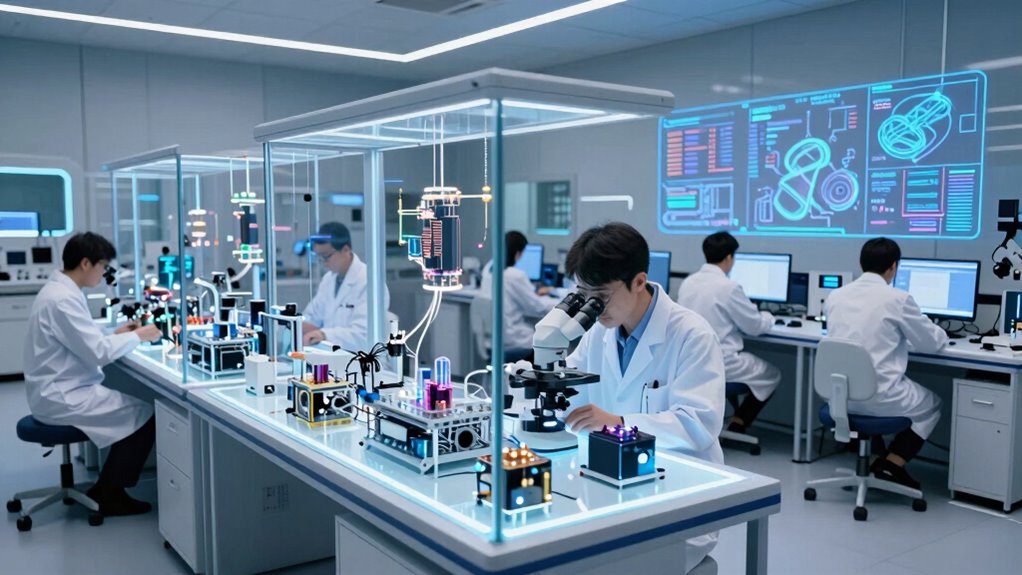

Inside the secret nanotech R&D labs of tech giants, you’ll find cutting-edge facilities with advanced equipment like cleanrooms, TEMs, and nanomanufacturing tools. Researchers focus on nanoscale materials, next-generation nanoelectronics, and nanophotonics to revolutionize electronics, medicine, and energy. Strategic collaborations and ecosystems accelerate innovations while managing safety and ethical risks. If you continue exploring, you’ll uncover how these labs shape tomorrow’s breakthroughs and disrupt industries at the tiniest scales.
Key Takeaways
- Tech giants invest heavily in state-of-the-art cleanroom facilities equipped with advanced nanofabrication and characterization tools like TEM, SEM, and AFM.
- Their R&D labs focus on nanoscale materials such as 2D materials, quantum dots, and carbon nanotubes for next-generation electronics and medical applications.
- Collaboration with universities, national labs, and industry partners accelerates innovation in nanoelectronics, nanomedicine, and photonics.
- Researchers develop scalable manufacturing processes, addressing challenges like contamination control, reproducibility, and process variability.
- Safety, ethical considerations, and regulatory compliance are integrated into their secretive research to ensure responsible nanotech development.
Strategic Vision and Long-Term Goals

The strategic vision of nanotech R&D labs at tech giants centers on harnessing nanoscale materials and devices to drive the next era of innovation across multiple industries. You focus on developing materials, devices, and systems at 1–100 nm scales that enable breakthroughs in semiconductors, sensors, therapeutics, and energy storage. Your long-term goal is to integrate these advancements into core product roadmaps, aligning with AI, semiconductor, life sciences, and cloud strategies. You aim to commercialize discoveries through pilot prototypes, scale-up partnerships, and spinouts. Protecting innovations via aggressive patenting and licensing is key, ensuring competitive advantage. To support this vision, you invest heavily in state-of-the-art facilities, attracting top talent, and fostering collaboration, all geared toward translating nanoscale science into impactful market solutions. Nanotechnology plays a crucial role in enabling these breakthroughs by allowing precise control at atomic and molecular levels. Additionally, advancements in material science are essential for creating more efficient and versatile nanoscale components that can be integrated into existing and emerging technologies.
Cutting-Edge Technical Domains in Nanotechnology
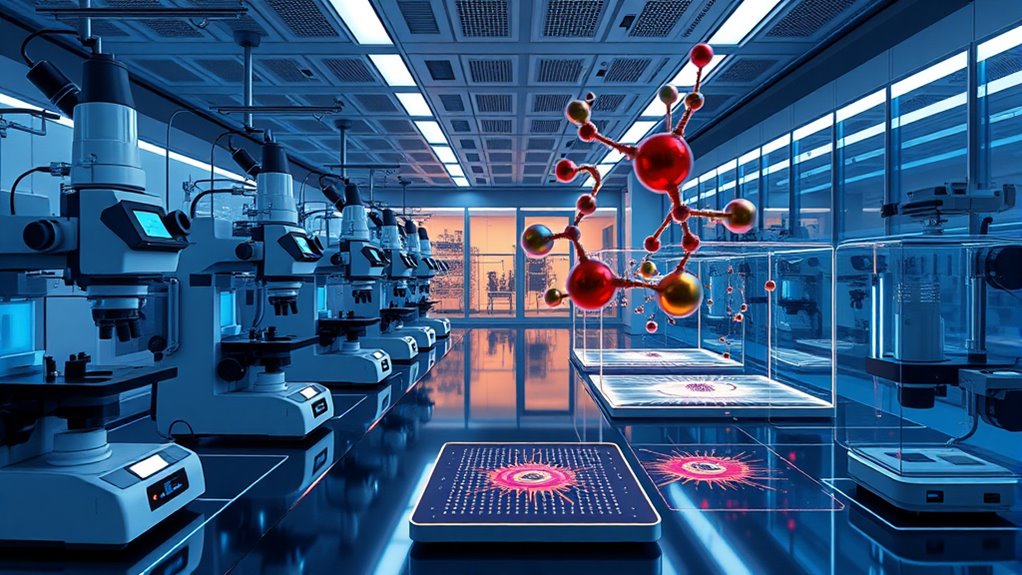
You’re exploring how tech giants are pushing the boundaries of nanotechnology in key areas like next-generation nanoelectronics, advanced nanophotonics, and nanomedicine. These fields focus on creating smaller, more efficient devices, smarter optical systems, and targeted medical treatments. By investing in these cutting-edge domains, companies aim to revolutionize industries and accelerate the shift from research to real-world applications.
Next-Gen Nanoelectronics
Next-generation nanoelectronics push beyond traditional silicon-based devices by leveraging advanced nanomaterials such as carbon nanotubes, 2D materials, and quantum-dot architectures. You’ll find these materials enable faster, smaller, and more energy-efficient transistors and memory systems. Carbon nanotubes offer exceptional electrical conductivity and mechanical strength, making them ideal for ultra-scaled transistors. 2D materials like graphene and transition metal dichalcogenides provide tunable electronic properties for novel device functions. Quantum-dot architectures allow precise control over charge and spin states, supporting quantum computing and high-density memory. Researchers are also exploring scalable fabrication processes that integrate these nanomaterials seamlessly into existing manufacturing infrastructure, ensuring practical large-scale deployment. Advances in nanomanufacturing techniques are critical for translating lab-based innovations into commercial technologies.
Advanced Nanophotonics & Metamaterials
Advances in nanophotonics and metamaterials are transforming how you manipulate light at the nanoscale, enabling applications in optical computing, sensing, and displays. By engineering nanoscale dielectric and metallic structures, you can control light with unprecedented precision. These innovations allow for ultra-fast data processing, highly sensitive detectors, and vibrant, energy-efficient displays. You’re working with materials like plasmonic nanoparticles, 2D layered structures, and layered metamaterials to achieve these effects. Metasurfaces also enable the creation of flat optical components that replace bulky traditional lenses, further miniaturizing optical devices.
Nanomedicine Innovations
Nanomedicine innovations leverage nanotechnology to create highly targeted and effective therapeutic and diagnostic tools. You harness lipid nanoparticles, nanocarriers, and targeted nanoparticles to deliver vaccines, treat cancer, and improve diagnostics. These systems enable precision medicine, reducing side effects and increasing efficacy. Your labs develop nanostructured drug delivery platforms, integrating advanced imaging and control mechanisms for real-time monitoring. To illustrate, consider this overview:
| Focus Area | Key Technologies |
|---|---|
| Vaccine Delivery | Lipid nanoparticles, microfluidics |
| Oncology Therapeutics | Nanocarriers, targeting ligands |
| Diagnostics | Nanosensors, quantum dots |
| Imaging & Monitoring | Magnetic nanoparticles, fluorophores |
State-of-the-Art Infrastructure and Instrumentation

You’ll find that advanced cleanroom facilities, equipped with photolithography and wafer-scale processing, are essential for developing nanoscale devices. High-resolution imaging tools like TEM, SEM, and AFM enable precise characterization of nanostructures and surface chemistry. Additionally, precision deposition systems such as ALD, CVD, and PVD guarantee controlled growth of thin films and nanomaterials. Incorporating contamination control protocols is vital to maintain the integrity of sensitive nanofabrication processes. Proper equipment transportation methods, including specialized luggage and bags, are crucial for safely moving delicate tools between labs and research sites. Implementing cleanroom standards ensures a contamination-free environment, which is critical for achieving consistent, high-quality results. Maintaining strict environmental monitoring is also essential to detect and mitigate potential sources of contamination throughout the fabrication process.
Advanced Cleanroom Facilities
State-of-the-art cleanroom facilities form the backbone of nanotech R&D labs, enabling precise fabrication and characterization of nanoscale materials and devices. These advanced environments maintain strict ISO standards, controlling airborne particles, humidity, and temperature to prevent contamination. Within these cleanrooms, you’ll find high-precision tools essential for nanofabrication, such as photolithography stations, electron-beam lithography systems, and wafer processing lines. The facilities also feature integrated deposition and etching equipment, like ALD, CVD, PVD, and reactive ion etching, ensuring controlled thin-film growth. This infrastructure supports rapid prototyping, iterative testing, and scaling efforts. Key aspects include:
- Ultra-clean environments with automated contamination control
- State-of-the-art nanofabrication and patterning tools
- Integrated systems for deposition, etching, and surface modification
High-Resolution Imaging Tools
High-resolution imaging tools form the backbone of nanotech R&D labs, enabling you to visualize and analyze materials at the atomic and molecular levels. Techniques like transmission electron microscopy (TEM) and scanning electron microscopy (SEM) reveal nanoscale morphology, while atomic force microscopy (AFM) measures surface topography with atomic precision. X-ray photoelectron spectroscopy (XPS) and time-of-flight secondary ion mass spectrometry (ToF-SIMS) provide surface chemistry insights essential for understanding material interactions. These instruments allow you to characterize nanostructures, verify fabrication accuracy, and optimize processes. State-of-the-art tools ensure you can detect even the tiniest defects, monitor surface modifications, and validate material properties—crucial steps for advancing nanomaterials toward commercial applications. Their precision accelerates innovation across nanoelectronics, nanomedicine, and energy storage. Advanced imaging techniques also enable real-time monitoring of dynamic processes at the nanoscale, further enhancing research capabilities.
Precision Deposition Systems
Precise control over material deposition is essential for advancing nanotech research and manufacturing, and specialized deposition systems enable this with exceptional accuracy and repeatability. These state-of-the-art tools include atomic layer deposition (ALD), chemical vapor deposition (CVD), and physical vapor deposition (PVD), each tailored for specific nanomaterial applications. You leverage these systems to create ultra-thin films, nanostructures, and complex multilayer stacks needed for cutting-edge devices. They operate in controlled environments, minimizing contamination and ensuring uniformity at the atomic level. This precision supports the development of next-generation semiconductors, sensors, and nanomedicine. Key features include real-time process monitoring, automation for reproducibility, and compatibility with various substrates, making these systems the backbone of high-performance nanofabrication.
- Integration with in-situ diagnostics for process control
- Compatibility with advanced patterning techniques
- Scalability from prototype to pilot production
Navigating Development Timelines and Scale-Up Challenges

Developing nanotech innovations from lab breakthroughs to commercial products involves steering complex timelines and overcoming significant scale-up challenges. You’ll face reproducibility issues, as nanoscale control becomes harder at larger volumes. Contamination management is critical; even tiny impurities can sabotage yields. shifting from lab tools to manufacturing fabs often results in yield loss and process variability. Cost factors, like expensive equipment and high-purity precursor materials, add pressure to meet deadlines. You must optimize processes to maintain nanoscale precision while ensuring scalability. Regulatory hurdles for nanomedicine and safety considerations further extend timelines. Navigating these challenges demands close coordination with foundries, rigorous quality control, and flexible strategies, all while balancing project milestones against technical feasibility to bring innovations from prototype to market efficiently.
Managing Risks, Safety, and Ethical Considerations

As nanotech innovations move closer to commercialization, managing associated risks and safety concerns becomes increasingly important. You must address health hazards like nanoparticle inhalation, environmental impacts, and lifecycle risks. Regulatory uncertainty complicates compliance, requiring ongoing monitoring and adaptation. Export controls and national security issues demand careful oversight of sensitive technologies. Ethical considerations around nanosensors and privacy raise civil-liberties questions, necessitating governance frameworks. Corporate safety measures include internal review boards, external panels, and cross-disciplinary audits to prevent misuse of high-risk projects. Understanding dark psychology tactics can also help anticipate potential manipulative threats in high-stakes research environments. To deepen your understanding, consider:
- Implementing exposure controls and lifecycle assessments
- Circumventing evolving regulations and export restrictions
- Establishing governance for ethical and privacy concerns
Building Ecosystems Through Partnerships and Market Strategies

Building strong ecosystems through partnerships and market strategies is essential for nanotech labs aiming to translate innovations into commercial success. You should leverage collaborations with internal business units like chip manufacturing, cloud services, and healthcare to accelerate application development and secure procurement channels. Partnering with academic and national labs provides access to advanced tools, de-risks early research, and fosters innovation. Engaging with industrial consortia, foundries, and equipment vendors helps scale processes and establish supply chains, especially amid the CHIPS-era investments. Additionally, forming startups and spinouts enables commercialization of non-core innovations, attracting external capital and expanding market reach. You must stay aware of market trends, like the multi-billion-dollar growth in nanomedicine and nanoelectronics, to position your ecosystem competitively against established firms and emerging startups. Incorporating sustainable manufacturing practices further enhances credibility and long-term viability in the evolving market landscape.
Frequently Asked Questions
How Do Nanotech Labs Protect Their Most Sensitive Intellectual Property?
You protect your most sensitive IP by implementing aggressive patenting and cross-licensing strategies, securing core nanomaterials like quantum dots and CNTs. You also restrict access through secure facilities, control contamination, and monitor personnel with strict protocols. Additionally, you collaborate with legal teams to enforce confidentiality, use non-disclosure agreements, and carefully manage licensing agreements to prevent unauthorized use, ensuring your innovations stay protected and your competitive edge remains intact.
What Are the Biggest Challenges in Scaling Nanomaterials for Commercial Use?
You face several major hurdles when scaling nanomaterials for commercial use. Reproducible nanoscale control and contamination management are tricky, often causing yield loss during transfer from lab to production. High capital costs of specialized equipment and low initial yields add financial strain. Additionally, supply constraints for high-purity materials and ensuring safety and regulatory compliance complicate scale-up. Overcoming these challenges requires precise process optimization and strong collaboration with foundries and suppliers.
How Do Researchers Address Environmental and Health Safety Risks?
You might worry about nanoparticle inhalation and environmental persistence, but researchers proactively implement exposure controls like enclosed synthesis systems and proper ventilation. They also conduct lifecycle assessments and risk analyses to understand ecotoxicology impacts. By adhering to strict safety protocols, regulators’ evolving standards, and ongoing monitoring, they minimize health and environmental risks while advancing nanotech innovations responsibly and ethically.
What Regulatory Hurdles Are Most Difficult for Nanomedicine Development?
You’ll find that regulatory hurdles for nanomedicine are tough mainly because of safety testing and clinical approval processes. You need to demonstrate rigorous safety and efficacy data, which can take years and face uncertain standards. Steering evolving regulations, ensuring compliance with international standards, and securing approvals from agencies like the FDA or EMA require extensive documentation, long timelines, and often, adapting your technology to meet strict safety and quality requirements.
How Do Labs Stay Ahead of Rapid Advancements in Nanotech Innovation?
You stay ahead of rapid nanotech innovation by continuously investing in cutting-edge tools like atomic layer deposition and high-resolution microscopy, just like how a leading lab developed a new 2D material for faster transistors. This approach lets you quickly prototype, validate, and scale breakthroughs. Collaborating with industry partners and academic institutions also accelerates access to emerging techniques and knowledge, ensuring you’re always at the forefront of nanotech advancements.
Conclusion
As you explore these secret nanotech labs, remember they’re like hidden treasure chests brimming with innovation, waiting to transform the future. With strategic visions guiding long-term breakthroughs, advanced infrastructure powering cutting-edge research, and careful navigation of risks and ethics, tech giants are shaping a new frontier. By building strong partnerships, they’re weaving an intricate web of possibilities—each discovery a shimmering thread. Stay curious; the tiniest innovations could spark the biggest revolutions.