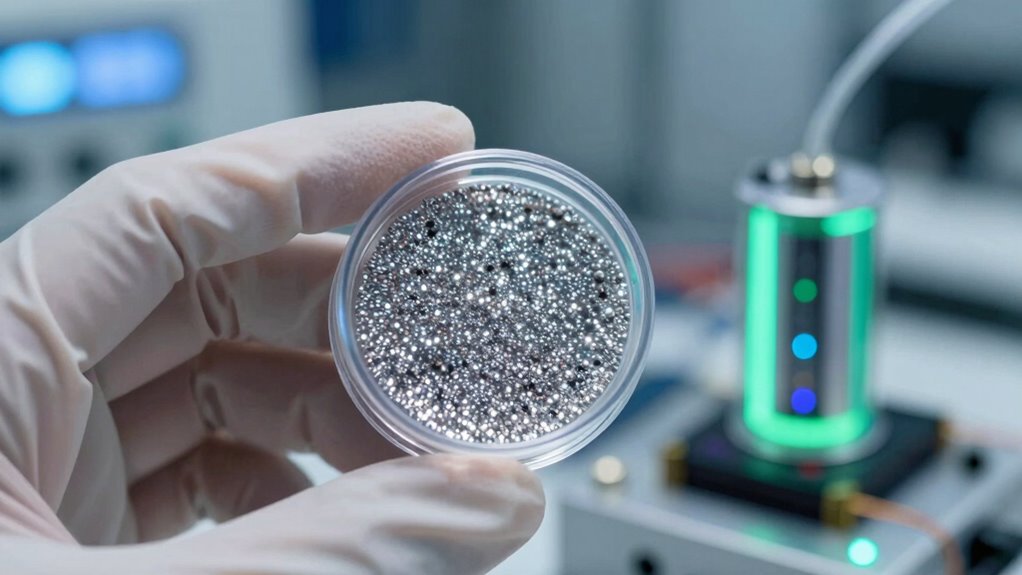

Nanomaterials are indeed pivotal for next-generation batteries. They enhance energy density, enable faster charging, and improve safety by creating more stable, efficient electrode and electrolyte interfaces. Technologies like silicon nanowires and graphene substantially boost performance and longevity, making batteries cleaner and more powerful. As research advances and manufacturing scales up, nanomaterials are poised to transform energy storage. To explore how these tiny materials are shaping the future of batteries, keep going.
Key Takeaways
- Nanomaterials enhance battery energy density, charge speed, and lifespan by improving electrode surface area and conductivity.
- They enable silicon and sodium-based batteries to accommodate volume changes and larger ion sizes, boosting performance.
- Scalable manufacturing processes are making nanomaterials more cost-effective and suitable for mass production.
- Nanocomposites improve interface stability and thermal management, increasing safety and durability of next-gen batteries.
- Commercial applications like EV batteries demonstrate nanomaterials’ potential to revolutionize energy storage solutions.

Nanomaterials for Ion Battery Applications
As an affiliate, we earn on qualifying purchases.
As an affiliate, we earn on qualifying purchases.
The Role of Nanotechnology in Enhancing Battery Performance
Nanotechnology plays a crucial role in enhancing battery performance by manipulating materials at the atomic and molecular levels. You can increase the surface area, reactivity, and conductivity of key components like electrodes and electrolytes, leading to more efficient energy storage and transfer. By precisely controlling nanoscale structures, you enable higher energy densities, faster charging times, and longer battery lifespans. For example, nanomaterials such as nanoparticles, nanowires, nanotubes, and graphene are used to optimize different battery parts. These materials improve how batteries store and release energy, making them more powerful and reliable. As a result, nanotechnology transforms traditional batteries into high-performance systems, paving the way for faster, safer, and longer-lasting energy solutions for electric vehicles, portable devices, and grid storage.

Silicon Anode Systems for Lithium-Ion Batteries
As an affiliate, we earn on qualifying purchases.
As an affiliate, we earn on qualifying purchases.
Breakthroughs With Silicon Nanowires in High-Energy Anodes

Silicon nanowires are transforming high-energy anodes by tackling the problem of swelling during charge cycles, which has limited silicon’s use. Their ability to deliver energy densities over 500 Wh/kg makes them a game-changer for battery performance. With scalable manufacturing processes already in place, these nanowires are paving the way for commercial, next-generation energy storage solutions. European cloud innovation is also advancing sustainable manufacturing practices that could further enhance nanomaterial production. Additionally, the high refresh rates of emerging nanomaterials enable faster charging and discharging cycles, improving overall battery efficiency.
Overcoming Silicon Swelling
Silicon-based anodes promise markedly higher energy densities for next-generation batteries, but their practical use has been hampered by the material’s tendency to swell and shrink during charge-discharge cycles. This volume change causes mechanical stress, leading to electrode fracture and capacity loss. To overcome this, researchers turn to silicon nanowires, which accommodate volume expansion better than bulk silicon. Their nanoscale structure provides flexible pathways for lithium ions and reduces stress buildup. Additionally, nanowire networks maintain electrical contact even as the silicon expands and contracts. These breakthroughs enable silicon anodes to retain capacity over many cycles, boosting battery lifespan. The nanostructuring approach offers a promising solution to silicon’s swelling problem, paving the way for high-energy, durable batteries that outperform traditional graphite anodes.
Achieving High Energy Density
Advancements in nanomaterials have opened new pathways to markedly boost energy density in batteries. By incorporating silicon nanowires into anodes, you can substantially increase capacity without sacrificing stability. These nanowires accommodate silicon’s volume changes during charge cycles, preventing degradation. Their high surface area enhances lithium-ion storage, pushing energy densities over 500 Wh/kg—much higher than traditional graphite anodes. This nanostructuring allows for more efficient charge transfer and faster charging times. Additionally, scalable manufacturing methods like chemical vapor deposition enable large-scale production of silicon nanowire electrodes. As a result, you get batteries that deliver longer runtimes, increased power, and improved lifespan. These breakthroughs are driving the development of high-energy-density batteries essential for electric vehicles, portable electronics, and grid storage.
Scalable Manufacturing Processes
Recent breakthroughs in manufacturing techniques have made large-scale production of silicon nanowire anodes feasible, addressing previous cost and scalability barriers. Techniques like chemical vapor deposition and advanced ball milling now allow for consistent, high-quality nanowire synthesis at commercial volumes. These methods reduce material waste and energy consumption, making the process more economical. Automated assembly lines and continuous-flow reactors enable rapid production, ensuring uniformity and reproducibility. Industry collaborations are streamlining supply chains, lowering costs further. Researchers are developing scalable methods to integrate silicon nanowires into existing battery manufacturing, minimizing disruptions. Additionally, leveraging Free Floating techniques can further optimize the manufacturing process for efficiency and sustainability. These innovations are vital for shifting from lab prototypes to mass-market batteries. As a result, silicon nanowire anodes are becoming viable for high-performance energy storage solutions, paving the way for next-generation batteries to reach widespread adoption.

Cat® 18V 1 FOR ALL 5Ah Graphene Battery – GXB5
[LET’S DO THE WORK] 18V CAT Cordless Power Tools utilize innovative battery technology to maximize performance and power,…
As an affiliate, we earn on qualifying purchases.
As an affiliate, we earn on qualifying purchases.
Graphene’s Impact on Battery Safety and Longevity
Graphene considerably enhances battery safety and longevity by enabling the development of non-flammable, stable electrolytes that reduce the risk of thermal runaway. Its exceptional conductivity helps maintain stable voltage levels, decreasing overheating chances. Graphene’s strength and flexibility reinforce electrode structures, preventing degradation over repeated cycles. Its large surface area improves ion transport, leading to more uniform charge distribution and reducing hot spots. This material property also facilitates faster charging times and better overall efficiency. The stability of graphene minimizes the formation of dendrites—tiny, dangerous metal filaments that can cause short circuits. Additionally, graphene’s chemical inertness ensures compatibility with various electrolytes, extending battery lifespan. Its conductivity further enhances charge transfer, boosting overall performance. Moreover, its material properties contribute to improved overall performance and durability of energy storage systems. Embracing these innovative materials further pushes the boundaries of battery technology. Together, these properties create safer, longer-lasting batteries suitable for electric vehicles, portable devices, and grid storage, making graphene a crucial nanomaterial for advancing energy storage safety and durability.

Electrochemical Energy Storage: Next Generation Battery Concepts (Topics in Current Chemistry Collections)
As an affiliate, we earn on qualifying purchases.
As an affiliate, we earn on qualifying purchases.
Improving Capacity and Charging Speed Through Nanostructured Electrodes

Nanostructured electrodes substantially boost battery capacity and charging speed by increasing surface area and improving ion transport pathways. This allows more lithium ions to be stored and moved quickly during charging and discharging cycles. This increased surface area enables a greater number of active sites for electrochemical reactions, enhancing overall performance. As a result, your battery can deliver higher energy output and recharge faster. You benefit from enhanced electron mobility and reduced degradation over time. Incorporating nanomaterials like nanoparticles, nanowires, and graphene allows you to optimize electrode design for maximum performance. Travel tech & electronics advancements like these can also help ensure your devices stay powered during long journeys.
- Greater surface area for active reactions
- Faster ion diffusion through nanoscale channels
- Reduced electrode polarization and resistance
- Improved mechanical stability during cycling
- Higher power density and shorter charging times
Addressing Ion Size Challenges With Nanomaterials in Sodium-Ion Batteries

Building on the advancements in nanomaterials to improve electrode performance, addressing the size of ions in sodium-ion batteries presents unique challenges. Sodium ions are roughly 70% larger than lithium ions, making insertion into traditional electrode materials difficult. Nanostructured materials, like crystalline nanowires and nanoporous structures, help create more accommodating pathways for these bigger ions. They increase surface area and reduce diffusion distances, enhancing ion mobility. Use the table below to understand how nanomaterials mitigate size-related issues:
| Nanomaterial Type | Benefit for Na-Ion Batteries |
|---|---|
| Nanowires | Provide flexible channels for larger ions |
| Nanoporous Structures | Increase surface area for ion access |
| Nanotubes | Improve mechanical stability during cycling |
| Graphene | Enhance conductivity, support ion transport |
These innovations are essential for making sodium-ion batteries viable for large-scale energy storage. Understanding ion size is crucial in designing effective nanomaterials for this purpose.
Manufacturing Advances and Scalability of Nanomaterial-Based Batteries
Advances in manufacturing techniques are making nanomaterial-based batteries more scalable and cost-effective. You need to consider how methods like chemical vapor deposition and hybrid processes can streamline production while maintaining quality. Overcoming industrial integration challenges will be vital to bringing these next-generation batteries to widespread use. Incorporating connected equipment and apps can further optimize manufacturing workflows and quality control processes. Additionally, implementing smart automation systems can enhance precision and reduce production costs in scaling up these innovative battery technologies.
Scalable Production Techniques
Scaling up nanomaterial-based battery production hinges on developing manufacturing methods that are both efficient and cost-effective. You need techniques that can produce high-quality nanomaterials at scale without excessive expense. Advances include:
- Chemical vapor deposition (CVD) for uniform graphene and nanotube layers
- Ball milling for large-volume nanoparticle synthesis
- Hybrid processes combining deposition and milling for tailored nanostructures
- Roll-to-roll manufacturing for continuous production
- Use of scalable reactors to ensure consistency and reduce waste
These methods help translate lab breakthroughs into commercial quantities. By optimizing process parameters and integrating automation, you can achieve higher throughput and lower costs. The focus remains on balancing quality, speed, and affordability, ensuring nanomaterials are ready for next-generation battery markets.
Manufacturing Cost Reduction
To reduce manufacturing costs for nanomaterial-based batteries, researchers are focusing on developing scalable and cost-effective production methods that maintain high quality. Techniques like chemical vapor deposition, ball milling, and hybrid approaches are increasingly refined for large-scale use. These methods lower material and processing expenses while ensuring consistent nanomaterial properties. The adoption of existing manufacturing infrastructure, such as lithium-ion production lines, helps cut costs further. Additionally, automating synthesis processes reduces labor and waste, boosting efficiency. Producing high-quality graphene and silicon nanowires at scale becomes more feasible through process optimization and continuous innovation. These advances enable manufacturers to ramp up production without considerably raising costs, bringing next-generation nanomaterial batteries closer to commercial viability and broad adoption across various industries.
Industrial Integration Challenges
Integrating nanomaterial-based batteries into industrial manufacturing processes presents significant challenges, despite recent progress in production techniques. Scaling up nanomaterial synthesis while maintaining quality remains complex and costly. You need to address issues like uniformity, reproducibility, and safety, especially at high volumes. Additionally, compatibility with existing manufacturing lines requires redesigns and new equipment. Variability in nanomaterial properties can impact battery performance, making quality control critical. You also face hurdles related to environmental and health regulations for nanomaterial handling. To overcome these, focus on:
- Developing scalable, cost-effective synthesis methods
- Ensuring consistent nanomaterial quality at large scale
- Integrating nanomaterials into existing production lines
- Addressing safety and environmental concerns
- Maintaining performance and reliability in mass production
- Implementing effective filtration and pump protection to safeguard manufacturing equipment, which is essential for maintaining the integrity of body-related manufacturing environments. Furthermore, establishing standardized quality assurance protocols is vital to ensure that nanomaterials meet the necessary specifications for reliable battery performance.
Overcoming Interfacial and Thermal Challenges With Advanced Nanocomposites
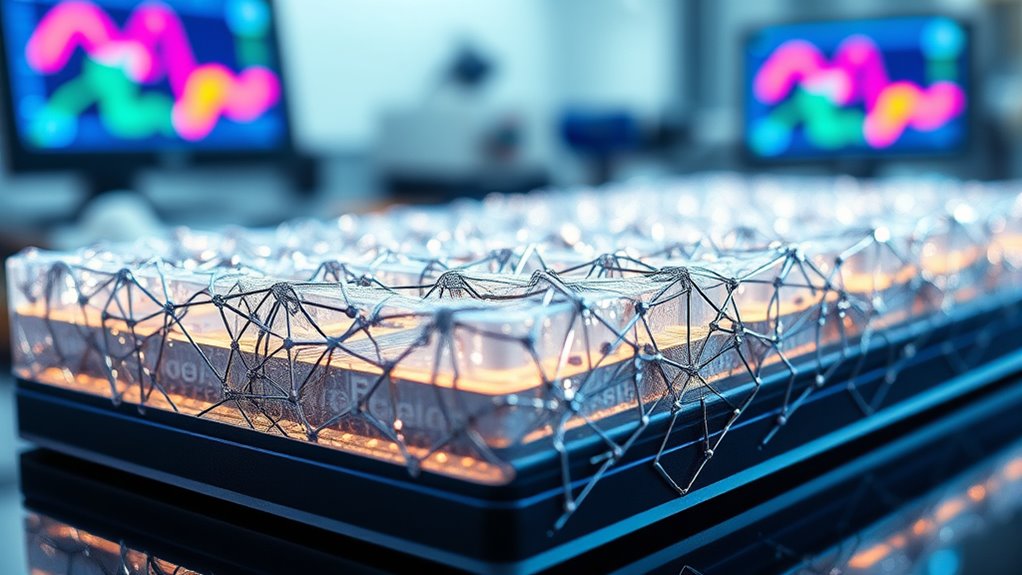
Advanced nanocomposites are transforming battery technology by effectively addressing interfacial and thermal challenges that limit performance and safety. These materials improve electrode-electrolyte interfaces, reducing side reactions that cause degradation and capacity loss. Nanostructured coatings, like Al2O3 on cathodes, prevent unwanted reactions and enhance stability, especially during high cycling rates. They also manage heat more efficiently by dispersing thermal energy across nanoscale components, decreasing the risk of thermal runaway. Incorporating nanomaterials such as graphene and nanotubes creates conductive networks that facilitate rapid electron transfer and better heat dissipation. Interfacial stability plays a crucial role in extending battery lifespan and maintaining consistent performance. These innovations lead to batteries with higher energy density, faster charging, and increased safety. By overcoming thermal and interfacial hurdles, advanced nanocomposites pave the way for more reliable, long-lasting next-generation energy storage solutions.
The Future Potential of Nanomaterials in Energy Storage Solutions

Nanomaterials hold immense promise for revolutionizing energy storage solutions by enabling batteries that are faster, safer, and more efficient. As you explore their future potential, you’ll see how they can dramatically improve performance and scalability. Advances in nanostructured electrodes and electrolytes will lead to higher energy densities, faster charging times, and longer cycle lives. You might also benefit from developing safer, non-flammable electrolytes and more sustainable materials. Additionally, nanomaterials could access cost-effective mass production, making next-generation batteries accessible worldwide. The ongoing research into silicon nanowires, graphene, and nanocomposites reveals their potential to transform energy storage. These innovations will not only enhance existing battery technologies but also pave the way for entirely new applications in electric vehicles, grid storage, and portable devices. Furthermore, leveraging application-specific nanomaterials can optimize battery performance for specialized uses. Moreover, advancements in scalability of nanomanufacturing are essential to transition these technologies from laboratory settings to commercial-scale production. Improvements in manufacturing techniques could accelerate the deployment of nanomaterial-based batteries on a global scale.
Real-World Applications and Commercialization Prospects
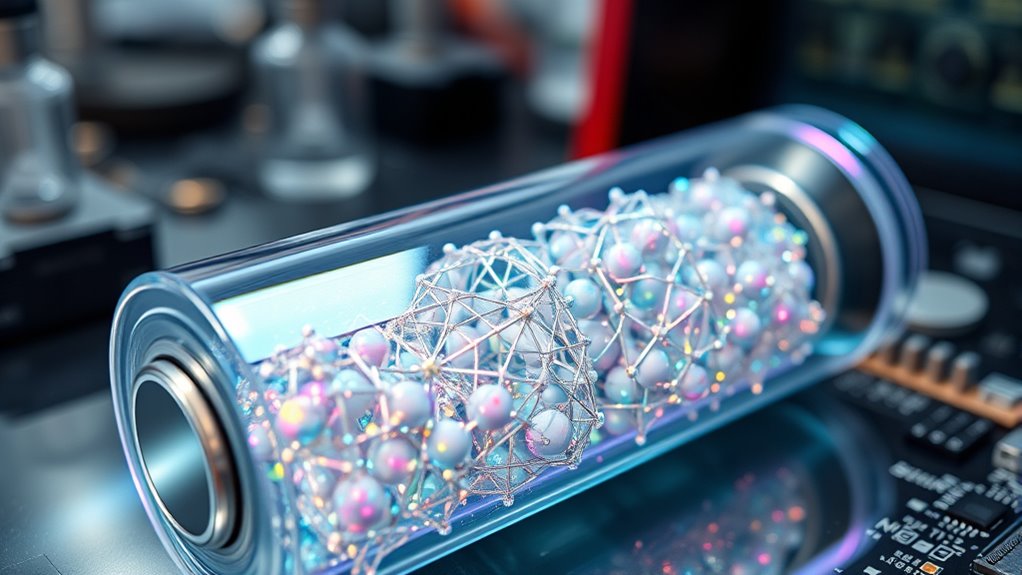
The commercialization of nanomaterial-based batteries is accelerating as manufacturers develop scalable production techniques and demonstrate clear performance benefits. You can now find nanomaterials in commercial lithium-ion batteries, especially in electric vehicles and portable electronics, where they boost energy density and charging speed. Companies like Amprius are scaling up silicon nanowire anode production, making high-capacity batteries more accessible. Graphene, with its exceptional conductivity and stability, is increasingly used in safer, longer-lasting batteries, supporting electric cars with over 400 miles per charge. Sodium-ion batteries are also entering the market, offering cost-effective alternatives for grid storage. While challenges remain—such as manufacturing consistency and cost reduction—the promising results and ongoing research suggest nanomaterials will play a crucial role in next-generation energy storage solutions, accelerating their path to widespread commercial adoption. Advancements in nanomaterial fabrication are helping overcome current production hurdles, paving the way for broader implementation.
Frequently Asked Questions
How Do Nanomaterials Improve Battery Lifespan and Safety?
Nanomaterials improve battery lifespan and safety by enhancing electrode durability and reducing degradation over charge cycles. They enable precise control at the nanoscale, increasing conductivity and stability. For safety, nanomaterials like graphene create non-flammable, stable electrolytes, preventing thermal runaway. Silicon nanowires combat volume changes, extending lifespan. Their high surface area and reactivity also support faster charging and safer operation, making batteries more reliable and long-lasting.
What Are the Environmental Impacts of Nanomaterial Production?
You might think it’s all smooth sailing, but nanomaterial production can have notable environmental impacts. Manufacturing often involves energy-intensive processes, chemical use, and waste generation, which can harm ecosystems and contribute to pollution. Extracting raw materials may also lead to habitat destruction. To stay ahead, you should advocate for greener methods, like recycling and sustainable sourcing, ensuring that advances in battery technology don’t come at Earth’s expense.
Can Nanomaterials Be Used in All Types of Batteries?
Yes, nanomaterials can be used in many types of batteries, including lithium-ion, sodium-ion, and emerging alternatives. You’ll find nanostructured electrodes and electrolytes improving performance by increasing surface area, conductivity, and stability. They help achieve faster charging, higher energy density, and longer cycle life across various battery chemistries. While not universal yet, ongoing research aims to adapt nanomaterials for all battery types, making them essential for future energy storage solutions.
What Are the Current Challenges in Scaling Nanomaterial Manufacturing?
You face challenges in scaling nanomaterial manufacturing due to complex, costly processes like chemical vapor deposition and hybrid methods. Ensuring consistent quality and uniformity at large scales is tough, and high production costs limit widespread adoption. Additionally, controlling safety and environmental impacts during mass production remains difficult. Overcoming these hurdles requires improving fabrication techniques, reducing costs, and developing scalable, safe methods to make nanomaterials viable for commercial battery applications.
How Soon Will Nanotech-Enhanced Batteries Be Available Commercially?
Nanotech-enhanced batteries are already starting to reach the market, with companies like Amprius launching scaled production lines. You can expect broader availability within the next 3 to 5 years as manufacturing processes improve and costs decrease. Advancements in nanomaterials, like silicon nanowires and graphene, accelerate commercialization, making high-capacity, faster-charging, and safer batteries more accessible for electric vehicles, portable devices, and grid storage soon.
Conclusion
Nanomaterials are revolutionizing battery tech, boosting capacity, speed, and safety. Did you know that silicon nanowire anodes can increase energy density by up to 10 times? As manufacturing scales up, expect more affordable, high-performance batteries in your devices. Embrace the future of energy storage — nanotechnology’s innovations are set to power your world with faster charging and longer-lasting solutions. The next generation is just around the corner, driven by tiny but mighty nanomaterials.