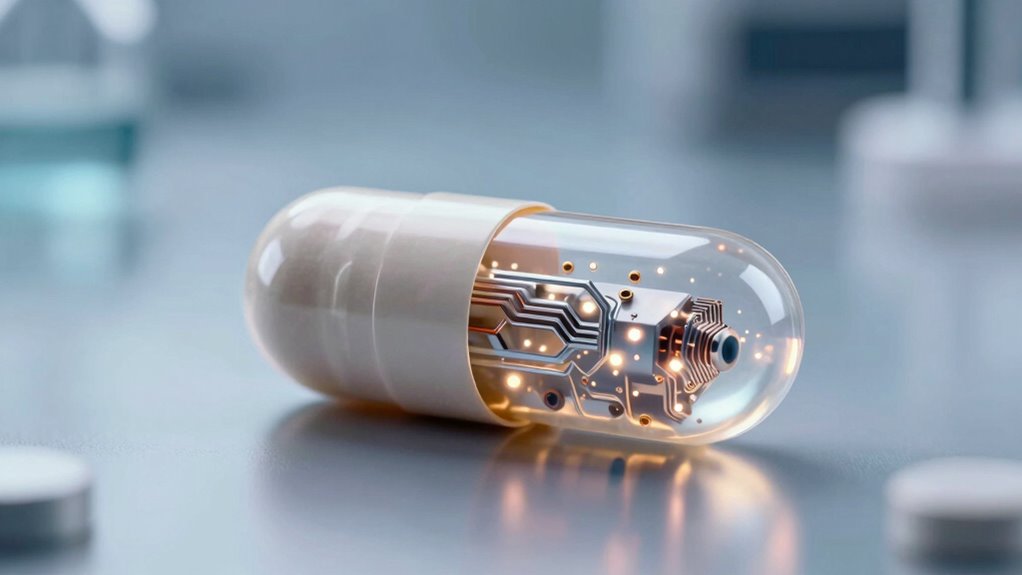

Nanotech is transforming drug delivery with smart pills that use innovative nanoparticle carriers like liposomes and polymer-based systems for precise targeting and controlled release. These devices can respond to stimuli or be guided electronically, ensuring medications reach the right spot at the right time, while reducing side effects. They also offer real-time monitoring and personalized treatment options. If you explore further, you’ll discover how these advances are shaping the future of healthcare.

Get the latest gadgets delivered free with Prime
- Fast, free delivery on millions of items
- Prime Video, Amazon Music and more included
- Member-only deals all year
Key Takeaways
- Nanotechnology enables smart pills with targeted, stimuli-responsive drug release, enhancing precision and minimizing side effects.
- Ingestible devices integrating nanotech allow real-time monitoring and adaptive drug delivery within the gastrointestinal tract.
- Engineered nanoparticles improve bioavailability and controlled release of therapeutics, revolutionizing personalized medicine.
- Smart pills utilize advanced materials like liposomes, polymers, and inorganic nanoparticles for customizable and efficient treatment options.
- Regulatory and safety challenges are addressed through ongoing innovations in nanoengineering, device reliability, and biocompatibility assessments.
As an affiliate, we earn on qualifying purchases.
Types of Innovative Nanoparticle Carriers

Innovative nanoparticle carriers are transforming drug delivery by enabling precise targeting and controlled release. You’ll encounter various formats, including liposomes—spherical vesicles with lipid bilayers that encapsulate drugs—ideal for improving bioavailability. Polymeric nanoparticles use biodegradable polymers to deliver drugs steadily over time, reducing dosing frequency. Solid lipid nanoparticles combine lipid stability with controlled release, perfect for lipophilic drugs. Inorganic nanoparticles, such as gold or silica, offer stability and imaging capabilities alongside delivery. These carriers can be engineered for size, surface properties, and drug load, optimizing their performance. Their versatility allows targeting specific tissues or cells, enhancing efficacy and minimizing side effects. Additionally, nanotech-enabled carriers can be tailored to improve drug stability and reduce toxicity, further advancing personalized medicine. The engineering of these nanoparticles involves precise control over their physical and chemical properties to maximize therapeutic benefits. Moreover, understanding nanoparticle design is crucial for developing safe and effective drug delivery systems. A thorough knowledge of material properties allows researchers to customize nanoparticles for specific medical applications. This broad spectrum of nano-enabled formats forms the backbone of advanced drug delivery systems, paving the way for more effective, personalized therapies and enabling targeted therapy to revolutionize treatment options.
nanotech ingestible medical devices
As an affiliate, we earn on qualifying purchases.
As an affiliate, we earn on qualifying purchases.
Precision Targeting and Controlled Release Mechanisms

Nanoparticle carriers can be engineered to deliver drugs precisely where they’re needed and release them in a controlled manner. You can customize surface properties for passive targeting, like exploiting the EPR effect in tumors. Active targeting involves adding ligands such as antibodies or peptides to bind specific cell markers. Stimuli-responsive systems release drugs in response to internal cues like pH, enzymes, or redox conditions, or external triggers such as light or magnetic fields. Physical actuation methods, including onboard electronics or magnetic switches, enable precise release at specific GI sites. Programmable matrices or timers provide temporal control for sustained or pulsatile dosing. Additionally, advancements in targeting mechanisms are continually improving the specificity and efficiency of drug delivery systems. Ongoing research into nanocarrier design is expanding the possibilities for personalized medicine and minimizing side effects, leading to more effective treatments with fewer complications. Incorporating advanced materials that respond to multiple stimuli further enhances the adaptability and precision of these delivery platforms.
stimuli-responsive nanoparticle drugs
As an affiliate, we earn on qualifying purchases.
As an affiliate, we earn on qualifying purchases.
Cutting-Edge Smart Capsule and Ingestible Device Technologies

Advancements in smart capsule and ingestible device technologies are transforming oral drug delivery by enabling precise targeting, controlled release, and real-time monitoring within the gastrointestinal (GI) tract. You can now use magnetically activated capsules that open at specific sites or electronic systems that respond to internal cues, such as pH or enzymes, to release drugs accurately. These devices often integrate sensors and microelectronics to track conditions, ensuring optimal dosing and timing. Robotic or “smart capsules” can navigate through the GI tract, actuating to deliver medication exactly where needed. Some systems combine sensors with drug reservoirs for feedback-controlled dosing, improving efficacy and safety. Additionally, these innovations leverage local automation to enhance targeted therapy and improve patient compliance. Such innovations provide personalized, minimally invasive options that enhance treatment precision and patient compliance, supported by ongoing research into biocompatible materials that reduce adverse reactions and improve device functionality. Furthermore, advances in microelectronics enable more sophisticated data collection and device responsiveness within the body, opening new avenues for personalized medicine.
As an affiliate, we earn on qualifying purchases.
Clinical Applications Revolutionizing Healthcare

Smart pills are transforming healthcare by enabling targeted, controlled, and real-time treatment within the body. You can now receive therapies precisely where needed, reducing side effects and improving outcomes. In oncology, smart nanoparticles deliver chemo drugs directly to tumors, minimizing systemic toxicity and increasing effectiveness. For gastrointestinal conditions, smart capsules release medication exactly in the large intestine, enhancing localized treatment. Oral bioavailability of biologics like peptides improves with nanoparticle carriers, making injections unnecessary. Precision antibiotics target infection sites, lowering microbiome disruption and resistance. Additionally, integrated sensor-delivery pills monitor health metrics and adjust therapy on the fly, providing personalized care. These innovations are shaping a future where treatments are more effective, safer, and tailored to individual patient needs, revolutionizing how healthcare is delivered. Advances in accessible drug delivery systems are further expanding the potential of smart pills to improve patient outcomes worldwide. Moreover, ongoing research into nanotech-enabled delivery promises even greater precision and efficiency in targeting specific tissues and cells. Recognizing the importance of best heat pump technology, researchers are exploring ways to integrate smart systems into drug delivery devices for enhanced performance and energy efficiency. As these systems evolve, their integration with wearable health monitors will enable more comprehensive and proactive healthcare management.
Advantages Driving Therapeutic Success

The benefits of smart pills substantially enhance therapeutic outcomes by increasing drug precision and reducing side effects. You’ll experience improved efficacy because targeted delivery concentrates medication exactly where needed. Additionally, controlled release extends treatment windows and minimizes dosing frequency. Here are some key advantages:
- Higher therapeutic index – drugs are focused on the target, lowering systemic toxicity.
- Fewer side effects – spatially restricted release limits off-target effects.
- Better patient adherence – prolonged release profiles reduce dosing frequency.
- Enhanced bioavailability – improved absorption of poorly soluble or labile drugs.
- Reduced risk of scams – utilizing reliable companies for developing smart pill technologies ensures safety and effectiveness.
- Incorporating advanced targeted screening techniques can help identify the most suitable candidates for smart pill therapies, maximizing treatment success. These innovations rely heavily on nanotechnology to achieve precise drug delivery at the cellular level. Moreover, ongoing research into personalized medicine continues to refine these approaches, making treatments more tailored and effective.
These benefits lead to more effective, safer treatments tailored to individual needs, ultimately transforming healthcare outcomes through smarter, more precise drug delivery methods.
Challenges and Barriers to Clinical Adoption

You’ll face significant hurdles in bringing smart pills from research to clinic, especially with complex regulatory approval processes. Manufacturing standardization is also a challenge, as ensuring consistent quality at scale remains difficult. Additionally, long-term safety concerns about nanoparticle accumulation and potential toxicity need thorough investigation before widespread adoption. Furthermore, establishing industry standards for production and safety testing is crucial to facilitate clinical acceptance and public trust. Without clear standards, it becomes harder to demonstrate device safety, which is essential for regulatory approval and clinician confidence.
Regulatory Approval Complexities
Regulatory approval for smart pills faces significant hurdles due to their complex design and multifunctional nature. First, you must demonstrate safety, including long-term biocompatibility and potential immunogenicity, which is challenging given their nanoscale features. Second, proving consistent manufacturing quality across batches is critical, especially for devices with integrated electronics or sensors. Third, regulators demand clear evidence of efficacy and reliable targeting, which can be difficult with multifunctional systems. Fourth, addressing data security and privacy for sensor-enabled pills adds another layer of scrutiny. Additionally, manufacturing consistency is essential to meet regulatory standards and ensure patient safety. These factors require extensive, often time-consuming evaluations, making the approval process complex. As a result, charting regulatory pathways demands significant resources, rigorous testing, and close collaboration with authorities to bring innovative smart pills to clinical practice.
Manufacturing Standardization Challenges
Achieving consistent manufacturing standards for smart pills remains a significant hurdle to their widespread clinical adoption. Variability in nanoparticle size, surface properties, and device components can impact safety and efficacy. Scaling up lab processes while maintaining precise control over nanomaterial quality poses major challenges. Regulatory standards for complex devices are still evolving, complicating quality assurance. To illustrate, consider the following:
| Manufacturing Aspect | Challenge |
|---|---|
| Nanoparticle production | Ensuring batch-to-batch uniformity at scale |
| Device assembly | Maintaining reliability and biocompatibility |
| Quality control | Developing standardized testing methods |
| Regulatory compliance | Aligning manufacturing with evolving safety standards |
Overcoming these barriers is essential for reliable, safe, and effective smart pill therapies. Additionally, addressing the thermal behavior of nanomaterials during production is crucial to ensure consistent performance.
Long-term Safety Uncertainties
Long-term safety remains a critical obstacle to the widespread clinical adoption of smart pills, as the long-term effects of nanomaterials and integrated electronic components are not yet fully understood. You face uncertainties about how these materials behave over time, including potential accumulation, toxicity, and immune responses. To address these concerns, consider:
- The risk of nanoparticle accumulation in organs and its long-term health impact.
- Potential immunogenicity and unintended immune system activation.
- Unknown interactions between electronic components and biological tissues.
- Challenges in predicting and controlling biodegradation or excretion pathways.
These uncertainties hinder regulatory approval and patient confidence. Without exhaustive data, you risk unforeseen adverse effects, making safety evaluations essential for clinical translation and acceptance of smarter, nano-enabled drug delivery systems.
Future Directions and Emerging Innovations

You’re about to explore how AI-driven personalization and advanced nanoengineering techniques are shaping the future of smart pills. These innovations will enable tailored treatments and more precise drug delivery, improving outcomes and reducing side effects. As these technologies evolve, they’ll transform how we design, manufacture, and administer targeted therapies.
AI-Driven Personalization
AI-driven personalization is transforming smart pill technology by enabling tailored treatment regimens based on real-time patient data. You can now leverage machine learning algorithms to analyze sensor inputs from ingestible devices, allowing precise adjustments to dosing and timing. This approach enhances treatment efficacy and minimizes side effects. Key innovations include:
- Adaptive dosing schedules that respond dynamically to patient feedback and physiological changes.
- Predictive analytics to forecast individual responses, improving proactive care.
- Custom formulation adjustments, such as modifying drug release profiles based on ongoing data.
- Integration with electronic health records for seamless, personalized treatment management.
These advancements ensure that therapies are more effective, patient-centric, and responsive, paving the way for truly personalized medicine in the domain of smart pills.
Advanced Nanoengineering Techniques
Advances in nanoengineering are poised to revolutionize the development of smart pills by enabling highly sophisticated and multifunctional nanostructures. You’ll see innovations like stimuli-responsive nanocarriers that release drugs on demand, triggered by pH, enzymes, or external stimuli like light and magnetic fields. Active targeting surfaces functionalized with ligands allow precise binding to specific tissues or cells, enhancing efficacy. You might also encounter integrated sensor-delivery systems combining diagnostics with therapy, providing real-time feedback and adaptive dosing. 3D printing and biofabrication enable personalized pill architectures tailored to individual needs, while hybrid nano-robotics offer active navigation within the body for precise drug deposition. These emerging techniques push the boundaries of targeted delivery, control, and customization, paving the way for smarter, safer, and more effective treatments.
Frequently Asked Questions
How Do Smart Pills Ensure Patient Safety During in Vivo Operation?
You guarantee patient safety during in vivo operation by relying on smart pills with built-in safety mechanisms, like stimuli-responsive release that only triggers under specific conditions, and fail-safe electronic systems that prevent malfunction. You also benefit from biocompatible materials designed to minimize toxicity, and rigorous testing ensures reliable performance. Additionally, device designs include secure excretion pathways and monitoring features to detect issues early, safeguarding your health throughout treatment.
What Regulatory Hurdles Exist for Approving Nano-Enabled Drug Delivery Systems?
You face hurdles like proving safety and efficacy, which can be complex with nanotech’s unpredictable behavior. Regulatory agencies demand thorough testing for long-term toxicity, biodistribution, and immunogenicity, slowing down approval. You must also navigate evolving standards, manufacturing reproducibility, and device reliability concerns. These challenges create a high-stakes race, where advancing nanomedicine hinges on overcoming these hurdles to gain trust and secure approval for clinical use.
How Is Long-Term Biocompatibility of Nanomaterials Assessed?
You assess long-term biocompatibility by conducting thorough in vitro and in vivo studies, monitoring for toxicity, immune response, and biodistribution over extended periods. You analyze how nanomaterials interact with tissues, checking for accumulation and clearance rates. You also evaluate potential immunogenicity, organ function impacts, and any adverse effects. Repeated testing ensures safety before progressing to clinical trials, helping you confirm that nanomaterials won’t cause long-term harm.
Can Smart Pills Adapt to Individual Patient Physiology Dynamically?
Yes, smart pills can adapt to your individual physiology dynamically. They use stimuli-responsive systems that detect real-time internal cues like pH, enzymes, or redox states. They also incorporate integrated sensors and microelectronics that monitor your body’s signals. This data guides controlled drug release, ensuring personalized treatment. By combining these technologies, smart pills offer tailored therapies that respond instantly to your unique physiological changes, enhancing effectiveness and minimizing side effects.
What Are the Cost Implications of Scaling up Nano-Enabled Drug Production?
Scaling up nano-enabled drug production can be costly initially due to the need for advanced manufacturing equipment, quality control measures, and regulatory compliance. You’ll face expenses in optimizing processes for reproducibility and ensuring safety standards. However, as technology matures and economies of scale kick in, costs should decrease. Investing now may lead to long-term savings, increased efficiency, and broader access to personalized therapies, ultimately benefiting patient outcomes and healthcare systems.
Conclusion
Just like Icarus reaching for the sun, your journey into smart pills pushes the boundaries of medicine. With nanotech’s precision, you’re stepping into an era where drug delivery is smarter, more targeted, and highly effective. While challenges remain, the horizon gleams with promise—transforming healthcare as surely as the dawn follows night. Embrace this revolution, for the future of healing lies in your hands, guided by innovation’s relentless pursuit.
Halloween Picks
halloween
As an affiliate, we earn on qualifying purchases.