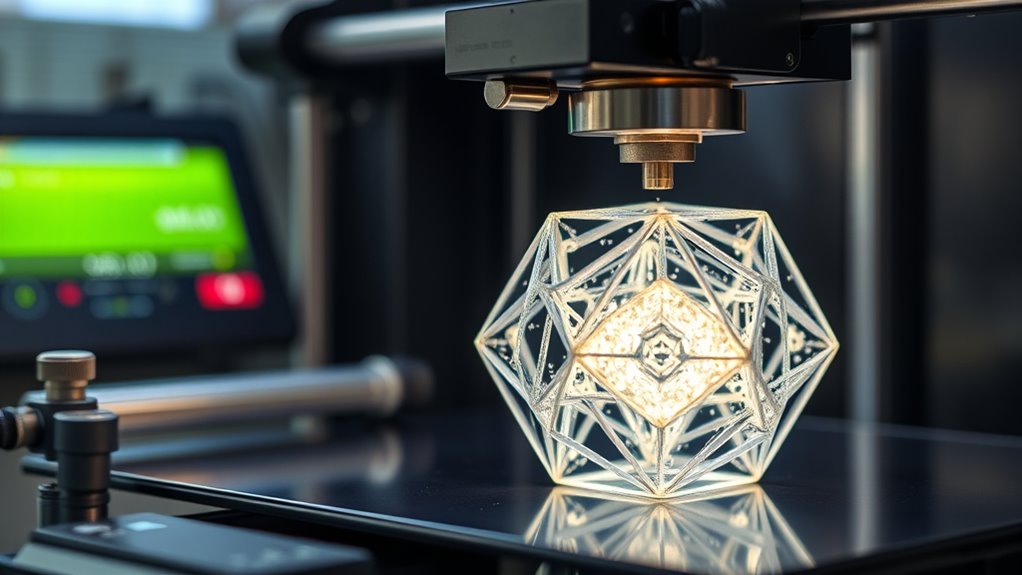

3D printing with nanocomposites involves adding nanoscale particles into base materials to create stronger, lighter, and more functional objects. These enhanced materials improve detail, surface finish, and thermal stability, making them ideal for advanced applications like medical implants, electronics, and aerospace parts. This innovative approach pushes traditional printing limits and offers customizable, high-performance solutions. Keep exploring to discover how nanocomposites are transforming the future of additive manufacturing.

Get the latest gadgets delivered free — and shop member deals
- Fast, free delivery on millions of items
- Access to Prime Big Deal Days deals on October 6–7
- Prime Video, Amazon Music and more included
Key Takeaways
- Nanocomposites enhance 3D printed parts by improving strength, flexibility, electrical conductivity, and thermal resistance.
- Uniform dispersion of nanoscale particles in base materials enables finer detail and higher resolution in prints.
- Incorporating nanocomposites allows for lightweight, durable, and customizable components across various industries.
- They improve print flow, adhesion, surface finish, and thermal stability during the manufacturing process.
- The use of nanocomposites broadens 3D printing applications in aerospace, electronics, medical devices, and advanced manufacturing.

Have you ever wondered how nanotechnology is transforming 3D printing? It’s revolutionizing the way we create complex, high-performance objects by enhancing the capabilities of traditional printing methods. At the heart of this transformation are nanocomposites—materials infused with nanoscale particles that dramatically alter their properties. These tiny additives can improve strength, flexibility, conductivity, and even thermal resistance, making nanocomposites incredibly versatile for various applications. When integrated into 3D printing technology, nanocomposites open up new possibilities for producing lightweight yet durable parts, customized medical implants, or advanced electronic components.
Understanding nanocomposite properties is essential to grasp their impact on printing technology. Because the particles are so small—measured in nanometers—they can be uniformly dispersed within a base material, such as plastics, resins, or metals. This uniform dispersion results in a material that exhibits enhanced mechanical strength, increased toughness, or improved electrical conductivity without considerably increasing weight. For instance, adding nanosilver or nanocarbon to polymers can produce conductive or antimicrobial surfaces, ideal for electronic devices or biomedical applications. The ability to tailor these properties precisely allows engineers and designers to develop parts that meet specific performance criteria, which was much harder with traditional materials.
Nanocomposites’ nanoscale particles enable uniform dispersion, enhancing strength, toughness, and conductivity without adding weight.
In terms of printing technology, nanocomposites enable finer detail, higher resolution, and smoother surface finishes. Because the nanoscale additives improve flow and adhesion during the printing process, they facilitate the creation of more intricate and precise structures. This is especially beneficial in applications requiring complex geometries or tiny features, such as aerospace components or custom prosthetics. Furthermore, nanocomposites can enhance the thermal stability of printed parts, allowing them to withstand higher temperatures or environmental stressors, consequently expanding their use cases. The compatibility of nanocomposites with various 3D printing methods—like fused deposition modeling (FDM), stereolithography (SLA), or selective laser sintering (SLS)—further broadens their potential.
The integration of nanocomposite materials into 3D printing isn’t just about improving existing processes; it’s about pushing the boundaries of what’s possible in manufacturing. As research advances, you’ll see more innovative applications emerge, from lightweight yet robust aerospace parts to flexible electronics embedded directly into 3D printed objects. The synergy of nanotechnology and printing technology is creating a future where material properties become more customizable and high-performing, making advanced manufacturing more accessible and affordable. This ongoing evolution is set to redefine industries and open new levels of creativity and functionality in 3D printed products.
3D printer with nanocomposite capabilities
As an affiliate, we earn on qualifying purchases.
As an affiliate, we earn on qualifying purchases.
Frequently Asked Questions
How Do Nanocomposites Affect the Recyclability of 3D Printed Parts?
Nanocomposites can make recycling 3D printed parts more challenging because their mixed materials often complicate separation and reuse. This increases recycling challenges and may reduce the overall environmental impact if not managed properly. You’ll need specialized processes to recycle nanocomposite parts effectively, which can be costly or limited. However, developing better recycling methods could mitigate these issues, ultimately making nanocomposite 3D printing more sustainable and environmentally friendly in the long run.
What Are the Safety Considerations When Handling Nanomaterials in 3D Printing?
Handling nanomaterials in 3D printing is like walking through a minefield—stay vigilant. You need to minimize nanoparticle exposure by wearing gloves, masks, and proper ventilation. Dust inhalation can cause health issues, so work in well-ventilated areas and avoid creating airborne dust. Always follow safety guidelines, dispose of waste carefully, and keep your workspace clean to prevent accidental inhalation or contact with harmful particles.
Can Nanocomposite 3D Prints Be Used in Biomedical Applications?
Yes, nanocomposite 3D prints can be used in biomedical applications. You need to conduct biocompatibility testing to guarantee safety and effectiveness. These materials are especially promising for tissue engineering applications, where their enhanced properties support cell growth and regeneration. However, always verify that the nanocomposites meet regulatory standards and are suitable for your specific medical use, ensuring patient safety and functionality.
How Does Nanocomposite Content Influence Printing Speed and Resolution?
Higher nanocomposite content can slow down your printing speed because increased material viscosity affects flow and print quality. It may also reduce resolution, as the added nanoparticles can cause irregularities or clogging in the nozzle. To maintain ideal print quality and material flow, you might need to adjust your printer settings or reduce nanocomposite concentration, ensuring smoother prints with better resolution without sacrificing detail.
Are There Specific Post-Processing Techniques Required for Nanocomposite 3D Prints?
Ever wondered if nanocomposite 3D prints need special post-processing? You’ll want to focus on surface finishing to smooth out rough layers and improve aesthetics. Also, check layer adhesion to ensure durability and strength. Sometimes, additional curing or polishing is necessary to attain the desired quality. Are you prepared to refine your prints effectively? Proper post-processing enhances both appearance and performance, making your nanocomposite parts stand out.
nanocomposite filament for 3D printing
As an affiliate, we earn on qualifying purchases.
As an affiliate, we earn on qualifying purchases.
Conclusion
Now you’re equipped to explore 3D printing with nanocomposites, revealing endless possibilities for stronger, lighter, and more functional parts. With advancements constantly on the rise, you’ll want to stay ahead of the curve. Remember, knowledge is power—so don’t let this opportunity slip through your fingers. Embrace the technology, experiment boldly, and turn your ideas into reality. After all, it’s the early bird that catches the worm in this innovative field.
high-resolution resin for nanocomposite 3D printing
As an affiliate, we earn on qualifying purchases.
As an affiliate, we earn on qualifying purchases.
conductive nanocomposite materials for 3D printing
As an affiliate, we earn on qualifying purchases.
As an affiliate, we earn on qualifying purchases.
Fall Picks
fall essentials
As an affiliate, we earn on qualifying purchases.