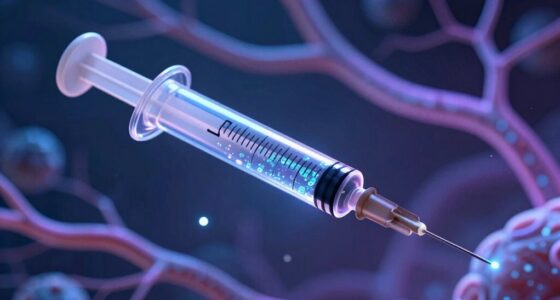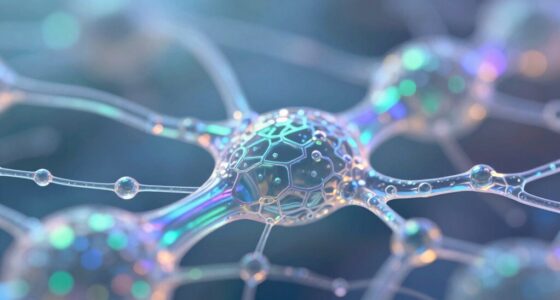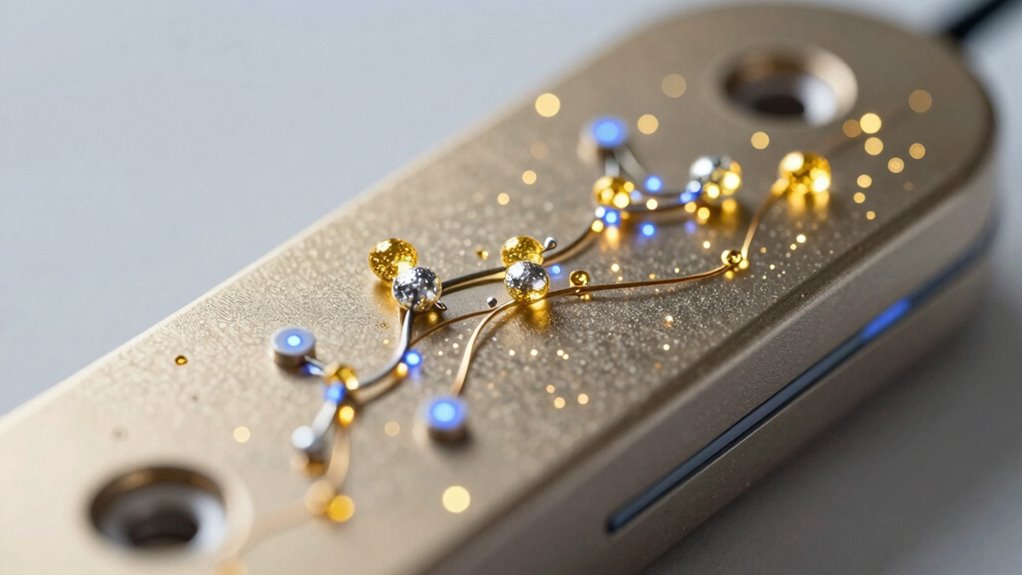

Nanoparticles improve signal detection in biosensors by harnessing their quantum effects, which create discrete energy levels for stronger, more specific signals. Their surface can be modified to attach molecules like antibodies, increasing target selectivity while reducing background noise. This synergy allows biosensors to detect low concentrations of biomarkers or toxins with high accuracy. By combining quantum properties and surface chemistry, nanoparticles make biosensors more sensitive and adaptable—if you look further, you’ll discover even more about how this technology revolutionizes detection.

Get the latest gadgets delivered free — and shop member deals
- Fast, free delivery on millions of items
- Access to Prime Big Deal Days deals on October 6–7
- Prime Video, Amazon Music and more included
Key Takeaways
- Quantum effects in nanoparticles create discrete energy levels, resulting in stronger and more specific signals for detection.
- Surface modifications enable targeted binding, enhancing biosensor selectivity and reducing background noise.
- Combining quantum properties with tailored surface chemistry improves sensitivity to low-concentration analytes.
- Nanoparticles’ enhanced optical, electrical, and magnetic behaviors amplify signal transduction.
- Functionalized nanoparticles increase biosensor stability and specificity, leading to more accurate detection.
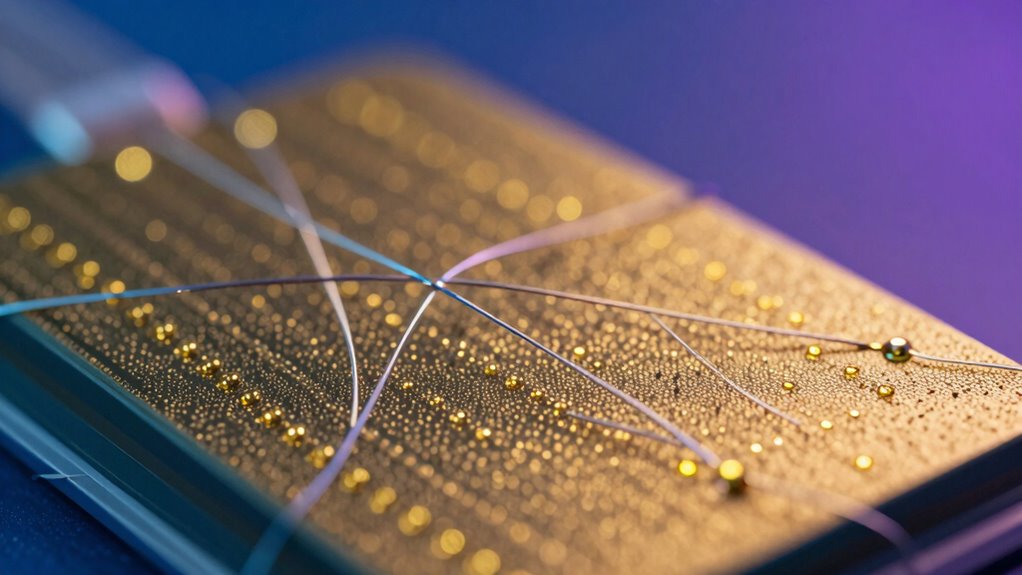
Have you ever wondered how modern biosensors achieve their remarkable sensitivity? The secret lies in the tiny particles that make up their core components—nanoparticles. These minuscule structures, often just a few nanometers in size, can dramatically amplify signals, allowing you to detect even trace amounts of biological molecules. One of the key factors behind this enhanced performance is the influence of quantum effects. When particles reach such a small scale, their electronic properties change considerably. Quantum effects cause discrete energy levels, which means nanoparticles can exhibit unique optical, electrical, or magnetic behaviors that bulk materials simply cannot match. For you, this translates to stronger, more specific signals that improve the overall accuracy and sensitivity of biosensors.
Nanoparticles leverage quantum effects to produce stronger, more precise signals in biosensors, enhancing detection sensitivity and accuracy.
But quantum effects aren’t the only trick up nanoparticles’ sleeves. Surface modifications play an equally essential role. By carefully tailoring the surface chemistry of nanoparticles, you can make them more compatible with biological environments and target specific molecules with high precision. For example, attaching molecules like antibodies or aptamers to the surface can help the biosensor selectively bind to the target analyte. These surface modifications also prevent nonspecific binding, reducing background noise and increasing the clarity of your signal. Additionally, surface functionalization can enhance the stability of nanoparticles, ensuring they maintain their properties over time and under different conditions. This stability is indispensable for reliable, repeatable measurements, especially in complex biological samples. Furthermore, understanding the quantum properties of nanoparticles allows researchers to fine-tune their responses for specific applications. Incorporating material science principles further optimizes the design and performance of these nanoparticles.
When you combine quantum effects with strategic surface modifications, the benefits multiply. The quantum properties can be tuned by altering the surface chemistry, allowing for a customized response to various analytes. This synergy enables nanoparticles to serve as highly sensitive transducers within biosensors, translating biological interactions into measurable signals with exceptional precision. Developing a deeper understanding of body compatibility of nanoparticles is also crucial for their safe and effective application in biological systems. The result is a device capable of detecting disease markers, environmental toxins, or genetic mutations at extremely low concentrations—something that traditional sensors struggle to achieve. Additionally, ongoing research into side-channel techniques can further enhance the detection capabilities by minimizing interference and improving signal integrity. Advances in nanotechnology continue to open new frontiers for biosensor performance, making the technology more accessible and versatile.
In essence, the integration of quantum effects and surface modifications in nanoparticles elevates biosensor technology by making it more sensitive, selective, and adaptable. As you explore these advancements, you’ll see how nanotechnology continues to push the boundaries of detection capabilities, bringing you closer to real-time, ultra-specific diagnostics and monitoring solutions.
As an affiliate, we earn on qualifying purchases.
Frequently Asked Questions
How Do Nanoparticle Sizes Affect Biosensor Sensitivity?
Nanoparticle sizes directly influence biosensor sensitivity through size refinement. Smaller nanoparticles provide a larger surface area-to-volume ratio, enabling more binding sites and greater sensitivity. However, if they’re too tiny, they may cause aggregation, reducing effectiveness. Larger particles enhance signal strength but might decrease specificity. Striking the right balance in nanoparticle size maximizes sensitivity enhancement, ensuring your biosensor performs ideally by efficiently detecting target molecules with high precision.
What Are the Environmental Impacts of Using Nanoparticles?
Imagine tiny particles floating in water, slipping past filters unnoticed. You should know that nanoparticles can pose environmental toxicity risks, harming aquatic life and ecosystems. As these particles accumulate, waste management becomes tougher, risking contamination. You need to evaluate safe disposal methods and develop eco-friendly alternatives. By understanding these impacts, you can help minimize environmental harm and promote responsible use of nanotechnology.
Can Nanoparticles Be Reused in Multiple Biosensor Tests?
You can often reuse nanoparticles in multiple biosensor tests, but nanoparticle regeneration is essential for maintaining their effectiveness. Reusability challenges, like maintaining stability and preventing contamination, can limit their repeated use. To overcome this, proper cleaning and regeneration protocols are necessary. While reuse is possible, it requires careful handling to guarantee the nanoparticles retain their signal-enhancement properties, making the process cost-effective and environmentally friendly.
How Do Nanoparticles Influence Biosensor Selectivity?
Imagine a finely tuned musical instrument, where each string’s tension determines the melody. Nanoparticles influence biosensor selectivity through surface modification, which customizes their binding sites for specific targets. This precise tuning enhances signal amplification, making detection more accurate. By adjusting surface properties, you improve the sensor’s ability to distinguish between closely related molecules, leading to more reliable, selective detection in complex biological samples.
What Are the Cost Implications of Nanoparticle Integration?
Integrating nanoparticles increases manufacturing costs due to the need for precise synthesis and quality control. You might also face regulatory challenges, as nanoparticle-based biosensors require thorough testing to guarantee safety and efficacy. These factors can raise expenses and extend development timelines. While the benefits of improved signal detection are clear, balancing cost implications with regulatory compliance is essential for successful commercialization.
As an affiliate, we earn on qualifying purchases.
Conclusion
You now see how nanoparticles act like tiny maestros, orchestrating a symphony of signals that sharpen biosensor detection. Their small size and unique properties turn faint whispers into clear melodies, transforming the landscape of diagnostics. As if wielding a magic wand, they amplify your ability to catch elusive signals, making detection more precise and reliable. With nanoparticles, you’re not just listening; you’re tuning into a vibrational chorus that reveals secrets hidden in plain sight.
nanoparticle surface modification kit
As an affiliate, we earn on qualifying purchases.
As an affiliate, we earn on qualifying purchases.
biological detection nanoparticles
As an affiliate, we earn on qualifying purchases.
As an affiliate, we earn on qualifying purchases.
Fall Picks
fall essentials
As an affiliate, we earn on qualifying purchases.