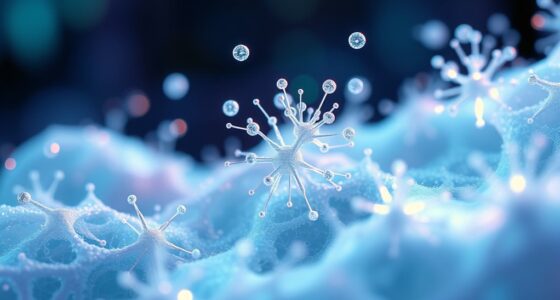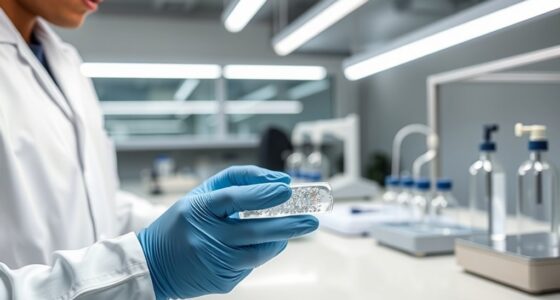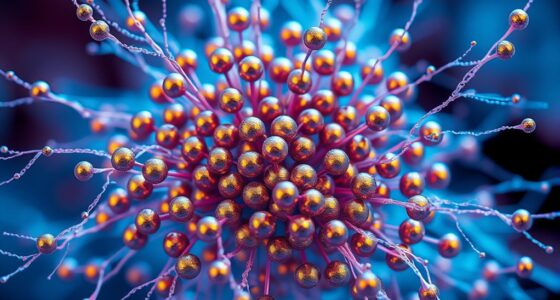
Nanotech in stem cell research allows you to manipulate and observe cells with incredible precision. You can target specific tissues using nanoparticles, which improves drug delivery and treatment outcomes while reducing side effects. Nanostructured scaffolds mimic natural tissues, supporting cell growth and regeneration. Functionalized nanomaterials guide stem cell behavior and enhance tissue repair. As you explore further, you’ll discover how these innovations are shaping the future of regenerative medicine and personalized therapies.
Key Takeaways
- Nanotechnology enables precise delivery of drugs, genes, and signaling molecules to stem cells, enhancing targeted therapy outcomes.
- Advanced nanoscale scaffolds mimic natural extracellular matrices, improving stem cell attachment, proliferation, and differentiation.
- Nanoparticles facilitate real-time in vivo tracking of stem cell behavior, providing insights into migration and development.
- Functionalized nanomaterials direct stem cell fate and promote tissue regeneration through targeted bioactive molecule delivery.
- Nanotech tools help overcome biological barriers, increasing control over stem cell therapy timing, localization, and safety.

Nanotechnology is revolutionizing stem cell research by enabling scientists to manipulate and observe cells at an unprecedented level of precision. With advanced tools like nanoparticle delivery, you can target specific cells or tissues, improving how you deliver drugs, genes, or signaling molecules directly where they’re needed. This precise delivery minimizes side effects and boosts the effectiveness of treatments. For example, by engineering nanoparticles that can cross biological barriers, you gain control over the timing and location of therapeutic agents, enhancing stem cell therapies’ success rates. Additionally, nanoparticle delivery allows you to track stem cell behavior in vivo, providing valuable insights into how these cells proliferate, differentiate, or migrate within tissues. This real-time monitoring helps refine your approaches, making regenerative treatments safer and more reliable.
Another critical aspect where nanotechnology makes a significant impact is in scaffold engineering. You can design nanoscale scaffolds that mimic the natural extracellular matrix, providing a supportive environment for stem cells to grow and differentiate. These scaffolds are tailored with nanostructures that influence cell attachment, proliferation, and specialization by closely resembling the body’s own tissue architecture. When you incorporate nanomaterials like carbon nanotubes or nanofibers into scaffold design, you improve mechanical strength and biological compatibility, which promotes better integration with host tissues. This precision in scaffold engineering allows you to create more effective tissue constructs for repairing damaged organs or tissues. You can also functionalize these scaffolds with bioactive molecules delivered via nanoparticles, further guiding stem cell behavior and enhancing tissue regeneration. Moreover, advancements in top mattress toppers and comfort solutions improve the overall environment, supporting cell growth and tissue health during regenerative processes.
nanoparticles for stem cell delivery
As an affiliate, we earn on qualifying purchases.
As an affiliate, we earn on qualifying purchases.
Frequently Asked Questions
How Does Nanotech Improve Stem Cell Targeting Accuracy?
Nanotech improves stem cell targeting accuracy through nanotech precision, allowing you to direct stem cells more effectively to specific areas. By using nanoscale materials, you can enhance targeting, ensuring cells reach precise locations. This targeting enhancement minimizes unintended effects and boosts the effectiveness of treatments. With nanotech, you gain better control over stem cell delivery, which can markedly improve your regenerative medicine outcomes and reduce side effects.
What Are Potential Risks of Nanotech in Stem Cell Therapy?
While nanotech offers promising advancements, you should be aware of potential risks, like ethical concerns and uncertain long-term effects. These tiny innovations might lead to unintended consequences, impacting safety and morality. You could face dilemmas about appropriate use and unforeseen biological impacts over time. Staying vigilant and thoroughly researching guarantees you navigate these innovations responsibly, safeguarding both progress and ethical standards in stem cell therapy.
Can Nanotech Help Regenerate Damaged Tissues More Effectively?
Nanotech innovations can markedly enhance tissue regeneration by delivering stem cells and growth factors precisely where needed. You’ll find that nanotech enables targeted therapy, increasing regeneration efficiency and reducing recovery times. By improving the delivery and integration of stem cells, these innovations make tissue repair more effective. As a result, nanotech holds great promise for advancing regenerative medicine and helping damaged tissues heal faster and more completely.
Are There Specific Nanomaterials Used in Stem Cell Research?
Did you know that over 70% of stem cell research now involves nanomaterials? You’ll find nanomaterial types like gold nanoparticles, carbon nanotubes, and silica-based nanostructures commonly used as stem cell scaffolds. These materials enhance cell growth, differentiation, and tissue regeneration. By integrating specific nanomaterials into scaffolds, researchers improve the precision and effectiveness of regenerative therapies, making breakthroughs in treating damaged tissues more achievable.
How Does Nanotech Influence Stem Cell Differentiation Processes?
Nanotech influences stem cell differentiation by integrating nanotech biosensors and stem cell scaffolds, which provide precise control over the cellular environment. These biosensors monitor cell signals in real-time, allowing you to adjust factors that guide differentiation. Meanwhile, nanotech-enhanced scaffolds mimic natural tissue structures, promoting targeted cell growth and specialization. Together, they enable more efficient, accurate control over stem cell fate, improving regenerative medicine outcomes.
nanostructured scaffolds for tissue engineering
As an affiliate, we earn on qualifying purchases.
As an affiliate, we earn on qualifying purchases.
Conclusion
Think of nanotech as the tiny compass guiding your stem cells through uncharted waters. With each precise move, it helps steer their potential toward healing and renewal. As you explore this frontier, remember you’re holding the map that could lead to groundbreaking cures. Embrace the journey, for in this miniature world lies the power to transform medicine forever. The voyage has just begun, and your curiosity is the key to unblocking its vast possibilities.
nanotech stem cell tracking tools
As an affiliate, we earn on qualifying purchases.
As an affiliate, we earn on qualifying purchases.
functionalized nanomaterials for regenerative medicine
As an affiliate, we earn on qualifying purchases.
As an affiliate, we earn on qualifying purchases.