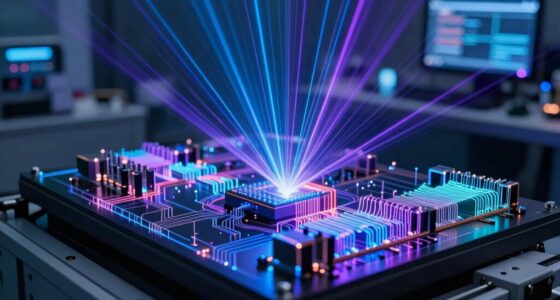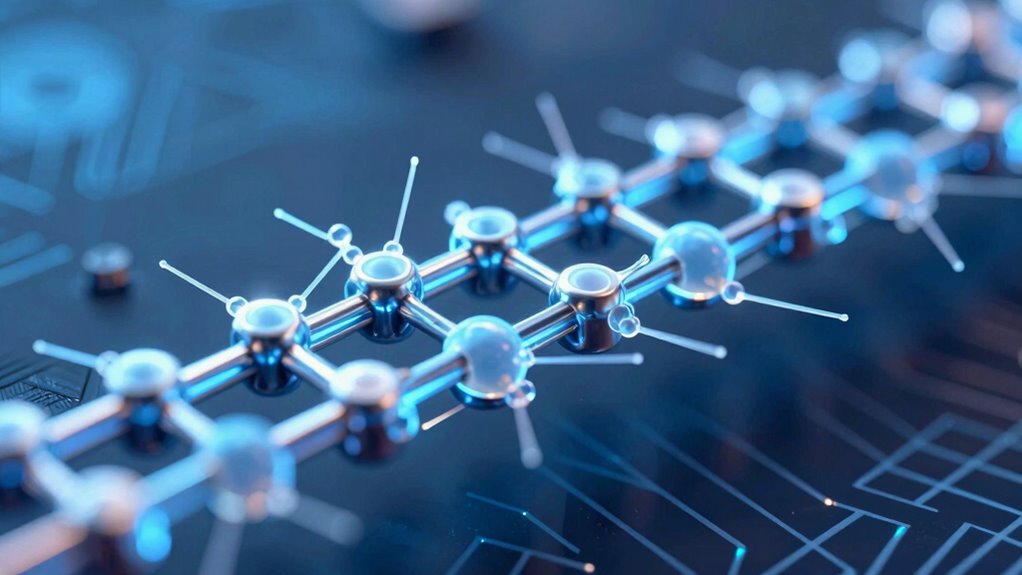

Molecular electronics involves using single molecules as fundamental circuit components like transistors and wires, paving the way for ultra-miniature devices beyond traditional limits. By controlling molecular structures and their interfaces with electrodes, you can influence electron flow through quantum tunneling and orbital alignment. While fabricating reliable junctions is challenging, advances in surface chemistry and nanoscale techniques help overcome these hurdles. To explore how researchers are building these tiny circuits and the future possibilities, keep discovering more.
Key Takeaways
- Single molecules can function as electronic components like wires, switches, and diodes by leveraging quantum tunneling and molecular orbital alignment.
- Precise molecule-electrode interfaces, often using chemical anchoring groups, are essential for stable and reproducible molecular circuits.
- Advanced fabrication techniques, such as break junctions and nanolithography, enable the creation of ultra-narrow gaps for molecular device integration.
- Controlling molecular conformation and surface interactions minimizes conductance variability, improving circuit reliability.
- Molecular electronics combine chemical design and nanoscale engineering to build functional circuits beyond traditional silicon-based limits.
Top picks for "molecular electronic build"
Open Amazon search results for this keyword.
As an affiliate, we earn on qualifying purchases.
Foundations of Molecular-Scale Electronics
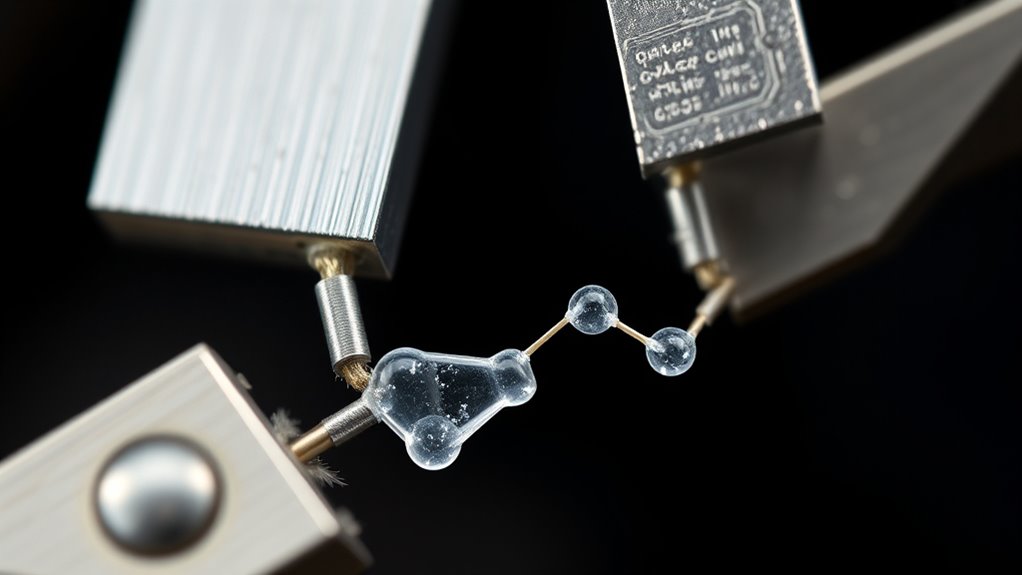
Molecular-scale electronics build on the principle that individual molecules can serve as functional electronic components, such as transistors, diodes, and wires. You understand that, unlike traditional silicon devices, these components rely on the unique properties of single molecules and nanoscale collections. By replacing bulk materials with bottom-up atomic assembly, you achieve unprecedented miniaturization, operating below 100 nanometers where quantum mechanics dominates electron transfer. You recognize that this approach opens doors to novel properties, like quantum tunneling and tunable molecular orbitals. The foundation lies in manipulating molecules’ structures and interfaces to control electrical behavior precisely. This involves understanding quantum effects, which are critical at the molecular level and influence electron transfer mechanisms. This field combines physics, chemistry, and materials science, emphasizing how the behavior of electrons at the molecular level differs from classical electronics, enabling innovative device functions at an atomic scale.
Historical Development and Interdisciplinary Roots
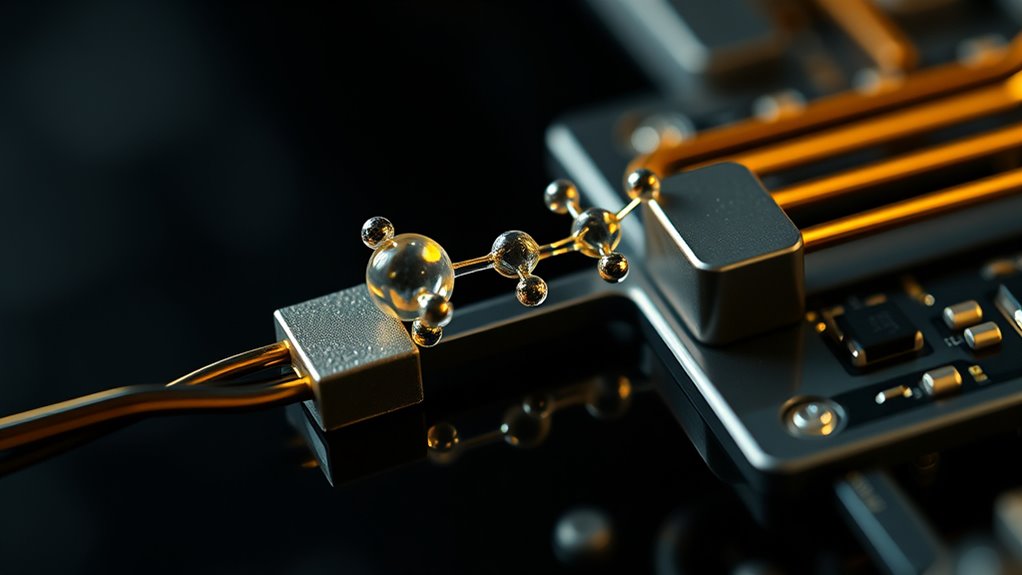
The development of molecular electronics has roots in the convergence of nanotechnology, chemistry, and physics, which collectively pushed the boundaries of traditional electronics. You can trace its origins to efforts aimed at extending Moore’s Law beyond silicon limits, replacing bulk materials with molecules for miniaturization. Over the past 20 years, researchers combined organic chemistry with nanofabrication to create functional molecular devices. This interdisciplinary field emerged from lab-based bottom-up approaches, blending chemistry’s molecular design with physics’ understanding of electron behavior at nanoscale. Early work focused on substituting solid-state wires with molecules, paving the way for innovations like molecular switches and transistors. The field continues to evolve as scientists leverage cross-disciplinary insights to build ever-smaller, more efficient electronic components based on interdisciplinary research. Advances in molecular synthesis and characterization techniques have further propelled the development of reliable molecular electronic devices. Additionally, the exploration of electron transport mechanisms at the molecular level has been crucial for optimizing device performance and stability.
Core Principles Governing Electron Transport
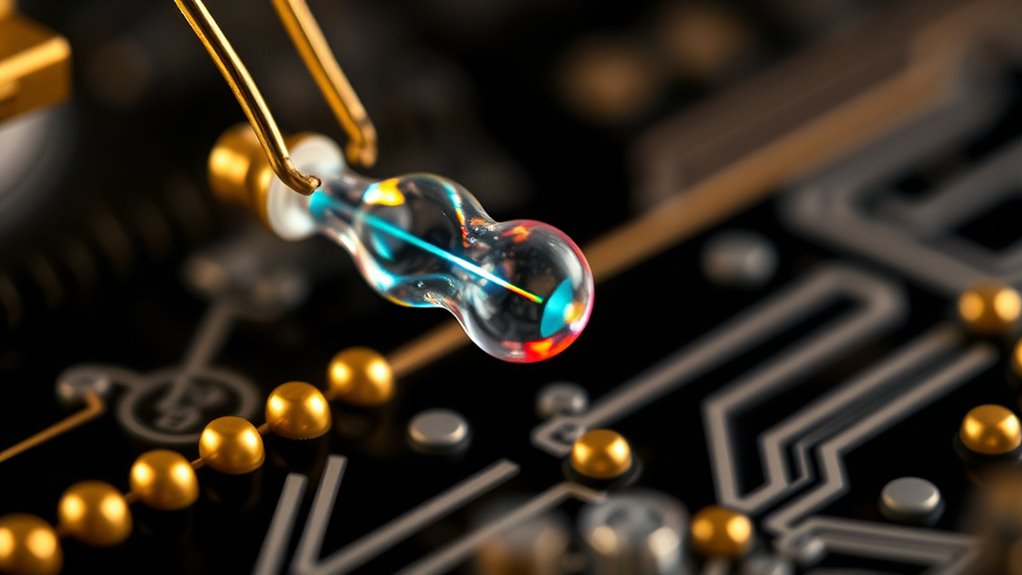
Understanding how electrons move through molecules starts with quantum tunneling, which allows electrons to pass through energy barriers at these tiny scales. You need to contemplate how molecular orbitals align with electrode energy levels, influencing the ease of electron flow. The importance of molecular orbital alignment can significantly impact electron conduction pathways and overall device performance. Additionally, the strength of molecule-electrode coupling determines the efficiency and stability of electron transport in molecular devices. Furthermore, the complexity of molecular structures can significantly impact electron conduction pathways and overall device performance. Recognizing the influence of molecular symmetry can aid in designing more efficient molecular electronic components. Accurate modeling of molecular structures is essential for predicting and optimizing electron transport properties in molecular electronics.
Quantum Tunneling Mechanism
Quantum tunneling is the primary mechanism that governs electron transport in molecular electronics, especially at the nanometer scale. Unlike classical conduction, electrons pass through energy barriers without needing enough energy to overcome them physically. Instead, they probabilistically tunnel through the barrier, which depends on the barrier’s width, height, and the electron’s energy. At these tiny scales, the probability of tunneling sharply decreases as the gap widens, making it highly sensitive to molecular distances and conformations. This process allows electrons to move efficiently across molecular junctions, even when classical conduction would be impossible. Because of quantum tunneling, electron flow becomes highly dependent on the precise molecular arrangement and the energy landscape of the system, enabling unique electronic behaviors at the single-molecule level. Understanding the importance of molecular conformations enhances our ability to design more efficient molecular electronic devices. Additionally, electron energy levels play a crucial role in determining tunneling probabilities and device performance.
Molecular Orbital Alignment
How do molecules control electron flow in molecular electronics? It all comes down to molecular orbital alignment. When you connect a molecule between two electrodes, its highest occupied molecular orbital (HOMO) and lowest unoccupied molecular orbital (LUMO) determine how easily electrons can pass through. If these orbitals align closely with the electrodes’ Fermi levels, electron transfer becomes more efficient. You can tune this alignment by chemically modifying the molecule’s structure, adjusting the energy levels to optimize conduction. This control influences whether the molecule acts as a conductor, insulator, or switch. Fundamentally, by engineering the molecular orbitals, you dictate the ease with which electrons move, shaping the device’s electrical behavior at the quantum level. Proper orbital alignment is key to reliable, predictable electron transport in single-molecule circuits.
Molecule-Electrode Coupling
Molecule-electrode coupling determines how effectively electrons transfer between a molecule and its contacts. You need strong, well-defined interactions at this interface to guarantee efficient electron flow. This coupling depends on the chemical bonds formed, like thiols bonding to gold, and the physical contact quality. Precise control over the contact geometry influences conductance and stability. If the coupling is weak or inconsistent, electron tunneling becomes unreliable, causing variability in device performance. Conversely, overly strong bonds can distort molecular structure or block electron movement. Achieving ideal coupling involves tuning the chemical and physical interface, often through chemical modification of the contact groups or advanced fabrication techniques. Strong, stable coupling is essential for reproducible, high-performance molecular electronic devices. Additionally, dog beds for Golden Retrievers can be used to support and stabilize the device during testing, ensuring consistent data collection. Incorporating surface characterization techniques can help optimize the contact quality and improve device reliability. Optimizing the contact interface may also involve understanding molecular orbital alignment, which influences electron transfer efficiency and device behavior. Furthermore, understanding heat dissipation at the interface can prevent thermal degradation and enhance device longevity.
Overcoming Challenges in Molecular Device Fabrication
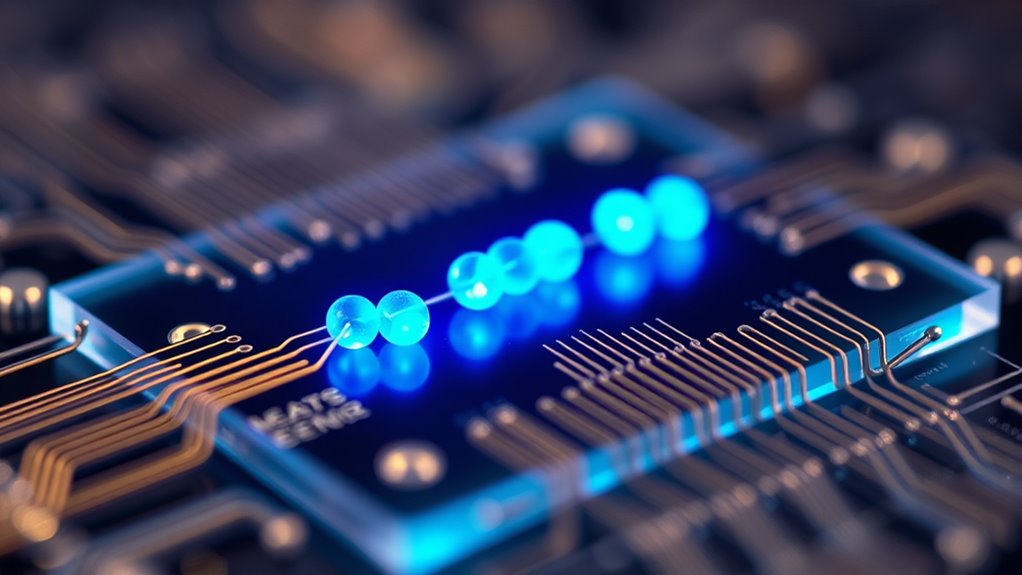
Overcoming fabrication challenges in molecular devices requires precise control over the molecule-electrode interface to guarantee stable and reproducible junctions. You must ensure reliable attachment of molecules to electrodes, often achieved through chemical anchoring groups like thiols. Controlling the gap size at the nanometer scale is vital, demanding advanced techniques such as break junctions or lithography. You also need to minimize molecular conformational variability, which can cause large conductance fluctuations. Addressing environmental factors, like temperature and vibrations, helps improve stability. Quantum effects become significant at this scale, so you must carefully consider distances and surface interactions. Achieving uniformity across many devices remains difficult, requiring innovative fabrication methods. Additionally, understanding material properties and how they influence device performance is essential for successful implementation. By refining these processes, you move closer to producing consistent, scalable molecular circuits capable of reliable operation.
Recent Advances and Innovative Molecular Components
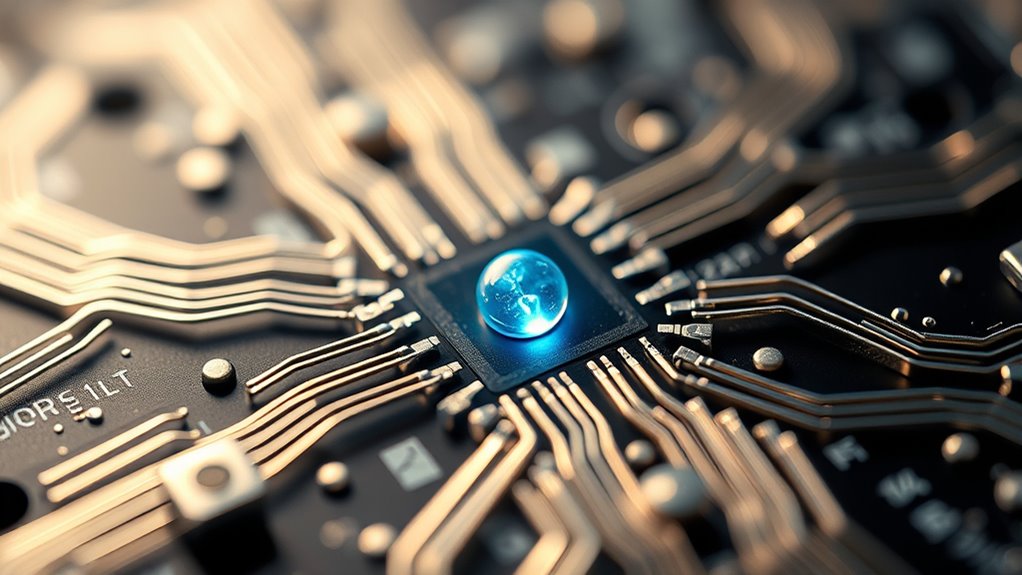
Recent breakthroughs in molecular electronics have led to the development of innovative components that push the boundaries of nanoscale device performance. You now have access to molecular switches, rectifiers, and transistors built with precise chemical control, enabling tailored electronic properties. Rigid ladder-type molecules with shape-persistent backbones reduce conductance variability caused by conformational changes. Researchers have also achieved atomic-precision fabrication, creating reliable, reproducible junctions at the single-molecule level. Organic molecules have been engineered as semiconductors, dyes, and interface layers, enhancing charge transport and device stability. These advances allow you to design highly functional molecular components that operate efficiently under quantum effects. Such innovations open new possibilities for ultra-dense electronics, where molecules serve as the fundamental building blocks, surpassing traditional silicon-based devices in size, flexibility, and performance. The integration of these molecules into complex circuits marks a significant step forward in achieving scalable molecular electronic systems. Furthermore, precise chemical control enables the customization of electronic properties for specific applications, leading to more reliable and efficient devices. Additionally, advancements in atomic-precision fabrication are crucial for creating consistent and reproducible molecular junctions essential for practical applications.
Future Directions and Potential Applications
As you explore the future of molecular electronics, integration into nanoelectronics offers exciting possibilities for ultra-dense, energy-efficient devices. However, you’ll need to address real-world challenges like ensuring stability, reproducibility, and scalable manufacturing. Overcoming these hurdles will be vital to transforming molecular components from laboratory prototypes into practical technologies. By drawing inspiration from local craftsmanship, researchers can develop innovative fabrication techniques that enhance the durability and scalability of molecular circuits. Additionally, understanding emerging Gold IRA markets can help protect these advanced systems from potential digital threats, ensuring safe deployment. Incorporating best manufacturing practices from industries with proven success can accelerate the transition from experimental setups to commercial products. Furthermore, implementing visual and auditory cues in testing protocols can improve the reliability of molecular systems during development.
Integration Into Nanoelectronics
The integration of molecular electronics into nanoelectronics promises to revolutionize device miniaturization and performance. You’ll see molecules acting as core circuit components, enabling ultra-dense, efficient systems below 10 nanometers. This approach supports continued scaling beyond silicon limits, allowing faster, energy-efficient devices. The table below highlights key aspects:
| Aspect | Impact |
|---|---|
| Miniaturization | Shrinks device sizes, increasing density |
| Quantum effects | Exploits quantum tunneling for novel functionalities |
| Customization | Chemically tuned properties for specific applications |
| Manufacturing | Compatible with existing nanofabrication techniques |
| Functionality | Enables switches, rectifiers, and memory at molecular scale |
Real-world Application Challenges
Despite its promising potential, integrating molecular electronics into practical devices faces significant challenges. You must achieve consistent fabrication of stable, reliable junctions, which is difficult due to molecules’ flexible conformations and dynamic motion. Precise control over molecule-electrode interfaces is essential but hard to maintain, impacting device reproducibility. Quantum effects require you to carefully manage distances between molecules and conducting surfaces, complicating device design. Scaling from single-molecule setups to high-density arrays remains an early-stage hurdle. Variability in conductance and stability limits commercial viability. Additionally, integrating molecular components with existing semiconductor technologies demands compatible fabrication processes. Overcoming these obstacles involves advanced molecular engineering, precise nanoscale fabrication, and thorough understanding of quantum behaviors—steps vital for advancing molecular electronics from lab prototypes to real-world applications. Furthermore, ventilation considerations and environmental stability are critical factors that influence device performance and longevity. Developing environmentally stable molecular junctions is essential to ensure long-term functionality in diverse operating conditions.
Frequently Asked Questions
What Are the Environmental Impacts of Large-Scale Molecular Electronics Manufacturing?
You might find that large-scale molecular electronics manufacturing can lessen environmental impacts by reducing material waste and energy use compared to traditional silicon-based processes. However, you should also consider potential risks like chemical waste from synthesis, solvent use, and disposal challenges. Careful management of these chemicals and sustainable practices are essential to minimize pollution and ecological harm, ensuring the technology benefits both innovation and environmental health.
How Do Molecular Electronics Compare Cost-Wise to Traditional Silicon-Based Devices?
Molecular electronics can be more cost-effective than traditional silicon devices due to their nanoscale size, which reduces material costs and allows for high-density production. You might find that their bottom-up manufacturing approach minimizes waste and energy use, potentially lowering expenses. However, current fabrication challenges and the need for specialized equipment can offset these savings initially. As technology advances, expect costs to decrease, making molecular electronics more commercially viable.
What Are the Long-Term Stability and Durability of Molecular Electronic Components?
You might worry about the long-term stability of molecular electronic components, but ongoing research shows promising durability with advances in molecular design and interface control. While organic molecules can be sensitive to environmental factors like moisture and temperature, scientists are developing protective coatings and more stable molecular structures. With proper fabrication techniques, you can expect these components to perform reliably over extended periods, making them viable for future electronic applications.
Can Molecular Electronics Be Integrated With Existing Semiconductor Technologies?
You can integrate molecular electronics with existing semiconductor technologies, but it requires overcoming several challenges. You’ll need precise control of molecule-electrode interfaces, stability of molecular junctions, and reproducibility in manufacturing. Advances in atomic-precision fabrication and chemical synthesis help bridge the gap. While still in development, combining these fields promises ultra-miniaturized, high-density devices, complementing traditional semiconductors and paving the way for next-generation nanoelectronics.
What Ethical Considerations Arise From Deploying Molecular-Scale Devices in Society?
You face a future where molecular-scale devices could revolutionize society, raising profound ethical questions. You must consider privacy risks, as ultra-miniaturized tech could enable covert surveillance or data breaches beyond imagination. Environmental impacts also matter, since manufacturing and disposal might introduce new pollutants or resource depletion. Additionally, you should think about equitable access, preventing a digital divide, and ensuring this powerful technology benefits everyone without misuse or unintended harm.
Conclusion
Imagine building circuits with just a single molecule—you’re opening a door to a universe where electronics shrink to the size of atoms. With rapid advances in molecular electronics, you’re on the brink of transforming technology itself. As scientists continue to unravel this tiny universe, you’ll find yourself at the forefront of innovations that could make today’s devices look like relics. The future of electronics is a delicate dance, and molecules are leading the way.