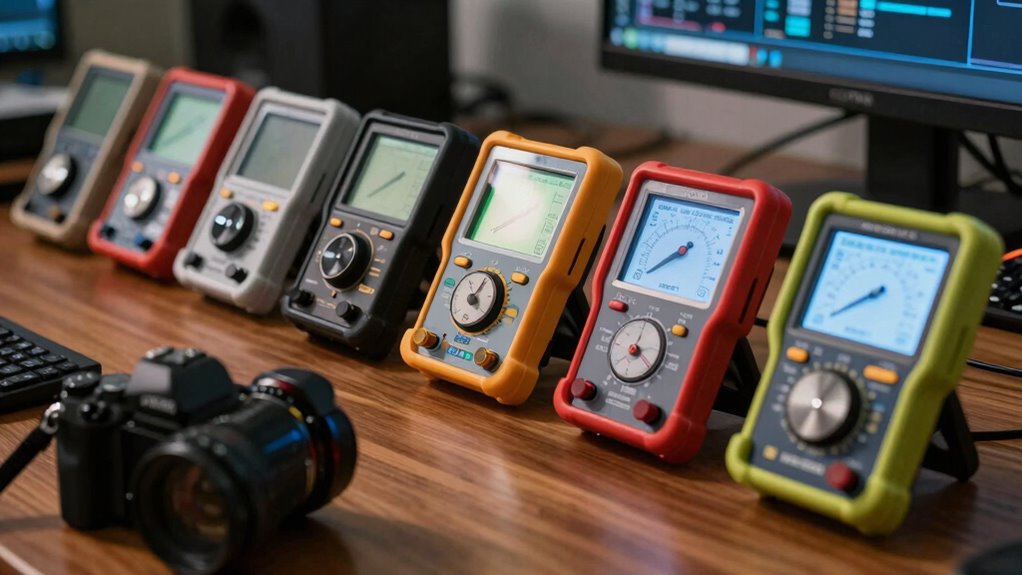

LCR meters measure inductance, capacitance, and resistance with far more precision than a standard multimeter, and the right one depends on whether you sort SMD parts at a bench, do field repair work, or need lab-grade accuracy. My top pick overall is the DE-5000 Handheld LCR Meter, which balances 0.3% basic accuracy, multiple test frequencies, and true portability at a mid-range price. For surface-mount work, the FNIRSI LCR-ST2 stands out with its smart-tweezer design and 100 kHz test signal, while the MATRIX MCR5200 is the strongest benchtop option here with 0.1% accuracy and a 40 Hz–200 kHz sweep. The core tradeoff in this category is accuracy and frequency range versus portability and price — tweezer-style meters are fast but limited, and benchtop instruments are precise but tethered to a workbench. Keep reading for the full breakdown of all 15 models.

Get the latest gadgets delivered free — and shop member deals
- Fast, free delivery on millions of items
- Access to Prime Big Deal Days deals on October 6–7
- Prime Video, Amazon Music and more included
Complete the kit



Key Takeaways
- Test frequency range is the biggest differentiator in this lineup: budget models like the Proster and CAMWAY test at a single low frequency, while the FNIRSI LCR-ST2, FNIRSI LC1020E, and MATRIX MCR5200 sweep up to 100–200 kHz, which matters for measuring inductors and capacitors at realistic operating conditions.
- The DE-5000 appears twice in this roundup (bare and bundled with TL-21/TL-22 leads) — the bundled version is the smarter buy because the accessory leads expand what you can measure without shopping separately.
- Smart tweezers (FNIRSI LCR-ST1, LCR-101A) trade accuracy and versatility for speed on SMD work; they are unbeatable for sorting reels of tiny parts but a poor choice as an only meter.
- Basic accuracy tiers are clear: 0.1% on the MATRIX MCR5200 and GW Instek LCR-6002, roughly 0.3% on the DE-5000 and B&K 879B, and 1% or worse on entry-level units — a gap that directly determines whether a meter suits production, repair, or hobby use.
- Hybrid devices like the FNIRSI LCR-P1 and the LCR600 multimeter combo are tempting as do-everything tools, but this comparison shows their LCR functions are supplementary rather than competitive with dedicated meters.
| FNIRSI LCR-ST2 100 kHz LCR Meter for SMD and Through-Hole Components |  | Best for Bench-to-Field Flexibility | Test frequencies: 100 Hz, 120 Hz, 1 kHz, 10 kHz, 100 kHz | Capacitance range: 1 pF–22 mF | Resistance range: 10 mΩ–10 MΩ | VIEW ON AMAZON | See Our Full Breakdown |
| DE-5000 Handheld LCR Meter |  | Best for Detailed Component Analysis | Measurements: Inductance, capacitance, resistance, D, Q, phase angle, ESR, and Rp | Test frequencies: 100 Hz, 120 Hz, 1 kHz, 10 kHz, 100 kHz | Display: Dual display, up to 19,999/9,999 counts | VIEW ON AMAZON | See Our Full Breakdown |
| B&K Precision 879B Dual Display Handheld LCR Meter with Backlit Display |  | Best for PC Logging and Specified Accuracy | Display: 40,000 counts; backlit dual display | Basic accuracy: 0.5% | Measurement parameters: L/C/R/Z/D/Q/Theta/ESR | VIEW ON AMAZON | See Our Full Breakdown |
| FNIRSI LC1020E 100 kHz LCR Meter | 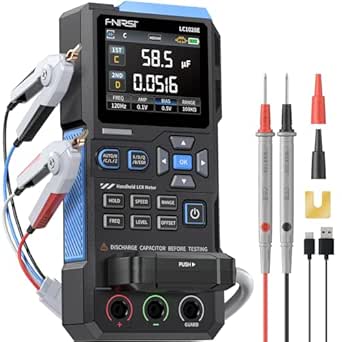 | Best for Extended Bench Sessions | Display: 2.8-inch color TFT, 19,999 counts | Frequencies: 100 Hz, 120 Hz, 1 kHz, 10 kHz, 100 kHz | Capacitance range: 1 pF–100 mF | VIEW ON AMAZON | See Our Full Breakdown |
| FNIRSI LCR-ST1 Portable LCR Meter Tweezers |  | Best Compact SMD Pick | Measurement types: Resistance, capacitance, inductance, diodes | Test frequencies: 100 Hz, 1 kHz, 10 kHz | Test voltage: 0.3 Vrms, 0.6 Vrms | VIEW ON AMAZON | See Our Full Breakdown |
| MATRIX MCR5200 Benchtop LCR Meter |  | Best Bench Pick for Production and QC | Basic Accuracy: 0.1% | Measurement Frequency: 40 Hz – 200 kHz (41 points) | Display: 4.3-inch TFT LCD, 5 digit | VIEW ON AMAZON | See Our Full Breakdown |
| Extech LCR200 Passive Component LCR Meter |  | Best Full-Featured Handheld | Test Frequencies: 100 Hz, 120 Hz, 1 kHz, 10 kHz, 100 kHz | Display: Dual backlit, 20,000/2,000 count | Measured Parameters: L, C, R, Q, D, Phase, ESR | VIEW ON AMAZON | See Our Full Breakdown |
| LCR-101A Handheld LCR Meter Tweezer |  | Best for SMD Sorting | Measured Parameters: L, C, R, Z, D, Q | Test Frequencies: 100 Hz, 1 kHz, 10 kHz | Display: Backlit LCD, 180-degree rotation | VIEW ON AMAZON | See Our Full Breakdown |
| GW Instek LCR-6002 Precision Bench LCR Meter |  | Budget Bench Option | Type: Bench LCR meter | Maximum Test Frequency: 2 kHz | Maximum Inductance: 9.99999 kH | VIEW ON AMAZON | See Our Full Breakdown |
| FNIRSI LCR-P1 Transistor Tester and LCR Meter |  | Best Budget Component Identifier | Supported Components: NPN, PNP, MOSFETs, FETs, diodes, Zeners, capacitors, resistors, inductors, batteries | Display: 1.44-inch full-color screen | Battery Capacity: 300 mAh | VIEW ON AMAZON | See Our Full Breakdown |
| CAMWAY LCR Meter – Digital Capacitance, Inductance & Resistance Tester with LCD Display |  | Best Budget Starter Kit | Display: LCD, 1999 counts (3 1/2 digit) | Capacitance Range: 200pF – 2000µF (±2.5%+5) | Inductance Range: 200µH – 20H (±2%+5) | VIEW ON AMAZON | See Our Full Breakdown |
| DE-5000 High-Accuracy Handheld LCR Meter with TL-21 and TL-22 Leads |  | Best Overall | Test Frequencies: 100 Hz, 120 Hz, 1 kHz, 10 kHz, 100 kHz | Display: 20,000 / 2,000 counts, backlit | Measurement Modes: Ls, Lp, Cs, Cp, Rs, Rp, DCR | VIEW ON AMAZON | See Our Full Breakdown |
| Proster LCR Meter for Capacitance, Inductance, and Resistance |  | Best for Beginners | Capacitance Ranges: 200pF – 2000µF (8 ranges) | Inductance Ranges: 200µH – 20H (6 ranges) | Resistance Ranges: 200Ω – 20MΩ (5 ranges) | VIEW ON AMAZON | See Our Full Breakdown |
| Peak Atlas LCR45 LCR and Impedance Meter |  | Best for Automatic Component ID | Test Frequencies: DC, 1kHz, 15kHz, 200kHz | Measurement Resolution: 0.2µH, 0.2pF, 0.2Ω | Parameters Displayed: L, C, R, complex impedance, admittance, magnitude and phase | VIEW ON AMAZON | See Our Full Breakdown |
| LCR600 Digital Multimeter and LCR Meter |  | Best Two-in-One Combo | Display Count: 6000 counts, auto-ranging | Measurement Functions: AC/DC voltage and current, resistance, inductance, capacitance, frequency, duty cycle, diode, continuity | Voltage Detection: Non-contact voltage detection (NCV) | VIEW ON AMAZON | See Our Full Breakdown |
| lcr meter | Display | Test frequencies |
|---|---|---|
| FNIRSI LCR-ST2 100 kHz LCR Met | 1.47-inch HD | 100 Hz, 120 Hz, 1 kHz, 10 kHz, 100 kHz |
| DE-5000 Handheld LCR Meter | Dual display, up to 19,999/9,999 counts | 100 Hz, 120 Hz, 1 kHz, 10 kHz, 100 kHz |
| B&K Precision 879B Dual Displa | 40,000 counts; backlit dual display | 100 Hz, 120 Hz, 1 kHz, 10 kHz |
| FNIRSI LC1020E 100 kHz LCR Met | 2.8-inch color TFT, 19,999 counts | — |
| FNIRSI LCR-ST1 Portable LCR Me | 1.14-inch HD color display; fixed | 100 Hz, 1 kHz, 10 kHz |
| MATRIX MCR5200 Benchtop LCR Me | 4.3-inch TFT LCD, 5 digit | — |
| Extech LCR200 Passive Componen | Dual backlit, 20,000/2,000 count | 100 Hz, 120 Hz, 1 kHz, 10 kHz, 100 kHz |
| LCR-101A Handheld LCR Meter Tw | Backlit LCD, 180-degree rotation | 100 Hz, 1 kHz, 10 kHz |
| GW Instek LCR-6002 Precision B | — | — |
| FNIRSI LCR-P1 Transistor Teste | 1.44-inch full-color screen | — |
| CAMWAY LCR Meter | LCD, 1999 counts (3 1/2 digit) | — |
| DE-5000 High-Accuracy Handheld | 20,000 / 2,000 counts, backlit | 100 Hz, 120 Hz, 1 kHz, 10 kHz, 100 kHz |
| Proster LCR Meter for Capacita | 3 1/2-digit LCD, 1999 counts, rotatable | — |
| Peak Atlas LCR45 LCR and Imped | — | DC, 1kHz, 15kHz, 200kHz |
| LCR600 Digital Multimeter and | — | — |
More Details on Our Top Picks
FNIRSI LCR-ST2 100 kHz LCR Meter for SMD and Through-Hole Components
The FNIRSI LCR-ST2 suits component checks that move between a workbench and a repair job. Its five frequencies reach 100 kHz, and selectable test levels let buyers adapt measurements to different components. Compared with the FNIRSI LC1020E, it trades a larger screen and longer listed battery capacity for a slimmer, lighter design with a magnetic back. The included Kelvin clips, tweezer tips, and hooks help it handle both SMD and through-hole parts without assembling a separate probe kit. Its small display may feel cramped when reading several values, and the 300 mAh battery has limited stated capacity. This is a flexible portable pick, though the LC1020E is better suited to longer sessions at a stationary bench.
Pros:- Five test frequencies from 100 Hz to 100 kHz
- Selectable test levels from 0.1 V to 1.0 V RMS
- Lightweight body with magnetic back and rechargeable Type-C charging
- Includes Kelvin clips, tweezer tips, hooks, and a storage pouch
Cons:- The 1.47-inch display offers less room for readings than the LC1020E’s 2.8-inch screen
- The listed 300 mAh battery capacity is modest
- Maximum inductance range is 10 H, below the LC1020E’s 100 H
Best for: Repair technicians who need one compact meter for SMD and through-hole checks at different work locations
Not ideal for: Buyers who want a large screen or a higher-capacity listed battery for extended bench sessions
- Test frequencies:100 Hz, 120 Hz, 1 kHz, 10 kHz, 100 kHz
- Capacitance range:1 pF–22 mF
- Resistance range:10 mΩ–10 MΩ
- Inductance range:1 μH–10 H
- Test levels:0.1 V, 0.3 V, 0.6 V, 1.0 V RMS
- Display:1.47-inch HD
- Battery and charging:300 mAh rechargeable; Type-C
- Weight:2.24 ounces
Our verdict“Choose the LCR-ST2 if you want a portable, well-equipped meter for varied component checks and can work with its small display and modest battery capacity.”
DE-5000 Handheld LCR Meter
The DE-5000 is a strong fit when a basic L, C, or R reading is not enough. Alongside those primary measurements, it reports dissipation factor, quality factor, phase angle, ESR, and Rp, helping component evaluators see more of how a part behaves. Its selectable frequencies match the FNIRSI models in this group up to 100 kHz, while auto-ranging and automatic series or parallel selection reduce setup choices during routine checks. Compared with the B&K Precision 879B, the DE-5000 offers a 100 kHz test frequency; the B&K instead supplies specified basic accuracy and USB logging in its listed package. The DE-5000 includes SMD tweezers and a guard line, but its IR-to-USB cable is optional, and no accuracy figure is provided in the supplied data.
Pros:- Reports D, Q, phase angle, ESR, and Rp in addition to L, C, and R
- Offers five selectable test frequencies up to 100 kHz
- Auto-ranging and automatic series or parallel mode simplify setup
- Package includes alligator leads, SMD tweezers, and a guard line
Cons:- The optional IR-to-USB cable is not included
- The supplied product data gives no accuracy figure
- A 9 V battery is included, but rechargeable operation is not specified
Best for: Electronics technicians who need secondary component parameters and frequently measure both SMD and leaded parts
Not ideal for: Buyers who need a stated accuracy figure or included PC connectivity hardware
- Measurements:Inductance, capacitance, resistance, D, Q, phase angle, ESR, and Rp
- Test frequencies:100 Hz, 120 Hz, 1 kHz, 10 kHz, 100 kHz
- Display:Dual display, up to 19,999/9,999 counts
- Measurement modes:Auto-ranging; automatic series or parallel mode
- Sorting:Component sorting mode
- Included power:9 V DC battery
- Included accessories:TL-21 alligator lead case, TL-22 SMD tweezers case, TL-23 guard line
- Optional accessory:IR-to-USB cable, not included
Our verdict“Pick the DE-5000 if secondary parameter readings and SMD accessories matter more to you than a published accuracy specification or included PC cable.”
B&K Precision 879B Dual Display Handheld LCR Meter with Backlit Display
The B&K Precision 879B stands apart for buyers who want a documented accuracy figure and a route to PC-based records. Its listed 0.5% basic accuracy, 40,000-count display, and USB virtual COM interface make readings easier to track in repeatable bench work. Free logging and panel emulation software are included, while the DE-5000 offers more test frequency choices, reaching 100 kHz versus the B&K’s 10 kHz ceiling. That difference matters when a component needs higher-frequency characterization. The B&K also records Min/Max/Average and supports tolerance sorting, but it reads at 1.5 readings per second, which can slow repetitive checks. Its included AC adapter and 9 V battery offer flexible power, though this is a heavier handheld than the tiny FNIRSI tweezer meters.
Pros:- 40,000-count display and listed 0.5% basic accuracy
- USB virtual COM interface with free data logging and panel emulation software
- Min/Max/Average recording, relative mode, and tolerance sorting
- Includes test leads, battery, USB cable, and AC adapter
Cons:- Measurement rate is 1.5 readings per second
- Maximum test frequency is 10 kHz, below the DE-5000 and FNIRSI meters
- At 330 g, it is less portable than the small FNIRSI tweezer meters
Best for: Bench technicians who want specified basic accuracy, tolerance sorting, and PC logging for measurement records
Not ideal for: Users who need fast high-volume checks or measurements at 100 kHz
- Display:40,000 counts; backlit dual display
- Basic accuracy:0.5%
- Measurement parameters:L/C/R/Z/D/Q/Theta/ESR
- Test frequencies:100 Hz, 120 Hz, 1 kHz, 10 kHz
- Test signal:0.6 Vrms
- Tolerance mode:1%, 5%, 10%, 20%
- Interface:USB virtual COM
- Power:9 V battery or 12–15 V DC adapter
Our verdict“Choose the 879B for documented accuracy and PC logging at the bench, provided its slower readings and 10 kHz frequency limit fit your work.”
FNIRSI LC1020E 100 kHz LCR Meter
The FNIRSI LC1020E is the most bench-oriented of these five picks. Its 2.8-inch color display can show main and secondary parameters together, while Kelvin connections and open/short calibration support more controlled component measurements. A 3,000 mAh rechargeable battery gives it a far larger listed capacity than the portable LCR-ST2, and its inductance range reaches 100 H compared with that model’s 10 H. The tradeoff is a larger, less pocket-friendly instrument that calls for calibration before measurement. Its five frequencies include 100 kHz, matching the FNIRSI handhelds and DE-5000, while the B&K 879B has a narrower 10 kHz ceiling but lists 0.5% basic accuracy. Buyers should also follow the stated requirement to discharge components before testing.
Pros:- Large 2.8-inch color display shows primary and secondary parameters together
- Five selectable frequencies from 100 Hz to 100 kHz
- Four-terminal Kelvin connections and open/short calibration
- 3,000 mAh rechargeable battery with Type-C charging
Cons:- Open/short calibration is required before measurement
- Components must be discharged, and live circuits should not be measured
- Larger screen and bench-focused setup are less suited to pocket carry than the LCR-ST2
Best for: Bench users who want a large color display, Kelvin connections, broad inductance coverage, and a high-capacity rechargeable battery
Not ideal for: Mobile repair workers who prioritize pocketable size or want a meter ready to measure without open/short calibration
- Display:2.8-inch color TFT, 19,999 counts
- Frequencies:100 Hz, 120 Hz, 1 kHz, 10 kHz, 100 kHz
- Capacitance range:1 pF–100 mF
- Resistance range:10 mΩ–10 MΩ
- Inductance range:1 µH–100 H
- Secondary parameters:X, D, Q, θ, ESR
- Connections:Four-terminal Kelvin measurement
- Battery and charging:3,000 mAh; USB Type-C
Our verdict“Choose the LC1020E for a better equipped stationary workflow and longer listed battery capacity if calibration and component preparation suit your routine.”
FNIRSI LCR-ST1 Portable LCR Meter Tweezers
The FNIRSI LCR-ST1 makes the most sense when the component itself is small and holding separate probes would be awkward. Its tweezer form automatically recognizes components and measures R, C, L, and diodes, while saved readings can be exported to a PC. Pointed and hook heads give buyers two ways to contact parts, an advantage over the more general-purpose handheld DE-5000 when working directly on SMD components. The tradeoff is narrower frequency coverage: it stops at 10 kHz, while the DE-5000 and LCR-ST2 reach 100 kHz. Its fixed 1.14-inch screen cannot rotate, which may make reading awkward in tight spaces, and the supplied data does not state battery runtime. This is a focused SMD tool, not the most versatile meter in the lineup.
Pros:- Tweezer format supports direct contact with small SMD components
- Automatically recognizes components and reports D, Z, Q, R, and ESR
- Saved records can be exported to a PC
- Includes pointed and hook tweezer heads
Cons:- Three test frequencies, with a 10 kHz maximum, versus 100 kHz on the LCR-ST2
- Fixed screen does not flip or rotate
- Battery runtime is not specified
Best for: SMD rework technicians who want direct tweezer measurements, automatic component recognition, and PC export of saved readings
Not ideal for: Buyers who need 100 kHz testing, a rotating screen, or a stated battery runtime
- Measurement types:Resistance, capacitance, inductance, diodes
- Test frequencies:100 Hz, 1 kHz, 10 kHz
- Test voltage:0.3 Vrms, 0.6 Vrms
- Resistance range:10 mΩ–10 MΩ
- Capacitance range:1 pF–22 mF
- Inductance range:1 µH–10 H
- Display:1.14-inch HD color display; fixed
- Data export:Saved records transfer to a PC via Excel
Our verdict“Pick the LCR-ST1 for hands-on SMD checks and record export if its 10 kHz limit and fixed screen work for you.”
MATRIX MCR5200 Benchtop LCR Meter
For anyone running production lines or QC stations, the MCR5200 makes a strong case as the workhorse of this roundup. Its 0.1% basic accuracy across 41 frequency points up to 200 kHz puts it far ahead of handheld options like the Extech LCR200 in both precision and flexibility, and the built-in comparator with pass/fail alarms means you can screen incoming components without babysitting the screen. The RS232C, USB Host, and Handler interfaces open the door to automated sorting setups — something no tweezer-style meter such as the LCR-101A can touch. The tradeoff is obvious: this is a corded, 7.7-pound benchtop instrument, so portability is off the table. Compared with the GW Instek LCR-6002, it also wins on frequency range by a factor of 100, making the Instek hard to justify at a similar bench footprint.
Pros:- 0.1% basic accuracy with 41 selectable frequency points up to 200 kHz
- Built-in comparator with pass/fail alarm modes for component screening
- RS232C, USB Host, and Handler interfaces with included PC software for data logging
- Extra-wide measurement ranges from 0.01 pF to 9.9999 F and 0.1 mΩ to 99.999 MΩ
Cons:- Corded benchtop design makes it immobile compared with handheld rivals
- At 7.7 pounds and over 13 inches deep, it demands dedicated bench space
Best for: Production floors, QC labs, and R&D benches that need logging, comparators, and high accuracy
Not ideal for: Field technicians and hobbyists — it needs AC power and bench space, and its capability would go unused
- Basic Accuracy:0.1%
- Measurement Frequency:40 Hz – 200 kHz (41 points)
- Display:4.3-inch TFT LCD, 5 digit
- Capacitance Range:0.01 pF – 9.9999 F
- Resistance Range:0.1 mΩ – 99.9999 MΩ
- Interfaces:RS232C, USB Host, Handler
- Power Source:110-220V AC, corded
- Weight:7.7 pounds
Our verdict“Buy this if you run a bench or production line where accuracy, logging, and pass/fail sorting matter more than portability.”
Extech LCR200 Passive Component LCR Meter
The LCR200 sits in a sweet spot between basic handhelds and bench instruments. Unlike the FNIRSI LCR-P1, which excels at auto-detection but is really a component identifier, the Extech gives you five selectable test frequencies up to 100 kHz and shows primary and secondary parameters — including ESR, Q, D, and phase — simultaneously on a dual backlit display. That secondary readout matters if you’re evaluating capacitor health or matching inductors, and it’s a capability the cheaper Proster-style meters simply skip. The tradeoff: it’s a passive-component-only meter, so anyone testing transistors or diodes will need a different tool, and the plastic housing won’t shrug off drops the way a padded bench unit like the MATRIX MCR5200 would. For a serious field kit, though, this pick makes the most sense.
Pros:- Measures secondary parameters including ESR, Q, D, and phase on a dual display
- Five test frequencies from 100 Hz to 100 kHz for flexible characterization
- Open/short calibration removes stray impedance for better low-value accuracy
- Ships complete with built-in test fixture, external leads, and a 9V battery
Cons:- Passive component meter only — cannot test active devices
- Plastic construction may not survive rough field handling
Best for: Electronics technicians and repairers who need ESR, D, and Q readings in a portable package
Not ideal for: Anyone testing active components — its passive-only design excludes transistors, diodes, and ICs
- Test Frequencies:100 Hz, 120 Hz, 1 kHz, 10 kHz, 100 kHz
- Display:Dual backlit, 20,000/2,000 count
- Measured Parameters:L, C, R, Q, D, Phase, ESR
- Measurement Modes:Series or parallel
- Calibration:Open and short zero calibration
- Power Source:9V battery
- Weight:0.43 kg
Our verdict“This is the handheld to get if secondary parameters like ESR and Q factor drive your component evaluations.”
LCR-101A Handheld LCR Meter Tweezer
SMD work rewards speed, and that’s exactly where the tweezer-form LCR-101A beats conventional meters. Gripping a 0402 capacitor with the Extech LCR200‘s fixture or external leads is fiddly; here you just squeeze and read, with auto component recognition doing the identification for you. The 180-degree rotating backlit LCD is a thoughtful touch for left- or right-handed probing on crowded boards, and USB data logging supports documentation for quality-control work. Its limits are real, though: only three test frequencies (100 Hz, 1 kHz, 10 kHz) means it can’t characterize components the way 100 kHz-class meters like the DE-5000 or FNIRSI LC1020E can, and the USB cable isn’t in the box. For high-volume SMD verification rather than precision analysis, this is the right shape of tool.
Pros:- Tweezer form factor grips SMD components directly without fixturing
- Auto-identification of component type speeds up high-volume sorting
- 180-degree rotating backlit LCD suits both handedness and tight angles
- USB data logging supports QC documentation
Cons:- Only three test frequencies, capped at 10 kHz
- USB cable not included out of the box
Best for: Technicians sorting or verifying surface-mount components at speed on populated boards
Not ideal for: Engineers needing high-frequency characterization — 10 kHz tops out well below bench-grade analysis
- Measured Parameters:L, C, R, Z, D, Q
- Test Frequencies:100 Hz, 1 kHz, 10 kHz
- Display:Backlit LCD, 180-degree rotation
- Data Connectivity:USB (cable not included)
- Form Factor:Handheld tweezer-style
- Auto Recognition:Yes
Our verdict“The fastest way to check SMD passives in bulk — pick it for sorting speed, not for deep characterization.”
GW Instek LCR-6002 Precision Bench LCR Meter
The LCR-6002 occupies an awkward but defensible niche: it gives you a proper bench platform with wide ranges — up to 9.99999 kH inductance, 9.99999 F capacitance, and 99.9999 MΩ resistance — at a price point below precision-class instruments. Compared with the MATRIX MCR5200, however, the compromise is stark: a maximum test frequency of just 2 kHz versus the Matrix’s 200 kHz. That’s fine for power magnetics, large electrolytics, and DC-adjacent work where high-frequency behavior isn’t the question, but it rules out meaningful analysis of RF components or modern ceramic capacitors. There’s also little published detail on interfaces or accuracy class, so buyers who need documentation and logging should look to the Matrix instead. This model is better suited to education labs and low-frequency bench duty than to serious characterization work.
Pros:- Bench form factor with stable measurement platform
- Very wide ranges: up to 9.99999 kH, 9.99999 F, and 99.9999 MΩ
- RoHS compliant with a reputable instrument brand behind it
- Straightforward operation for teaching and basic verification
Cons:- 2 kHz maximum test frequency is far below competing bench meters
- Sparse published specifications on accuracy and connectivity make comparison difficult
Best for: Students, educators, and low-frequency bench work like power inductors and large capacitors
Not ideal for: Engineers characterizing components above 2 kHz — the frequency ceiling is disqualifying
- Type:Bench LCR meter
- Maximum Test Frequency:2 kHz
- Maximum Inductance:9.99999 kH
- Maximum Capacitance:9.99999 F
- Maximum Resistance:99.9999 MΩ
- RoHS Compliant:Yes
Our verdict“A reasonable low-cost bench choice for low-frequency measurement, as long as 2 kHz covers everything you’ll ever test.”
FNIRSI LCR-P1 Transistor Tester and LCR Meter
The LCR-P1 plays a different game than the rest of this lineup: it’s a Swiss-army component identifier first and an LCR meter second. Drop in an unknown part and it auto-detects whether it’s an NPN, PNP, MOSFET, diode, Zener, capacitor, resistor, inductor, or even a battery — with pin definitions mapped automatically. Neither the Extech LCR200 nor the MATRIX MCR5200 can identify active components at all, which is this device’s whole reason to exist. The replaceable adapter for tiny precision parts and high-power devices adds genuine versatility, and capacitor discharge protection is a smart safety touch. But the compromises are real: the 1.44-inch color screen demands squinting, the 300 mAh battery runs thin during long sessions, and measurement precision is hobby-grade, not lab-grade. Buy it for identification breadth, not accuracy.
Pros:- Automatically identifies component type, pinout, and key parameters
- Covers an unusually broad range including transistors, MOSFETs, Zeners, and batteries
- Replaceable adapter handles both tiny SMD parts and high-power devices
- Capacitor discharge protection and USB-C charging add practicality
Cons:- Tiny 1.44-inch display is hard to read detailed results on
- 300 mAh battery capacity limits long work sessions
Best for: Hobbyists and repair techs who need to identify unknown salvaged parts quickly
Not ideal for: Precision measurement work — accuracy and screen size fall well short of dedicated LCR meters
- Supported Components:NPN, PNP, MOSFETs, FETs, diodes, Zeners, capacitors, resistors, inductors, batteries
- Display:1.44-inch full-color screen
- Battery Capacity:300 mAh
- Power Source:Battery powered, USB-C charging
- Weight:2.72 ounces
- Dimensions:3.19 x 2.56 x 0.98 inches
- Certification:CE
Our verdict“A cheap, capable parts identifier for the repair bench — just don’t expect it to replace a real LCR meter for accuracy.”
CAMWAY LCR Meter – Digital Capacitance, Inductance & Resistance Tester with LCD Display
Most cheap LCR meters ship barebones, but the CAMWAY arrives ready to work — crocodile clips, a 9V battery, and a manual are all in the box, which immediately sets it apart from bare-lead competitors like the Proster. Its ranges are genuinely broad for the class: 200pF to 2000µF for capacitance and 200µH to 20H for inductance cover the bulk of hobbyist and automotive troubleshooting tasks. Where it falls short of pricier options like the DE-5000 is accuracy and flexibility — there’s a single fixed test condition, no series/parallel modes, and capacitance tolerance sits at ±(2.5%+5), so it’s a sorting-and-checking tool rather than a precision instrument. Compared with the LCR600 combo meter, the CAMWAY trades multimeter functions for slightly deeper LCR ranges, including a 200MΩ resistance ceiling.
Pros:- Wide capacitance, inductance, and resistance ranges for the price
- Complete kit with battery, clips, and manual included
- Data hold, auto power off, and capacitance zero adjustment
- Resistance range extends to 200MΩ, deeper than most budget rivals
Cons:- Capacitance accuracy of ±(2.5%+5) is loose compared with the DE-5000
- No selectable test frequencies or series/parallel measurement modes
Best for: Hobbyists and automotive troubleshooters who want a complete, ready-to-run LCR kit for identifying and sanity-checking components
Not ideal for: Anyone characterizing components at specific test frequencies — there are no selectable frequencies or measurement modes here
- Display:LCD, 1999 counts (3 1/2 digit)
- Capacitance Range:200pF – 2000µF (±2.5%+5)
- Inductance Range:200µH – 20H (±2%+5)
- Resistance Range:200Ω – 200MΩ (±0.8%+2)
- Sampling Rate:3 readings per second
- Power Source:9V battery (included)
- Included Accessories:Crocodile clips, manual, certificate, 9V battery
Our verdict“A sensible first LCR meter for checking parts bins and vehicle wiring, as long as you don’t need precision readings.”
DE-5000 High-Accuracy Handheld LCR Meter with TL-21 and TL-22 Leads
The DE-5000 is the benchmark handheld LCR meter in this roundup, and the reason is flexibility: five test frequencies from 100 Hz to 100 kHz, plus series and parallel modes for L, C, and R. That lets you characterize a component the way a datasheet specifies it — something no fixed-frequency budget model like the CAMWAY or Proster can do. The included TL-22 SMD tweezers also make it far friendlier for surface-mount work than clip-lead-only meters. It measures D, Q, phase angle, and ESR, which matters if you’re hunting bad capacitors in power supplies, and the selectable tolerance bands plus component sorting speed up incoming-parts inspection. The tradeoff: this is a dedicated LCR instrument, so unlike the LCR600 it won’t measure voltage or current, and its depth of modes means a steeper learning curve for casual users.
Pros:- Five test frequencies from 100 Hz to 100 kHz
- Series and parallel modes plus D, Q, ESR, and phase angle
- TL-21 alligator leads, TL-22 SMD probes, and carrying case included
- Component sorting with eight selectable tolerance bands
Cons:- Dedicated LCR-only instrument — no voltage, current, or continuity functions
- More modes and settings to learn than simple 1999-count meters
Best for: Electronics technicians and serious hobbyists who need frequency-selectable LCR measurements, ESR checking, and SMD testing in one handheld package
Not ideal for: Casual household users — if you just want to check a fuse or outlet voltage, a combo multimeter like the LCR600 serves better for less complexity
- Test Frequencies:100 Hz, 120 Hz, 1 kHz, 10 kHz, 100 kHz
- Display:20,000 / 2,000 counts, backlit
- Measurement Modes:Ls, Lp, Cs, Cp, Rs, Rp, DCR
- Additional Parameters:D, Q, phase angle, ESR
- Tolerance Settings:0.25% to -20%+80% (8 bands)
- Included Accessories:TL-21 alligator lead, TL-22 SMD leads, carrying case
- Certification:ISO 9001
Our verdict“If you can only buy one LCR meter and components are your focus, this is the one to get.”
Proster LCR Meter for Capacitance, Inductance, and Resistance
The Proster earns its spot through ergonomics that budget meters usually ignore: a rotatable LCD you can angle toward you when the meter is flat on a bench, plus data hold and auto power off that make long troubleshooting sessions less fiddly. Its range coverage (200pF–2000µF, 200µH–20H, 200Ω–20MΩ) essentially matches the CAMWAY, so the real difference is the bundled storage bag and the friendlier form factor versus CAMWAY’s straight multimeter styling. It even adds diode testing, which the CAMWAY lists but the LCR600 handles more naturally as a full multimeter. Like the CAMWAY, though, it lacks selectable test frequencies, so it can’t touch the DE-5000 for serious component characterization. Think of it as the approachable first meter for someone learning to identify components rather than a lab tool.
Pros:- Rotatable display makes bench readings comfortable
- Broad ranges across 8 capacitance, 6 inductance, and 5 resistance scales
- Generous accessory bundle including storage bag and battery
- Data hold, zero adjustment, and auto power off
Cons:- Fixed test frequency with no series/parallel modes
- 1999-count display limits resolution for small-value components
Best for: Beginners and students who want an easy-to-read, fully accessorized first LCR meter for learning component identification
Not ideal for: Users who need frequency-dependent measurements or ESR testing — this meter measures at one fixed condition only
- Capacitance Ranges:200pF – 2000µF (8 ranges)
- Inductance Ranges:200µH – 20H (6 ranges)
- Resistance Ranges:200Ω – 20MΩ (5 ranges)
- Display:3 1/2-digit LCD, 1999 counts, rotatable
- Sampling Rate:3 readings per second
- Power Source:9V battery
- Weight:590 g
- Included Accessories:Test leads, crocodile clips, mini screwdriver, 9V battery, manual, storage bag
Our verdict“A comfortable, well-equipped starter meter that trades measurement sophistication for ease of use.”
Peak Atlas LCR45 LCR and Impedance Meter
The Peak Atlas LCR45 takes the thinking out of measurement: clip on a component, press one button, and it identifies whether you’re holding an inductor, capacitor, or resistor and reports the value automatically. That’s a workflow no other meter in this lineup matches — the DE-5000 is more capable but demands you configure modes and frequencies yourself, and the FNIRSI LCR-101A offers auto-recognition only in tweezer form for tiny parts. The LCR45 also goes beyond basic LCR with complex impedance, admittance, and magnitude/phase display, and its 0.2pF / 0.2µH resolution resolves small-signal parts that 1999-count meters like the Proster simply can’t see. Continuous reading mode is handy for peaking a coil in real time. The catch: the tiny 4-inch body crams display and controls into a small panel, and it’s a single-purpose tool with no multimeter functions at all.
Pros:- Automatic component type and value identification with one button
- Selectable DC, 1kHz, 15kHz, and 200kHz test frequencies
- Fine 0.2µH / 0.2pF / 0.2Ω resolution
- Continuous readings plus impedance, admittance, and phase display
Cons:- Very small body makes the display and controls cramped
- Single-purpose LCR instrument with no voltage or current measurement
Best for: Repair techs and experimenters who sort unlabeled components quickly and want impedance magnitude and phase in a pocket-size tool
Not ideal for: Bench-heavy workflows — the compact controls and small display are fatiguing for all-day use, and there are no multimeter functions
- Test Frequencies:DC, 1kHz, 15kHz, 200kHz
- Measurement Resolution:0.2µH, 0.2pF, 0.2Ω
- Parameters Displayed:L, C, R, complex impedance, admittance, magnitude and phase
- Dimensions:4.06 x 2.76 x 0.79 inches
- Weight:145 g
- Warranty:1 year manufacturer warranty
- Specification Met:NIST
Our verdict“The fastest way to identify an unknown component on a crowded bench, provided small controls don’t bother you.”
LCR600 Digital Multimeter and LCR Meter
If your toolbox has room for one meter, the LCR600 doubles as a full multimeter — AC/DC voltage and current, frequency, duty cycle, diode, and continuity — while still covering inductance and capacitance. That’s a package no dedicated LCR instrument here offers; the DE-5000 measures components beautifully but can’t tell you whether an outlet is live. The 6000-count display with auto-ranging also out-resolves the 1999-count CAMWAY and Proster, and the non-contact voltage detection plus built-in flashlight make it genuinely useful around the house, not just at the bench. The honest tradeoff is depth: this is pitched as an entry-level tester, and with no published accuracy specs or selectable test frequencies, it can’t replace a real LCR meter for component characterization. It finds and verifies; it doesn’t analyze.
Pros:- Combines multimeter functions with L, C, and R measurement in one tool
- 6000-count auto-ranging display beats budget 1999-count rivals
- Non-contact voltage detection, backlight, and flashlight
- Data hold and auto power off round out daily-use features
Cons:- No published accuracy specifications or measurement ranges
- Entry-level positioning limits trust for precision component work
Best for: DIYers and home repairers who want voltage, current, and basic LCR functions in a single affordable meter
Not ideal for: Electronics engineers — without stated accuracy specs or test-frequency control, it’s unsuitable for serious component characterization
- Display Count:6000 counts, auto-ranging
- Measurement Functions:AC/DC voltage and current, resistance, inductance, capacitance, frequency, duty cycle, diode, continuity
- Voltage Detection:Non-contact voltage detection (NCV)
- Features:Backlight, flashlight, data hold, auto power-off
- Intended Use:DIY electronics, circuit testing, home repair
Our verdict“The right pick when you’d rather carry one do-everything meter than a dedicated LCR instrument.”
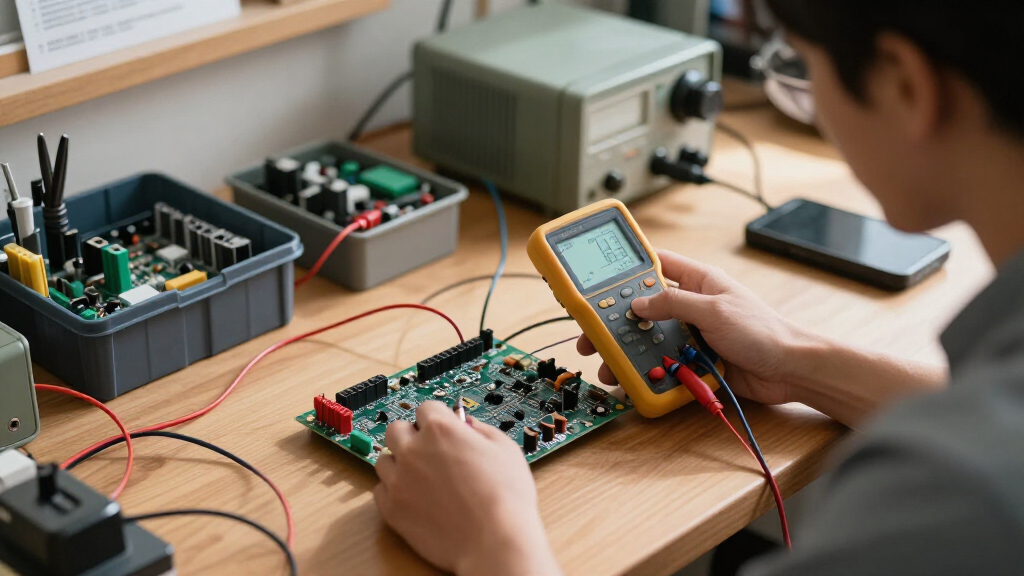
How We Picked
I ranked these LCR meters by weighing measurement accuracy, test frequency range, form factor, and value for the intended job. Accuracy specs were compared on basic accuracy percentages and how each meter handles low-impedance or low-capacitance parts, since those are the measurements where cheap meters fall apart. Frequency coverage mattered because a capacitor’s measured value shifts with test frequency, so a meter limited to 100 Hz or 1 kHz can misrepresent how a part behaves in a switching supply or RF circuit.
From there, I separated the field by use case rather than treating all fifteen as direct competitors. Benchtop precision models were judged against lab standards, handhelds against field-repair practicality, and smart tweezers against SMD sorting speed. Build quality, display readability, connectivity (like the DE-5000’s data output), and the quality of included leads and fixtures all factored into ranking, as did each product’s drawbacks — no meter here is flawless, and the ordering reflects where each one’s compromises are easiest to live with.
Factors to Consider When Choosing Lcr Meters
Before choosing an LCR meter, it helps to understand what actually drives performance differences — and where buyers most often overspend or underbuy. These are the factors that shaped this ranking.Test Frequency Range and Why It Matters More Than You Think
The single most underappreciated spec on an LCR meter is its test frequency coverage. A capacitor that reads 100 nF at 120 Hz may read noticeably differently at 100 kHz because its dielectric behavior changes with frequency — and if you’re designing for a switching regulator or RF circuit, the high-frequency reading is the one that reflects reality. Meters limited to a single fixed frequency, common at the entry level, can only tell you part of the story. The mistake I see most often is buying a budget meter for power-supply or audio work, then discovering its readings don’t match how components behave in-circuit. If your projects involve switch-mode supplies, filters, or anything above audio frequencies, a meter with selectable frequencies up to at least 10 kHz — ideally 100 kHz — is worth the extra cost.
Basic Accuracy Tiers and Matching Them to Your Work
LCR meters cluster into rough accuracy tiers: about 0.1% for precision bench instruments, 0.3% for serious handhelds, and 1–3% for hobbyist units. The gap sounds academic until you’re trying to match components for a precision oscillator, sort a batch of parts against a tight tolerance, or verify whether a film capacitor is still within spec after years of service. A 0.1% meter earns its price in production QA, calibration-adjacent work, and any task where you need to trust the reading without a second opinion. For hobby use, sorting salvage parts, or general troubleshooting, 1% accuracy is usually plenty — paying for precision you won’t use is one of the most common overspending patterns in this category. Be honest about whether you need accuracy or just consistent, repeatable readings; hobbyists often only need the latter.
Form Factor: Tweezers, Handheld, or Benchtop
The physical design of an LCR meter dictates what work it’s actually good at. Smart tweezers excel at rapid one-handed measurement of SMD components straight off a reel or tape, but their tiny fixtures make through-hole parts and in-circuit checks awkward. Handheld meters with banana jacks accept clip leads, tweezers, and fixture adapters, making them the most versatile middle ground. Benchtop units offer the best measurement engines and four-terminal Kelvin connections but live on a power strip and take up permanent bench space. A common mistake is treating these formats as interchangeable — a tweezer meter is not a cheaper substitute for a handheld, and a benchtop is overkill if you mainly do field repairs. Many serious hobbyists and professionals end up owning two formats, and this roundup reflects that by covering strong options in all three.
Measurement Range and Secondary Parameters
Cheap meters advertise headline capacitance and inductance ranges, but the ranges where they maintain accuracy are much narrower than the brochure suggests. Large electrolytics, very small picofarad caps, and low-ESL inductors are where entry-level units struggle or time out. Also look beyond L, C, and R: quality meters display dissipation factor (D), quality factor (Q), ESR, and sometimes impedance angle or phase. These secondary parameters are often more diagnostic than the main value — D and ESR tell you whether an old electrolytic is drying out, and Q tells you whether an inductor has core losses. If you restore vintage electronics or service power supplies, a meter that measures ESR and D well is worth more than one with a slightly wider capacitance range.
Leads, Fixures, and the Hidden Cost of Accessories
Test leads are a real accuracy bottleneck, not an afterthought. Two-wire leads pick up stray capacitance and contact resistance that can dominate readings at the precision end, which is why serious meters use four-terminal (Kelvin) connections — and why quality Kelvin clips cost real money on their own. When comparing prices, check what’s actually in the box. Some meters arrive with nothing but basic leads, forcing you to buy tweezers, clips, or a fixture separately, while others bundle a full accessory kit that changes the value equation. This is exactly why the bundled DE-5000 configuration ranks ahead of the bare version in this roundup. Budget for accessories as part of the purchase, because a precision meter with cheap leads performs like a cheap meter.
Auto-Recognition and Usability Features
Automatic component identification — where the meter detects whether it’s touching a resistor, capacitor, or inductor and selects the right mode — sounds like a gimmick but genuinely changes workflow when you’re sorting mixed component drawers or testing unmarked parts. Pair it with auto-ranging and a clear display, and measurement becomes a two-second task instead of a menu-navigation exercise. Backlit dual displays, hold functions, and data logging output matter more for long sorting sessions than they do for occasional checks. The tradeoff: meters with auto-recognition sometimes sacrifice accuracy or user control over test parameters, since the meter makes decisions for you. Decide whether you want a tool that thinks for you or one that gives you manual control over frequency, level, and measurement mode — the answer depends on whether your priority is speed or rigor.
Frequently Asked Questions
Do I need a 100 kHz LCR meter, or is a lower-frequency model enough?
It depends entirely on the circuits you work on. For audio-frequency work, power-line filtering, and general component sorting, testing at 100 Hz, 120 Hz, or 1 kHz gives perfectly useful readings. But capacitors and inductors behave differently at higher frequencies — equivalent series resistance rises, dielectric losses increase, and a part that measures fine at 1 kHz can perform poorly in a 100 kHz switching circuit. If you build or repair switch-mode power supplies, DC-DC converters, or RF circuits, a meter with selectable frequencies up to 100 kHz or higher will reflect real-world behavior. If your work stays below a few hundred kilohertz of operating frequency and you mostly verify part values, a lower-frequency meter saves money without costing you anything practical.
Are smart tweezer meters accurate enough to replace a handheld LCR meter?
For their intended job — measuring SMD components quickly — good smart tweezers like the FNIRSI LCR-ST1 or LCR-101A are more than accurate enough, typically landing in the 0.5–1% range, which easily clears the tolerances of most surface-mount parts you’ll handle. Where they fall short is versatility: the fixed tweezer tips make through-hole components, large electrolytics, and wired test setups impractical, and their measurement engines are simpler than what you get in a full handheld. If you spend most of your time at a bench sorting tape-and-reel parts, tweezers might legitimately be your primary tool. For anyone who measures a wider variety of parts or works away from a bench, tweezers work best as a complement to a handheld rather than a replacement.
What’s the difference between the two DE-5000 listings, and which should I buy?
The meter itself is identical in both listings; the difference is the accessory package. The bundled version includes the TL-21 short-lead set and TL-22 alligator-clip leads, which are the accessories that make the meter genuinely convenient for through-hole and general bench work. Buying those leads separately tends to cost more than the price difference between the two packages, and third-party leads often introduce contact-resistance errors that undermine the meter’s 0.3% accuracy spec. Unless you already own compatible leads or plan to use the meter exclusively with your own smart tweezers, the bundled configuration is the better value and is why I rank it higher. The bare meter only makes sense if you’re pairing it with accessories you already have.
Is a benchtop LCR meter worth it for hobbyist use?
For most hobbyists, no — and this comparison made that clear. Benchtop units like the MATRIX MCR5200 and GW Instek LCR-6002 deliver 0.1% accuracy, four-terminal connections, and stable measurements that handhelds can’t match, but those advantages only pay off when you’re doing precision matching, characterization work, or repeated measurements where drift and lead errors accumulate. Hobby electronics rarely demands that level of rigor, and a benchtop also consumes permanent workspace and lacks the portability that many home workbenches can’t spare. The exception is the hobbyist who restores test equipment, builds precision analog circuits, or matches components for filters and oscillators — for that niche, a bench meter is a legitimate investment. Everyone else gets better value from a strong handheld and a good set of leads.
Can I use an LCR meter to test components in-circuit?
Only with heavy caveats. An LCR meter measures whatever impedance exists between its probes, and in a populated circuit, parallel paths through other components will corrupt the reading — a capacitor reading low might be fine, just shunted by surrounding parts. Best practice is to measure out-of-circuit, or at minimum with one leg lifted. Some meters handle this better than others: selectable test frequency helps because you can sometimes pick a frequency where the component under test dominates the parallel impedance, and low test-signal levels avoid forward-biasing semiconductor junctions nearby. The auto-recognition features on models like the LCR-101A are also less reliable in-circuit, since the meter may misidentify the network it’s seeing. Treat in-circuit LCR readings as a rough screen, not a verdict.
Conclusion
The right pick here depends less on price and more on what you actually measure. For best overall, the DE-5000 (ideally the lead-bundled version) earns the top spot with its combination of 0.3% accuracy, multiple test frequencies, and portability that suits both bench and field work. The best value goes to the FNIRSI LCR-ST2, which brings 100 kHz testing and smart-tweezer convenience to a price point where most competitors offer a single fixed frequency. For beginners, the Extech LCR200 or Proster meters offer simple operation and enough accuracy to learn on without a steep investment.
Best premium belongs to the MATRIX MCR5200, with the GW Instek LCR-6002 close behind for buyers who want a proven lab instrument at a fixed 2 kHz test frequency — both suit production and precision work. For specific needs: choose the FNIRSI LCR-ST1 or LCR-101A tweezers for high-volume SMD sorting, the Peak Atlas LCR45 for a grab-and-go pocket meter with guided measurement, and the B&K Precision 879B if you want a dual-display handheld built for professional service work. Hybrid tools like the FNIRSI LCR-P1 and LCR600 make sense only as secondary instruments. Match the tool to your bench, and you won’t pay for capability you’ll never touch.
Fall Picks
fall essentials
As an affiliate, we earn on qualifying purchases.