Spectrophotometers split into two broad camps: lab-grade UV-Vis instruments for quantitative absorbance work and portable color measurement devices for paint matching and quality control. After comparing 14 models, the Nix Spectro 2 stands out as the best overall pick for professional color work thanks to dual aperture flexibility and a built-in densitometer, while the UV-5100B earns the top lab spot with its 190–1000 nm range and 2 nm bandwidth at an accessible price. The main tradeoff readers face is precision versus portability — benchtop units deliver tighter wavelength control but tether you to a lab bench, while handheld units trade optical finesse for on-site convenience. Budget also fragments the field dramatically, from consumer paint-matching tools to full analytical instruments. Keep reading for the full breakdown of every pick and who each one suits best.

Get the latest gadgets delivered free with Prime
- Fast, free delivery on millions of items
- Prime Video, Amazon Music and more included
- Member-only deals all year
Complete the kit


Key Takeaways
- The roundup split cleanly into two categories — handheld color-matching spectrophotometers and benchtop UV-Vis lab instruments — and no single model excels at both jobs, so matching the tool to the workflow matters more than raw specs.
- Aperture size emerged as the deciding spec for color work: the Nix Spectro 2 (2mm) variant and the EberSpec CMYK 2 with swappable 11/5/3mm apertures handle textured or small samples that defeat single-aperture rivals like the base Spectro 1 Pro.
- In the lab tier, bandwidth separated real analytical instruments from repackaged colorimeters — the UV-5100B‘s 2 nm bandwidth supports quantitative work, while the 350–1020 nm visible-only units are limited to basic absorbance teaching applications.
- Densitometer functionality proved to be the hidden differentiator in the Nix lineup, adding CMYK print-density measurement that standalone spectrocolorimeters like the VTSYIQI D/8 cannot match.
- Several visually similar visible spectrophotometers (the three 350–1020 nm LCD models) differ mainly in lamp type, display quality and included accessories rather than measurement capability — comparing the bundled glassware and voltage compatibility saves buyer regret.
| Spectro 1 Pro Spectrophotometer Paint Color Matching Tool |  | Best for Paint Contractors | Model: Spectro 1 Pro | Product Type: Spectrophotometer / color reader | Connectivity: Wireless (iOS and Android Spectro App) | VIEW ON AMAZON | See Our Full Breakdown |
| UV-5100B UV-Vis Spectrophotometer, 190–1000 nm, 2 nm Bandwidth |  | Best Benchtop Lab Workhorse | Wavelength Range: 190–1000 nm | Spectral Bandwidth: 2 nm | Wavelength Accuracy: ±1 nm | VIEW ON AMAZON | See Our Full Breakdown |
| VTSYIQI Portable Spectrophotometer D/8 Spectrocolorimeter |  | Best for Print Production QC | Measurement Geometry: D/8 | Repeatability Accuracy: dE*ab ≤ 0.04 | Apertures: Φ8mm, Φ11mm | VIEW ON AMAZON | See Our Full Breakdown |
| Nix Spectro L Spectrophotometer and Densitometer – Professional Color Matching Tool |  | Best Premium Handheld | Measurement Modes: M0, M1, M2 | Sensor Channels: 31 (expanded from 9) | Connectivity: USB-C charging | VIEW ON AMAZON | See Our Full Breakdown |
| Nix Spectro 2 Spectrophotometer – Professional Portable Color Measurement Device |  | Best Overall Value for Color Pros | Brand: Nix Sensor Ltd. | Model: Spectro 2 | Scan Speed: 1 scan per second | VIEW ON AMAZON | See Our Full Breakdown |
| Visible Spectrophotometer, 350–1020 nm, with LCD Display |  | Best Budget Benchtop for Teaching Labs | Wavelength range: 350–1020 nm | Measurement accuracy: ±2 nm | Light source: Tungsten lamp | VIEW ON AMAZON | See Our Full Breakdown |
| Spectro 1 Mobile Spectrophotometer for Paint Color Matching |  | Best for DIY Paint Matching | Device type: Mobile spectrophotometer | Connectivity: Wireless | App compatibility: iOS and Android | VIEW ON AMAZON | See Our Full Breakdown |
| 721 LCD Digital Visible Spectrophotometer, 110V Tungsten Lamp, 350-1020nm | 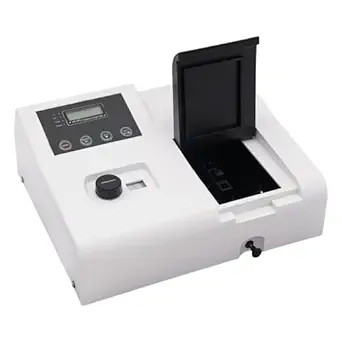 | Best Value Benchtop | Wavelength range: 350–1020 nm | Measurement accuracy: ±2 nm | Spectral bandwidth: 6 nm | VIEW ON AMAZON | See Our Full Breakdown |
| Nix Spectro 2 (2mm) Spectrophotometer and Densitometer with 2mm Targeting Jig |  | Best for Print QC | Targeting jig size: 2mm | Device type: Portable spectrophotometer and densitometer | Dimensions: 2.5 x 2.5 x 1.75 inches | VIEW ON AMAZON | See Our Full Breakdown |
| Spectro 3 Mobile Spectrophotometer Paint Color Matching Tool |  | Best Premium Portable | Manufacturer: Variable, Inc. | Optical geometries: 45/0° and d/8° | Gloss measurement: 60° gloss meter | VIEW ON AMAZON | See Our Full Breakdown |
| EberSpec CMYK 2 Digital Spectrophotometer with 11/5/3mm Apertures |  | Best for Printing & Packaging Professionals | Apertures: Φ11mm, Φ5mm, Φ3mm | Repeatability Accuracy: dE*ab≤0.02 | Measurement Indicators: 30+ including spectral reflectance, CIE-Lab, CIE-LCh, ΔE*ab | VIEW ON AMAZON | See Our Full Breakdown |
| Portable Digital Spectrophotometer with LCD Display |  | Best Value Lab Workhorse | Wavelength Range: 320-1100nm | Wavelength Accuracy: ±2nm | Spectral Bandwidth: 4nm | VIEW ON AMAZON | See Our Full Breakdown |
| Ultraviolet Digital Lab Spectrophotometer |  | Best Premium Lab Instrument | Monochromator: High-resolution C-T structural | Processor: ARM microprocessor | Light Sources: Deuterium and tungsten lamps | VIEW ON AMAZON | See Our Full Breakdown |
| Visible Spectrophotometer 350-1020nm with Backlit LCD Display |  | Best for Long-Path Sample Analysis | Wavelength Range: 350-1020nm | Wavelength Accuracy: ±2nm | Spectral Bandwidth: 6nm | VIEW ON AMAZON | See Our Full Breakdown |
More Details on Our Top Picks
Spectro 1 Pro Spectrophotometer Paint Color Matching Tool
For anyone whose entire business revolves around matching wall paint, this option stands out as the most workflow-friendly pick here. Unlike the VTSYIQI D/8, which is built for printing labs, the Spectro 1 Pro is purpose-built for paint: it reads shades across multiple surfaces and lighting conditions and maps them to fan deck libraries from major paint brands, which is exactly what a painter on a job site needs. Wireless syncing to the Spectro App on iOS and Android keeps the whole process paperless. Compared with the Nix Spectro 2, the tradeoff is scope — this device is a color matcher, not a print QA instrument — but that focus is precisely why it earns its place for tradespeople. Casual DIYers will balk at professional pricing, and the hard dependency on a smartphone means it’s dead weight without one.
Pros:- Lab-level color matching accuracy in a truly portable handheld body
- Wireless sync to the Spectro App on both iOS and Android
- Direct matching to fan deck libraries from major paint brands
- Complete kit with USB charging cable and carrying pouch included
Cons:- Professional-grade pricing is hard to justify for occasional DIY touch-ups
- Full functionality requires a smartphone and the companion app
Best for: Painters, contractors, and interior designers who need fast, accurate paint color matches on job sites
Not ideal for: Print or lab professionals — it lacks densitometry, Delta-E workflows, and M0/M1/M2 measurement modes
- Model:Spectro 1 Pro
- Product Type:Spectrophotometer / color reader
- Connectivity:Wireless (iOS and Android Spectro App)
- Charging:USB charging cable
- Portability:Lightweight, compact handheld design
- Supported Brands:Fan deck libraries from major paint brands
- Includes:Device, USB charging cable, protective carrying pouch
Our verdict“The right choice for paint professionals who match colors daily and want a fast, app-driven workflow rather than a lab instrument.”
UV-5100B UV-Vis Spectrophotometer, 190–1000 nm, 2 nm Bandwidth
This is the only true analytical lab instrument in this batch, and it plays a completely different game than the color-matching devices around it. Where the Spectro 1 Pro and Nix Spectro 2 translate readings into paint shades, the UV-5100B measures absorbance and transmittance from 190 to 1000 nm, making it suited to chemistry, water quality, and education work. The 2 nm spectral bandwidth with ±1 nm wavelength accuracy covers routine quantitative analysis comfortably. The single-beam design is the honest tradeoff: it costs less than double-beam instruments but drifts more if the lamp warms unevenly, so expect to re-blank periodically during long runs. Add that the PC software for spectrum scanning and kinetics is sold separately, and the true cost of a full setup climbs. Compared with the visible-only 350–1020 nm models elsewhere in this roundup, the UV extension to 190 nm is the real differentiator.
Pros:- Broad 190–1000 nm range extends into the UV for nucleic acid and chemical assays
- Stores measurement records and standard curves on the device
- 0.1 nm wavelength setting increments allow fine method control
- Optional software adds spectrum scanning, kinetics, and multi-wavelength analysis
Cons:- Single-beam design is more susceptible to drift than double-beam instruments
- PC software is a separate purchase, inflating total cost for advanced workflows
Best for: Academic labs, water testing facilities, and QC teams running UV-range absorbance assays on a budget
Not ideal for: Field or job-site use — it’s a benchtop instrument with no portability or app-based color matching
- Wavelength Range:190–1000 nm
- Spectral Bandwidth:2 nm
- Wavelength Accuracy:±1 nm
- Wavelength Repeatability:≤0.2 nm
- Stray Light:≤0.05%T at 220 nm and 360 nm
- Measurement Modes:Absorbance and transmittance
- Display:128 × 64 LCD
- PC Software:Optional; spectrum scanning, kinetics, multi-wavelength analysis
Our verdict“The pick for labs that need genuine UV-Vis absorbance measurement rather than paint or print color matching.”
VTSYIQI Portable Spectrophotometer D/8 Spectrocolorimeter
When color consistency has contractual stakes, this instrument earns its premium positioning. The dE*ab ≤ 0.04 repeatability is tighter than anything else in this lineup, and the D/8 measurement geometry with ASTM and ISO compliance means results will hold up in disputes with print clients. Compared with the Nix Spectro L, which also targets print and packaging, the VTSYIQI leans harder into laboratory rigor: nearly 40 evaluation light sources, over 30 measurement parameters, and 10,000 stored data entries through the ColorExpert PC software. The zirconium auto-calibration reference (Mohs hardness 9) is a thoughtful durability touch for a device that gets handled constantly. The tradeoffs are real, though — at over 11 pounds, ‘portable’ is a stretch next to the pocket-sized Nix devices, and the industrial pricing will scare off anyone without a production floor to justify it.
Pros:- Best-in-batch repeatability of dE*ab ≤ 0.04 for demanding production tolerances
- ASTM and ISO compliant for defensible, standards-based reporting
- 10,000-entry storage with 30+ parameters and ~40 evaluation light sources
- Durable zirconium auto-calibration reference resists wear
Cons:- At 11 pounds it is far less portable than handheld rivals like the Nix Spectro 2
- Industrial-grade cost is difficult to justify outside professional production environments
Best for: Print shops, packaging converters, and coating manufacturers who need certified, audit-ready color measurement
Not ideal for: Small studios or mobile color consultants — it’s heavy, expensive, and over-specified for occasional matching
- Measurement Geometry:D/8
- Repeatability Accuracy:dE*ab ≤ 0.04
- Apertures:Φ8mm, Φ11mm
- Data Storage:10,000 entries
- Measurement Parameters:Over 30
- Evaluation Light Sources:Nearly 40
- Calibration:Auto calibration with zirconium reference (Mohs hardness 9)
- Software:ColorExpert PC-based color management system
- Standards Compliance:ASTM, ISO
Our verdict“A standards-compliant workhorse for print production floors where measurement precision is contractual, not optional.”
Nix Spectro L Spectrophotometer and Densitometer – Professional Color Matching Tool
This model makes the most sense for buyers who want print-industry capability in a pocket. Its 31-channel sensor (expanded from 9) plus M0, M1, and M2 measurement modes is the key differentiator — those modes handle optical brighteners in papers and inks, something neither the Spectro 1 Pro nor most budget color readers can address. The built-in densitometer and Delta-E functionality put it closer to the VTSYIQI’s professional territory, but at a fraction of the weight and with far friendlier app-based workflows via Nix Toolkit. The 200,000+ shade paint library also makes it dual-purpose across print and coatings work. The catch is the subscription wall: Pantone, RAL, and NCS library access — the libraries many print buyers actually care about — sits behind ongoing fees. Compared with the Nix Spectro 2, you’re paying more upfront for measurement modes you may never use unless brighteners and densitometry are part of your daily vocabulary.
Pros:- M0, M1, and M2 measurement modes handle optical brighteners in modern papers
- 31-channel sensor with Delta-E and densitometry in one pocket-sized device
- Access to 200,000+ paint shades plus cloud-based custom color libraries
- Convenient USB-C charging in a highly portable form factor
Cons:- Pantone, RAL, and NCS library access requires a paid subscription
- Overkill for casual users who only need paint matching
Best for: Print, packaging, and graphic arts professionals who need M0/M1/M2 modes and densitometry on the go
Not ideal for: Budget-conscious users or paint-only matchers — the premium hardware and subscription model add cost without payoff
- Measurement Modes:M0, M1, M2
- Sensor Channels:31 (expanded from 9)
- Connectivity:USB-C charging
- App:Nix Toolkit
- Paint Library Size:200,000+ shades
- Supported Libraries:Pantone, RAL, NCS (subscription)
Our verdict“The premium handheld for graphics professionals who need measurement modes and densitometry the cheaper options simply don’t offer.”
Nix Spectro 2 Spectrophotometer – Professional Portable Color Measurement Device
This is the pick I’d point most color professionals toward first, because it hits the sweet spot between capability and cost. The 31 UV-visible channels and one-second scan speed deliver what Nix describes as benchtop-level accuracy, and the output spans CMYK, ink density, RGB, HEX, and Delta-E — enough format flexibility to serve print, paint, and coatings work from a single device. Compared with the Spectro 1 Pro, it covers far more color systems than paint fan decks alone; compared with the Nix Spectro L, you give up the M0/M1/M2 measurement modes but keep the same 200,000+ color library and save meaningfully upfront. The recurring friction is the same as the Spectro L’s: Pantone, RAL, and NCS libraries require a subscription, and Nix Print Pro for advanced print QA is a separate purchase. Budget for those add-ons before assuming the sticker covers everything.
Pros:- Benchtop-level accuracy across 31 UV-visible channels in a portable body
- Fast one-scan-per-second workflow suits busy production environments
- Outputs in CMYK, ink density, RGB, HEX, and Delta-E from one reading
- Library of 200,000+ paint colors from Benjamin Moore, Behr, PPG, Sherwin-Williams, and more
Cons:- Pantone, RAL, and NCS library access sits behind a paid subscription
- Nix Print Pro software for enhanced print QA is sold separately
Best for: Color professionals in print, paint, or coatings who want versatile multi-format measurement without benchtop cost
Not ideal for: Users who refuse subscription models or labs needing certified analytical UV-Vis measurement
- Brand:Nix Sensor Ltd.
- Model:Spectro 2
- Scan Speed:1 scan per second
- Measurement Channels:31 UV-visible channels
- Color Formats:CMYK, Ink Density, RGB, HEX, Delta-E
- Paint Color Library:200,000+ colors (Benjamin Moore, Behr, PPG, Valspar, Sherwin-Williams)
- Battery:1 Lithium Polymer (included)
- Item Weight:3.45 pounds
Our verdict“The best-balanced choice for professionals who want broad color measurement capability at well below benchtop prices, provided they accept subscription-based extras.”
Visible Spectrophotometer, 350–1020 nm, with LCD Display
This model makes the most sense for teaching labs and small facilities that need basic absorbance readings without paying for features they will never use. The 350–1020 nm range covers standard visible-light coursework, and the automatic zero and 100 adjustment means students spend less time fiddling with manual calibration. Compared with the 721 LCD Digital model later in this lineup, the published specifications here are thinner — there is no spectral bandwidth or stray light figure — which is exactly why it lands in the budget slot rather than the top benchtop position. The generous sample chamber, accepting cuvettes up to 3.94 inches long, matches what the pricier units offer and suits long-path water-quality work. The tradeoff is trust in the numbers: with fewer published performance metrics, buyers relying on it for regulated reporting should look elsewhere.
Pros:- Broad 350–1020 nm range handles standard visible analysis
- Automatic zero/100 adjustment and calibration reduce setup time
- Sample chamber fits long cuvettes up to 3.94 inches
- Tungsten lamp delivers stable, consistent illumination
Cons:- No published spectral bandwidth, stray light, or photometric accuracy figures
- Sparse documentation makes performance hard to verify against pricier units
Best for: High school and university teaching labs running basic visible absorbance experiments on a tight budget
Not ideal for: Labs that need documented photometric specs for QC documentation or regulatory reporting — the performance data simply isn’t published
- Wavelength range:350–1020 nm
- Measurement accuracy:±2 nm
- Light source:Tungsten lamp
- Display:LCD
- Sample chamber:Cuvettes up to 3.94 in (10 cm)
- Automation:Automatic light gate, auto zero/100, instrument calibration
Our verdict“A reasonable starter benchtop for visible-range coursework when detailed specs and audit trails aren’t required.”
Spectro 1 Mobile Spectrophotometer for Paint Color Matching
For homeowners and small shops trying to match an existing wall color, the Spectro 1 is the most approachable entry point in this roundup. Unlike the benchtop visible spectrophotometers, it puts reflectance curves and spectral data in a phone app, translating raw measurements into practical paint matches without any lab knowledge. It is smaller and simpler than the Nix Spectro 2 (2mm), which is aimed squarely at print professionals — here, the audience is someone matching paint at a hardware store counter. The dependency on the Spectro app on iOS or Android is the main tradeoff: no phone, no data, and the device offers no standalone display. Buyers should also note that no measurement accuracy or battery specifications are published, so anyone needing quantified precision for production work will want to step up to a unit like the Spectro 3 instead.
Pros:- Pocket-sized handheld design works anywhere
- Wireless pairing with both iOS and Android
- Provides reflectance curves and raw spectral data, not just color names
- Useful across paint, packaging, and design applications
Cons:- Fully dependent on the Spectro app to view any results
- No published measurement accuracy or battery life details
Best for: DIYers, decorators, and small contractors who need to match paint and surface colors quickly using a phone
Not ideal for: Print or manufacturing QC teams who need stated accuracy specs and standalone operation — the app dependency and missing specs are dealbreakers
- Device type:Mobile spectrophotometer
- Connectivity:Wireless
- App compatibility:iOS and Android
- Measurements:Reflectance curves, raw color values, spectral data
- Intended applications:Paint matching, printing, packaging, manufacturing, design
Our verdict“The easiest way for a phone owner to turn a wall color into a paint match, as long as app-based workflows and unverified precision are acceptable.”
721 LCD Digital Visible Spectrophotometer, 110V Tungsten Lamp, 350-1020nm
Among the tabletop units in this guide, this 721 model stands out for transparency of specifications — stray light ≤0.1% T, photometric repeatability of 0.2% T, and wavelength repeatability ≤1 nm are all stated, which is more than the simpler 350–1020 nm LCD model can claim at a similar scale. Those numbers matter because they define whether your absorbance readings can be trusted run-to-run. The automatic light gate and auto 0/100 adjustment cut daily setup time, and the backlit LCD is readable in bright lab lighting. It is not built like a premium metal-chassis instrument, though — the plastic housing will not shrug off knocks the way heavier lab gear does, and the fixed 110V US plug rules out straightforward international deployment. For a domestic lab or classroom needing documented visible-range performance at a modest price, this pick makes the most sense.
Pros:- Full published spec sheet including stray light, drift, and repeatability figures
- Automatic light gate and auto 0/100 adjustment simplify daily calibration
- Backlit LCD readable in bright conditions
- Large chamber accepts cuvettes up to 3.94 inches for long-path measurements
Cons:- Plastic construction is less durable than metal-chassis lab instruments
- 110V US plug limits use abroad without a transformer and adapter
Best for: Small labs, environmental monitoring stations, and QC benches in the US that need documented visible-range specs without a premium budget
Not ideal for: Overseas facilities on 220V power, or heavy-industrial settings where a plastic chassis will take abuse
- Wavelength range:350–1020 nm
- Measurement accuracy:±2 nm
- Spectral bandwidth:6 nm
- Wavelength repeatability:≤1 nm
- Stray light:≤0.1% T @ 360 nm
- Photometric accuracy / repeatability:0.5% T / 0.2% T
- Light source:Tungsten lamp, 110V US plug
- Dimensions / weight:15.75 x 13.78 x 6.69 in; 16.76 lbs
Our verdict“The strongest documented-performance-per-dollar benchtop in this lineup for US-based visible-light work.”
Nix Spectro 2 (2mm) Spectrophotometer and Densitometer with 2mm Targeting Jig
This is the specialist of the roundup: a palm-sized spectrophotometer and densitometer built around a 2mm targeting jig for reading print control strips, which is exactly the aperture size press operators need for color bars. Compared with the general-purpose Spectro 1, it trades broad DIY appeal for benchtop-level print accuracy — but the specialization cuts both ways. The device only functions with its 2mm jig, so it cannot double as a general surface matcher. The Nix Print Pro software is sold separately, and Pantone, RAL, and NCS libraries sit behind a Premium Access subscription, so the true cost of a complete workflow is higher than the box alone. For print shops battling color drift and wasted stock, the ability to integrate readings into press-side QC still justifies the buy; for everyone else, the Nix Spectro L or Spectro 1 are more flexible choices.
Pros:- Benchtop-level accuracy at a much lower cost than full pressroom instruments
- 2mm targeting jig purpose-built for print control strips
- Compatible with Pantone, RAL, and NCS color libraries
- Free Nix Toolkit app on Android and iOS for basic workflows
Cons:- Only operates with the 2mm targeting jig — no general surface scanning
- Print Pro software and color library access require additional purchases or subscriptions
Best for: Print and packaging professionals who measure control strips daily and need consistent small-aperture readings to cut waste and downtime
Not ideal for: General users or paint matchers — the 2mm-jig-only design and print-centric software make it impractical outside a pressroom
- Targeting jig size:2mm
- Device type:Portable spectrophotometer and densitometer
- Dimensions:2.5 x 2.5 x 1.75 inches
- Software:Nix Print Pro (sold separately); Nix Toolkit (free)
- Color libraries:Pantone, RAL, NCS (Premium Access subscription)
- Intended use:Print industry color measurement and quality control
Our verdict“A focused pressroom tool that earns its price for print QC teams but wastes money on anyone outside that niche.”
Spectro 3 Mobile Spectrophotometer Paint Color Matching Tool
The Spectro 3 sits at the top of the portable tier because it combines instruments that are usually separate: a 60° gloss meter plus dual 45/0° and d/8° optical geometries in an 11.7-ounce package. Why does that matter? A matte fabric and a glossy paint can read the same color to a single-geometry device but look completely different to the eye — the Spectro 3 catches what the Spectro 1 and Nix Spectro 2 (2mm) cannot. Add UV illumination for fluorescence detection and a battery rated for 1,000+ measurements per charge, and it becomes a genuine field QC instrument rather than a consumer gadget. The drawbacks are structural: the advanced QC Module for tracking color drift across production runs is optional and extra, and this level of instrumentation is simply overkill for a homeowner matching one wall color. It earns its premium slot for professionals measuring paints, plastics, leather, and textiles daily.
Pros:- Lab-grade color accuracy in an 11.7-ounce portable body
- Combined 60° gloss and dual 45/0° and d/8° geometries handle tricky surfaces
- UV illumination detects fluorescence the other portables miss
- 1,000+ measurements per charge supports full-day field sessions
Cons:- Advanced QC workflows require an optional, separately purchased QC Module
- Specialized industrial capability that is excessive for simple paint-matching tasks
Best for: Industrial QC professionals and coatings specialists who need lab-grade color, gloss, and fluorescence data on surfaces in the field
Not ideal for: Casual or home users — the cost and dual-geometry capability go unused when all you need is a single paint match
- Manufacturer:Variable, Inc.
- Optical geometries:45/0° and d/8°
- Gloss measurement:60° gloss meter
- UV illumination:Yes, for fluorescence detection
- Battery:Lithium-ion, 1,000+ measurements per charge
- Connectivity:Wireless via Spectro by Variable app
- Weight / dimensions:11.7 oz; 6 x 3 x 3 inches
Our verdict“The most capable portable in this roundup, worth it only for professionals who need gloss, geometry, and fluorescence data on the go.”
EberSpec CMYK 2 Digital Spectrophotometer with 11/5/3mm Apertures
Most spectrophotometers in this roundup measure color in the abstract — Lab values and reflectance curves. The EberSpec CMYK 2 is built for people who live in press-check territory, where dot area, printing contrast, overprint rate, and hue error matter as much as ΔE values. That printing-first focus is what separates it from general-purpose color tools like the Nix Spectro 2, which excels at paint and surface matching but doesn’t speak the densitometry language of a print production floor.
The three interchangeable apertures (11/5/3mm) give it flexibility the fixed-aperture portables can’t match, letting you move from large solid patches down to fine spot-color targets. The dE*ab≤0.02 repeatability is strong for this class, and app connectivity across Android, iOS, and HarmonyOS makes logging measurements into a workflow straightforward.
The tradeoff is narrowness: this is a specialized instrument, and the September 2025 release means long-term durability is simply unproven compared with more established models.
Pros:- Printing-specific metrics like dot area, overprint rate, and printing contrast that general spectrophotometers lack
- Three interchangeable apertures (11/5/3mm) cover everything from solid patches to small spot targets
- Excellent dE*ab≤0.02 repeatability with nearly 40 evaluation light sources
- Physical positioning holes with observation window prevent off-target measurements
- Cross-platform mobile app support including HarmonyOS
Cons:- Deeply specialized for printing/packaging — overkill and misplaced budget for general lab use
- Very recent release (September 2025) with no track record for long-term reliability
Best for: Print production managers and packaging QA teams who need CMYK density, dot gain, and spot-color data on the pressroom floor
Not ideal for: Labs or hobbyists doing general absorbance/transmittance work — it’s a reflection color instrument with no transmission capability
- Apertures:Φ11mm, Φ5mm, Φ3mm
- Repeatability Accuracy:dE*ab≤0.02
- Measurement Indicators:30+ including spectral reflectance, CIE-Lab, CIE-LCh, ΔE*ab
- Light Sources:Nearly 40 options including A, C, D50, D55, D65
- Printing Metrics:Color density, dot area, overprint rate, printing contrast, hue error, grayscale
- Connectivity:Android, iOS, HarmonyOS apps
- Weight:1.5 pounds
Our verdict“If your day involves press sheets, ink density, and spot-color verification, this is the most complete printing-focused option in the lineup — everyone else should look elsewhere.”
Portable Digital Spectrophotometer with LCD Display
For straightforward absorbance and concentration readings, this portable digital spectrophotometer keeps things refreshingly simple: a large 80×52mm backlit LCD shows results directly, and automatic zero, full-scale, and wavelength adjustment remove the fiddly manual calibration steps that trip up students and occasional users. Compared with the UV-5100B, it trades UV capability and tighter bandwidth for a lower barrier to entry — its 4nm bandwidth and ±2nm accuracy put it firmly in the teaching and routine-testing tier rather than research grade.
Where the Ultraviolet Digital Lab Spectrophotometer (Product 13) justifies its premium with a touchscreen and dual light sources, this model wins on simplicity and included extras: four glass cuvettes come in the box, and USB connectivity covers basic data export.
Patience is part of the deal — the 30-minute preheat time means this isn’t an instrument you power on and immediately use, and high-precision applications will find ±2nm accuracy limiting.
Pros:- Automatic zero, full-scale, and wavelength adjustment eliminate most operator error
- Direct LCD readout of absorbance, transmittance, and concentration without extra calculation
- Four glass cuvettes included, so it’s usable out of the box
- Wide 90-250V power tolerance works across regions
Cons:- 30-minute preheat required before any measurement can be trusted
- ±2nm wavelength accuracy and 4nm bandwidth fall short of analytical-grade work
Best for: University teaching labs, environmental monitoring teams, and petrochemical QA setups that need routine absorbance and concentration readings at low complexity
Not ideal for: Researchers needing UV-range measurement below 320nm or wavelength accuracy tighter than ±2nm
- Wavelength Range:320-1100nm
- Wavelength Accuracy:±2nm
- Spectral Bandwidth:4nm
- Wavelength Adjustment Interval:0.5nm minimum
- Display:80×52mm backlit LCD
- Accessories:4x 1cm glass cuvettes
- Power:90-250V, 50-60Hz
- Preheat Time:30 minutes
Our verdict“A sensible pick for routine visible-range measurement where ease of operation matters more than cutting-edge precision.”
Ultraviolet Digital Lab Spectrophotometer
This is the most capable bench instrument in this batch. A high-resolution C-T structural monochromator paired with ARM microprocessor control delivers the stability and repeatability that the simpler Portable Digital Spectrophotometer (Product 12) can’t match, and the dual deuterium and tungsten lamp setup means it covers the UV range that visible-only units like the Visible Spectrophotometer 350-1020nm simply cannot reach.
The 7-inch color touchscreen is the standout usability feature — glove-compatible touch plus physical buttons means it works whether you’re in a clean lab or wearing protection on the production line. Maintenance gets real attention too: the flange-style lamp replacement windows let you swap deuterium or tungsten lamps without disassembly, which matters for uptime in busy labs.
The four-slot rack handles 10-50mm path lengths, though it’s manual rather than automated, and the documentation lives on a USB drive rather than on paper — an annoyance if you’re troubleshooting mid-experiment.
Pros:- C-T monochromator with ARM processing delivers strong stability, precision, and repeatability
- Dual deuterium/tungsten light sources extend measurement into the UV range
- Tool-free lamp replacement via flange-style positioning windows minimizes downtime
- Four-slot adjustable rack accepts 10-50mm path length cuvettes
Cons:- Manual sample rack requires hands-on operation for every measurement
- Operation manual is only available on the included USB drive, not printed
Best for: Analytical labs that need UV-range capability, frequent lamp changes, and a glove-friendly interface for high-throughput sample runs
Not ideal for: Budget-conscious buyers doing only visible-range work, who would be paying for UV capability they never use
- Monochromator:High-resolution C-T structural
- Processor:ARM microprocessor
- Light Sources:Deuterium and tungsten lamps
- Display:7-inch color LCD touchscreen
- Operation:Touchscreen and buttons (glove-compatible)
- Path Length Range:10-50mm
- Quality Control:32 key QC points
- Documentation:Manual on included USB drive
Our verdict“The pick when UV capability, maintainability, and interface quality justify a bigger spend than the entry-level visible instruments.”
Visible Spectrophotometer 350-1020nm with Backlit LCD Display
What earns this visible spectrophotometer its place is the sample chamber that accepts cuvettes up to 10cm — a capacity the 1cm-only portable units can’t touch. Long path lengths matter for measuring dilute solutions, where a longer optical path boosts absorbance signal, so environmental labs testing trace water contaminants get real analytical benefit here. Compared with the similar 721 LCD Digital Visible Spectrophotometer, the automatic 0/100 adjustment and calibration functions cut setup time noticeably.
Its 6nm bandwidth is wider than the Portable Digital Spectrophotometer’s 4nm, which means less spectral resolution — acceptable for routine QC and teaching, less so for distinguishing closely overlapping absorption peaks. The tungsten-only light source keeps it visible-range only, consistent with its positioning as a workhorse rather than an analytical instrument.
Build quality is the honest compromise: plastic housing and a fixed 110V US plug make this a bench-bound, domestically-oriented unit.
Pros:- Sample chamber accommodates cuvettes up to 10cm for dilute-sample sensitivity
- Automatic 0/100 adjustment and built-in calibration streamline daily setup
- Wide 350-1020nm range covers most routine visible applications
- Backlit LCD stays readable in varied lab lighting
Cons:- Plastic construction is less durable than metal-bodied lab instruments
- 110V US-only plug and tungsten lamp limit international use and UV measurement
Best for: Environmental monitoring and industrial QC labs that need long-path (up to 10cm) cuvette measurements for dilute or low-absorbance samples
Not ideal for: Buyers outside the US or labs needing UV-range or high-resolution spectral work — the 110V plug and 6nm bandwidth rule both out
- Wavelength Range:350-1020nm
- Wavelength Accuracy:±2nm
- Spectral Bandwidth:6nm
- Wavelength Repeatability:≤1nm
- Light Source:Tungsten lamp
- Cuvette Length:Up to 10cm/3.94in
- Photometric Accuracy:0.5% T
- Net Weight:7.6kg/16.76lbs
Our verdict“The right choice when long path-length flexibility is your priority; skip it if you need rugged construction or UV capability.”

How We Picked
My evaluation started by sorting these 14 products into their actual use cases, because a spectrophotometer built for paint color matching and one built for DNA quantification share almost nothing beyond a name. For the portable color instruments, I weighed aperture options, measurement geometry (M0 versus D/8), calibration stability, app and software integration, and whether the device doubles as a densitometer. For the benchtop UV-Vis units, the deciding factors were wavelength range, spectral bandwidth, lamp type, stray light behavior, and the completeness of included accessories like cuvettes and software.
Ranking then balanced capability against practicality. A model like the UV-5100B ranks highly because its 190 nm lower limit and 2 nm bandwidth enable genuine quantitative UV work, while visible-only 350–1020 nm units rank lower for serious labs yet remain strong value picks for teaching. On the color side, devices with swappable or small apertures, such as the EberSpec CMYK 2 and the Nix Spectro 2 (2mm), earned higher placement because sample flexibility is the single biggest frustration reported with fixed-aperture handhelds. Build quality, ecosystem maturity, and the realism of each device’s intended buyer rounded out the ordering.
Factors to Consider When Choosing Spectrophotometers
Choosing a spectrophotometer is less about finding the most features and more about avoiding an expensive mismatch. These are the factors that actually change what you can measure and how much you will enjoy using the instrument.Wavelength Range Defines What You Can Actually Measure
The most common buying mistake is paying for range you will never use — or being blindsided by range you need but do not have. A visible-only instrument spanning 350–1020 nm handles colorimetry, basic teaching labs, and visible absorbance assays, but it cannot quantify nucleic acids or proteins at 260/280 nm because those absorbances live in the ultraviolet. That is why units like the UV-5100B, which reaches down to 190 nm, occupy a different performance class despite looking similar on a listing page. Conversely, if your work is purely paint or print color, wavelength range in the analytical sense barely matters at all; the handheld color devices sample the visible spectrum by design. My advice: write down the specific absorbance peaks or color standards your work requires before comparing spec sheets, because the wavelength floor is the one spec you cannot upgrade later.
Bandwidth and Optical Quality Separate Instruments From Toys
Spectral bandwidth determines how sharply the instrument resolves absorbance peaks, and it is the spec most buyers overlook. A 2 nm bandwidth, like the UV-5100B offers, preserves peak shape for quantitative methods and compliance-adjacent work, while wider bandwidths flatten peaks and can skew concentration calculations — a silent error that reveals itself only when your numbers disagree with a reference lab. Lamp type matters too: deuterium lamps for the UV region and tungsten for visible each age differently, and replacement cost and availability should factor into your total ownership math. Stray light performance, rarely advertised on budget units, dictates the upper absorbance limit where readings stop being linear. If a listing does not state bandwidth or lamp specifications, treat that absence as information in itself.
Aperture Size and Geometry for Color Work
For paint matching and print measurement, the measurement aperture is the difference between a confident match and a frustrating guessing game. Large apertures average over texture and are ideal for smooth wall paint, but they fail on tight spots, threads, small logos, or curved surfaces where a 2–3 mm spot is the only option. That is why models with swappable apertures or small-aperture variants consistently outperform single-configuration devices in real-world versatility. Measurement geometry — typically 45/0 for appearance-matching or spherical D/8 for trapping total color including gloss — changes results more than most buyers expect, and mixing geometries across a workflow makes archived measurements non-comparable. Decide whether you match what the eye sees or total pigment content before choosing between these designs.
Portability, Power, and the Question of Mains Voltage
Benchtop UV-Vis instruments draw real power and ship configured for specific mains voltage — a 110V tungsten-lamp model plugged into 220V service without a transformer becomes an expensive paperweight, so international buyers should verify voltage compatibility before ordering. Portability for color instruments involves different tradeoffs: battery life, Bluetooth reliability, and whether the device stores readings offline for later sync all matter in the field. A benchtop unit rewards you with stability and repeatability; a handheld rewards you with measuring the actual wall instead of a chip carried back to a lab. Some buyers end up needing both, and knowing that upfront is cheaper than discovering it after a failed deployment. Also check whether the handheld requires a paired phone or tablet, since that dependency shapes the workflow for shop crews.
Software, Calibration, and Long-Term Ecosystem Lock-In
The measurement is only half the system — the software that processes, exports, and archives spectral data determines daily usability. Established ecosystems like Nix’s app platform provide color-library matching against large paint databases, which multiplies the hardware’s usefulness, while generic units with barebones LCD output leave you transcribing numbers manually. Calibration is the other long-term cost: white-tile calibration, lamp replacement schedules, and whether the device self-calibrates on wake all affect how much maintenance discipline your team needs. Proprietary accessories and closed ecosystems can lock you in, but they also tend to mean firmware updates and support years down the road. Weigh whether you are buying an instrument or joining a platform, because that framing clarifies most of the price gaps in this category.
Who Should Spend More — and Who Should Not
Spending more makes sense when repeatability across operators and time carries financial consequences: production print QA, formulation workflows, or regulated analytical lab work justify premium instruments with stable calibration and traceable standards. It does not make sense for a homeowner matching touch-up paint once, a hobbyist checking water clarity, or a classroom running Beer-Lambert demonstrations — the entry visible spectrophotometers and consumer color tools cover those jobs completely. The middle of the market is where buyers most often overspend, purchasing features like UV range or densitometry they will never invoke. A useful exercise is to ask what happens if a reading is slightly wrong; if the answer is minor inconvenience, buy on value, and if the answer is a rejected print run or invalid assay, buy on repeatability and support.
Frequently Asked Questions
Can a paint-matching spectrophotometer like the Nix or Spectro 1 replace a lab UV-Vis instrument?
No — these are different instruments that happen to share a category name. Paint-matching devices sample the visible spectrum to characterize reflected color and output color values or paint formula matches, while a UV-Vis spectrophotometer measures light transmitted through a sample to quantify concentration of analytes, often in the ultraviolet range. A handheld color device cannot produce an absorbance spectrum at 260 nm for DNA quantification, and a benchtop UV-Vis cannot walk up to a wall and match paint. If your work spans both needs, you genuinely need two tools, which is why this roundup evaluates the two groups against their own peers rather than head-to-head.
Is a 2 mm aperture better than a larger standard aperture?
Neither is universally better — aperture choice depends entirely on your samples. A small 2 mm aperture, like the Nix Spectro 2 (2mm) variant with its targeting jig, lets you measure tight spots, thin stripes, small printed elements, and curved surfaces that a large aperture would smear across background material. A larger aperture averages a bigger patch, which produces more stable, repeatable readings on uniform surfaces and tolerates slight texture or grain. The catch is that small apertures gather less light and demand steadier positioning, so expect somewhat more care per measurement. If your samples vary in size, a swappable-aperture model like the EberSpec CMYK 2 avoids committing to one compromise.
What can I actually do with a visible-only 350–1020 nm spectrophotometer?
Plenty, as long as your analytes absorb in the visible range. These instruments handle colorimetric assays, water-quality testing with reagent-based color development, teaching-lab Beer-Lambert experiments, and any method built around colored complexes or dyes. The limitation is biological and chemical work centered on UV absorbance — nucleic acid and protein quantification at 260/280 nm is off the table, as is any method requiring a deuterium lamp’s spectral coverage. For education and routine visible assays, the tungsten-lamp design is actually an advantage because tungsten sources are inexpensive, long-lived, and warm up quickly. What you give up relative to the UV-5100B is purely the UV region and typically tighter bandwidth.
Do I need densitometer functionality on a color spectrophotometer?
You need it only if you work in print production or prepress, where CMYK ink density is the language of quality control. Devices like the Nix Spectro L and Spectro 2 combine spectral color measurement with densitometry, letting one tool serve both color matching and press-check density verification, which is genuinely more efficient than carrying separate instruments. For paint, textiles, coatings, or general color matching, densitometry adds cost and menu complexity without practical benefit. The tradeoff is that combination devices often cost more than spectrocolorimeter-only rivals like the VTSYIQI D/8. If you cannot name a reason you would read ink density, choose the dedicated colorimeter and spend the difference elsewhere.
How much does app and software dependency matter for handheld spectrophotometers?
More than most buyers expect, because the hardware is only as useful as the software processing its readings. Ecosystems with mature apps provide paint-database matching, cloud-stored color libraries, team sharing, and exportable data — effectively turning a sensor into a workflow tool. The dependency cuts both ways: if the app is discontinued, poorly maintained, or requires an OS version your aging tablet cannot run, the device loses capability through no fault of its optics. Standalone units with onboard LCD displays and buttons avoid that risk but typically output raw values you must interpret yourself. Field teams should verify offline operation and Bluetooth reliability in their actual environment before standardizing on any app-driven device.
Conclusion
The right spectrophotometer depends entirely on which of two jobs you are buying for. For best overall in professional color measurement, the Nix Spectro 2 earns the top spot with its flexible design, densitometer capability, and mature software ecosystem. The best value picks split by category: the VTSYIQI D/8 spectrocolorimeter delivers laboratory-style D/8 geometry at a handheld price, while the 721 LCD visible spectrophotometer is the smart budget entry for basic bench work. For best premium, the EberSpec CMYK 2 with its 11/5/3 mm aperture system offers the sample flexibility that production environments pay a premium for, and the UV-5100B takes the premium lab position with UV coverage and 2 nm bandwidth.
Beginners and homeowners are best served by the Spectro 1 Mobile or Spectro 1 Pro, which trade advanced features for simplicity in paint matching. For specific needs: small-target measurement belongs to the Nix Spectro 2 (2mm) with its targeting jig, teaching labs should look at the 350–1020 nm LCD models, and field color QC teams will appreciate the Spectro 3 Mobile’s balance of capability and portability. Match the instrument to the workflow, verify voltage and aperture requirements before ordering, and you will avoid the most common — and most expensive — mistakes in this category.
Halloween Picks

Vexalify 11-Inch Halloween Pumpkin Fog Machine with 12-Color Lights

12.5-Foot Lighted Halloween Inflatable Archway

Spirit Halloween Scary Sitting Scarecrow Animatronic, 4 ft 6 in
As an affiliate, we earn on qualifying purchases.