The UV-9000S double-beam spectrophotometer is my best overall pick on paper because its 190–1100 nm range and selectable bandwidths offer the most flexibility in this lineup. For routine single-beam work, the UV-5200PC stands out for its stated PC software, while the SCILOGEX SCI-V1000 includes glass and quartz cuvettes for labs that need both visible and UV measurements. The main tradeoffs are wavelength coverage, bandwidth, single- versus double-beam design, and how much data handling you need. A broader range or narrower bandwidth can help with particular methods, but it does not by itself confirm accuracy or fit for regulated work. Continue reading for my full comparison and guidance on matching a model to your samples and workflow.

Get the latest gadgets delivered free with Prime
- Fast, free delivery on millions of items
- Prime Video, Amazon Music and more included
- Member-only deals all year
Complete the kit


Key Takeaways
- The UV-9000S is the only listed double-beam model, and its selectable 0.5, 1, 2, and 4 nm bandwidths distinguish it from the single-beam alternatives.
- PC connectivity separates the UV-5200PC and UV-5500PC from similarly named models without PC software in their listed descriptions; confirm what software and data export functions are actually included.
- Wavelength ranges differ meaningfully: the 721 model starts at 350 nm and is limited to visible measurements, while several UV-Vis models list coverage from 190 nm.
- Bandwidth claims are not uniform. Many single-beam choices list 2 nm, the SM1000 lists 5 nm, and the UV-9000S offers several settings, so check the method requirements before choosing.
- Included accessories matter to readiness: the SCI-V1000 lists both glass and quartz cuvettes, but buyers should verify cuvette path length, quantity, and compatibility for their intended methods.
| Ultraviolet Digital Lab Spectrophotometer |  | Best for Hands-On Lab Flexibility | Display: 7-inch color LCD touchscreen | Monochromator: High-resolution C-T structure | Processor: ARM microprocessor | VIEW ON AMAZON | See Our Full Breakdown |
| CGOLDENWALL UV752N UV-Visible Spectrophotometer with LED Display |  | Best for Large Cuvettes | Wavelength range: 195–1020 nm | Optical system: Achromatic Czerny-Turner, 1200 bars/mm grating | Wavelength accuracy: ±2 nm | VIEW ON AMAZON | See Our Full Breakdown |
| UV-5200PC UV-Vis Spectrophotometer, 190–1100 nm, 2 nm Bandwidth, with PC Software |  | Best for PC-Based Analysis | Wavelength range: 190–1100 nm | Spectral bandwidth: 2 nm | Wavelength accuracy: ±1.0 nm | VIEW ON AMAZON | See Our Full Breakdown |
| GOYOJO UV-5100B UV/Vis Spectrophotometer, 190–1000 nm |  | Best for Onboard Result Storage | Model: UV-5100B | Wavelength range: 190–1000 nm | Wavelength setting: Automatic | VIEW ON AMAZON | See Our Full Breakdown |
| UV-5500PC UV-Vis Spectrophotometer, 190–1100 nm, 2 nm, with PC Software |  | Best for Stored Methods and Power Recovery | Wavelength range: 190–1100 nm | Spectral bandwidth: 2 nm | Display: 128 × 64 dot LCD | VIEW ON AMAZON | See Our Full Breakdown |
| 721 LCD Digital Visible Spectrophotometer, 110V Tungsten Lamp, 350-1020nm Wavelength Range | 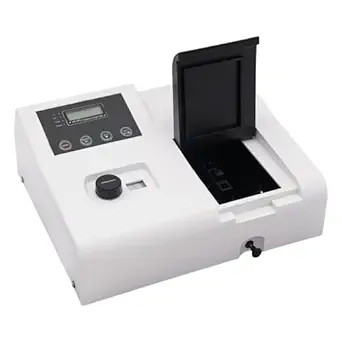 | Best for Visible-Range Work | Wavelength range: 350–1020 nm | Wavelength accuracy: ±2 nm | Spectral bandwidth: 6 nm | VIEW ON AMAZON | See Our Full Breakdown |
| UV-5500 UV/VIS Spectrophotometer, 190–1100 nm Wavelength Range | | Best for Stored Results and Routine Quantitation | Wavelength range: 190–1100 nm | Spectral bandwidth: 2 nm | Wavelength accuracy: ±0.5 nm | VIEW ON AMAZON | See Our Full Breakdown |
| SM1000 5 nm UV-Vis Spectrophotometer, 195-1020 nm |  | Best for Basic UV-Vis Coverage | Model: SM1000 | Wavelength range: 195–1020 nm | Spectral bandwidth: 5 nm | VIEW ON AMAZON | See Our Full Breakdown |
| NANBEI NU-T3C Ultraviolet Lab Spectrophotometer, 190-1100 nm |  | Best for Multi-Mode Lab Analysis | Wavelength range: 190–1100 nm | Wavelength accuracy: ±1 nm | Spectral bandwidth: 4 nm | VIEW ON AMAZON | See Our Full Breakdown |
| UV-5100 Single Beam UV-Vis Spectrophotometer, 190-1100nm, 2nm Bandwidth |  | Best for PC-Based Scanning | Wavelength range: 190–1100 nm | Bandwidth: 2 nm | Beam type: Single beam | VIEW ON AMAZON | See Our Full Breakdown |
| UV-5100B Single-Beam UV-Vis Spectrophotometer, 190–1000 nm, 2 nm Bandwidth | 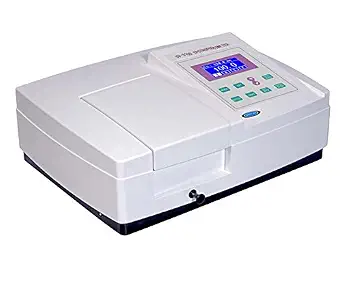 | Best for Flexible Bench Work | Optical design: Single beam | Wavelength range: 190–1000 nm | Bandwidth: 2 nm | VIEW ON AMAZON | See Our Full Breakdown |
| UV-9000S Double Beam UV-Vis Spectrophotometer, 190–1100 nm, 0.5/1/2/4 nm |  | Best for Precision-Focused Workflows | Optical system: Double beam | Wavelength range: 190–1100 nm | Spectral bandwidth: Selectable: 0.5, 1, 2, or 4 nm | VIEW ON AMAZON | See Our Full Breakdown |
| UV-VIS Spectrophotometer 752N/UV1100 | 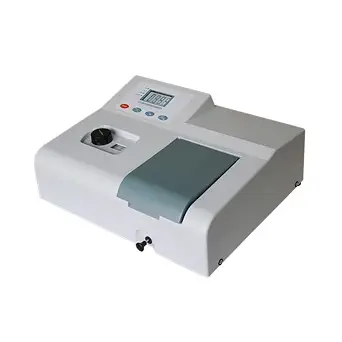 | Best for First-Time Lab Users | Wavelength range: 195–1020 nm | Photometric accuracy: ±0.5%T | Wavelength accuracy: ±2 nm | VIEW ON AMAZON | See Our Full Breakdown |
| UV-5100B UV-Vis Spectrophotometer, 190-1000 nm, 2 nm Bandwidth |  | Best for Standalone Routine Measurements | Instrument type: Single-beam UV-Vis spectrophotometer | Wavelength range: 190–1000 nm | Spectral bandwidth: 2 nm | VIEW ON AMAZON | See Our Full Breakdown |
| SCILOGEX SCI-V1000 UV-Vis Spectrophotometer with Glass & Quartz Square Cuvettes |  | Best for Visible-Range Labs with Included Cuvettes | Optical design: Single beam | Wavelength range: 325–1000 nm | Bandwidth: 4 nm | VIEW ON AMAZON | See Our Full Breakdown |
| uv vis spectrophotometer | Wavelength range | Wavelength accuracy | Spectral bandwidth |
|---|---|---|---|
| Ultraviolet Digital Lab Spectr | — | — | — |
| CGOLDENWALL UV752N UV-Visible | 195–1020 nm | ±2 nm | 4 nm |
| UV-5200PC UV-Vis Spectrophotom | 190–1100 nm | ±1.0 nm | 2 nm |
| GOYOJO UV-5100B UV/Vis Spectro | 190–1000 nm | — | — |
| UV-5500PC UV-Vis Spectrophotom | 190–1100 nm | — | 2 nm |
| 721 LCD Digital Visible Spectr | 350–1020 nm | ±2 nm | 6 nm |
| UV-5500 UV/VIS Spectrophotomet | 190–1100 nm | ±0.5 nm | 2 nm |
| SM1000 5 nm UV-Vis Spectrophot | 195–1020 nm | ±2.0 nm | 5 nm |
| NANBEI NU-T3C Ultraviolet Lab | 190–1100 nm | ±1 nm | 4 nm |
| UV-5100 Single Beam UV-Vis Spe | 190–1100 nm | — | — |
| UV-5100B Single-Beam UV-Vis Sp | 190–1000 nm | — | — |
| UV-9000S Double Beam UV-Vis Sp | 190–1100 nm | ±0.3 nm | Selectable: 0.5, 1, 2, or 4 nm |
| UV-VIS Spectrophotometer 752N/ | 195–1020 nm | ±2 nm | — |
| UV-5100B UV-Vis Spectrophotome | 190–1000 nm | ±1 nm | 2 nm |
| SCILOGEX SCI-V1000 UV-Vis Spec | 325–1000 nm | — | — |
More Details on Our Top Picks
Ultraviolet Digital Lab Spectrophotometer
The four-slot adjustable rack gives this model a practical edge for labs that switch between cuvette sizes, with support for 10–50 mm path lengths. Its 7-inch touchscreen and glove-friendly button controls should make routine setup easier than on the CGOLDENWALL UV752N, which uses a simpler LED display and manual wavelength drive. The C-T monochromator and ARM processor are aimed at stable, repeatable readings, while separate lamp access windows simplify replacement. The tradeoff is that the sample rack is manual, so it lacks the convenience of automated handling. I would also account for the USB-only manual if staff need printed instructions at the instrument. This is a flexible bench option for varied sample formats, rather than a choice for labs prioritizing automation.
Pros:- Adjustable four-slot rack accommodates 10–50 mm path lengths
- 7-inch touchscreen plus physical controls supports operation with gloves
- C-T monochromator and ARM processor are designed for stable measurements
- Separate access windows simplify replacing the deuterium and tungsten lamps
Cons:- Manual sample rack requires hands-on sample changes
- The manual is supplied on USB rather than as a printed copy
Best for: Teaching and routine analytical labs that use several cuvette path lengths and want a glove-friendly interface
Not ideal for: Labs seeking automated sample handling or printed documentation included with the instrument
- Display:7-inch color LCD touchscreen
- Monochromator:High-resolution C-T structure
- Processor:ARM microprocessor
- Sample rack:Four-slot adjustable manual rack
- Path length range:10–50 mm
- Light sources:Deuterium and tungsten lamps
- Manual:Pre-loaded on included USB drive
- Quality control:32 checkpoints
Our verdict“Choose this model for flexible cuvette handling and a modern, glove-friendly interface if manual sample loading fits your workflow.”
CGOLDENWALL UV752N UV-Visible Spectrophotometer with LED Display
The UV752N earns a distinct place here through its 5–100 mm cuvette compatibility, the widest stated path-length span among these five products. That range can suit labs working with larger sample volumes or specialized holders, while the UV-5500PC also supports up to 100 mm with optional holders. Its 195–1020 nm range covers common UV-visible work, and the automatic light switching reduces one manual step. The tradeoff is a more traditional operating experience: wavelength selection is manual, and the four-digit LED display offers less on-screen guidance than the touchscreen on the Ultraviolet Digital Lab Spectrophotometer. At 12 kg, it is best treated as a stationary bench instrument. I would choose it for sample-size flexibility, not for fast wavelength changes or frequent relocation.
Pros:- Accommodates cuvettes from 5 to 100 mm
- 195–1020 nm range spans UV and visible measurements
- Automatic light switching between tungsten and xenon sources
- Achromatic Czerny-Turner optical system with a 1200 bars/mm grating
Cons:- Manual wavelength drive takes more operator input than automatic wavelength selection
- Basic LED display provides less interface guidance than touchscreen models
- 12 kg net weight limits portability
Best for: Laboratories that need to measure samples in cuvettes from 5 to 100 mm and can dedicate bench space
Not ideal for: Users who frequently change wavelengths, need a guided touchscreen, or move instruments between work areas
- Wavelength range:195–1020 nm
- Optical system:Achromatic Czerny-Turner, 1200 bars/mm grating
- Wavelength accuracy:±2 nm
- Spectral bandwidth:4 nm
- Photometric accuracy:0.5%T
- Display:4-digit LED
- Wavelength drive:Manual
- Sample compatibility:5–100 mm cuvettes
- Net weight:12 kg
Our verdict“Pick the UV752N when broad cuvette-size compatibility matters more than automated wavelength selection or portability.”
UV-5200PC UV-Vis Spectrophotometer, 190–1100 nm, 2 nm Bandwidth, with PC Software
The UV-5200PC is the clearest fit for labs that want analysis tools on a connected computer: its UV-Professional software supports quantitative work, kinetics, scans, DNA and protein testing, and multi-wavelength measurements. Automatic wavelength selection also cuts down on manual setup compared with the CGOLDENWALL UV752N, whose wavelength drive is manual. Its 190–1100 nm range extends beyond the UV752N’s stated upper limit, while the 2 nm bandwidth and stated wavelength accuracy of ±1.0 nm give buyers useful performance details for method planning. The product data does not specify onboard storage, a display type, or included accessories, so I would check those against the intended bench workflow. This model makes most sense when USB-connected analysis is central to the work.
Pros:- UV-Professional software supports multiple analysis modes
- Automatic wavelength selection reduces manual adjustment
- 190–1100 nm wavelength range covers UV and visible measurements
- Supports standard curves and coefficient-based quantitative analysis
Cons:- PC-based workflow depends on a USB-connected computer
- Product data does not state onboard storage or display specifications
Best for: Analytical labs and research groups that need PC-supported scans, kinetics, quantitative analysis, or nucleic acid and protein testing
Not ideal for: Labs that need a clearly specified standalone workflow, onboard data storage, or detailed instrument-interface information
- Wavelength range:190–1100 nm
- Spectral bandwidth:2 nm
- Wavelength accuracy:±1.0 nm
- Wavelength repeatability:0.5 nm
- Stray light:≤0.1%T at 220 nm and 360 nm
- Absorbance display range:−0.3 to 3.0 A
- Transmittance display range:0–200%T
- Connectivity:USB
- Software:UV-Professional PC software
Our verdict“Choose the UV-5200PC if computer-based analytical modes matter more than a fully specified standalone workflow.”
GOYOJO UV-5100B UV/Vis Spectrophotometer, 190–1000 nm
The GOYOJO UV-5100B suits users who want automatic wavelength setting and a way to retain results without making optional PC software the center of the workflow. It stores up to 200 results, which gives it a practical standalone advantage over the UV-5200PC, whose supplied details emphasize USB software and analysis modes rather than onboard storage. The die-cast aluminum optical mount adds a rigid foundation, and USB connectivity leaves room for PC display and analysis. The range reaches 1000 nm, shorter than the UV-5200PC and UV-5500PC at 1100 nm. Software is optional, so buyers needing spectrum scans, kinetics, or multi-wavelength PC workflows should account for that before choosing it. This is a straightforward fit for routine measurements and saved results.
Pros:- Automatic wavelength setting reduces manual operation
- Stores up to 200 results onboard
- Rigid die-cast aluminum optical mount
- USB connection supports PC-based data display
Cons:- PC software is optional
- 1000 nm upper wavelength limit is narrower than the 1100 nm reach of the UV-5200PC and UV-5500PC
Best for: Routine testing labs that value automatic wavelength setting and onboard retention of up to 200 results
Not ideal for: Users who need included PC software, advanced computer-based analysis, or measurements above 1000 nm
- Model:UV-5100B
- Wavelength range:190–1000 nm
- Wavelength setting:Automatic
- Data storage:Up to 200 results
- Connectivity:USB
- Optical mount:Die-cast aluminum
- Displayed measurements:Wavelength, absorbance, and transmittance
- Results per screen:5
- Software:Optional
Our verdict“Choose the UV-5100B for routine UV-visible work with onboard result storage, provided optional software meets your analysis needs.”
UV-5500PC UV-Vis Spectrophotometer, 190–1100 nm, 2 nm, with PC Software
The UV-5500PC is a strong match for labs that need to keep working data and curve equations on the instrument: it stores up to 200 groups and can recover data after a power cut. That standalone retention separates it from the UV-5200PC, whose listed strengths focus more on its PC software and analysis modes. The included UV-Professional software still supports quantitative analysis, kinetics, scans, and DNA or protein testing, while independently switchable tungsten and deuterium lamps give operators control over the light sources. Its 190–1100 nm range matches the UV-5200PC, but the 5–100 mm cuvette range requires optional holders. The compact 128 × 64 LCD is less expansive than the touchscreen on the Ultraviolet Digital Lab Spectrophotometer. I would favor this model when data continuity and stored curves matter most.
Pros:- Stores up to 200 groups of data and curve equations
- Recovers stored data after a power cut
- Included PC software supports several analytical modes
- Independently switchable tungsten and deuterium lamps
Cons:- Cuvette holders for the 5–100 mm path-length range are optional
- 128 × 64 dot LCD is smaller and less capable than a touchscreen interface
Best for: Labs that repeat established methods and want instrument-side storage plus recovery of data after power interruptions
Not ideal for: Buyers who need all cuvette holders included or prefer a large, modern touchscreen display
- Wavelength range:190–1100 nm
- Spectral bandwidth:2 nm
- Display:128 × 64 dot LCD
- Data storage:Up to 200 groups
- Computer connection:Built-in USB
- Software:UV-Professional
- Supported tests:Quantitative, kinetics, wavelength scan, DNA/protein, and multi-wavelength
- Cuvette path length:5–100 mm with optional holders
- Lamps:Tungsten and deuterium, independently switchable
Our verdict“Choose the UV-5500PC when stored methods and power-loss recovery are priorities and you can source the needed cuvette holders.”
721 LCD Digital Visible Spectrophotometer, 110V Tungsten Lamp, 350-1020nm Wavelength Range
The 721 is the pick here for labs that only need visible-range measurements and want room for longer cuvettes. Its 350–1020 nm range and chamber capacity of up to 3.94-inch cuvettes suit varied sample setups, while automatic 0/100 adjustment simplifies routine calibration. Compared with the UV-5500, it gives up UV measurements and the broader analytical functions described for that model, so it is a narrower fit for UV-Vis workflows. Its stated ±2 nm wavelength accuracy also trails the NU-T3C’s ±1 nm. The 721 makes more sense when visible analysis is the actual task and the large chamber is useful; its plastic housing and 110V US-standard power setup are practical limits for some labs.
Pros:- Visible range extends from 350 to 1020 nm
- Large chamber accepts cuvettes up to 3.94 inches
- Automatic 0/100 adjustment helps streamline routine setup
- Backlit LCD presents readings on the instrument
Cons:- Cannot measure in the UV range, unlike the UV-5500 and NU-T3C
- Plastic construction may be less durable than a metal-housed instrument
- 110V US-standard plug limits fit with other power setups
Best for: Teaching and quality-control labs measuring visible-range samples that need a tabletop unit with space for longer cuvettes
Not ideal for: Labs running UV assays or needing tighter stated wavelength accuracy, since this model begins at 350 nm and is rated at ±2 nm
- Wavelength range:350–1020 nm
- Wavelength accuracy:±2 nm
- Spectral bandwidth:6 nm
- Light source:Tungsten lamp
- Photometric accuracy:0.5% T
- Stray light:≤0.1% T at 360 nm
- Cuvette length:Up to 3.94 in (10 cm)
- Display:Backlit LCD
- Power:110V, US-standard plug
Our verdict“Choose the 721 for visible-only analysis and longer cuvettes, but select a UV-Vis model if your work includes UV measurements.”
UV-5500 UV/VIS Spectrophotometer, 190–1100 nm Wavelength Range
The UV-5500 suits labs that want UV-Vis coverage plus a way to retain and export routine measurements. It spans 190–1100 nm, measures absorbance, transmittance, and energy, and supports standard-curve or coefficient-based quantitation. Onboard result storage and USB output give it a practical data workflow that the SM1000’s supplied details do not describe. Its 2 nm bandwidth and ±0.5 nm wavelength accuracy are also tighter than the SM1000’s 5 nm bandwidth and ±2 nm accuracy. The NU-T3C lists spectral, time, and DNA/protein functions, making it a better match for users who need those specific workflows. The UV-5500’s LCD is modest, and its supplied specifications do not state those advanced scan modes.
Pros:- 190–1100 nm range covers UV and visible measurements
- 2 nm bandwidth and ±0.5 nm wavelength accuracy
- Supports standard-curve and coefficient quantitative methods
- Onboard storage and USB output support result retention and transfer
Cons:- The 128×64 dot matrix LCD offers limited display detail
- Spectral scanning, time scanning, and DNA/protein analysis are not specified
- No supplied details establish included accessories or computer software
Best for: Routine laboratory and quality-control teams that need UV-Vis measurements, standard-curve quantitation, and saved results with USB export
Not ideal for: Researchers who require specified spectral or time scanning, or DNA/protein workflows, since those capabilities are not listed for this model
- Wavelength range:190–1100 nm
- Spectral bandwidth:2 nm
- Wavelength accuracy:±0.5 nm
- Wavelength repeatability:0.3 nm
- Measurements:Absorbance, transmittance, and energy
- Quantitative methods:Standard curve and coefficient methods
- Display:128×64 dot matrix LCD
- Data storage:Onboard storage with automatic result saving
- Data output:USB
Our verdict“Pick the UV-5500 for routine UV-Vis quantitation with saved, exportable results; choose the NU-T3C if you need its listed scan and DNA/protein modes.”
SM1000 5 nm UV-Vis Spectrophotometer, 195-1020 nm
The SM1000 offers straightforward UV-Vis wavelength coverage from 195 to 1020 nm, making it a fit for routine work that does not call for a narrower bandwidth. Its 5 nm bandwidth is wider than the 2 nm bandwidth of the UV-5500 and UV-5100, so it is less suited to work where finer spectral detail matters. The stated ±2.0 nm wavelength accuracy also trails those models’ listed accuracy figures. Its photometric accuracy is ±0.5%T, with stray light specified at 220 and 340 nm. Compared with the NU-T3C, the SM1000 has fewer supplied details about functions, connectivity, and included accessories; that makes it harder to match to a data-heavy workflow. It is a focused option when the listed range and routine analysis are enough.
Pros:- UV-Vis range covers 195–1020 nm
- 5 nm bandwidth is specified for routine analysis
- Photometric accuracy is listed as ±0.5%T
- Stray-light performance is stated at both 220 and 340 nm
Cons:- 5 nm bandwidth is wider than the 2 nm bandwidth on the UV-5500 and UV-5100
- ±2.0 nm wavelength accuracy is less precise than the UV-5500’s stated ±0.5 nm
- Supplied data does not specify display, connectivity, or included accessories
Best for: Labs performing routine UV-Vis measurements that can work with a 5 nm bandwidth and do not need listed scanning or data-transfer features
Not ideal for: Researchers resolving narrower spectral features or seeking defined connectivity and included accessories, since the bandwidth is 5 nm and those details are not supplied
- Model:SM1000
- Wavelength range:195–1020 nm
- Spectral bandwidth:5 nm
- Wavelength accuracy:±2.0 nm
- Photometric accuracy:±0.5%T
- Stray light:0.3%T at 220 nm and 340 nm
Our verdict“Choose the SM1000 for basic UV-Vis work when its 5 nm bandwidth is sufficient and you do not need a specified data workflow.”
NANBEI NU-T3C Ultraviolet Lab Spectrophotometer, 190-1100 nm
The NU-T3C is the most function-focused pick in this group: it lists multi-wavelength measurement, spectral scanning, time scanning, and DNA/protein analysis across a 190–1100 nm range. That breadth gives university, environmental, and food labs more named workflows than the UV-5500, which specifies routine absorbance, transmittance, energy, and quantitative methods. Its ±1 nm accuracy and 4 nm bandwidth sit between the UV-5500’s tighter stated accuracy and the SM1000’s wider bandwidth. The included four glass cuvettes and USB connection help provide a ready starting setup. In return, it weighs 26 pounds, calls for 30 minutes of preheating, and requires manual blank calibration and wavelength selection, so it is less convenient for frequent quick measurements.
Pros:- Lists photometric, quantitative, spectral, and time-scanning functions
- Supports DNA/protein analysis and up to 10 wavelength points
- 190–1100 nm range with ±1 nm wavelength accuracy
- Includes USB connectivity and four 1×1 cm glass cuvettes
Cons:- Requires 30 minutes of preheating before use
- At 26 pounds, it is less portable than a lighter bench instrument
- Blank calibration and wavelength selection require manual setup
Best for: University and applied laboratory teams that need listed spectral or time scans, multi-wavelength measurements, or DNA/protein analysis
Not ideal for: Users prioritizing portability or rapid startup, given its 26-pound weight and 30-minute preheating requirement
- Wavelength range:190–1100 nm
- Wavelength accuracy:±1 nm
- Spectral bandwidth:4 nm
- Measurements:Absorbance and transmittance
- Scanning and analysis:Multi-wavelength, spectral scan, time scan, and DNA/protein analysis
- Interface:USB
- Display:LCD digital
- Power compatibility:90–250 V, 50–60 Hz
- Weight:26 lb
Our verdict“Choose the NU-T3C when your lab will use its scanning and DNA/protein modes, and accept the warmup and setup time.”
UV-5100 Single Beam UV-Vis Spectrophotometer, 190-1100nm, 2nm Bandwidth
The UV-5100 stands out for users who plan to move beyond readings on the instrument and analyze data on a computer. Its USB connection supports PC-based spectrum scanning, kinetics, and multi-wavelength testing, capabilities not listed for the UV-5500. The 190–1100 nm range and 2 nm bandwidth also match that model’s stated coverage and bandwidth, while the UV-5500 provides specific wavelength accuracy and repeatability figures that are absent from the UV-5100’s supplied data. A 2.5-inch LCD displays standard curves and result groups, and automatic wavelength setting can reduce keying errors. The tradeoff is that the PC software is optional, so the computer workflow may require a separate purchase; the deuterium lamp also needs periodic replacement. It is a single-beam instrument, which may not suit every measurement protocol.
Pros:- USB connection supports PC spectrum scanning, kinetics, and multi-wavelength testing
- 190–1100 nm range with 2 nm bandwidth
- 2.5-inch LCD shows standard curves and result groups
- Automatic wavelength setting can reduce operation errors
Cons:- PC software is optional and sold separately
- Deuterium lamp requires periodic replacement
- Single-beam design may not fit protocols that call for a double-beam instrument
Best for: Lab users who want to run spectrum scans, kinetics, or multi-wavelength tests through a PC-connected UV-Vis instrument
Not ideal for: Buyers who need PC software included or prefer a double-beam configuration, since software is optional and this model is single beam
- Wavelength range:190–1100 nm
- Bandwidth:2 nm
- Beam type:Single beam
- Display:2.5-inch LCD
- Light source:Imported deuterium lamp
- Connectivity:USB port for PC connection
- Software:Optional
Our verdict“Choose the UV-5100 for PC-based scanning and kinetics if you are prepared to source the software and maintain the deuterium lamp.”
UV-5100B Single-Beam UV-Vis Spectrophotometer, 190–1000 nm, 2 nm Bandwidth
The UV-5100B suits labs that want several routine analysis modes in one single-beam instrument. Its 190–1000 nm range reaches into the UV and visible regions, while spectrum scanning, kinetics, multi-wavelength testing, and standard curve setup cover more than basic absorbance readings. Compared with the second UV-5100B in this group, this version lists its testing modes as part of the instrument description, while the other specifies finer wavelength increments and measurement accuracy. The 200-result memory helps keep work moving without a connected computer, and the die-cast aluminum base provides a rigid optical mount. The tradeoff is that PC software is optional, and its single-beam design may call for more attention to baseline changes than the double-beam UV-9000S.
Pros:- 190–1000 nm range spans UV and visible measurements
- Supports spectrum scanning, kinetics, multi-wavelength testing, and standard curves
- Stores up to 200 results
- Rigid die-cast aluminum optical base
Cons:- PC software is optional
- Single-beam setup can require closer attention to baseline drift than a double-beam instrument
Best for: Teaching and routine analytical labs that need several measurement modes and onboard result storage without relying on a computer for every reading.
Not ideal for: Labs that need double-beam baseline compensation or depend on PC-based scanning and data processing as part of the included setup.
- Optical design:Single beam
- Wavelength range:190–1000 nm
- Bandwidth:2 nm
- Optical mount:Rigid die-cast aluminum base
- Connectivity:USB for PC connection
- Software:Optional
- Memory:Up to 200 results
- Testing functions:Spectrum scanning, kinetics, multi-wavelength testing, and standard curve setup
Our verdict“Choose this UV-5100B if you want broad routine testing modes and onboard storage, and can accept optional software and single-beam operation.”
UV-9000S Double Beam UV-Vis Spectrophotometer, 190–1100 nm, 0.5/1/2/4 nm
The UV-9000S is the most measurement-focused option in this batch: its double-beam optical system, selectable bandwidths, and stated wavelength accuracy of ±0.3 nm give labs more control than either single-beam UV-5100B. The 0.5 nm setting supports narrower-band work, while the 190–1100 nm range extends beyond those UV-5100B models. Automatic baseline, wavelength, and dark-current calibration can reduce setup steps between measurements. It also includes UV/VIS Analyst software for processing and time-based measurements; compared with the 752N/UV1100, that makes computer analysis part of the supplied package rather than an optional add-on. The tradeoffs are a more computer-dependent workflow for some functions, optional printer connectivity, and a wider selection of settings that may be unnecessary for labs doing only straightforward photometric checks.
Pros:- Double-beam optical system
- Selectable 0.5, 1, 2, or 4 nm bandwidth
- 190–1100 nm wavelength range with ±0.3 nm stated accuracy
- Included analyst software and automatic calibration functions
Cons:- Some software-based functions require a USB-connected computer
- Printer connectivity is optional
- Its range of analytical settings may exceed the needs of basic routine testing
Best for: Research and quality-control labs that need double-beam measurements, selectable bandwidths, and included software for analytical workflows.
Not ideal for: Small teaching labs that mainly need simple absorbance or transmittance readings and do not need selectable bandwidths or computer-based analysis.
- Optical system:Double beam
- Wavelength range:190–1100 nm
- Spectral bandwidth:Selectable: 0.5, 1, 2, or 4 nm
- Wavelength accuracy:±0.3 nm
- Stray light:≤0.03%T
- Calibration:Automatic baseline, wavelength, and dark-current calibration
- Connectivity:USB; printer connectivity optional
- Included software:UV/VIS Analyst
Our verdict“Pick the UV-9000S when double-beam operation, bandwidth choice, and included analysis software matter more than a simple standalone workflow.”
UV-VIS Spectrophotometer 752N/UV1100
The 752N/UV1100 is the approachable pick for buyers who want common UV-Vis operating modes and the basic sample accessories in the box. It covers 195–1020 nm and provides T, A, C, and F modes, making it suitable for varied routine work in settings such as teaching, food production, and agriculture. Its stated stability of 0.002A and photometric accuracy of ±0.5%T give buyers concrete performance figures to compare with the UV-5100B models, whose supplied descriptions emphasize testing modes or standalone measurements instead. Included glass and quartz cuvettes help a new lab get started with different sample types. It is less equipped for advanced data workflows: PC software and a thermal printer are optional, and the listed wavelength accuracy of ±2 nm is less precise than the UV-9000S’s ±0.3 nm.
Pros:- T, A, C, and F operating modes
- Includes glass and quartz sample cuvettes
- Stated photometric accuracy of ±0.5%T
- 195–1020 nm wavelength range
Cons:- PC software and thermal printer are optional
- ±2 nm wavelength accuracy is less precise than the UV-9000S’s stated ±0.3 nm
- Advanced research features are limited compared with the UV-9000S
Best for: Teaching labs and small food or agricultural testing teams that want several basic operating modes and glass and quartz cuvettes included.
Not ideal for: Research groups that need tighter wavelength accuracy, advanced analysis software in the package, or capabilities beyond routine spectroscopic measurements.
- Wavelength range:195–1020 nm
- Photometric accuracy:±0.5%T
- Wavelength accuracy:±2 nm
- Stability:0.002A
- Operating modes:T, A, C, F
- Included accessories:Glass and quartz sample cuvettes, power cord, and user manual
- Optional accessories:PC software and thermal printer
Our verdict“Choose the 752N/UV1100 for accessible routine testing with cuvettes included, but look to the UV-9000S for tighter wavelength accuracy and a more advanced workflow.”
UV-5100B UV-Vis Spectrophotometer, 190-1000 nm, 2 nm Bandwidth
This UV-5100B makes the strongest case for labs that want to take absorbance and transmittance readings without needing a computer attached. It adds useful detail absent from the other UV-5100B’s description, including ±1 nm wavelength accuracy, ≤0.2 nm repeatability, and 0.1 nm setting increments. Standard curve and coefficient modes, plus automatic storage of measurement records and curves, help support repeated routine analyses. Against the UV-9000S, it has a simpler single-beam setup and narrower wavelength coverage, ending at 1000 nm rather than 1100 nm; the UV-9000S also offers double-beam operation and selectable bandwidths. PC software is needed for this model’s spectrum scanning, kinetics, and multi-wavelength analysis, so its useful standalone operation comes with a clear limit on advanced analysis.
Pros:- Standalone absorbance and transmittance measurements
- 190–1000 nm range with 2 nm bandwidth
- ±1 nm wavelength accuracy and ≤0.2 nm repeatability
- Stores measurement records and standard curves
Cons:- Spectrum scanning, kinetics, and multi-wavelength analysis require optional PC software
- Single-beam design may be less convenient for workflows that benefit from double-beam measurement
- LCD offers limited space for reviewing complex data
Best for: Routine testing teams that need stored absorbance, transmittance, and standard-curve measurements at the instrument, with occasional access to PC analysis.
Not ideal for: Labs that need double-beam measurements, included computer analysis software, or wavelength coverage above 1000 nm.
- Instrument type:Single-beam UV-Vis spectrophotometer
- Wavelength range:190–1000 nm
- Spectral bandwidth:2 nm
- Wavelength accuracy:±1 nm
- Wavelength repeatability:≤0.2 nm
- Stray light:≤0.05%T at 220 nm and 360 nm
- Photometric range:-0.3 to 3 A; 0 to 200%T
- Wavelength setting increments:0.1 nm
- Display and storage:128×64 LCD; measurement records and standard curves stored automatically
Our verdict“This UV-5100B fits routine standalone measurements with stored curves; choose the UV-9000S for double-beam operation and included software analysis.”
SCILOGEX SCI-V1000 UV-Vis Spectrophotometer with Glass & Quartz Square Cuvettes
The SCILOGEX SCI-V1000 is the lineup’s specialist for visible-range work where a lab wants sample holders and basic data handling supplied together. Its 325–1000 nm range covers visible measurements but excludes the deeper UV wavelengths reached by both UV-5100B models and the UV-9000S, so it is a poor match for buyers whose methods require ultraviolet coverage. Automatic tungsten/deuterium lamp switching, storage for 200 results and 200 curves, and USB plus RS232 offer a self-contained routine setup. The included four glass and two quartz cuvettes, with 5–100 mm path-length support, give it more sample-holding flexibility out of the box than the 752N/UV1100’s listed accessories alone suggest. Its 4 nm bandwidth is broader than the UV-9000S’s narrowest setting, and at 28 pounds it is not a lightweight bench choice.
Pros:- Includes four glass and two quartz square cuvettes
- Supports 5–100 mm cuvette path lengths
- Stores 200 results and 200 curves
- USB and RS232 connectivity with automatic lamp switching
Cons:- 325 nm lower limit excludes ultraviolet measurements below that wavelength
- 4 nm bandwidth is broader than the UV-9000S’s selectable 0.5 nm setting
- 28-pound weight makes it less convenient to move between work areas
Best for: Visible-range testing labs that value included cuvettes, multiple path lengths, onboard curve storage, and legacy RS232 data transfer.
Not ideal for: UV method users who need measurements below 325 nm, or labs seeking double-beam performance or a compact instrument.
- Optical design:Single beam
- Wavelength range:325–1000 nm
- Bandwidth:4 nm
- Lamps:Tungsten and deuterium with automatic switching
- Data storage:200 results and 200 curves
- Connectivity:USB and RS232
- Cuvette path length:5–100 mm
- Included cuvettes:Four glass square and two quartz square cuvettes
- Dimensions and weight:24 × 16 × 10 inches; 28 pounds
Our verdict“Choose the SCI-V1000 for visible-range methods that benefit from included cuvettes and broad path-length support, and skip it if your work needs deeper UV coverage.”

How We Picked
I compared the listed models on the details that can change day-to-day lab fit: stated wavelength range, spectral bandwidth, single- or double-beam design, display and controls, PC software, and included cuvettes. I treated each specification as a claim to verify with the seller or manufacturer, since the supplied product names do not establish performance, validation, warranty, or service support.
The ranking favors instruments whose stated specifications address a wider range of likely lab needs, then gives credit for workflow features such as software and cuvettes. That places the UV-9000S first for its double-beam design and multiple bandwidth choices; PC-equipped UV-5200PC and UV-5500PC models stand out next for data handling. Visible-only and 5 nm options rank lower for general UV-Vis use, though they may suit narrower routines. Similar model numbers are treated as distinct listings only where their stated features differ, so buyers should confirm the exact configuration before ordering.
Factors to Consider When Choosing Uv Vis Spectrophotometers
Before choosing among UV-Vis spectrophotometers, I would start with the method and sample workflow, then check whether the product listing supplies enough detail to support that use. Model names can be similar while wavelength range, bandwidth, beam arrangement, and included accessories vary.
Match wavelength range to the assay
Write down the full wavelength interval your methods require, including any reference or blank measurements, before comparing models. A unit beginning at 350 nm, such as the listed 721, cannot perform measurements in the ultraviolet region, even though its name calls it a spectrophotometer. A range beginning at 190 or 195 nm offers UV coverage on paper, but the sample, cuvette material, and instrument configuration still need to support the target wavelength. Ask for the instrument’s wavelength accuracy and repeatability specifications, not just its range. Buyers sometimes choose a model based on the upper limit alone and miss a lower limit that excludes their assay. If your methods may change, broader coverage can reduce the chance of replacing the instrument later.
Choose bandwidth for the spectra you need
Bandwidth affects how finely an instrument can resolve nearby spectral features, so it matters more for some analytical work than for routine absorbance checks. A listed 0.5 nm setting can be useful when a method needs finer resolution, while a 5 nm instrument may be adequate for broad peaks or simple concentration measurements. Narrower bandwidth alone does not guarantee better results; optical performance, wavelength accuracy, stray light, and method validation also matter. Check whether a product’s stated bandwidth is fixed or selectable and whether the claimed settings are supported across its range. Match the instrument to the method’s stated requirements rather than assuming the smallest number is always the right choice. For routine assays with broad peaks, paying for finer resolution may not improve the decision you need to make.
Decide whether double-beam operation earns its place
In a single-beam instrument, sample and reference readings are taken in sequence; a double-beam design compares sample and reference paths during measurement. That distinction can matter when lamp drift or longer measurement sequences affect the work, but it does not automatically make every result more accurate. The UV-9000S is the only double-beam model in this group, making it the clear candidate for buyers who specifically need that arrangement. For simple, short routines, a single-beam instrument may be easier to operate and sufficient for the method. Ask how the instrument handles baseline correction and reference measurement, since the beam label does not explain the whole workflow. Consider throughput and measurement stability needs alongside purchase and service requirements.
Check data handling before committing to a workflow
A built-in display can be enough when operators take occasional readings and record them manually, while computer software can help with storing, exporting, and comparing results. The UV-5200PC and UV-5500PC listings explicitly mention PC software, but a product title does not establish operating-system support, file formats, licensing, or whether a computer is included. Ask for a software demonstration or documentation if electronic records are part of the lab’s process. Confirm whether data can be exported in a format your analysis tools accept and whether user access or audit features meet your requirements. A simple display model may be a better fit for a teaching bench or a stable routine with paper records. Avoid adding a PC workflow unless it solves a real traceability or analysis need.
Verify cuvettes and sample compatibility
Cuvette material affects which wavelengths and solvents are suitable, so check compatibility against both the method and sample chemistry. Quartz cuvettes are generally needed for UV measurements, while glass cuvettes can suit visible-range work; the SCI-V1000 listing names both types. Confirm that the included cuvettes have the path length your method specifies and that their dimensions fit the instrument holder. Also ask how many are supplied, whether caps are included, and whether replacement cuvettes are readily available. Samples that are corrosive, volatile, or prone to scattering may call for different cuvette materials or handling than clear aqueous solutions. Treat bundled accessories as a starting configuration, not proof that every sample can be measured safely or reliably.
Assess service, validation, and total ownership needs
Published wavelength range and bandwidth do not answer whether an instrument can be maintained and documented to your lab’s standard. Before ordering, request specifications for photometric accuracy and repeatability, stray light, wavelength accuracy, warm-up time, and calibration procedures. Ask who can service the unit in your region, what the warranty covers, and whether lamps and other consumables are available. Regulated or accredited labs should confirm that installation qualification, operational qualification, and traceable calibration support are available when required. A lower-complexity model can be a sensible fit for a teaching lab, while a quality-controlled workflow may justify more documentation and support. Compare the full ownership requirements with the work the instrument will actually perform.
Frequently Asked Questions
Can a visible-only spectrophotometer measure UV samples?
No. The listed 721 model starts at 350 nm, so it does not cover the ultraviolet wavelengths used by many UV assays. Quartz cuvettes cannot extend an instrument’s wavelength capability. If your methods include UV measurements, choose a model whose stated range reaches the required wavelengths and verify that range in the technical documentation. The 190 nm lower limit shown for several models is a product specification to confirm, not a guarantee that every sample or method will work there.
Should I choose a double-beam instrument for routine absorbance testing?
Not automatically. Double-beam operation can help when reference comparison during measurement is useful, especially across longer runs, but a single-beam instrument can serve many straightforward assays. First check whether your method or sample sequence is sensitive to baseline drift and how often you need to measure blanks. Also compare photometric performance and service support, because beam design alone does not establish measurement quality. In this lineup, the UV-9000S is the double-beam choice; the other listed UV-Vis models are single-beam or do not state a double-beam design.
What does a 2 nm versus 5 nm bandwidth change for my results?
A narrower bandwidth can separate closely spaced spectral features more effectively, while a wider one can blur fine detail but may be adequate for broad absorbance peaks. Whether that affects your result depends on the assay and its acceptance criteria. The SM1000 lists 5 nm, many other models list 2 nm, and the UV-9000S lists selectable bandwidths including 0.5 and 1 nm. Check the method’s required resolution and the instrument’s performance specifications before deciding. Do not infer accuracy or overall quality from bandwidth alone.
Do the PC software models include everything needed for electronic records?
The UV-5200PC and UV-5500PC descriptions mention PC software, but they do not specify operating-system support, export formats, licensing terms, or audit-trail features. Ask the seller for a current software manual and a demonstration using the computer setup your lab plans to use. If records must meet regulated requirements, verify compliance with your quality system rather than assuming ordinary data export is sufficient. Confirm whether the computer, cables, and any required license are included. A built-in display may be simpler when manual recording is acceptable.
What should I confirm before buying a similar-named UV-5100 model?
Compare the exact model identifier and documentation, since this roundup includes several UV-5100 and UV-5100B listings with overlapping descriptions. Confirm wavelength limits, bandwidth, included software, accessories, power requirements, and whether the configuration is single-beam. Request a datasheet tied to the specific listing rather than relying on a shortened product title. Check warranty, calibration, and local service arrangements as well. Those details can matter more to a lab’s workflow than small naming differences.
Conclusion
For the best overall fit, I would start with the UV-9000S if double-beam operation and selectable bandwidths match the method. For data handling, the UV-5200PC is my pick among the PC-software listings, subject to confirming what the software supports. For beginners or simple visible-only routines, the 721 has a straightforward LCD description, but it is not suitable for UV assays. I would treat the SM1000 as a narrower-use value candidate only when its 5 nm bandwidth and listed range fit the work; the product details provided do not support a price-based value claim. For labs seeking included UV and visible cuvettes, the SCI-V1000 is the specific option to investigate, after checking cuvette dimensions and documentation. Before choosing any model, verify performance specifications, calibration, warranty, and service against your lab’s requirements.
Halloween Picks

Star Wars Yoda and R2-D2 Inflatable Halloween Decor, 6 ft with LEDs, Indoor/Outdoor

Fun Costumes Creepy Twin Boys Halloween Animatronic

DomKom 6-Foot Halloween Inflatable Ghosts Roasting Marshmallows
As an affiliate, we earn on qualifying purchases.