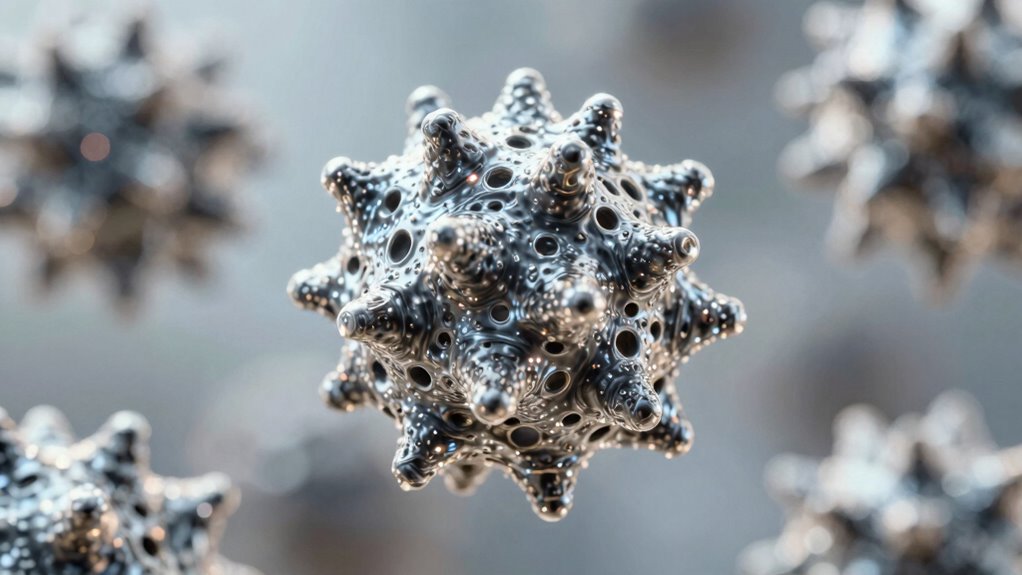

At the nanoscale, surface area takes center stage because it’s where most of the action happens. You’ll find that surface atoms form a large part of the material, affecting how it reacts, strengthens, or conducts electricity. Quantum effects also influence electron behavior, altering properties like reactivity and optical responses. Because surface phenomena dominate, nanomaterials behave very differently from bulk ones. Exploring further reveals how these surface features open new possibilities for innovative technologies—so keep going to discover more.

Get the latest gadgets delivered free with Prime
- Fast, free delivery on millions of items
- Prime Video, Amazon Music and more included
- Member-only deals all year
Key Takeaways
- Increased surface area at the nanoscale amplifies reactivity, enhancing catalytic and chemical processes.
- Surface atoms significantly influence material strength, flexibility, and durability at small scales.
- Quantum effects become prominent, affecting electronic and optical properties uniquely at the nanoscale.
- Larger surface-to-volume ratios enable targeted drug delivery and environmental interactions.
- Surface phenomena redefine material behavior, leading to innovative nanotechnology applications.

Have you ever wondered why materials behave so differently at the nanoscale? When you shrink objects down to nanometer sizes, the surface area becomes a game-changer. Unlike larger materials, where the bulk properties dominate, at the nanoscale, the surface atoms make up a significant portion of the entire structure. This shift means that surface phenomena—like chemical reactions, strength, and conductivity—become much more prominent. Because of this, the material’s properties can change drastically compared to their bulk counterparts.
At this tiny scale, quantum effects start playing a crucial role. You might not notice it in everyday life, but when materials are reduced to nanometers, their electrons behave differently. These quantum effects influence how electrons move through the material, which directly impacts electrical conductivity, optical properties, and even chemical reactivity. Instead of smooth, predictable behavior, you get discrete energy levels and novel interactions that don’t occur in larger materials. As a result, the material’s overall properties shift, often giving rise to unique behaviors that are only possible at the nanoscale. Recognizing how quantum effects influence these properties is vital for developing advanced nanotechnologies.
The increased surface area also amplifies the material’s reactivity. Think of it like this: more surface atoms mean more places for reactions to happen. For example, nanoparticles of gold or silver are more reactive than their bulk forms because their atoms are more exposed. This heightened reactivity is invaluable in applications like catalysis, where it speeds up chemical reactions. Similarly, in medicine, nanoparticles can target specific cells more effectively because their large surface area allows for better attachment of drugs or targeting molecules. Additionally, the surface-to-volume ratio plays a critical role in determining how these particles interact with their environment.
The relationship between surface area and material properties influences strength and durability. At the nanoscale, materials can become stronger or more flexible because of how surface atoms interact. This is why nanomaterials often outperform traditional materials—they’re engineered to take advantage of these surface effects. Whether it’s creating lighter, stronger composites or more efficient energy storage devices, understanding how surface area impacts nanoscale materials is key.
In essence, by shrinking materials down, you unlock a world where quantum effects and surface phenomena redefine what’s possible. The material properties are no longer dictated solely by the bulk, but by the intimate, surface-level interactions. That’s why surface area changes everything at the nanoscale—it transforms the fundamental behavior of materials, opening doors to innovative technologies and applications that simply aren’t feasible at larger scales. Recognizing how surface phenomena influence material behavior is essential for advancing nanotechnology.
As an affiliate, we earn on qualifying purchases.
Frequently Asked Questions
How Does Increased Surface Area Affect Chemical Reactions at the Nanoscale?
You see that increased surface area at the nanoscale boosts chemical reactions by enhancing catalytic efficiency. More surface means more active sites for molecules to adsorb, which improves adsorption capacity. This allows reactions to occur faster and more effectively because the reactants have greater access to the catalyst’s surface. So, by increasing surface area, you optimize how well catalysts perform, making nanoscale materials incredibly powerful for chemical processes.
Can Surface Area Modifications Improve Nanomaterial Durability?
Yes, increasing surface area modifications can improve nanomaterial durability by enhancing surface chemistry, which strengthens bonds and reduces degradation. When you optimize surface chemistry, you improve mechanical strength, making the nanomaterials more resistant to wear and tear. By carefully controlling surface modifications, you can create more robust nanomaterials that last longer and perform better under demanding conditions, ensuring their durability in various applications.
What Techniques Are Used to Measure Nanoscale Surface Area?
You use measurement techniques like BET (Brunauer-Emmett-Teller) adsorption for surface characterization, which measures how gas molecules adhere to a material’s surface. Additionally, techniques like atomic force microscopy (AFM) and scanning electron microscopy (SEM) give detailed images that help quantify nanoscale surface area. These methods allow you to accurately assess surface properties, vital for understanding and optimizing nanomaterial performance at this tiny scale.
How Does Surface Area Influence Energy Storage in Nanomaterials?
Think of nanomaterials as tiny batteries with a surface chemistry that’s like a bustling city. The larger surface area boosts energy storage by providing more sites for electron transfer, making charge movement more efficient. This increased surface area enhances interactions at the nanoscale, allowing for faster energy storage and release. Ultimately, surface chemistry and electron transfer work hand-in-hand, turning these minuscule materials into powerful energy reservoirs.
Are There Environmental Impacts Linked to Surface Area Changes in Nanomaterials?
You should be aware that increased surface area in nanomaterials can heighten environmental toxicity, as more particles interact with ecosystems. This can lead to ecological impacts like toxicity in aquatic life or soil contamination. These changes may cause unforeseen consequences, so it’s vital to assess the ecological impact and guarantee safe handling to prevent environmental harm linked to surface area modifications in nanomaterials.
As an affiliate, we earn on qualifying purchases.
Conclusion
Just like Prometheus bringing fire to humanity, understanding nanoscale surface area reveals incredible potential. When you realize how tiny changes in surface area can amplify reactivity and strength, you see why the nanoscale holds the key to future innovations. Embrace this knowledge, and you’ll harness the power of nature’s smallest building blocks—transforming industries and rewriting what’s possible, much like Icarus reaching for the sun. The nanoscale isn’t just small; it’s a universe of endless possibilities.
nanoscale materials for electronics
As an affiliate, we earn on qualifying purchases.
As an affiliate, we earn on qualifying purchases.
nanomaterials for optical applications
As an affiliate, we earn on qualifying purchases.
As an affiliate, we earn on qualifying purchases.
Columbus Day / Indigenous Peoples' Day Picks
long weekend sales
As an affiliate, we earn on qualifying purchases.