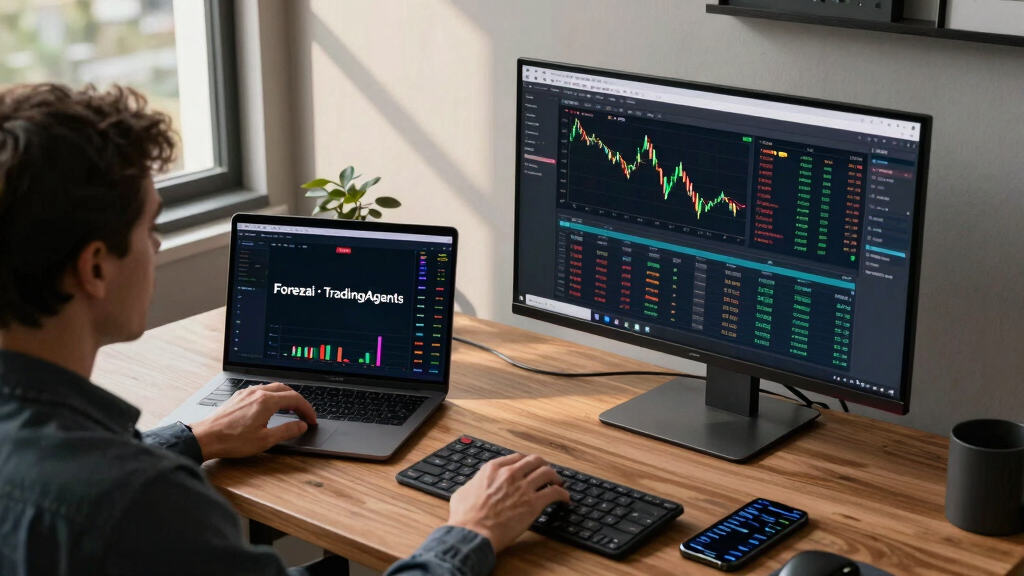

📊 Full opportunity report: Introducing Forezai · TradingAgents — a committee of LLMs decides paper-trades on ThorstenMeyerAI.com — validation score, market gap, and execution plan.
TL;DR
Forezai · TradingAgents launches a system where multiple large language models collaboratively decide paper trades. It aims to explore AI decision-making in trading without risking real money. The project builds on prior research showing parametric strategies often fail, testing whether LLMs can outperform randomness.
Forezai · TradingAgents has launched an operational version of a multi-LLM committee system designed to generate paper-trading decisions based on structured, multi-agent reasoning. This development transforms prior research prototypes into a practical research instrument, enabling continuous, automated simulation of AI-driven trading strategies.
The project is a fork of the original TradingAgents framework, which organizes thirteen specialized LLM roles—analysts, debate agents, risk teams, and decision-makers—to simulate a trading decision process. The new operational layer adds an autonomous scheduler, paper-trading interfaces with multiple broker modes, and a web dashboard for real-time monitoring and analysis.
Unlike previous experiments that focused on backtested parametric strategies, Forezai’s system actively runs daily simulations, maps decisions to paper orders, and evaluates performance through detailed logs. It includes safeguards to prevent real trading unless explicitly overridden, emphasizing research rather than live trading.
The system uses ChatGPT Pro via Codex OAuth to run the engine locally, ensuring data privacy and control. The project aims to test whether a committee of LLMs, structured with diverse roles and explicit reasoning, can produce decisions that are at least no worse than random chance, addressing fundamental questions about AI’s capability in market decision-making.
Introducing Forezai · TradingAgents.
A committee of LLMs
decides paper-trades.
Analysts · Debate · Risk · Decision
combined with -33% bankroll
services, HTTP routes (starting baseline)
(falls back to public API per token)
The bet is on a different mechanism, not a different parameter setting. The point is not to find a money-printing AI. The point is to put honest measurements of these systems into the public record — so the next person looking at the space starts a step further along than the last.Thorsten Meyer AI · Introducing Forezai · TradingAgents · § 03
Implications for AI-Driven Market Decision-Making
This development is significant because it operationalizes a sophisticated multi-agent AI framework for trading research, moving beyond theoretical models. If successful, it could demonstrate that structured LLM collaborations can generate decision-making processes comparable to or better than random or rule-based strategies, advancing understanding of AI’s role in financial contexts.
While not designed for real trading, the project provides a platform for testing hypotheses about AI reasoning, bias, and decision quality in complex, uncertain environments, with potential implications for future AI-assisted trading systems and financial research.

Chemical Process Simulation and the Aspen HYSYS Software
- Condition: Used Book in Good Condition
As an affiliate, we earn on qualifying purchases.
As an affiliate, we earn on qualifying purchases.
Background on AI and Trading Strategy Research
Previous research by Thorsten Meyer and the TauricResearch team involved testing parametric trading strategies against prediction markets, revealing that most explicit rule-based approaches tend to fail over time due to overfitting and mechanical artefacts. Their findings emphasized the difficulty of achieving sustainable edge with hand-tuned rules.
This led to exploring less rule-bound AI approaches, notably multi-agent systems of LLMs structured into specialized roles that argue and synthesize trading decisions. The original TradingAgents framework demonstrated that such systems could produce decisions that are at least as good as random, but lacked operational features for continuous simulation.
The new Forezai fork builds on this foundation, adding automation, multiple broker modes, and a user interface, transforming the concept into a practical research tool capable of running daily simulations without risking real money.
“This system allows us to test whether a committee of LLMs, structured with diverse roles, can produce trading decisions that stand up to real-time simulation, moving beyond theoretical exploration.”
— Thorsten Meyer

The Intelligent AI Investor: A Beginner’s Guide to Using AI Tools for Informed Investment Decisions, Risk Management, and Wealth Building (Trading & Investing Series Book 7)
As an affiliate, we earn on qualifying purchases.
As an affiliate, we earn on qualifying purchases.
Limitations and Open Questions in AI Trading Research
It remains unclear how well the multi-LLM committee will perform over longer periods or in more volatile market conditions. The system currently operates in a simulated environment with strict safeguards, and its effectiveness in real trading scenarios or with live data is untested.
Additionally, questions persist about the interpretability of the AI decisions, the potential biases introduced by role assignments, and whether such structured reasoning can scale or adapt to different markets or asset classes.
Further research is necessary to evaluate the robustness, consistency, and practical utility of this approach in diverse trading environments.
Context Engineering for Multi-Agent Systems: Move beyond prompting to build a Context Engine, a transparent architecture of context and reasoning
As an affiliate, we earn on qualifying purchases.
As an affiliate, we earn on qualifying purchases.
Next Steps in Evaluating Multi-LLM Trading Systems
The project will continue running daily simulations, collecting performance data, and refining the agent roles and decision protocols. Researchers aim to analyze the decision quality over extended periods, compare results against baseline strategies, and explore adjustments to improve robustness.
Plans include integrating more market data sources, testing in different asset classes, and possibly experimenting with live trading under strict oversight. The goal is to assess whether AI-driven committees can meaningfully contribute to financial decision-making beyond theoretical models.
Advanced Stock Market Analysis Dashboard: Design and Implementation of a Real-Time Financial Analytics Platform
As an affiliate, we earn on qualifying purchases.
As an affiliate, we earn on qualifying purchases.
Key Questions
Can this system be used for real trading?
No. Currently, Forezai · TradingAgents is designed for research and simulation. It includes safeguards to prevent real trading unless explicitly overridden, and its effectiveness in live trading remains unproven.
How does the multi-LLM committee make decisions?
The system assigns specialized roles to different LLMs—analysts, debate agents, risk teams, and decision-makers—that argue and synthesize insights. The final decision is a structured aggregation of these arguments, designed to articulate reasoning explicitly.
What are the main advantages of this approach?
This structure encourages explicit reasoning, reduces reliance on single-model predictions, and allows detailed analysis of decision processes. It aims to explore whether collaborative AI reasoning can improve over simple rule-based or random strategies.
What are the main limitations of the current system?
It is limited to simulated environments, with uncertain applicability to real markets. The system’s decision quality over long periods and in volatile conditions is still being evaluated, and interpretability remains a challenge.
Source: ThorstenMeyerAI.com