
Nanotechnology is transforming supercapacitors by increasing surface area with advanced carbon materials and designing nanoscale pore structures that improve ion access and transport. Nano-fluidic effects, like nano-vortices, speed up ion movement for faster charging. Combining these with pseudocapacitance from redox reactions boosts energy storage. Continued innovations in material engineering and modeling reveal how to optimize performance, so if you keep exploring, you’ll uncover more about the future of quick-charging energy storage.
Key Takeaways
- Nanostructured electrode materials like graphene and CNTs increase surface area, boosting charge storage and facilitating faster charging.
- Hierarchical pore architectures optimize ion transport and access, reducing diffusion resistance for rapid supercapacitor response.
- Nano-fluidic effects within nanopores generate vortex flows that accelerate ion movement and enhance charge/discharge rates.
- Surface redox reactions and functionalization improve pseudocapacitance and electrode stability at nanoscale interfaces.
- Combining advanced electrolytes with nanostructured electrodes extends voltage windows and reduces ion transport limitations for quicker charging.

Maxwell 16V 500F Graphene Super Capacitor Battery 16v Solar Power System Home
Super capacitor:16v 500F,Weight:5kg
As an affiliate, we earn on qualifying purchases.
As an affiliate, we earn on qualifying purchases.
Unlocking Surface Area: The Role of Carbon-Based Materials
Carbon-based materials are fundamental to maximizing supercapacitor performance because their high surface area directly enhances electric double-layer capacitance. Activated carbon remains the most widely used due to its affordability and surface areas reaching several thousand square meters per gram, which allows for substantial charge storage. Carbon nanotubes (CNTs) and graphene improve wettability and provide more uniform, accessible surfaces, leading to higher specific capacitances. Their nanostructures enable better ion access and faster charge/discharge cycles. By tailoring pore size and connectivity, you can optimize ion packing and transport within these materials. Nanostructuring effectively increases the electrode’s active surface, boosting capacitance without sacrificing stability. Additionally, understanding vetted wave and wind energy sources can inspire innovative approaches for sustainable supercapacitor applications. Incorporating advanced fabrication techniques can further enhance the structural integrity and performance of these materials. Overall, leveraging these advanced carbon materials helps you maximize energy storage and power delivery in supercapacitors. Surface area plays a critical role because it directly influences the amount of charge that can be stored at the electrode-electrolyte interface, further enhancing performance.

Graphene-Carbon Nanotube Hybrids for Energy and Environmental Applications (SpringerBriefs in Green Chemistry for Sustainability)
As an affiliate, we earn on qualifying purchases.
As an affiliate, we earn on qualifying purchases.
Pseudocapacitance: Harnessing Redox Reactions for Higher Storage
You can enhance your supercapacitor’s energy storage by utilizing materials that undergo surface redox reactions, creating pseudocapacitance. These redox processes allow for higher charge storage compared to traditional double-layer mechanisms. Understanding the surface redox dynamics is key to improving the performance of pseudocapacitive materials. Incorporating free floating components can further optimize the interaction between the electrode surface and electrolyte, boosting overall efficiency. Additionally, attention to attention to detail in material selection and surface modification can significantly influence the effectiveness of pseudocapacitive behavior. Exploring surface chemistry can lead to innovative ways to control and enhance redox activity for better energy storage. Recent studies suggest that manipulating electrochemical interfaces can further improve charge transfer and storage capabilities. Moreover, understanding Youngster Choice can provide insights into material stability and longevity in various applications.
Surface Redox Dynamics
Have you ever wondered how supercapacitors achieve higher energy storage beyond simple surface charge? It’s through surface redox dynamics, where fast redox reactions occur at the electrode surface, creating pseudocapacitance. Unlike pure double-layer capacitance, these reactions involve electron transfer, enabling additional charge storage. Transition-metal oxides like molybdenum or niobium oxide facilitate rapid surface redox processes, markedly boosting capacitance. These reactions are highly reversible, allowing many charge-discharge cycles without degradation. The key lies in the electrode’s surface chemistry and nanostructure, which influence how quickly electrons and ions participate in redox exchanges. By harnessing these surface redox dynamics, you can design supercapacitors that store more energy while maintaining high power and durability, bridging the gap between traditional capacitors and batteries. Understanding electrode surface chemistry is crucial for optimizing supercapacitor performance. Additionally, advances in nanostructure engineering help maximize the efficiency of these surface reactions. Furthermore, research indicates that the reversibility of redox reactions plays a significant role in ensuring long-term stability of the energy storage process.
Material Pseudocapacitance Performance
Material pseudocapacitance leverages fast surface redox reactions to markedly boost energy storage capacity beyond traditional double-layer mechanisms. You can harness this by selecting materials that undergo rapid, reversible redox processes, substantially increasing capacitance per mass.
Here are key factors to maximize performance:
- Transition-metal oxides like niobium and molybdenum oxides deliver high pseudocapacitive contributions through surface redox reactions.
- Composite electrodes combine pseudocapacitive materials with carbon, balancing high power with increased energy density.
- Nanostructuring enhances surface area and facilitates quick ion access, boosting redox kinetics.
- Surface functionalization improves electrode stability and optimizes redox activity, enabling faster charge/discharge cycles.

Advanced Bilayer Heterostructure Electrodes for High-Performance Supercapacitors: A Comprehensive Study on Polyaniline, Polypyrrole, MnO₂, Cr₂O₃ and Composite Thin Films
As an affiliate, we earn on qualifying purchases.
As an affiliate, we earn on qualifying purchases.
You can improve ion access by carefully tuning pore size, ensuring it matches the ions’ dimensions for ideal packing. Enhancing connectivity and reducing tortuosity allows ions to move more freely through the electrode, boosting performance. Incorporating hierarchical pore structures combines micro-, meso-, and macropores to balance high surface area with fast transport pathways. Additionally, smart material design plays a crucial role in optimizing pore architecture for superior energy storage capabilities. Implementing advanced nanotech engineering techniques further refines pore structures at the atomic level, enabling even greater control over ion flow and charge storage efficiency. Moreover, precise control over pore geometry is essential for maximizing ion access and overall device performance, as it directly influences the efficiency of ion transport within the electrode matrix. Fine-tuning pore size distribution ensures optimal ion movement and enhances overall device longevity.
Pore Size Optimization
Optimizing pore size is critical for maximizing ion access and charge storage in supercapacitors. You need to match pore dimensions with ion size to guarantee efficient packing and rapid transport. When pores are too small, ions are hindered by steric effects and solvation shells, reducing capacitance. Conversely, overly large pores decrease surface area, limiting charge storage. To optimize pore size, consider these key points:
- Match pore diameter to ion size for optimal packing and minimal energy barriers.
- Balance micro- and mesopores to enhance both surface area and ion mobility.
- Minimize pore tortuosity to facilitate faster ion diffusion.
- Tailor pore shape and distribution to improve ion accessibility and reduce dead zones.
- Surface area optimization plays a vital role in maximizing charge storage capacity by providing more active sites for ion adsorption.
- The pore geometry directly influences how efficiently ions can traverse the material, impacting overall device performance.
- Carefully controlling pore connectivity can further improve ion transport pathways, boosting supercapacitor efficiency.
Fine-tuning these parameters boosts performance, ensuring rapid charging and higher energy storage.
Connectivity and Tortuosity
The way pore networks are connected considerably influences ion transport and charge storage efficiency in supercapacitors. If pores form direct, low-resistance pathways, ions can quickly access active sites, boosting power output. Conversely, poorly connected or tortuous networks create dead-ends and convoluted routes, slowing ion movement and reducing charge/discharge rates. High tortuosity forces ions to navigate winding paths, increasing resistance and decreasing effective capacitance. Optimized connectivity ensures ions flow smoothly through interconnected, well-aligned pores, minimizing transport delays. Designing pore structures with streamlined pathways reduces ion diffusion barriers, enhances rate performance, and improves overall efficiency. By controlling connectivity and minimizing tortuosity, you can facilitate faster charging, higher power density, and better utilization of electrode surface area, pushing supercapacitors closer to their theoretical limits. Enhanced pore design plays a crucial role in achieving these improvements by allowing more efficient ion access and movement within the electrode structure. Additionally, pore connectivity can be tailored through nano-engineering techniques to optimize ion pathways for specific applications, further boosting performance. Improving pore uniformity also helps in reducing irregularities that may hinder ion flow and charge storage capabilities.
Hierarchical Pore Structures
Hierarchical pore structures integrate micro-, meso-, and macropores within a single electrode to address the limitations posed by simple pore networks. This design improves ion transport, enhances accessible surface area, and reduces diffusion pathways. You benefit from optimized ion flow and faster charging times. To understand their impact: 1. Micro-pores provide high surface area for charge storage. 2. Meso-pores facilitate ion transfer between micro- and macro-pores. 3. Macro-pores enable rapid ion movement and reduce diffusion resistance. 4. Pore connectivity ensures continuous ion pathways, maximizing efficiency, and facilitating overall performance. This pore connectivity is crucial for maintaining efficient ion flow throughout the electrode. Additionally, the development of hierarchical pore architectures allows for tailored pore size distributions that optimize energy storage and power delivery.
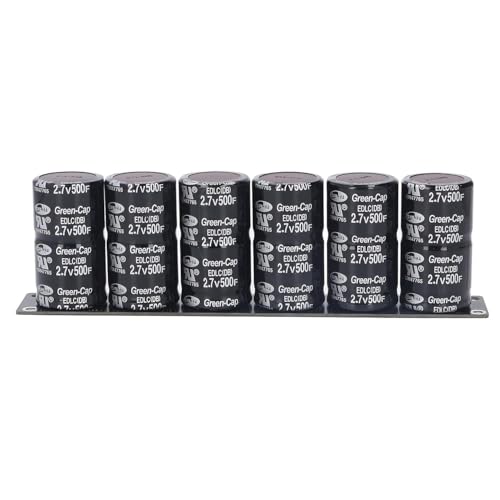
6-inch supercapacitor Bank 1 2.7V500F supercapacitor Energy Storage Component for Electronic Devices 16V 83F
High-Capacity Energy Storage: This 6-inch super capacitor module offers two configurations: 2.7V 500F and 16V 83F, providing robust…
As an affiliate, we earn on qualifying purchases.
As an affiliate, we earn on qualifying purchases.
Dynamic Ion Transport: Convection and Nano-Vortices in Action

Convection and nano-vortices play a crucial role in enhancing ion transport within supercapacitor electrodes, especially at the nanoscale. These fluid movements accelerate ion movement, reducing charging times and improving power delivery. In nanopores, tiny vortices form due to pressure differences and flow instabilities, creating recirculating streams that help ions overcome diffusion limitations. By actively stirring the electrolyte, convection minimizes concentration gradients and boosts ion accessibility to active sites. Researchers have observed these vortex flows using advanced imaging techniques like in situ NMR and neutron scattering. Incorporating design features that promote nano-vortex formation—such as pore geometry and surface roughness—can markedly enhance charge/discharge rates. Recognizing the importance of these nanoscale fluid dynamics enables smarter electrode engineering and more efficient supercapacitor performance.
Multiscale Modeling: From Molecules to Devices
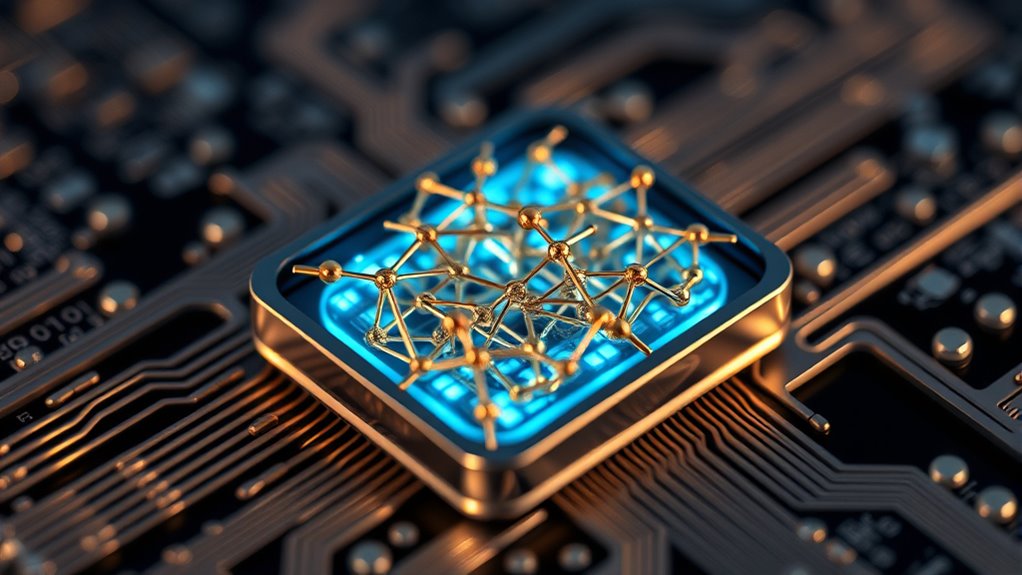
Multiscale modeling bridges the gap between molecular-level ion physics and macroscopic device performance, enabling accurate predictions of supercapacitor behavior. You can use this approach to understand how nanoscale ion interactions influence overall charge/discharge times and energy storage. Here are four key aspects:
Multiscale modeling links ion physics to device performance, predicting supercapacitor charge times and energy storage effectively.
- Pore-level simulations predict ion packing, solvation, and transport within electrode structures.
- Reduced-order models incorporate flow and convection effects, improving charging time estimates.
- Coupled multiscale frameworks link molecular dynamics with device-scale models, reducing errors from orders of magnitude to factors of 2–3.
- Parameter sensitivity analysis guides electrolyte and pore design by connecting molecular properties with device performance.
Tuning Voltage Windows With Advanced Electrolytes
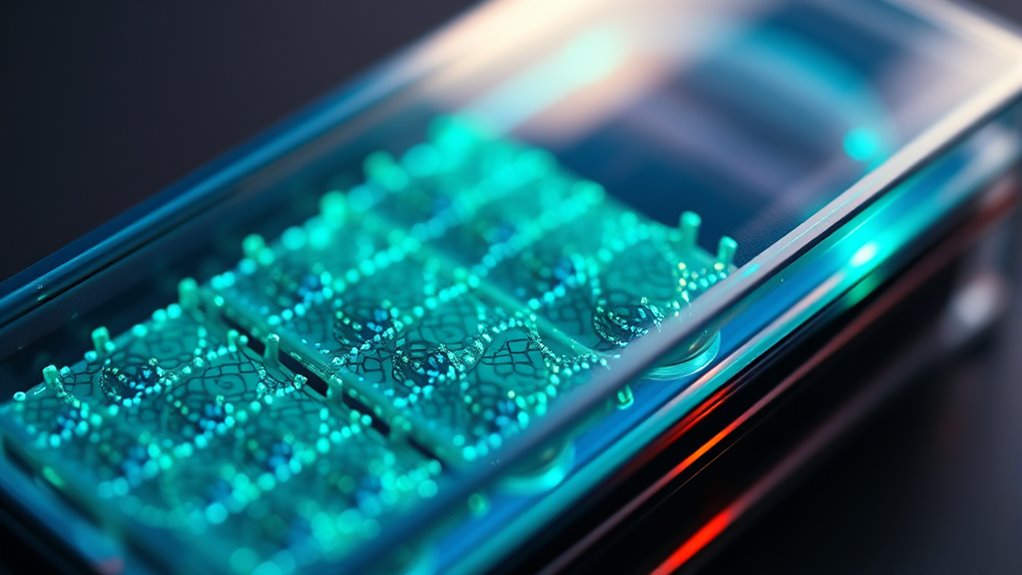
Advancing supercapacitor performance requires not only optimizing electrode materials and pore architectures but also expanding the electrochemical stability window of the electrolytes used. You can achieve this by selecting advanced electrolytes like organic solvents and ionic liquids that tolerate higher voltages, often up to several volts, compared to aqueous electrolytes limited by water splitting at around 1.23 V. Tuning electrolyte composition, such as choosing ions with favorable solvation and desolvation properties, influences both capacitance and voltage stability. Surface functionalization of electrodes can also resist oxidation, enabling higher operating voltages safely. Lower viscosity electrolytes and smaller, less strongly solvated ions improve ion transport, boosting power and rate performance. By carefully engineering these electrolyte properties, you access higher energy densities without sacrificing stability or safety.
Balancing Power and Energy: Material Trade-Offs in Supercapacitors

Balancing power and energy in supercapacitors involves steering inherent material trade-offs that impact device performance. You need to contemplate how different materials influence charge storage and transfer.
- Activated carbon offers high surface area for rapid charge/discharge but limits energy density.
- Carbon nanotubes and graphene improve conductivity and surface uniformity, boosting power and some energy capacity.
- Transition-metal oxides provide pseudocapacitance, increasing energy density but often reducing cycle life.
- Composite electrodes blend materials to optimize both power and energy, though they add complexity and cost.
Your goal is to select materials that strike the right balance for specific applications, whether prioritizing quick bursts of power or longer-lasting energy storage, all while managing trade-offs inherent in material properties.
Innovations in Pore Engineering and Hierarchical Structures
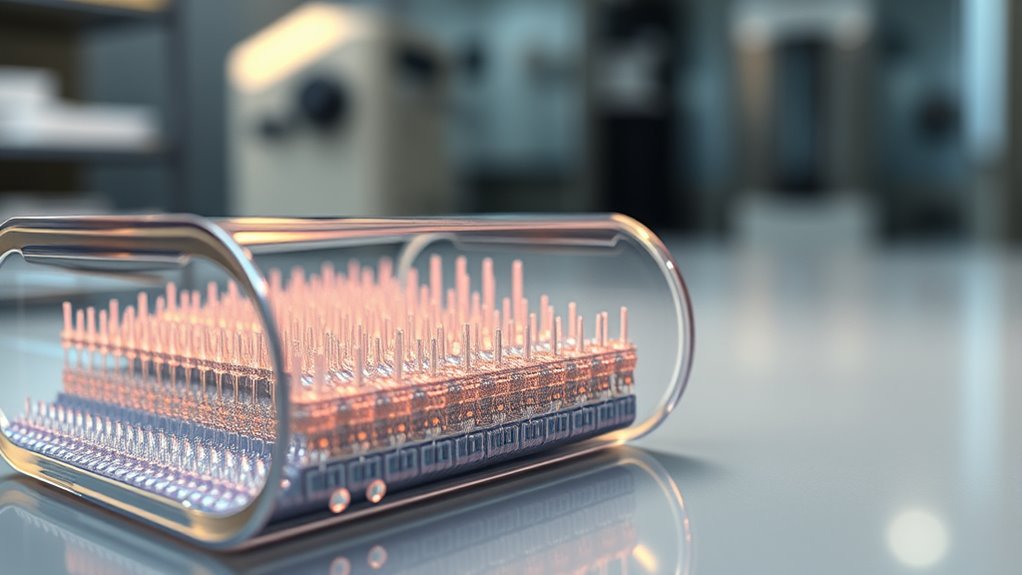
Innovations in pore engineering and hierarchical structures are transforming supercapacitor electrodes by optimizing ion transport and surface accessibility. You can now design electrodes with micro-, meso-, and macropores that work together to maximize surface area while reducing ion diffusion distances. Introducing interconnected pore networks enhances electrolyte penetration and provides multiple pathways for ions, boosting charge/discharge rates. Hierarchical architectures improve wettability and facilitate rapid ion exchange, especially during high-voltage operation. By tailoring pore size distribution, you enable selective ion desolvation and reduce energy losses. These structural advancements also help mitigate pore clogging and uneven current distribution, leading to more reliable, high-performance supercapacitors. Overall, pore engineering and hierarchical structuring are key to balancing energy density with power capability, pushing supercapacitors closer to practical, high-energy storage solutions.
Exploiting Nano-Fluidic Effects for Faster Charging

Nano-fluidic effects within nanopores can notably accelerate ion transport, enabling faster charging times for supercapacitors. These effects harness tiny flow phenomena that enhance ion movement beyond simple diffusion, reducing resistance and improving response speed. By designing nanopores to encourage mini-vortices and recirculating flows, you can significantly boost ion mobility.
Here are four ways to exploit nano-fluidic effects:
- Tailor pore geometry to promote vortex formation and convective flows.
- Use hierarchical pore structures combining micro-, meso-, and macropores.
- Incorporate surface functionalization to facilitate ion desolvation and flow.
- Optimize electrolyte composition for lower viscosity and smaller ion size.
Implementing these strategies can cut charging times dramatically, pushing supercapacitors closer to real-time energy storage solutions.
Future Directions: Integrating Experiments and Simulations

Integrating experiments and simulations is essential for advancing supercapacitor technology because it allows for accurate validation of theoretical models and deeper understanding of ion transport mechanisms. By combining molecular dynamics, pore-scale, and continuum models, you can capture complex phenomena like convection, recirculation, and solvation effects that influence charging times and capacity. Experimental validation through techniques like in situ NMR or neutron scattering ensures models reflect real device behavior, reducing uncertainties. This synergy accelerates material design, optimizing pore structures, electrolytes, and electrode chemistry. Ultimately, integrating experiments with simulations helps identify limitations, predict performance, and guide innovations more efficiently—paving the way for higher energy density, faster charging, and more reliable supercapacitors in practical applications.
Frequently Asked Questions
How Does Pore Size Distribution Influence Ion Selectivity and Capacitance?
You’ll find that pore size distribution critically affects ion selectivity and capacitance. Smaller pores favor desolvation and select specific ions, boosting capacitance but limiting ion access. Larger pores improve ion transport and enable faster charging, though they may lower overall energy density. An ideal mix of micro-, meso-, and macropores balances high surface area with efficient ion flow, maximizing both selectivity and capacitance for your supercapacitor’s performance.
What Are the Main Factors Limiting Supercapacitor Charging Speed?
You might say speed bumps slow you down, and the same goes for supercapacitors. Main limiting factors include ion transport within electrode pores, especially if pore sizes are too small or poorly connected. Additionally, solvation effects and electrolyte viscosity hinder rapid ion movement. Convection and pore architecture also play critical roles; neglecting these can make charging times skyrocket. Optimizing pore design and fluid flow is key to speeding things up.
How Do Different Electrolytes Affect Voltage Stability and Hysteresis?
You find that electrolytes influence voltage stability and hysteresis by their ion size, solvation, and ionic mobility. Organic and ionic liquids expand the voltage window, allowing higher voltages, while aqueous electrolytes are limited by water electrolysis. Partial desolvation inside nanopores can alter ion packing, impacting hysteresis. Choosing electrolytes with ideal viscosity and ion size enhances voltage stability and reduces hysteresis, enabling better device performance.
Can Hierarchical Porosity Significantly Improve Both Power and Energy Density?
Yes, hierarchical porosity can substantially boost both power and energy density. By combining micro-, meso-, and macropores, you create pathways that facilitate fast ion transport and maximize surface area. This design allows you to achieve high power through quick charging and discharging, while maintaining substantial energy storage. It balances accessibility with capacity, enabling your supercapacitor to perform efficiently across various applications without sacrificing either high power or high energy density.
What Role Do Nano-Vortices Play in Enhancing Ion Transport During Fast Charging?
Imagine you’re in a sci-fi movie, and nano-vortices act like tiny whirlpools, dramatically boosting ion transport during fast charging. These mini-vortices create localized convection within nanopores, speeding up ion movement and reducing charging time. By harnessing this effect, you can design electrodes that deliver higher power and faster energy delivery, making supercapacitors more efficient. Embracing nano-vortices could revolutionize energy storage, bridging the gap between supercapacitors and batteries.
Conclusion
You now see how supercapacitors showcase stunning science through smart surface structuring, swift ion transport, and sophisticated simulations. By blending bold breakthroughs with basic building blocks, you can harness hybrid hierarchies and nano-know-how for faster, more efficient power. Keep pushing potential with pioneering pore designs and fluidic feats, because the future of supercapacitors is bright, bold, and bursting with boundless possibilities. Your journey into nano-knowledge powers progress and propels performance forward.