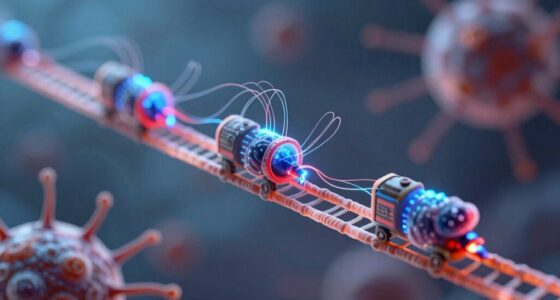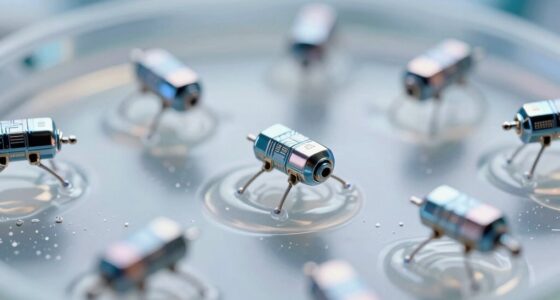
Inside labs building the world’s smallest robots, scientists are pushing microfabrication techniques to create devices as tiny as a few hundred micrometers. They incorporate innovative propulsion methods like chemical, light-driven, or magnetic actuation, enabling these robots to navigate complex biological environments. Powering and sensing are integrated using energy harvesting and tiny sensors, supporting applications like targeted drug delivery and minimally invasive procedures. Keep exploring to discover how these microscopic marvels are revolutionizing healthcare and technology.

Get the latest gadgets delivered free — and shop member deals
- Fast, free delivery on millions of items
- Access to Prime Big Deal Days deals on October 6–7
- Prime Video, Amazon Music and more included
Key Takeaways
- Researchers utilize advanced microfabrication and MEMS techniques to create tiny robots with integrated sensors, actuators, and power sources.
- Labs develop novel materials like hollow skeletons and biocompatible coatings to enhance functionality and durability of microscopic robots.
- Precision assembly methods enable the integration of complex components within sub-millimeter footprints for autonomous operation.
- Experimental setups often involve external fields (magnetic, optical) and microfluidic environments to control and test robot navigation.
- Continuous innovation focuses on scaling down components, improving biocompatibility, and ensuring reproducibility for large-scale production.
microfabrication kits for robotics
As an affiliate, we earn on qualifying purchases.
As an affiliate, we earn on qualifying purchases.
Achieving Miniaturization Milestones in Robotics
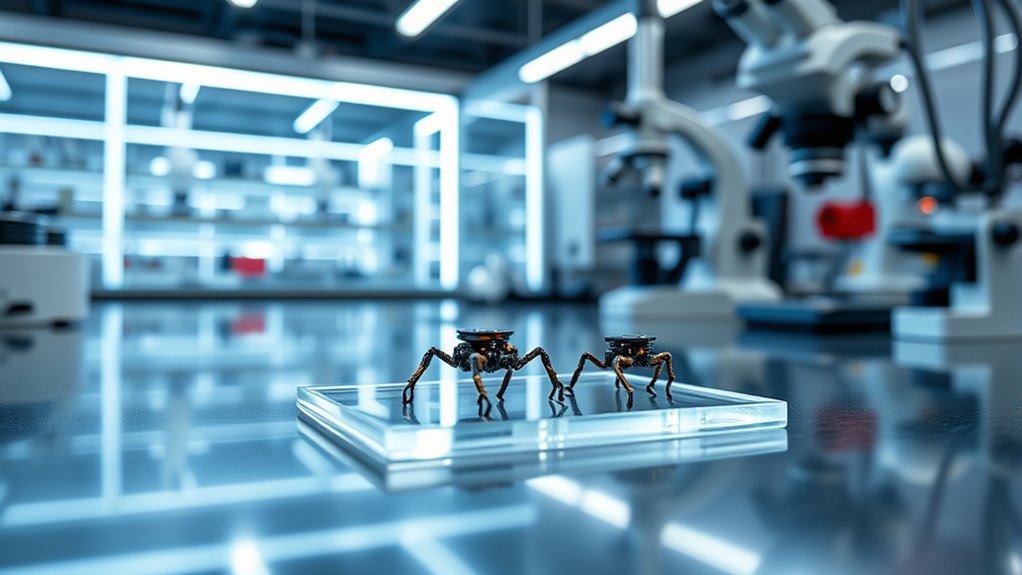
Achieving miniaturization milestones in robotics involves pushing the size limits of devices to sub-millimeter and micrometer scales, enabling new capabilities in medical, environmental, and industrial applications. You’ve seen robots shrink from centimeters to less than half a millimeter, with some as small as 0.2 × 0.3 × 0.05 mm. These tiny devices now integrate full subsystems—sensing, propulsion, power, and computation—within microscopic footprints. Material innovations like hollow skeletons, coatings, and microfabricated electrodes help preserve function at such scales. Cost-effective fabrication methods produce prototypes costing mere cents per unit, making large-scale production feasible. These milestones demonstrate how engineers overcome physical and material constraints to push the boundaries of what microscale robots can achieve, opening doors to previously impossible tasks in medicine, manufacturing, and beyond. Additionally, advanced microfabrication techniques are essential for creating complex, integrated systems at these minuscule dimensions. Furthermore, ongoing research into scaling laws supports the development of even smaller and more capable robotic systems, and innovations in material science continue to expand their potential applications. Innovations in self-assembly processes are also playing a pivotal role in assembling components efficiently at microscopic scales, as researchers explore automated assembly methods to improve precision and scalability.
As an affiliate, we earn on qualifying purchases.
Innovative Locomotion and Propulsion Techniques at Micro Scales

Miniaturized robots rely on a variety of innovative propulsion methods to navigate complex fluid environments effectively. Electrochemical and electrode-based micropropulsion use tiny electrodes to generate ionic flows, pushing the robots through liquids. Light-driven propulsion and external-field actuation, like magnetic or optical forces, steer devices without bulky onboard motors. Flapping-wing designs mimic insect flight with artificial muscles and high-frequency actuation, suitable for milligram-scale flyers. Continuum and flexible-body locomotion enable navigation through narrow, tortuous channels, such as bronchi or oviducts. Surface functionalization and passive hydrodynamics reduce drag and enhance maneuverability. These techniques allow microswimmers to operate efficiently in biological fluids, overcoming challenges posed by size constraints and fluid properties, and opening new possibilities for medical and environmental applications.
micro sensors for medical devices
As an affiliate, we earn on qualifying purchases.
As an affiliate, we earn on qualifying purchases.
Powering and Sensing in the Tiny World of Microswimmers

Powering and sensing in microswimmers require innovative approaches that operate within their tiny size constraints. You’ll leverage energy harvesting methods like microphotovoltaics and external-field power delivery, such as magnetic or optical fields, to supply power without bulky batteries. These strategies enable autonomous operation for tasks like sensing and simple actuation. Efficient energy management is essential for enhancing the capabilities of these tiny devices in real-world settings. Integrated sensors—temperature detectors accurate to 0.3 °C and optical fibers for imaging—allow microswimmers to gather crucial data inside narrow channels. To process information, you’ll use microcontrollers that operate at nanowatt power levels, optimizing energy use through compressed instructions and minimal memory. Employing low-power electronics is vital for sustaining their functionalities over extended periods. Additionally, energy harvesting techniques, such as microphotovoltaics, are crucial for extending operational lifespan without external power sources. By utilizing miniaturized components, engineers are able to further improve the performance and capabilities of microswimmers. Autonomous behaviors emerge from local sensing, processing, and actuation loops. This combination of powering and sensing techniques ensures microswimmers can perform complex functions in confined environments, paving the way for advanced biomedical and environmental applications.
As an affiliate, we earn on qualifying purchases.
Medical Applications and Challenges of Sub-Millimeter Robots
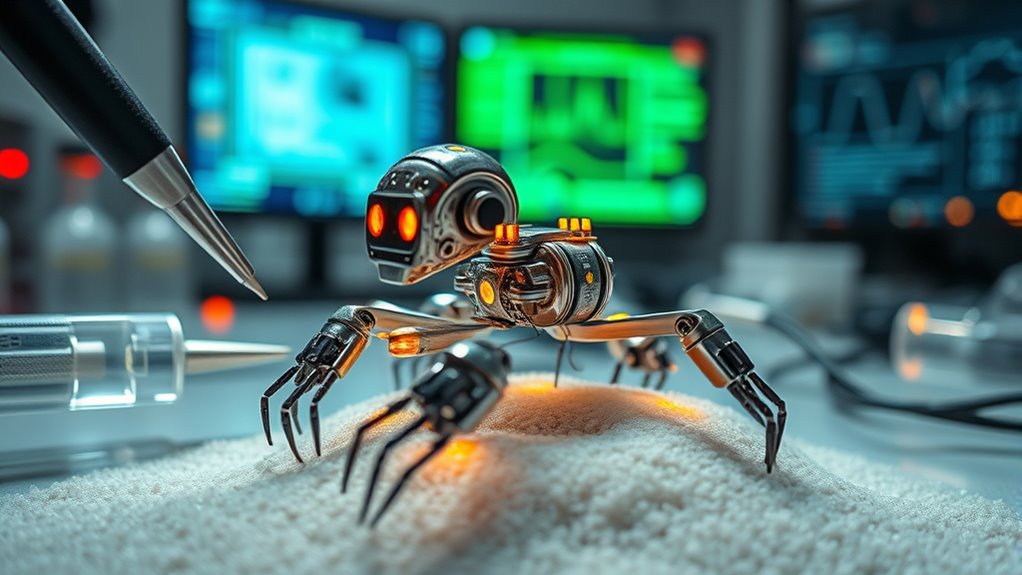
How can sub-millimeter robots transform medicine? They enable minimally invasive procedures, accessing hard-to-reach areas like bronchi and oviducts with precision. These tiny devices can perform targeted diagnostics, deliver drugs, and even carry out laser treatments inside the body, reducing patient trauma and recovery time. Challenges include ensuring biocompatibility, maneuvering complex biological environments, and integrating sensors for real-time monitoring. The table below highlights key aspects:
| Aspect | Details |
|---|---|
| Target Areas | Narrow channels, bloodstream |
| Functions | Imaging, sampling, therapy |
| Challenges | Immune response, biocompatibility |
| Power | Microphotovoltaics, external fields |
| Regulatory | Safety, manufacturing standards |
Manufacturing Hurdles and Future Directions in Micro-Robot Fabrication
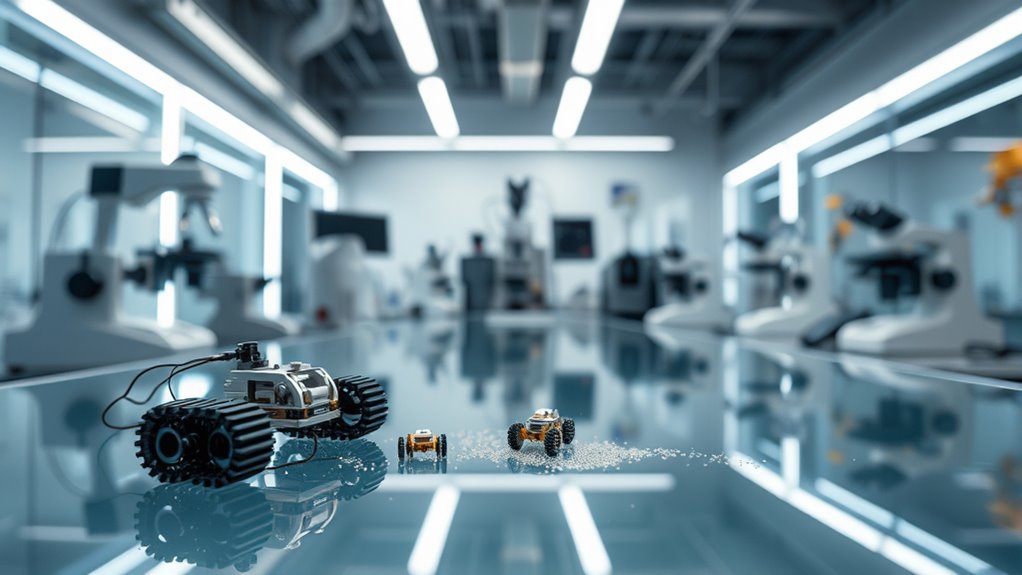
Manufacturing sub-millimeter robots presents significant technical challenges due to their tiny scale and complex functionality. You must integrate diverse components like sensors, actuators, and power sources into a minuscule footprint, often requiring advanced MEMS, photonics, and microassembly techniques. Material compatibility is critical; biocompatible, corrosion-resistant coatings are necessary for in vivo use, but they can compromise size and performance. Achieving high yield and reproducibility across billions of units remains difficult, impacting scalability and cost. Packaging must balance protection and functionality, which adds mass and complexity. Future directions focus on refining microfabrication processes, developing standardized protocols, and exploring advanced materials that can meet the demanding requirements of micro-robot applications. Overcoming these hurdles is essential to *shift* from laboratory prototypes to reliable, scalable medical and industrial micro-robots. Additionally, Material compatibility plays a crucial role in ensuring long-term performance and safety of these tiny devices.
Frequently Asked Questions
How Do Micro-Robots Communicate Within Large Swarms Effectively?
You can make micro-robots communicate effectively within large swarms by implementing local sensing and processing, enabling each unit to respond to nearby robots. Using external fields like magnetic or optical signals helps coordinate actions without bulky onboard components. Swarm strategies involve shared algorithms and minimal communication protocols, so your micro-robots can work collaboratively, adapt to environments, and accomplish complex tasks while conserving energy and maintaining precise control.
What Materials Are Most Promising for Biocompatible, Durable Micro-Robot Coatings?
You should consider biocompatible, durable coatings like glass-like materials, which offer excellent corrosion resistance and minimal toxicity. Notably, these coatings can extend the lifespan of micro-robots by preventing degradation in biological environments. They also provide protection against biofouling, ensuring consistent performance. Materials like silica-based coatings, functionalized skins, and advanced polymer composites show great promise, balancing biocompatibility with mechanical robustness essential for safe, long-term operation inside the body.
How Is Precise Control Maintained Over Multiple Micro-Robots Simultaneously?
You can maintain precise control over multiple micro-robots by using external fields like magnetic, optical, or acoustic signals to steer them remotely. These methods allow you to coordinate their movements without onboard actuators. Additionally, you can incorporate local sensing and autonomous decision-making, enabling each robot to respond to environmental cues. This combination of external control and onboard intelligence helps you achieve accurate, synchronized navigation in complex environments.
What Are the Biggest Safety Concerns for in Vivo Micro-Robot Deployment?
You might think tiny robots are perfectly safe, but the biggest concerns lie in immune reactions, toxicity, and unforeseen tissue damage. Their small size doesn’t guarantee invisibility to your body’s defenses or harmlessness. If these micro-robots malfunction or aren’t properly biocompatible, they could trigger inflammatory responses or even become impossible to remove. So, while they promise medical miracles, safety remains a tricky, essential hurdle before they can truly be trusted.
How Close Are Micro-Robots to Achieving Full Autonomous Decision-Making?
You’re getting close to micro-robots achieving full autonomous decision-making. Researchers have demonstrated local sensing, processing, and actuation loops that enable environment-responsive behavior. Microcontrollers operate at extremely low power, and integrated sensors support real-time decision-making. However, achieving complex, reliable autonomy for diverse, real-world tasks remains a challenge. Scaling up software robustness, ensuring safety, and integrating sophisticated AI are critical steps before full autonomy becomes a practical reality.
Conclusion
You’re witnessing the dawn of a new robotic era where tiny machines could revolutionize medicine and industry. These micro-robots, smaller than a grain of sand, hold the potential to change everything, from targeted drug delivery to delicate surgeries. As researchers push boundaries with each tiny step, you can’t help but marvel at how this miniature universe is shaping the future—an innovation so incredible, it’s almost hard to believe it’s real. The smallest robots are making the biggest impact yet.
Fall Picks
fall essentials
As an affiliate, we earn on qualifying purchases.