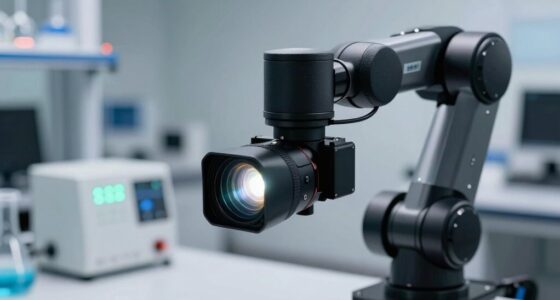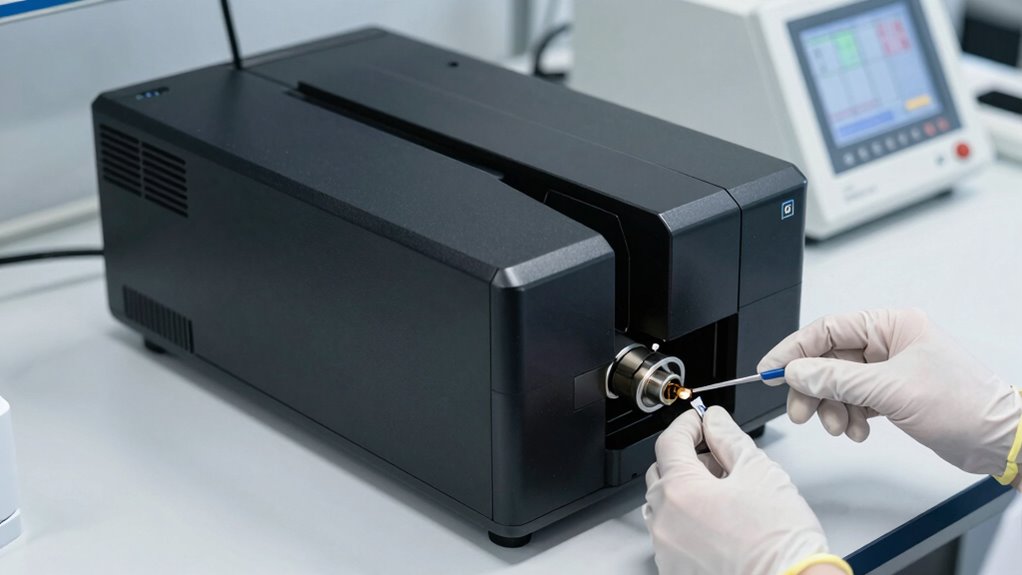

Before buying a Raman spectrometer, consider your sample types, analysis frequency, and environmental conditions. Decide if you need a portable device for fieldwork or a benchtop model for lab use. Check spectral resolution, laser options, and software features for precise results. Evaluate durability for outdoor use and support services to avoid downtime. Balance your budget with future upgrade possibilities. If you explore further, you’ll discover how to choose the perfect fit for your needs.
Key Takeaways
- Assess sample types and analysis frequency to determine the required spectral resolution and device sensitivity.
- Consider portability versus benchtop models based on your typical usage environment.
- Evaluate software features for data analysis, reporting, and ease of use.
- Check device durability and availability of technical support for your working conditions.
- Balance initial cost with future needs, including upgrade options and ongoing maintenance expenses.
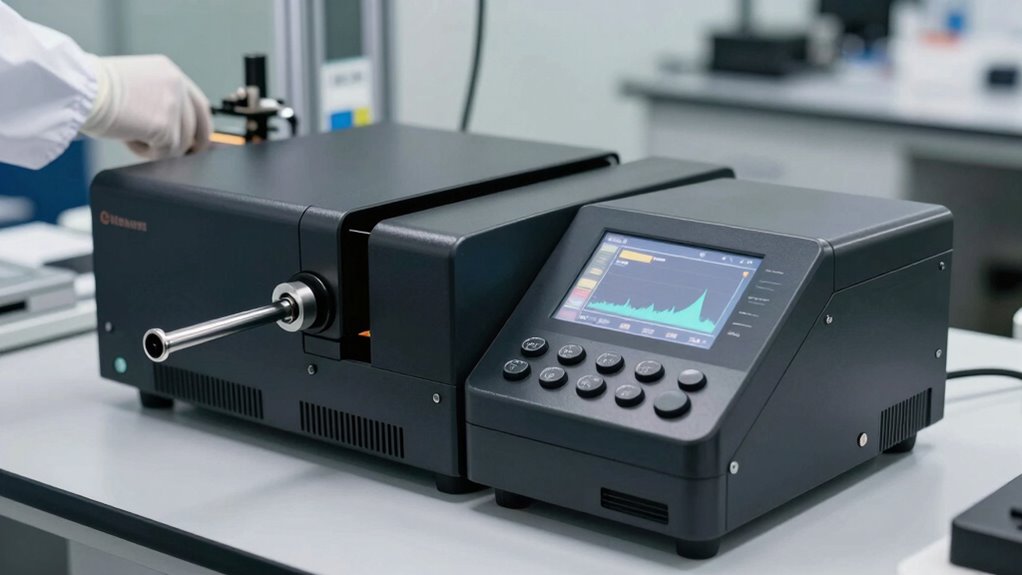
Buying a Raman spectrometer is a significant investment, so it’s essential to know what factors to contemplate before making your choice. One of the first things to consider is the sample cost. Different spectrometers are designed to analyze various types of samples, and the associated costs can vary widely. If your work involves frequent analysis of expensive or rare samples, you’ll want a device that’s efficient and minimizes sample consumption. Some spectrometers require larger sample sizes, which can increase your overall costs, while others are optimized for tiny quantities, helping you save money and resources. Understanding your typical sample types and their costs will guide you to a model that balances performance with affordability.
Device portability is another critical factor. Depending on your field of work, you might need a spectrometer that’s portable enough to carry into the field or a fixed instrument for laboratory use. If you’re conducting on-site analysis, a lightweight, portable device can save you time and enable immediate results, which is often essential in industrial, environmental, or clinical settings. Conversely, if your work is primarily lab-based, a benchtop model with higher sensitivity and advanced features might be more suitable. Consider where you’ll use the device most frequently, and whether portability will enhance your workflow or if a stationary unit suffices. Remember, portable spectrometers might have trade-offs, such as slightly reduced resolution or sensitivity compared to larger, more sophisticated models.
Beyond sample cost and portability, you should also evaluate the spectral resolution, laser wavelength options, and software capabilities. High spectral resolution allows for more precise identification of substances, which is critical in complex samples. Multiple laser options can expand your analysis capabilities across different applications. Additionally, intuitive software with data analysis tools can streamline your workflow and improve accuracy. When choosing a spectrometer, understanding the spectral resolution and how it impacts your ability to distinguish between similar substances is crucial. It’s also important to consider the software features that support data interpretation and reporting, saving you time and reducing errors. A device with durability features suited for your environment will last longer and reduce downtime, especially in outdoor or industrial conditions. Considering the availability of technical support and training can also be beneficial, ensuring you maximize the instrument’s potential throughout its lifespan.
Lastly, consider your budget holistically. While it’s tempting to opt for the most advanced, feature-rich model, make sure it aligns with your actual needs. Sometimes, a more modest device with the right features can deliver excellent results without overextending your budget. Weigh the initial investment against ongoing costs, including maintenance, consumables, and potential upgrades. It’s also worth exploring upgradable hardware or software options that can grow with your needs without requiring a complete replacement. By carefully analyzing these factors, you’ll be better equipped to select a Raman spectrometer that meets your analytical needs efficiently and cost-effectively.

GOYOJO Portable Spectrometer Color Illuminometer Meter Spectrophotometer (HP330)
Advanced Technology Integration: GOYOJO Portable Spectrometer seamlessly integrates advanced micro spectrometer technology with embedded operating systems and microcomputer…
As an affiliate, we earn on qualifying purchases.
As an affiliate, we earn on qualifying purchases.
Frequently Asked Questions
Can a Raman Spectrometer Analyze Liquids Effectively?
Yes, a Raman spectrometer can analyze liquids effectively if you consider liquid sample compatibility and proper sample preparation techniques. You’ll want to guarantee the instrument handles aqueous or viscous samples well and uses suitable containers like quartz cuvettes. Adjusting laser power and acquisition time helps prevent sample degradation. By focusing on these factors, you can obtain accurate, high-quality spectra from liquid samples, making Raman spectroscopy a versatile tool for liquid analysis.
What Are the Maintenance Requirements for a Raman Spectrometer?
You need to regularly perform calibration procedures to guarantee your Raman spectrometer provides accurate results. Maintenance frequency varies, but typically, you should clean the optics weekly and check the laser alignment monthly. Keep the instrument free of dust and handle the components carefully. Periodic software updates and thorough inspections help maintain peak performance. Following these maintenance routines will extend your spectrometer’s lifespan and ensure consistent, reliable data collection.
How Does Environmental Noise Affect Raman Measurements?
Think of environmental noise as a mischievous gremlin that disrupts your harmony. It can cause environmental interference, leading to fluctuating signals and reduced signal stability. This makes it harder to distinguish true Raman signals from background noise. To guarantee accurate measurements, you need a controlled environment, shielding, and proper calibration. Otherwise, the gremlin’s interference risks compromising your data’s integrity and the reliability of your results.
Are Portable Raman Spectrometers as Accurate as Lab Models?
Portable Raman spectrometers can offer good accuracy, but they generally don’t match the precision of lab models. You might find portable devices convenient for on-the-spot analysis, but for detailed, high-resolution results, lab spectrometers are superior. If your work demands high accuracy and detailed data, a lab model is the better choice. Portable accuracy is improving, yet lab comparison still favors professional-grade systems for critical applications.
What Software Features Should I Look for in a Raman Spectrometer?
You should look for software with high spectral resolution capabilities and robust data processing features. Spectral resolution guarantees you can distinguish between closely spaced peaks, essential for accurate analysis. Data processing tools simplify interpreting complex spectra, automate baseline correction, and facilitate noise reduction. Even if you’re not tech-savvy, intuitive interfaces and extensive analysis options help you get reliable results efficiently, making your spectrometer more versatile and easier to operate.
benchtop Raman spectrometer with high spectral resolution
As an affiliate, we earn on qualifying purchases.
As an affiliate, we earn on qualifying purchases.
Conclusion
So, before you toss your hard-earned cash at the latest shiny Raman spectrometer, remember: it’s not just about fancy specs or the coolest brand. Make sure it actually matches your needs, isn’t a nightmare to use, and won’t turn your lab into a cluttered disaster zone. Because, let’s face it, investing in high tech that gathers dust isn’t exactly the scientific breakthrough you dreamed of—unless, of course, your goal is to collect dust in style.

HPC300 Spectrometer Analysis
Spectrometers
As an affiliate, we earn on qualifying purchases.
As an affiliate, we earn on qualifying purchases.
durable outdoor Raman spectrometer
As an affiliate, we earn on qualifying purchases.
As an affiliate, we earn on qualifying purchases.